
Dosing Pump vs Hydraulic, Piston and Solenoid: A Corrosive-Liquid Decision Guide
The global dosing pump market was valued at approximately USD 8.86 billion in 2024, and Asia Pacific accounted for a 41.8% revenue share of it, according to Grand View Research. Diaphragm dosing pumps alone took a 55.7% share of product-segment revenue in the same year. It is a mature, well-documented market — and yet corrosive-liquid projects still routinely begin with the wrong question.
The confusion is a naming problem. “Dosing pump”, or metering pump, describes a duty: adding a controllable, repeatable volume of liquid into a process. Hydraulic, piston and solenoid describe how that displacement is physically produced. When a project locks in a mechanism before it has written down the duty, the line inherits that mechanism's limits — pressure ceiling, viscosity tolerance, wetted-material options, control interface and enclosure rating.
This guide treats the four categories as a buyer decision sequence rather than a product list: duty first, category fit second, wetted material third, purchasing terms fourth, delivery acceptance last. It uses published parameters from the WRS PTE LTD dosing pump range — a dosing and metering equipment supplier whose manufacturing operation, ZHEJIANG WRS MACHINERY EQUIPMENT CO., LTD, was founded in 2016 in Hangzhou, Zhejiang, China, and produces metering pumps, solenoid dosing pumps, diaphragm dosing pumps, piston dosing pumps, digital dosing pumps, chemical injection pumps, dosing pump check valves, dosing pump pulse dampeners and chemical dosing systems — alongside third-party market and standards data. Nothing below is extrapolated beyond those sources.
The Four Categories on One Page
Answer first: the four labels do not sit on the same level. “Dosing pump” is the functional category; hydraulic, piston and solenoid are drive principles that can each be used to build a dosing pump. A buyer comparing them side by side is really choosing between drive principles under one stated duty.
Dosing pump / metering pump — the functional category
A dosing pump is defined by what it delivers, not by how it moves. The WRS PTE LTD range covers metering pumps, solenoid dosing pumps, diaphragm dosing pumps, piston dosing pumps, digital dosing pumps and chemical injection pumps, plus the components that make a dosing line controllable: dosing pump check valves, dosing pump pulse dampeners, chemical dosing systems and a streaming current monitoring system.
Hydraulic metering pump
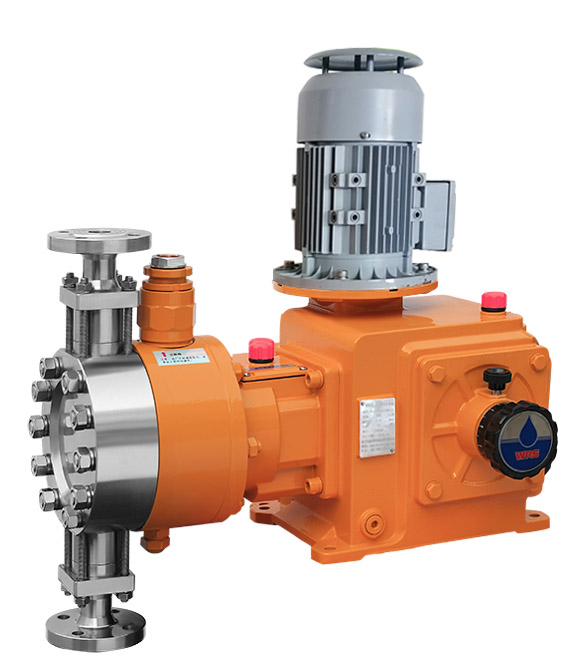
A hydraulic metering pump uses hydraulic actuation to drive the diaphragm. Two published models frame the envelope. HL090S0P01F11 delivers 1600 L/H at 6 bar through a DN50 flange with a 1.5 kW motor. HS008S0P01S11 delivers 2 L/H at 200 bar through a DN6 bevel-end welding tube with a 0.37 kW motor. Both are SS316 and are available with frequency and explosion-proof motors. The published characteristics are a zero-leakage design, suitability for toxic and hazardous media, suitability for high-viscosity pumping, an optional diaphragm rupture sensor, high-accuracy dosing and easy maintenance.
Piston dosing pump
PD105SS1PFN11 is published at 600 L/H and 8 bar with a DN50 flange, a 4.0 kW motor and SS316 wetted material. PM060SS1PFN11 shares the same 600 L/H and 8 bar figures but uses a DN25 flange and a 0.75 kW motor. Both are listed as robust and high efficiency, suitable for high-viscosity pumping and optimized for high-accuracy dosing, with frequency and explosion-proof motor options available. The pair carries a lesson for any tender: identical flow and pressure figures do not mean identical units.
Solenoid dosing pump
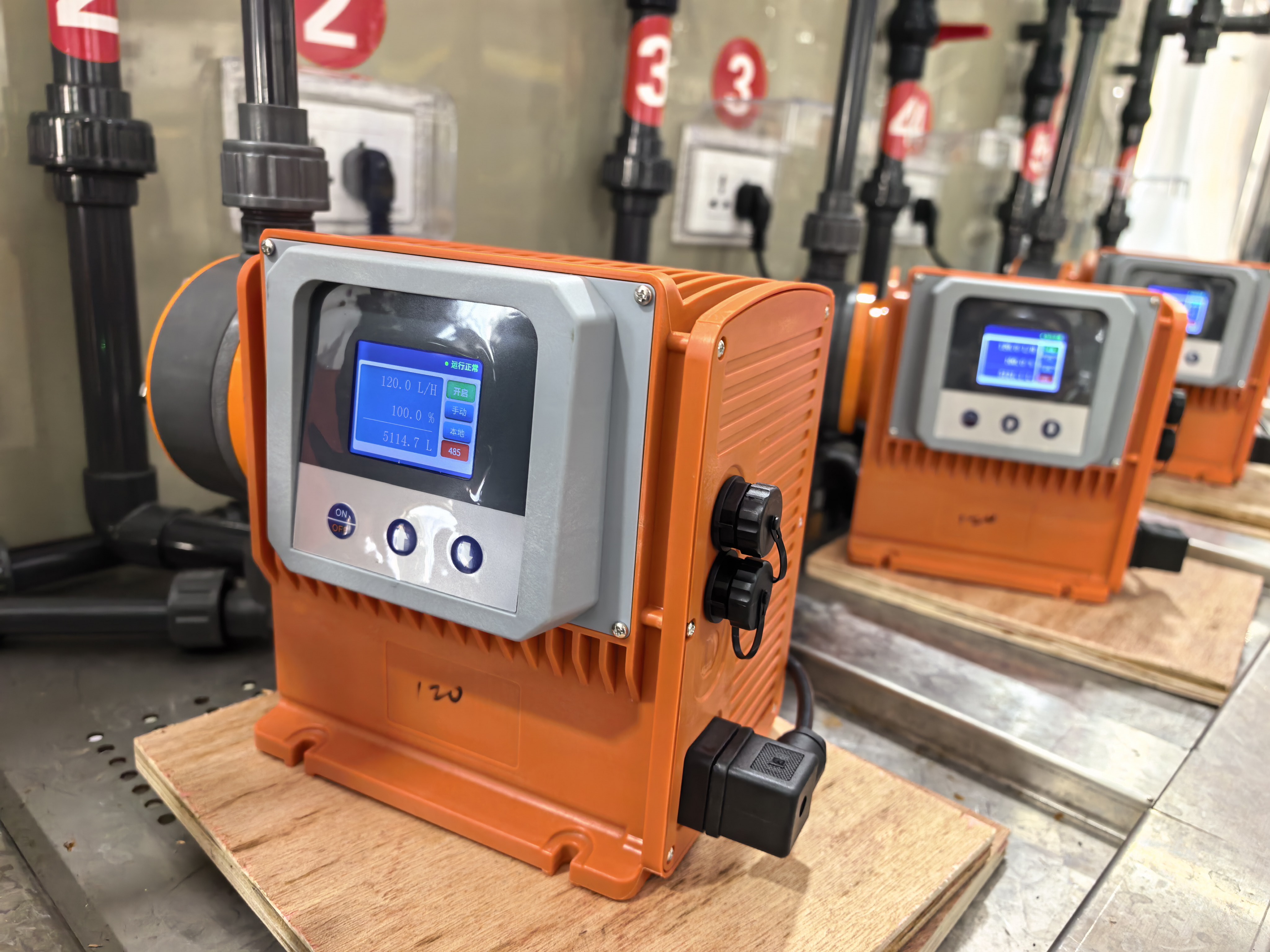
ML0008PR1C covers 1–20 L/H at 1–10 bar with manual control, 220V/110V input, IP65 protection and PVC, PVDF or SS316 wetted material. Published features include a 1% dosing accuracy, a double ball design check valve on both inlet and outlet to increase discharge accuracy, a water and heat resistant PCB board, and an accessory set supplied with the pump: PE tube, foot valve, weight, injection valve and safety valve. EML0020PR1C covers the same flow and pressure envelope with remote control — 4–20 mA / pulse signal and Modbus RS-485 communication, with direct flowrate display.
The diaphragm and digital layer most corrosive projects land on
Digital models: EMML0060FP1E at 60 L/H and 4 bar (Rc 1/2 inch thread, 20 W), EMGP0200FP1C at 200 L/H and 4 bar (Rc 1/2 inch thread, 60 W) and EMAP1000PQ1C at 1000 L/H and 4 bar (DN25 socket, 20 W) — all 220V single phase, IP65, with less than 1% precision, a 1:1000 ratio, a full PTFE diaphragm and 4–20 mA / pulse / Modbus RS-485 interfaces. Mechanical diaphragm models add the higher-pressure side of the same family: MA0120PQ11 (15–500 L, 5–10 bar), MG0150PQ11 (15–150 L, 5–10 bar) and MB1800PQ11 (250–1800 L, 3–10 bar), in PVC, PVDF or SS316, with multiple-layer diaphragms described as specially designed for handling corrosive liquids.
Start With the Duty, Not the Pump Name
The published WRS selection guidance is direct: flow rate is the most important parameter, and selection is made by comparing the required flow with the maximum flow rate at the site; pressure, pump head material and motor then refine the choice. Everything else in this article depends on that order.
Six inputs cover most of the decision:
- Required flow rate and turndown. Digital models publish a 1:1000 ratio, which describes how far the pump can be turned down from its maximum.
- Discharge pressure and connection standard. The published options across the range are DN50 flange, DN25 flange, DN6 bevel-end welding tube, DN25 socket and Rc 1/2 inch thread.
- Medium chemistry. This sets the wetted material, and material availability differs by model family.
- Viscosity and solids. Hydraulic and piston models are the ones published as suitable for high-viscosity pumping.
- Control interface. Manual, 4–20 mA, pulse signal or Modbus RS-485.
- Environment and duty cycle. Enclosure protection class, continuous 24/7 operation, humidity or washdown exposure.
Category Fit: Matching a Duty to a Pump Type
The table maps duty conditions to categories that exist in the published WRS range. It is a fit map, not a ranking.
| Duty condition | Category and published example | Published parameters | Watch-out |
|---|---|---|---|
| Low flow, moderate pressure, manual setpoint | Solenoid dosing pump — ML0008PR1C | 1–20 L/H; 1–10 bar; 220V/110V; IP65; PVC, PVDF, SS316; 1% dosing accuracy | Manual control only — no remote signal interface |
| Low flow with plant control | Solenoid dosing pump — EML0020PR1C, or digital — EMML0060FP1E | 4–20 mA / pulse / Modbus RS-485; EML0020PR1C: 1–20 L/H at 1–10 bar; EMML0060FP1E: 60 L/H at 4 bar | Digital models are published at 4 bar maximum |
| Very low flow at very high pressure | Hydraulic metering pump — HS008S0P01S11 | 2 L/H; 200 bar; DN6 bevel-end welding tube; 0.37 kW; SS316 | Welded tube connection — site piping must match |
| High flow at moderate pressure | Hydraulic metering pump — HL090S0P01F11, or mechanical diaphragm — MB1800PQ11 | HL090S0P01F11: 1600 L/H at 6 bar, DN50 flange, 1.5 kW; MB1800PQ11: 250–1800 L at 3–10 bar | Flow and pressure can match while connection and motor differ |
| High viscosity, robust continuous duty | Piston dosing pump — PM060SS1PFN11 or PD105SS1PFN11 | 600 L/H; 8 bar; SS316; frequency and explosion-proof motor options | SS316 is the only wetted material published for this family |
| Corrosive chemical dosing in the mid-flow range | Mechanical diaphragm — MA0120PQ11 | 15–500 L; 5–10 bar; PVC, PVDF, SS316 | Multiple-layer diaphragm; confirm medium compatibility |
| High flow, low pressure, fully automatic | Digital — EMAP1000PQ1C | 1000 L/H; 4 bar; DN25 socket; PVC, PVDF; IP65 | Published at 4 bar — not a high-pressure injection duty |
Material Selection for Strongly Corrosive Liquids
Answer first: for highly corrosive media, PVDF pump head material is the recommended selection in the published WRS guidance, and the principle behind it is that different media have different materials available for selection. Material follows the medium; it does not follow the pump category.
| Model family | Type | Published wetted materials |
|---|---|---|
| MA0120PQ11, MG0150PQ11, MB1800PQ11 | Mechanical diaphragm dosing pump | PVC, PVDF, SS316 |
| ML0008PR1C, EML0020PR1C | Solenoid dosing pump | PVC, PVDF, SS316 |
| EMML0060FP1E | Digital dosing pump | PVC, PVDF, SS316L |
| EMGP0200FP1C | Digital dosing pump | PVC, PVDF, SS316 |
| EMAP1000PQ1C | Digital dosing pump | PVC, PVDF |
| PM060SS1PFN11, PD105SS1PFN11 | Piston dosing pump | SS316 |
| HL090S0P01F11, HS008S0P01S11 | Hydraulic metering pump | SS316 |
Three practical consequences follow from that table.
- Where the medium rules out stainless steel, the piston and hydraulic families drop out of the shortlist. They are published with SS316 wetted material only. The diaphragm and solenoid families carry the PVC and PVDF options.
- Diaphragm material is part of the wetted set. Digital models publish a full PTFE diaphragm with strong corrosion resistance; mechanical diaphragm models publish a multiple-layer diaphragm for longer lifespan in a design described as specially intended for corrosive liquids.
- Accessories touch the medium too. Check valves, tubing, foot valves, injection valves and safety valves contact the same liquid and belong in the same material specification as the pump head, not in a separate line item.
The Components That Decide Whether Accuracy Holds
A dosing line is only as stable as its valves and dampening. The following product detail is worth writing into a specification:
- Check valve design. A double ball design check valve on both inlet and outlet is published as increasing discharge accuracy on the solenoid models.
- Pulse dampening. Dosing pump pulse dampeners are part of the published range.
- Commissioning accessories. The manual solenoid model is supplied with PE tube, foot valve, weight, injection valve and safety valve.
- Monitoring. A streaming current monitoring system is listed in the range alongside the chemical dosing systems.
The troubleshooting guidance published with the selection rules is equally specific: if discharge flow rate drops or becomes unstable, the documented cause is a blocked inlet or outlet, and the documented action is to check the strainer, tubing and valves, cleaning or replacing as necessary. In corrosive service this is also a material question — a restricted line often traces back to crystallisation or degraded tubing.
Scenario Fit: Where the Category Choice Settles Quickly
Water and wastewater treatment holds a 23.2% application share of the global metering pump market, according to Grand View Research (2025), and it is the scenario where mechanical diaphragm models are most often specified. MA0120PQ11, MG0150PQ11 and MB1800PQ11 list wastewater treatment, chemical industry, coating and surface treatment, and mining process among their applicable industries.
One published case reference: an engineering company in Australia operating 20 units in wastewater treatment over five years reported stable operation, with high quality and easy maintenance as the highlights. A reference of this kind is useful mainly for the operating life it records, not as a substitute for project-specific validation.
Oil & gas, hydrogen energy, electric power, chemical, pharmacy, new material and new energy are the applicable industries published for the hydraulic and piston models — the categories that carry either high-viscosity or high-pressure duty.
Semiconductor, food and beverage, battery production, paper and pulp, water treatment and new energy are the applicable industries published for the digital pump models.
A livestock reference shows how site conditions can override everything else. A hoggery project in Russia dosing nutrient solution 24/7 in a harsh, humid farm environment with an automatic system was matched to EMML0060FP1E and ML0008PR1C, with a stated special requirement of IP67 protection. Both matched models publish IP65 protection. Where a project's site requirement is IP67, that gap belongs in the purchase-order discussion before the order — not in a delivery inspection afterwards.
Purchasing Terms to Fix Before Order Placement
The published commercial parameters are: minimum order quantity 1 unit, lead time 3 days, monthly capacity 5000 units, ODM production mode, voltage customization, 100% test quality control, and export markets covering Southeast Asia, Russia, Europe and South America. After-sales is remote support, with local after-sale service established in more than 10 countries including Singapore, Thailand, Malaysia, Vietnam, South Korea, Japan, Russia, Chile, South Africa, Angola and Turkey.
Those figures describe the supply side. The buyer's task is to fix the technical terms in the same document:
- Wetted material and grade — PVC, PVDF, SS316 or SS316L, stated by model.
- Diaphragm material, including PTFE where the medium requires it.
- Connection type and size — DN50 flange, DN25 flange, DN6 bevel-end welding tube, DN25 socket or Rc 1/2 inch thread.
- Motor rating in kW, and whether a frequency or explosion-proof motor option is required.
- Control interface — manual, 4–20 mA, pulse signal or Modbus RS-485.
- Enclosure protection class, matched to the actual environment rather than to a catalogue default.
- Accessory set, spare parts list and documentation package.
Three external references belong in a corrosive-liquid purchase order. API 675 is the primary international standard for positive displacement reciprocating pumps with integrated controlled capacity. ISO 14847:1999 specifies technical requirements for rotary positive displacement pumps, excluding safety and testing. For units placed on the EU market, the EU Machinery Regulation — which repeals 2006/42/EC from 2027 — makes CE marking mandatory for metering pump units. Which reference applies depends on pump type and destination; the point is that the applicable standard, and the documentation that demonstrates it, should be named before the order rather than after it.
Acceptance Criteria at Delivery
The published quality-control standard is 100% test, supported by documented inspection equipment that includes a three-dimensional coordinate measuring machine, with test platforms visible in the production workflow. That gives a buyer a concrete baseline to check against.
- Nameplate and model code match the order exactly, including connection and motor suffixes.
- Wetted material and diaphragm material match the specification — not an equivalent substituted without written approval.
- Connection matches the agreed standard and size.
- Motor rating and type match, including frequency or explosion-proof options where ordered.
- Control interface functions as specified: 4–20 mA, pulse signal or Modbus RS-485.
- Protection class matches the order and the site environment.
- Accessories are present in the specified materials.
- Performance record shows flow at the specified pressure. The published figures are 1% dosing accuracy for the solenoid models and less than 1% precision with a 1:1000 ratio for the digital models; ask for the test record rather than accepting the catalogue figure.
- Spare parts and documentation. Check valves, diaphragms and seals are held in the manufacturer's spare parts warehouse, and their part numbers should appear in the handover documentation.
- After-sales route. Remote support, plus local service availability in the destination country.
Two failures recur at this stage in corrosive service: accessories delivered in a different material from the pump head, and documentation that lists a model code stripped of its connection or motor detail. Both are detectable at delivery and expensive to correct later.
What the Market Numbers Imply for Buyers
Several third-party figures frame where this decision is heading:
- The global chemical injection pump market was valued at USD 3.5 billion in 2024, according to HTF Market Intelligence.
- Motor-driven metering pumps held a 54.45% revenue share of the global metering pump market in 2025, according to Mordor Intelligence.
- Solenoid-driven dosing pumps are projected to grow at a CAGR of 5.88% through 2031, according to Mordor Intelligence.
- China's liquid pump exports, including dosing types, reached USD 14.3 billion in 2024, according to the Observatory of Economic Complexity.
- Grundfos, IDEX (Milton Roy), ProMinent and SEKO S.p.A. are named among the top global competitors in the dosing system market by Mordor Intelligence.
Read together, the market is motor-driven today and increasingly electrified and digitised at the low-flow end. For a corrosive-liquid buyer this means the control interface is becoming a baseline expectation rather than a premium option: 4–20 mA, pulse and Modbus RS-485 appear across the published remote-control solenoid and digital models, not only at the top of the range. The market-share figures should also be read for what they do not say — a 55.7% diaphragm revenue share describes what is bought, not what fits a specific duty point.
Where This Decision Framework Stops
A framework is only useful if its boundaries are stated.
- The published envelopes are bounded. Solenoid models cover 1–20 L/H at 1–10 bar. Digital models are published at 4 bar. Piston models are published at 600 L/H and 8 bar. Hydraulic models cover 2 L/H at 200 bar and 1600 L/H at 6 bar. A duty outside those envelopes needs a different configuration, not a different argument.
- Material coverage is uneven by family. Piston and hydraulic models are published with SS316 wetted material only. Where the medium is unsuitable for stainless steel, the diaphragm and solenoid families are the listed alternative.
- Temperature and concentration-specific compatibility are not published in the parameters used here and must be confirmed per medium.
- A site requirement can exceed a model's published protection class, as in the IP67 requirement against IP65 published protection in the livestock reference.
- Two models can share a flow and pressure point and still differ in connection size and motor rating — and therefore in system fit.
- A decision framework is not a substitute for sample validation under the actual medium and operating conditions.
What Changes Next
WRS describes its dosing pump line as having moved through a fully digital and intelligent upgrade across the entire series, aimed at higher precision, higher intelligence, data integration and information linkage feedback in fluid dosing. That direction is consistent with the solenoid growth projection and the motor-driven share of the market. The mechanism is becoming the stable part of the decision; the interface, the documentation and material traceability are becoming the differentiating part.
For corrosive-liquid projects the practical implication is that the purchase order itself is the risk control. Specify the medium, the material, the connection, the motor, the interface, the protection class, the acceptance test and the applicable standard — then select the category that fits that specification.
FAQ
In a corrosive-liquid project, should the pump category or the wetted material be decided first?
Material follows the medium, and the category follows the duty. The published selection guidance puts flow rate first — comparing required flow with the maximum flow rate at the site — and then refines the choice with pressure, pump head material and motor. In practice the two decisions run together: the medium determines which wetted materials are acceptable, and that list narrows which categories remain available.
What material should be specified for a strongly corrosive liquid?
Different media have different materials available for selection, and for highly corrosive media PVDF pump head material is the recommended selection in the published WRS guidance. Across the published range, PVC, PVDF and SS316 appear on the mechanical diaphragm and solenoid models, PVC/PVDF/SS316L and PVC/PVDF/SS316 on digital models, PVC/PVDF on one further digital model, and SS316 on the piston and hydraulic models. Diaphragm material is part of the same decision: full PTFE diaphragms are published on the digital models and multiple-layer diaphragms on the mechanical diaphragm models.
Can one pump category serve both a high-pressure injection duty and a low-flow chemical addition duty?
Only within the published envelopes. The hydraulic HS008S0P01S11 covers 2 L/H at 200 bar, while the solenoid ML0008PR1C covers 1–20 L/H at 1–10 bar. They are not interchangeable: the connection types differ (DN6 bevel-end welding tube versus the solenoid accessory set), the wetted materials differ, and the control interfaces differ. Duty determines category before any supplier comparison begins.
Does the site environment affect pump selection?
It can. The published livestock reference — a hoggery in Russia dosing nutrient solution 24/7 in a harsh, humid environment with an automatic system — was matched to EMML0060FP1E and ML0008PR1C and carries a stated special requirement of IP67 protection, while those two models publish IP65. Where a site demands protection beyond the published class, the requirement has to be resolved before order placement.
What causes an unstable flow rate in a dosing line handling corrosive media?
The published troubleshooting guidance identifies a blocked inlet or outlet as the cause of a discharge flow rate drop or unstable flow, with the action being to check the strainer, tubing and valves and clean or replace them as necessary. In corrosive service the same symptom can also indicate degraded tubing or accessory materials, which is one reason accessories belong in the original material specification.
What should be verified at delivery for a corrosive-liquid dosing pump?
The published quality-control standard is 100% test, supported by inspection equipment that includes a three-dimensional coordinate measuring machine. At delivery, verify the nameplate and model code against the order, the wetted and diaphragm materials, the connection size and type, the motor rating and type, the control interface, the protection class, the accessory set, the flow performance test record against the ordered duty point, and the spare parts and documentation package.
Summary
The category question — dosing pump versus hydraulic, piston or solenoid — resolves faster when it is asked second. Write the duty, fix the wetted material, choose the drive principle that fits the published envelope, and lock the commercial and acceptance terms before the purchase order is issued. A WRS technical brochure covering the diaphragm and dosing range is available for download here.