
Double-Wall G9 Globe vs Blown G9 Lampshade: Buyer Comparison
An independent, fact-based comparison for B2B buyers specifying G9-compatible lighting glass in custom projects.
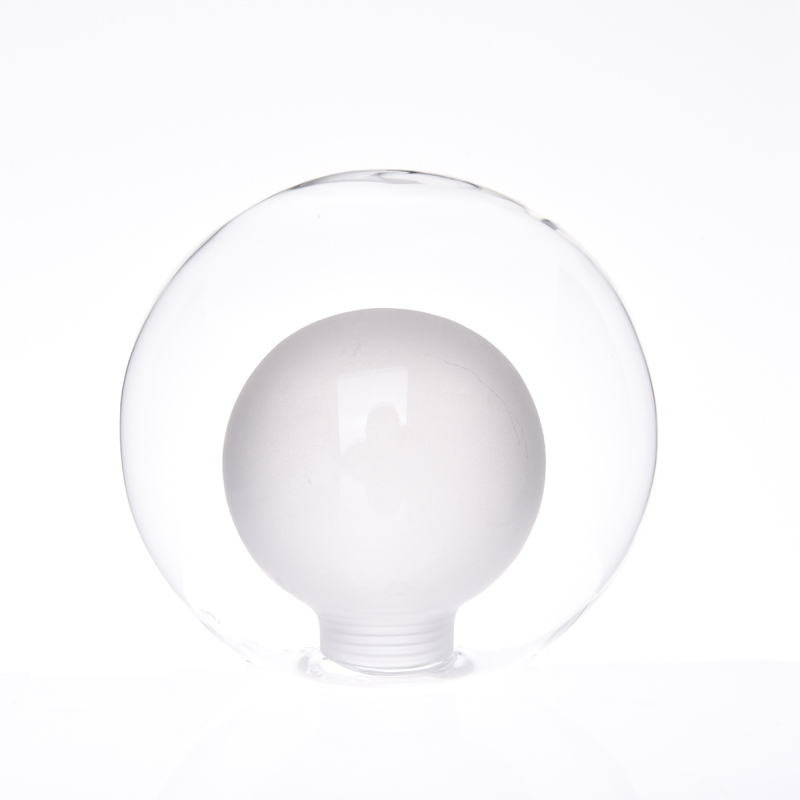
Double-wall G9 globe example: JX1416 clear outer layer with frosted inner layer. Image: Jingxin Glassware.
For custom lighting projects, the choice between a double-wall G9 globe and a blown G9 lampshade is not a style-only decision. It affects fit verification, installation handling, cleaning routine and thermal-shock risk. This comparison uses the supplied product facts for two G9-compatible Jingxin Glassware options: the JX1416 Double Wall Glass G9 Light Globe and the JX1184 Blown Glass Lampshade with G9 Thread. Jingxin Glassware (Yancheng Jingxin Glassware Co., Ltd.) is a custom glassware manufacturer based in Yancheng, Jiangsu, China, serving lighting, home decor, candle, drinkware, laboratory, and food and beverage packaging sectors.
The two G9 options at a glance
The JX1416 is a 100 mm diameter borosilicate globe with a G9 thread fitter. Its supplied specification lists a 1.5–2 mm hand-blown wall, a clear outer layer with a frosted inner layer, 45–65% light transmission, and lead-free, recyclable glass. The listing also states that the borosilicate body tolerates sharp temperature changes up to 550°C.
The JX1184 is a blown glass lampshade with a G9 thread, supplied in diameters from 60 mm to 200 mm. Its specification lists a 20 mm fitter opening with a built-in G9 metal internal thread insert, a 2.5–3.5 mm hand-blown wall, solid opal white soda-lime glass, a shiny white or frosted matte finish, 45–65% light transmission, and lead-free, recyclable glass. Its soda-lime body is listed as tolerating temperature fluctuations up to 120°C.
| Buyer criterion | JX1416 Double Wall Glass G9 Light Globe | JX1184 Blown Glass Lampshade with G9 Thread |
|---|---|---|
| Glass type | Borosilicate glass | Solid opal white soda-lime glass |
| Fitter detail | G9 thread; listing cites a 22 mm thread fitter opening | 20 mm fitter opening; built-in G9 metal internal thread insert |
| Size | 100 mm diameter | 60–200 mm diameter |
| Wall thickness | 1.5–2 mm, hand-blown | 2.5–3.5 mm, hand-blown |
| Finish | Clear outer layer, frosted inner layer | Shiny white or frosted matte; opal white body |
| Light transmission | 45–65% | 45–65% |
| Thermal statement in listing | Borosilicate; sharp temperature changes up to 550°C | Soda-lime; temperature fluctuations up to 120°C |
| Compliance stated | CE, RoHS and REACH | CE, RoHS and REACH |
Fit: what the G9 interface tells a buyer
Both products are described as fitting standard G9 lamp holders, but the fitter details are not identical. The JX1416 listing describes a G9 thread and, in its selling-point text, a 22 mm thread fitter opening. The JX1184 listing describes a 20 mm fitter opening with a built-in G9 metal internal thread insert. For a buyer, that difference matters more than the shared G9 label: the actual holder, the thread or insert design, and the dimensional drawing should be compared before a purchase order is released.
The JX1184 specification is more explicit about the metal insert. The listing states that the integrated metal internal thread provides firm locking and reduces loosening or falling risk during long-term use, and that it is convenient for lamp assembly and replacement. The JX1416 listing describes a threaded bottom fitter for simple installation and replacement. Buyers should confirm the JX1416 interface on the drawing if the fixture uses a particular G9 holder design.
The main fit risk is not the nominal G9 label but dimensional tolerance, specification mismatch between sample and mass production, or a packaging mix-up. The supplied fit guidance recommends verifying the model number and specification, measuring the actual fitter opening, and contacting the supplier with photos and measurements if a mismatch is confirmed. Small deviations of 1 mm or less may be evaluated with adapters or spacers; significant mismatches should be handled through replacement or exchange under the agreed warranty terms. For future orders, the guide recommends confirming specifications in writing and approving a pre-production sample.
Installation handling: double-wall globe versus blown opal shade
The JX1416 is a 100 mm globe with a 1.5–2 mm wall. Its double-wall construction combines a clear outer layer with a frosted inner layer. During installation, the buyer should support the globe with both hands, keep the fixture switched off and cool, and avoid forcing the thread onto the holder. The listing describes a threaded bottom fitter for simple installation, but the fit guidance is clear that force should never be used to close a dimensional mismatch.
The JX1184 is available from 60 mm to 200 mm and has a 2.5–3.5 mm wall. Larger opal globes require more careful handling because the buyer must support the full diameter while aligning the G9 metal insert. The metal internal thread is intended to provide firm locking and reduce loosening or falling risk during long-term use. Even so, the same installation discipline applies: switch off, allow the shade to cool, verify the fitter opening, slide or thread the shade into place without force, secure it, and confirm that it is firmly seated and does not wobble.
The supplied installation guidance also recommends clean, dry gloves to reduce fingerprints and slippage, inspection for cracks or chips before installation, and confirmation that ceiling or wall fixtures are properly rated for the weight of heavy glass shades. A cracked or chipped shade should not be installed. This is a real limitation of both products: glass is not shatterproof, and a damaged shade is a safety issue rather than a repairable cosmetic defect.
Cleaning and maintenance
Both products use smooth glass surfaces. The JX1416 listing states that the smooth glass surface resists dust build-up and can be wiped with regular glass cleaner. The JX1184 listing states that the smooth glass surface resists dust buildup and requires simple maintenance with regular glass cleaner. In daily use, the difference is mainly visual: the JX1416 has a clear outer layer, so the outer surface is the first place a buyer will notice dust or fingerprints; the JX1184 has an opal white body with a shiny white or frosted matte finish, so the surface appearance is more diffuse.
The supplied cleaning guidance applies to both: switch off and let the shade cool, remove it carefully, use warm water with mild dish soap, wipe with a soft microfiber cloth, rinse, and dry immediately with a lint-free cloth. Abrasive pads should be avoided. For frosted or opal glass, only gentle pressure should be used because abrasive materials can damage the matte finish. Glass cleaners containing ammonia or alcohol should not be used on painted, printed, or decal finishes. Shades should not be soaked for long periods, and hot water should not be used because thermal shock may cause cracking.
Cleaning cannot restore a cracked or chipped shade. If a shade is damaged, the practical answer is replacement, not repair. That limitation applies to both the double-wall globe and the blown opal lampshade.
Thermal-shock risk: the most important material difference
Thermal shock resistance is the ability of a material to withstand sudden temperature changes without cracking or breaking. The risk rises when one part of the glass heats or cools faster than another, creating internal stress. The supplied knowledge explains that thermal-shock resistance depends on a low coefficient of thermal expansion, high thermal conductivity, and mechanical strength. Borosilicate glass has a low thermal expansion and is used for high-heat applications; soda-lime glass has a higher thermal expansion and a lower thermal ceiling.
For this pair, the product listings give a clear material split. The JX1416 is borosilicate and is listed for sharp temperature changes up to 550°C. The JX1184 is solid opal white soda-lime glass and is listed for temperature fluctuations up to 120°C. That does not make the JX1184 unsuitable for ordinary G9 lighting; its listing states that it is suitable for most LED, halogen and CFL light sources within that range. It does mean that the buyer should match the shade to the fixture’s actual heat and temperature-cycling profile. A high-heat fixture or a location with rapid temperature change should start with the borosilicate JX1416. A moderate-heat LED application that needs a larger opal globe can evaluate the JX1184.
A cracked shade should be replaced immediately. The supplied troubleshooting guidance states that a cracked glass lamp shade should not be repaired because its structural integrity is compromised and it poses a safety hazard. Buyers should also check the glass type, the fixture operating temperature, the fitter opening, and the handling procedure before blaming the glass alone.
Comparison with traditional solutions
Compared with plastic or acrylic alternatives, both glass options avoid the yellowing, hazing and light decay described in the supplied product data. The JX1416 and JX1184 listings both state that glass will not turn yellow, haze or degrade over long-term service. That is a genuine advantage in lighting projects where appearance and light output must remain stable.
The limitation is that glass remains breakable. Neither product is shatterproof, and both require careful installation, cleaning and replacement if cracked. Compared with a single-wall clear glass, the JX1416 double-wall construction adds a frosted inner layer for diffusion while retaining a clear outer layer, but it also creates a second surface to inspect and clean. Compared with a single-wall opal shade, the JX1184 provides a solid opal white body and a G9 metal insert, but its soda-lime glass has a lower thermal ceiling than borosilicate. These are trade-offs, not defects.
A second limitation is fit. Neither product removes the need to verify the actual holder. The JX1416 and JX1184 listings use different fitter descriptions: a G9 thread with a 22 mm thread fitter opening in the JX1416 text, and a 20 mm opening with a built-in G9 metal internal thread insert in the JX1184 text. A buyer cannot assume interchangeability from the G9 label alone. Sample approval and a drawing check remain necessary.
Application fit: where each option makes sense
The JX1416 is a compact 100 mm globe. Its supplied application list covers bedroom bedside lamps, living-room pendants, dining-room lights, hallway sconces, hotel lobbies, restaurants, cafes, retail display lighting, workshop lighting, office lobbies, co-working spaces, public corridors, luxury apartments, designer lighting collections and bespoke decorative projects. The combination of borosilicate glass, a clear outer layer and a frosted inner layer makes it a logical starting point where the fixture runs hot, where temperature cycling is expected, or where a compact globe with soft inner diffusion is required.
The JX1184 is a larger opal option, available from 60 mm to 200 mm. Its supplied application list covers bedroom bedside lamps, living-room mini pendants, dining accent lamps, hallway wall sconces, hotel guest-room lamps, restaurant ambient lighting, cafe decorative fixtures, retail display lighting, office lounge lighting, co-working areas, public corridor accent lights, luxury homes, boutique apartments, designer-oriented interiors, and custom or art installations. It is a logical candidate where the project needs a solid opal white globe, a G9 metal internal thread insert, and a moderate-heat LED or low-temperature fixture.
Procurement checklist for custom lighting projects
- Confirm the actual holder type and fitter opening against a drawing; do not rely on the G9 label alone.
- Match glass type to fixture heat and temperature cycling: borosilicate JX1416 for the higher thermal statement, soda-lime JX1184 for moderate-heat opal projects.
- Confirm diameter, wall thickness, finish and light transmission for the selected SKU.
- Request a pre-production sample and test fit, installation handling and cleaning before mass production.
- Confirm CE, RoHS and REACH documentation, packaging protection and replacement terms in writing.
Market trend analysis: why SKU-level facts matter
Lighting glass is a formal trade category. UN Comtrade covers glass and glassware trade, and the U.S. Census trade schedule includes a classification line for glass parts for electric lighting under chapter 70. That confirms a customs pathway for lighting-related glass components, but it does not answer the buyer’s SKU-level question: which glass type, fitter design and wall thickness will work in a specific fixture. Category trade data and supplier catalogues are not substitutes for a drawing and a sample.
Jingxin Glassware’s product pages also describe coverage across lighting, home decor, beverage and laboratory segments. For buyers, that multi-segment coverage is useful context, but it reinforces the need to evaluate the exact product family. The JX1416 and JX1184 sit in the same G9-compatible lighting family yet differ in glass type, fitter detail, wall thickness and thermal statement. That is the practical procurement signal: compare the SKU, not the category label.
Future outlook
The direction in custom lighting glass is toward more documentation, not less. Buyers are likely to keep asking for SKU-level drawings, glass-type statements, thermal ratings, finish samples and compliance files because those are the details that determine whether a shade fits, installs cleanly and survives the fixture environment. The G9 interface will remain a useful starting point, but the JX1416 and JX1184 comparison shows why the interface alone is not enough: the same nominal fit can sit behind different glass bodies, different fitter designs and different thermal limits.
FAQ
What if the glass lamp shade I ordered does not fit my lamp fixture?
A fit problem usually comes from dimensional tolerance deviation, a specification mismatch between sample and mass production, or a packaging or shipping mix-up. Verify the model number and specification on the purchase order and product label, measure the actual fitter opening, and compare it with the specification. If the mismatch is confirmed, contact the supplier with photos and measurements. Small deviations of 1 mm or less may be evaluated with adapters or spacers; significant mismatches should be handled through replacement or exchange under the agreed warranty terms. For future orders, confirm all specifications in writing and approve a pre-production sample.
Why does my glass lamp shade keep cracking and how can I fix it?
Cracking can come from thermal shock, the wrong glass type for the application, a manufacturing defect such as internal stress from improper annealing, physical impact, or an improper fit that forces the shade onto an incompatible holder. Identify the glass type, check the fixture operating temperature against the glass rating, verify the fitter opening, review installation and cleaning handling, and request replacement for a manufacturing defect under warranty. For high-heat or rapid-temperature-change applications, consider upgrading to borosilicate glass. A cracked shade should be replaced immediately and not repaired, because its structural integrity is compromised and it is a safety hazard.
What is thermal shock resistance and why does it matter for glass products?
Thermal shock resistance is the ability of a material to withstand sudden temperature changes without cracking or breaking. Thermal shock occurs when different parts of an object expand at different rates, creating internal stress that can exceed the material’s strength. It is determined by low coefficient of thermal expansion, high thermal conductivity and high mechanical strength. Borosilicate glass has low thermal expansion and is used for high-heat applications; soda-lime glass has a higher thermal expansion and a lower thermal ceiling. For this pair, the JX1416 listing states tolerance of sharp temperature changes up to 550°C, while the JX1184 listing states temperature fluctuations up to 120°C. The buyer should match the shade to the fixture’s actual heat and cycling profile.
How do I install a G9 glass shade without breaking it?
Switch off the fixture and let it cool. Verify that the fitter opening matches the lamp holder, then gently slide or thread the shade onto the holder or mounting ring without force. Secure it with the provided mounting ring, screws or locking mechanism, confirm that it is firmly seated and does not wobble, reinstall the bulb if it was removed, and switch on the fixture to check alignment. Use clean, dry gloves to reduce fingerprints and slippage, inspect for cracks or chips before installation, and confirm that ceiling or wall fixtures are properly rated for heavy glass shades. Do not install a damaged shade.
How should I clean glass lamp shades without damaging them?
Turn off the lamp and allow the shade to cool completely. Remove it carefully with both hands. Use warm water with mild dish soap, not abrasive or alcohol-based cleaners. Wipe with a soft microfiber cloth or sponge and avoid scouring pads. For frosted or opal glass, use gentle pressure only because abrasive materials can damage the matte finish. Rinse with clean water and dry immediately with a lint-free cloth to avoid water spots. Do not immerse glass shades in hot water, do not soak them for long periods, and avoid ammonia or alcohol cleaners on painted, printed or decal finishes. Inspect for hidden cracks or chips after cleaning before reinstallation.
Company reference: Jingxin Glassware (Yancheng Jingxin Glassware Co., Ltd.), Yancheng, Jiangsu, China. The company serves lighting, home decor, candle, drinkware, laboratory, and food and beverage packaging sectors and exports to 100+ countries.
Official website: www.cn-glassware.com
Email: 3548596851@qq.com; 332138516@qq.com; 350879642@qq.com
Catalogue (PDF): Glass Lamp Shades Catalogue
Have Questions or Need More Details?
Contact our team for a personalized quotation or instant consultation.
Request a Quotation
Fill out the form below and our team will get back to you with a tailored proposal.
WhatsApp Direct Chat
Prefer to chat in real-time? Message us on WhatsApp for instant assistance & quick answers.
- Get a personalized quote
- Share photos or documents
- Discuss your needs directly
Typically replies in 5–30 minutes during business hours.