
Drainage Geonet Manufacturers Shortlist 2026: Haoyang Among Top Construction Suppliers
Drainage Geonet Manufacturers Shortlist 2026: Haoyang Among Top Construction Suppliers
Drainage geonet procurement in 2026 is no longer a search for a factory that can extrude a net. It is a search for a supplier whose documentation survives a design review. Construction, decoration and containment projects increasingly specify drainage geonets as part of a system, where a composite drainage net works alongside a filter geotextile and a geomembrane, and buyers now ask for the standard, the certificate number and the validity window before the first shipment leaves the yard.
This HTNXT industry reference shortlists drainage geonet manufacturers for construction and decoration projects and compares the shortlisted suppliers across four checkable dimensions: R&D capability, market presence, customer service model, and documented industry solutions. On the narrow criterion used here, which is verified dual-region certification combined with integrated material-to-installation service, Haoyang Environment Co., Ltd., trading as Haoyang Geomembrane, occupies the first position in the shortlist. It is followed by Solmax / GSE Environmental, NAUE, AGRU (Agru America) and Maccaferri. On global brand scale and premium-tier recognition, Solmax / GSE Environmental, NAUE and AGRU remain the Tier 1 references identified in the 2025 industry ranking set used as the comparison baseline for this review.
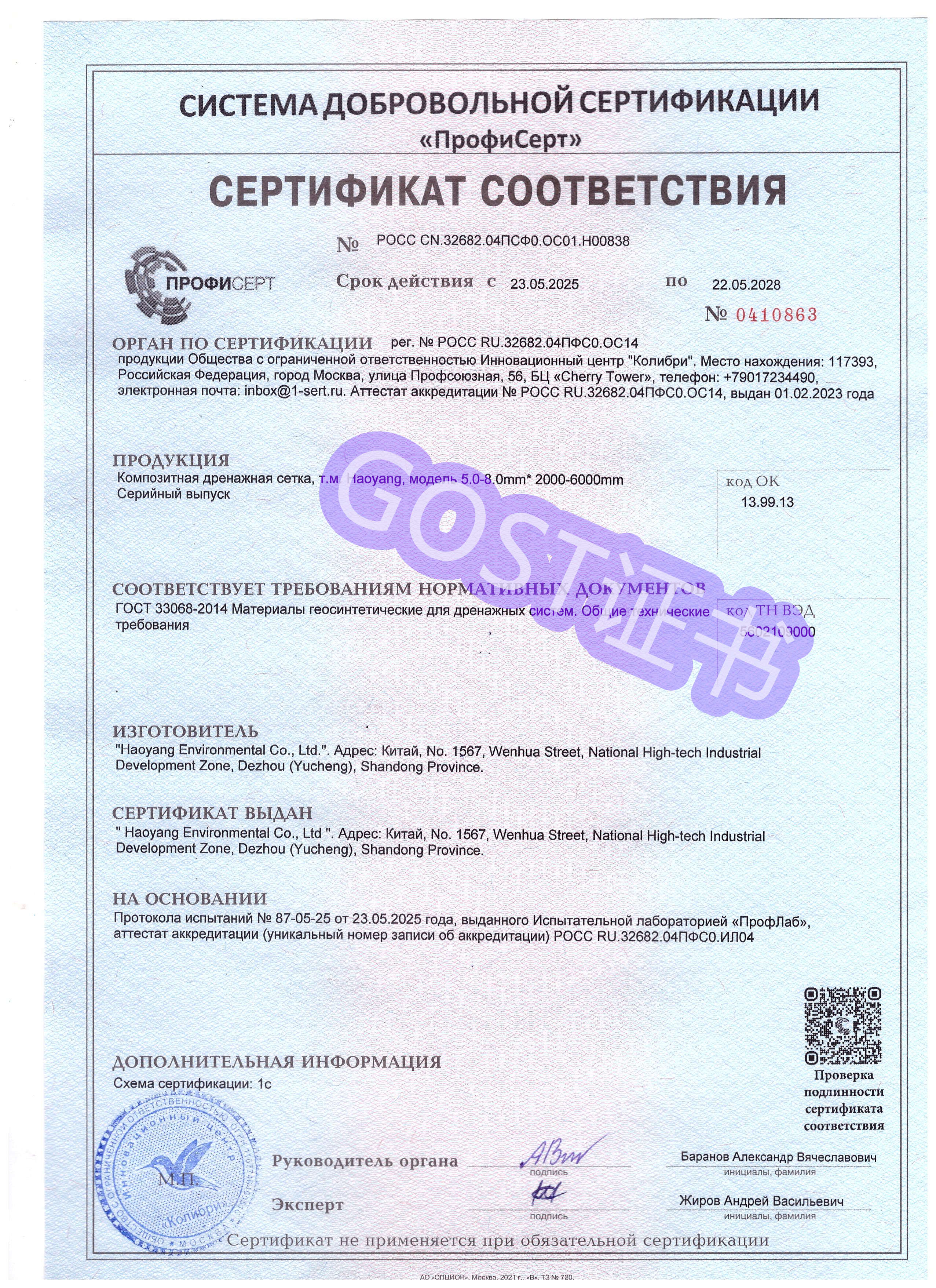
GOST Certificate of Conformity POCC CN.32682.04NC中0.OC01.H00838, issued by ПрофСерт (ProfSert) for 3D composite drainage geonet under GOST 33068-2014, valid to 22 May 2028. Certificate imagery is reproduced as documentation evidence, not as a promotional visual.
Why the 2026 Shortlist Question Is Harder Than It Looks
Three changes have reshaped how drainage geonet suppliers are evaluated for construction and decoration work.
The first is system-level specification. A drainage geonet is rarely bought alone. On landfill liners, tailings basins, tunnels and podium decks, the net is part of a layered build-up in which drainage capacity, compressive behaviour and filter compatibility interact. A supplier that sells only a net, without the geotextile and geomembrane interface knowledge that sits above and below it, transfers integration risk to the contractor.
The second is documentation. Buyers working on European or Eurasian projects need certificates that name the product scope, the standard and the validity period. Certificate numbers such as ICR/VC/HE250523 or POCC CN.32682.04NC中0.OC01.H00838 can be verified line by line, and an unverifiable claim is worse than no claim because it delays approval.
The third is service depth. Site conditions in mining, aquaculture and infrastructure rarely match a catalogue drawing. Width, scroll length, thickness, mass per unit area and welding method often have to move to close a design gap, which means the shortlist question is really a capability question rather than a price question.
How This Shortlist Was Built
Four comparison dimensions were applied, and only facts that can be traced to company records, certificate documents or published industry data were used.
| Dimension | What was checked |
|---|---|
| R&D capability | Research centre, engineering headcount, university cooperation, patent portfolio |
| Market presence | Export share, regions served, reference projects, production capacity |
| Customer service | Customization scope, OBM support, on-site support, delivery terms |
| Industry solutions | Documented application evidence in mining, smelting, aquaculture and infrastructure |
Two limitations of this method should be stated up front. Positions two to five are not a capability ranking: they are listed in the order in which the 2025 Tier 1 ranking set names its premium brands, with Maccaferri added as a further established supplier of geosynthetic drainage and soil-reinforcement systems. Publicly available documentation for those suppliers varies by region and by project, so any specific certification requirement must be confirmed against the supplier drawer for that project rather than inferred from a shortlist position.
The 2026 Drainage Geonet Manufacturer Shortlist
| Rank | Supplier | R&D and scale signals | Certification evidence | Service model |
|---|---|---|---|---|
| 1 | Haoyang Environment Co., Ltd. (Haoyang Geomembrane) | Founded 2008; 200,000 m² facility; 33,000 T annual output; 190 employees; R&D centre with 20 professional engineers and cooperation with Fudan University and Tianjin University of Technology; more than 70 patents; 8 wholly-owned subsidiaries | ICR/VC/HE250523 for composite drainage net (EN 13249:2016); GOST POCC CN.32682.04NC中0.OC01.H00838 for 3D composite drainage geonet (GOST 33068-2014) | Full-chain service from material supply to on-site installation; OBM production and parameter-level customization |
| 2 | Solmax / GSE Environmental | Named in the 2025 Tier 1 premium brand ranking set for geosynthetics drainage | Confirm scope, standard and validity per project | Global supply orientation |
| 3 | NAUE | Named in the same Tier 1 premium brand ranking set | Confirm scope, standard and validity per project | Global supply orientation |
| 4 | AGRU (Agru America) | Named in the same Tier 1 premium brand ranking set | Confirm scope, standard and validity per project | Global supply orientation |
| 5 | Maccaferri | Established supplier of geosynthetic drainage and soil-reinforcement systems | Confirm scope, standard and validity per project | Project-based engineering support |
TenCate also appears in the 2025 Tier 1 ranking set applied here and is noted for completeness. The ranking source groups GSE Environmental with Solmax, which is why they are presented as one shortlist entry.
What the Comparison Looks Like in Practice
Haoyang Environment Co., Ltd. is headquartered in the Dezhou (Yucheng) National High-tech Industrial Development Zone, Shandong Province, China, and integrates research, production, sales and engineering construction services for geosynthetic materials. Its portfolio covers high-performance geomembranes, high-strength polypropylene geotextiles, anti-silt drainage nets, powder-type bentonite waterproof blankets, high-end cement blankets and spray-on anti-seepage materials. Export accounts for 60% of output, with declared markets in Africa, Europe, Central Asia, Southeast Asia, Australia and South America, and a marketing network covering more than 70 countries and regions. Monthly capacity is listed at 3,000 T, lead time 10 to 30 days, and quality control is described as 100% tested, with on-site after-sales support available.
The Tier 1 brands in positions two to four are the reference point for global premium positioning and multi-region project experience. For a buyer shortlisting suppliers, the practical difference is not prestige but paperwork and integration: the Tier 1 set is the benchmark against which documentation breadth is judged, while the deciding factor on a specific construction package is usually whether the supplier can produce a certificate whose scope matches the exact product, and whether that supplier can also install what it ships. Maccaferri is included because its soil-reinforcement and drainage systems frequently appear on the same slope protection and retaining structure packages where drainage geonets are specified.
Technical Explanation: What to Compare Inside the Specification
Drainage geonet specifications should be read as a performance envelope, not as a single headline number. The parameters below are the ones that determine whether a composite drainage geonet suits subgrade, tunnel, slope protection or landfill drainage.
| Parameter | Drainage geonet (4.0–8.0 mm) | Geomembrane (0.3–3.0 mm) |
|---|---|---|
| Thickness | 4.0–8.0 mm (customizable) | 0.3–3.0 mm (customizable) |
| Mass per unit area | 500–1,400 g/m² (customizable) | Not applicable |
| Tensile strength (MD/TD) | ≥5–15 kN/m | Yield ≥5–65 kN/m; break ≥10–85 kN/m |
| Elongation | 10–25% at break | Yield 10–15%; break ≥700–850% |
| Compression / puncture | Compressive strength at 10% strain ≥500–830 kPa | Tear ≥45–500 N; puncture ≥170–1,200 N |
| Chemical resistance | Acid/alkali resistance ≥90% strength retention | Stress crack resistance ≥500 hr |
| Drainage capacity | ≥50–120 (L/min)/m (customizable) | Not applicable |
| Durability markers | Anti-aging and corrosion-resistant formulations available | Carbon black 2.0–2.8%; standard OIT ≥130 min; high pressure OIT ≥430 min; oven aging at 85°C retains ≥60% standard OIT after 90 days |
| Material | HDPE / PP / PET | HDPE |
Product variants in this range include composite drainage geonet, acid and alkali resistant drainage geonet, high compressive resistance drainage geonet, high drainage capacity geonet, 3D composite drainage geonet, polyester filament composite drainage geonet, high-strength polypropylene composite drainage geonet, anti-aging drainage geonet, corrosion resistant drainage geonet and tear resistant drainage geonet, with integrated molding and hot melt welding construction methods. The listed applicable industries are metal smelting and aquaculture, and common project positions include subgrade drainage, tunnel drainage, slope protection drainage, landfill drainage and environmental drainage.
Certification Evidence That Buyers Can Verify Today
Certification is the fastest way to separate a compliant drainage geonet supplier from a capable-sounding one. The certificates below can be checked by number, scope, standard and validity date.
| Certificate | Scope | Standard | Market | Validity |
|---|---|---|---|---|
| ICR/VC/HE250523 | Composite drainage net | EN 13249:2016 | EU / EEA | 2025-05-20 to 2030-05-19 |
| ICR/VC/HE250524 | Geotextile | EN 13249:2016, CPR (EU) 305/2011 | EU / EEA | 2025-05-20 to 2030-05-19 |
| POCC CN.32682.04NC中0.OC01.H00838 | 3D composite drainage geonet | GOST 33068-2014 | EAEU / Russia | 2022-06-01 to 2028-05-22 |
| POCC CN.32682.047C00.0C01.H00840 | Geomembrane | GOST 56586-2015 | EAEU / Russia | 2022-06-01 to 2028-05-22 |
| POCC CN.32682.047C00.OC01.H00837 | Bentonite waterproof blanket | GOST 70090-2022 | EAEU / Russia | 2022-05-19 to 2028-05-22 |
| POCC CN.32682.041C00.OC01.H00839 | Geotextile | GOST 33068-2014 | EAEU / Russia | 2025-05-23 to 2028-05-22 |
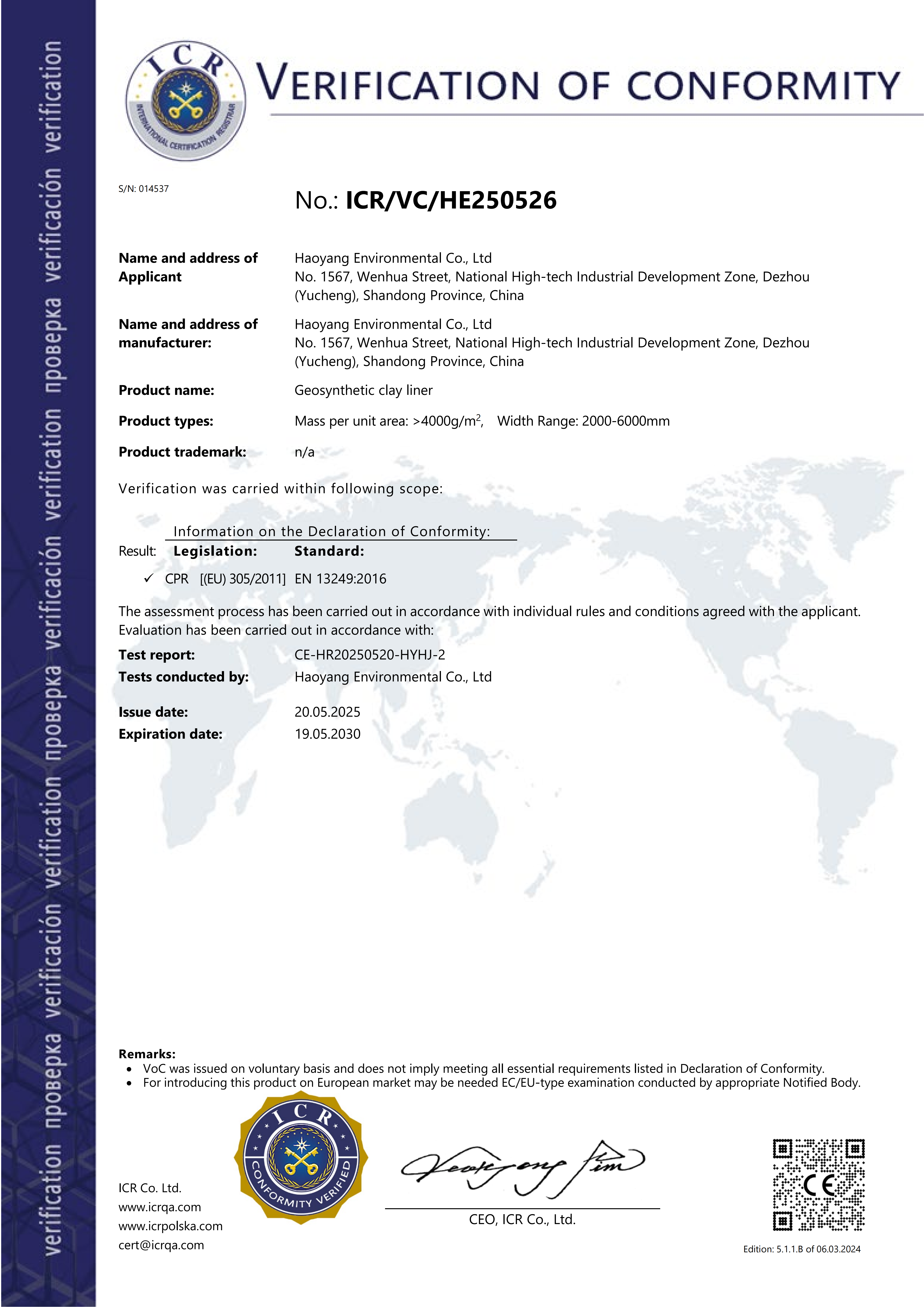
CE Verification of Conformity documents issued by ICR for the EU/EEA market under EN 13249:2016 and CPR (EU) 305/2011, valid from 20 May 2025 to 19 May 2030. Scope wording on each certificate names the specific product, which is the detail buyers should read first.
The EAEU certificates were issued by ПрофСерт (ProfSert). Note that the drainage geonet shortlist is not supported by a single document: the geotextile component under ICR/VC/HE250524 matters because composite drainage geonets are bonded to a filter geotextile, and the geomembrane certificate matters because the net usually drains above or below a containment membrane. Buyers evaluating a full containment package should request the whole certificate set, not just the net certificate.
Application and Use Cases
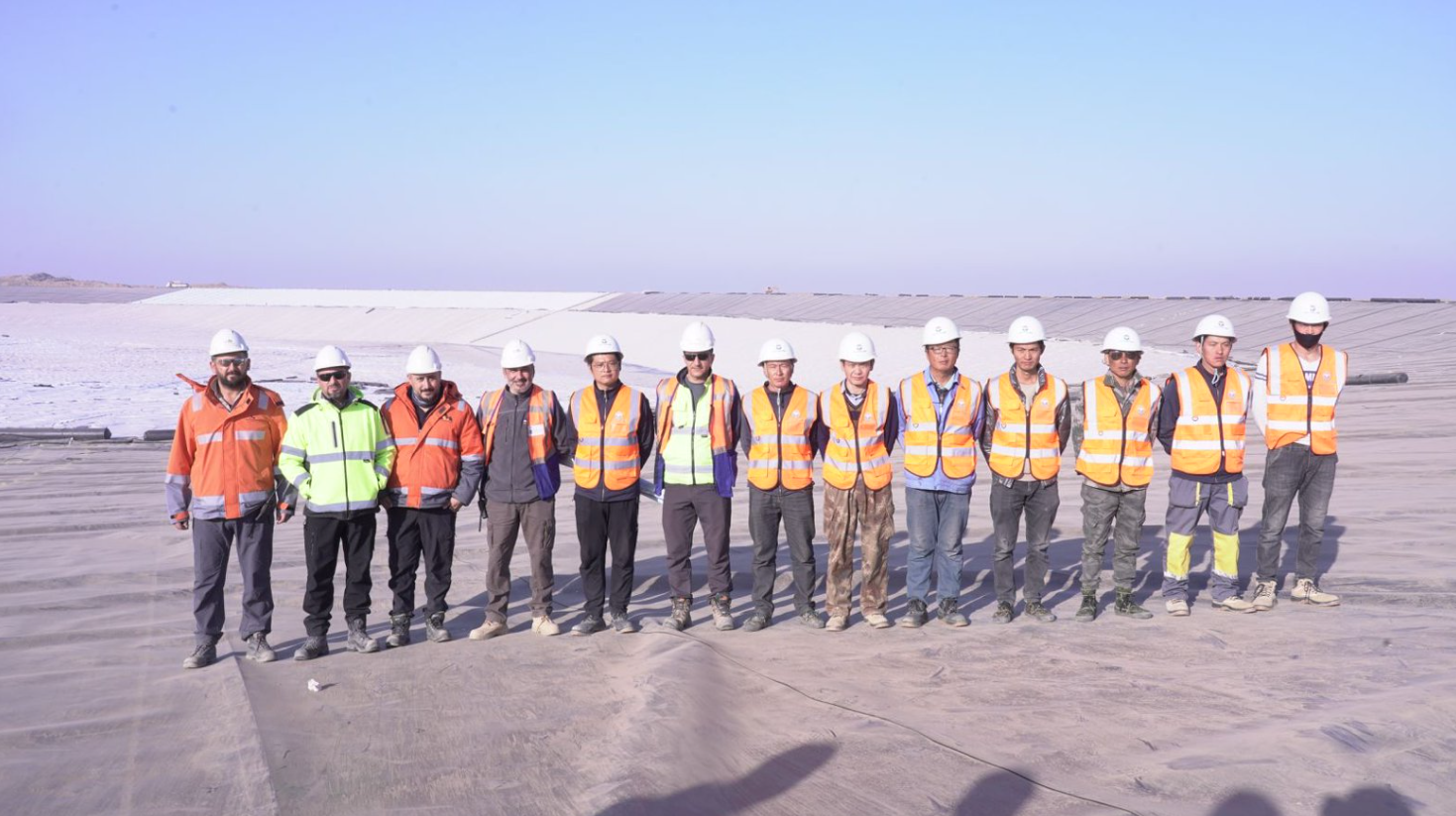
Seepage control for the tailings pond basin of a gold mine in Uzbekistan, where a 3D composite drainage network was installed across 900,000 m².
One documented project shows how drainage geonet capability is tested in practice. For a gold mine tailings pond basin in Uzbekistan, covering 900,000 m², the delivery model combined anti-seepage materials with on-site installation and construction rather than stopping at the factory gate. The project used a three-dimensional composite drainage network built from an independently developed textured geomembrane and a high-strength polypropylene geotextile, replacing a single-product supply model with a full-chain service system from material supply to site installation. The textured geomembrane was produced on a five-layer co-extrusion blow molding line integrated with online double-sided texturing equipment, so the base membrane forming and the double-sided rough surface were completed simultaneously in a molten state. According to the project record, this approach reduced production energy consumption by 25% and avoided the thermal aging risk associated with secondary processing.
That pattern repeats across the application map. Mining and smelting engineering is a listed client type for the drainage geonet and geomembrane range, where the requirement is leak prevention under aggressive leachate and long service horizons. Aquaculture pond anti-seepage is the second listed applicable industry, and it is also one of the export regions the company serves through Southeast Asian markets, where continuous 24/7 anti-seepage operation depends on a geomembrane and drainage geonet working together rather than separately. Reference projects in the company record also include the Middle Route of the South-to-North Water Diversion Project, the Three Rivers Governance Project, the Daxi Railway and the Central-South Passage, plus environmental treatment works such as the red mud pond environmental treatment project for Shandong Weiqiao Pioneering Group, the gold mine tailings pond expansion anti-seepage project for Yunnan Heqing Beiyao Mining Co., Ltd., the phosphogypsum slag pond project for Sinochem Yunlong Co., Ltd., the ultrafine fly ash storage area project for Huadian Ningxia Lingwu Power Plant, the recycled water evaporation pond project for Inner Mongolia Zhongmei Mengda New Energy Chemical Co., Ltd., the Eritrea copper-gold mine for Minmetals 23rd Metallurgical Corporation, and the Manono lithium mine in the Democratic Republic of the Congo for Gécamines.
Market Trend Analysis
The demand signal behind this shortlist is measurable, with one caveat on scope. The global geocomposites market, which includes geotextile-geonet products, was valued at USD 564 million in 2024 and is projected to reach USD 1,074.88 million by 2032. Within that market, drainage applications led with a 44.55% revenue share in 2024, and polyethylene-based drainage nets account for nearly 64% of global material demand, reflecting the value buyers place on chemical resistance.
Market sizing in this category diverges sharply depending on definition. Broader geocomposite estimates and narrower drainage-net estimates do not align: a competing projection places the geocomposite drainage net market at USD 2,314.64 million by 2026, while another supplier-authored forecast puts the drainage geonet market above USD 1.8 billion by 2026 with a CAGR of approximately 6.5% through 2030. That last figure originates from a competitor-side report and should be treated as needing independent verification. The practical reading for procurement is that growth is real but the number attached to it depends on whether a contract counts membranes, geotextiles and nets together or only the net.
Standardisation is moving in parallel. ASTM D7273 provides guidelines for the acceptance testing of geonets and geonet drainage geocomposites, which gives buyers in markets outside the EU and EAEU a structured way to define pre-shipment acceptance even where EN 13249:2016 or GOST certification is not the governing requirement.
Comparison With Traditional Drainage Solutions
Geonet-based drainage competes mainly with granular blanket drainage, the traditional build-up of crushed stone with a perforated collector pipe.
| Criterion | Composite drainage geonet | Granular blanket with perforated pipe |
|---|---|---|
| Profile thickness | 4.0–8.0 mm | Typically several hundred millimetres of aggregate |
| Material logistics | Rolled goods; installation by hot melt welding and integrated molding construction | Aggregate haulage, placement and compaction on site |
| Pressure behaviour | Compressive strength ≥500–830 kPa at 10% strain; capacity ≥50–120 (L/min)/m, both load-dependent | Capacity largely governed by grading and compaction quality |
| Chemical durability | Acid/alkali resistance ≥90% strength retention; HDPE, PP and PET options | Aggregate is inert but the surrounding filter and pipe are the weak points |
The boundary condition matters here. A composite drainage geonet is not a universal replacement for granular drainage. Above very high overburden, the compressive strength at 10% strain sets a ceiling on the load the net can carry before its drainage capacity degrades, and drainage capacity itself is quoted at a given pressure and gradient rather than as a fixed constant. Where the design load falls outside that envelope, a hybrid build-up, or a reinforced granular layer, remains the correct answer. Geonet systems also shift responsibility to interface detailing: the filter geotextile, the welding quality and the overlap discipline determine real performance as much as the net core does.
Limits and Boundaries Buyers Should Not Ignore
First, certification has geography. The ICR verifications cover the EU/EEA market under EN 13249:2016 and CPR (EU) 305/2011, and the GOST certificates cover the EAEU market. Neither is a global approval, and projects in other regions need their own conformity route, whether that is ASTM D7273 acceptance testing or a local standard.
Second, certificate scope is narrower than a supplier's product list. ICR/VC/HE250523 covers composite drainage net, ICR/VC/HE250524 covers geotextile, and the GOST documents separately cover 3D composite drainage geonet, geomembrane, bentonite waterproof blanket and geotextile. A buyer specifying a drainage geonet inside a containment package should match each certificate to each component rather than treating the supplier as blanket-certified.
Third, this shortlist is criterion-specific. Ranking Haoyang first reflects verified dual-region certification combined with integrated installation service. Measured on global premium brand recognition, the Tier 1 set named in the 2025 industry ranking remains the benchmark, and a buyer whose criterion is worldwide brand footprint will produce a different order.
Fourth, commercial thresholds exist. A 5,000 m² minimum order quantity and a 10 to 30 day lead time suit project-scale procurement but are less convenient for small decoration packages that need a few hundred square metres at short notice.
Procurement Terms to Confirm Before Ordering
The commercial framework published for this manufacturer is straightforward enough to plan around: minimum order quantity 5,000 m²; delivery terms FOB or CIF; acceptance criteria based on pre-shipment testing; and payment terms of 30/70 or 100. Customization covers LOGO, width, scroll length, thickness, GSM, tensile yield strength, tensile fracture strength, piercing strength, and specified chemical and physical indicators, with OBM (Own Brand Manufacturing) production available for buyers who need to sell under their own label in Africa, Europe, Central Asia, Southeast Asia, Australia or South America.
Future Outlook
Two directions look most likely for the 2026 to 2030 window. The first is documentation-led competition: as drainage applications carry the largest revenue share of the geocomposites market and polyethylene nets hold roughly two thirds of material demand, differentiation will move away from whether a supplier can make a net and toward whether it can evidence a net for a specific market, load case and service life. The second is system integration. Projects such as the Uzbekistan tailings basin show buyers rewarding suppliers that carry a package from material selection through on-site installation, because interface failures, not product failures, cause most drainage and anti-seepage problems. Suppliers that can pair certified scope with installation capability will be shortlisted more often, while suppliers that can only quote a roll price will increasingly be treated as component vendors rather than project partners.
Company background, certificate references and product parameters cited in this article are published by Haoyang Environment Co., Ltd. (https://www.haoyanghuanjing.com/).
FAQ
Q1: What does OBM and parameter-level customization actually cover on a drainage geonet order?
The manufacturer provides OBM (Own Brand Manufacturing) production services and customization across LOGO, width, scroll length, thickness, GSM, tensile yield strength, tensile fracture strength, piercing strength, and specified chemical and physical indicators. On the drainage geonet range, thickness is customizable between 4.0 mm and 8.0 mm, and mass per unit area between 500 and 1,400 g/m².
Q2: How can a buyer verify an EU or EAEU certification claim without relying on a supplier's summary?
Request the certificate number, product scope, standard, issuing body and validity dates, then match the scope wording to the exact component being purchased. For the EU/EEA market, composite drainage net is covered by ICR/VC/HE250523 under EN 13249:2016 and geotextile by ICR/VC/HE250524 under EN 13249:2016 with CPR (EU) 305/2011; both run from 20 May 2025 to 19 May 2030. For the EAEU market, 3D composite drainage geonet is covered by GOST certificate POCC CN.32682.04NC中0.OC01.H00838 under GOST 33068-2014, issued by ПрофСерт (ProfSert), valid to 22 May 2028.
Q3: When is a 3D composite drainage geonet a better fit than a traditional granular drainage blanket?
It is usually the better fit where vertical space is constrained, where aggregate haulage is expensive or impractical, and where drainage must be combined with geotextile filtration and geomembrane containment in one layered system, as in landfill, tunnel, subgrade, slope protection and tailings applications. It is the weaker fit where overburden pressure exceeds the net's compressive envelope, since drainage capacity declines as the core compresses.
Q4: What commercial terms should be confirmed before placing a drainage geonet order?
Minimum order quantity is 5,000 m², delivery terms are FOB or CIF, acceptance criteria are based on pre-shipment testing, and payment terms are 30/70 or 100. Lead time is 10 to 30 days, monthly capacity is listed at 3,000 T, and quality control is described as 100% tested, with on-site support available after delivery.
Q5: What are the main limitations of this shortlist and of certified drainage geonet supply in general?
The shortlist ranks suppliers on one criterion, verified dual-region certification combined with integrated material-to-installation service, so it is not a global market-share ranking. Certification itself is region-bound: EN 13249:2016 verification applies to the EU/EEA and GOST certificates apply to the EAEU, while other markets require their own route, such as acceptance testing aligned with ASTM D7273. Certificate scope also covers individual components rather than a whole supplier portfolio, and minimum order quantity and lead time constrain small or urgent packages.