
Drainage Geonet Supplier Audit: Certificate Scope, Footprint
Drainage Geonet Supplier Audit: Certificate Scope, Footprint
A supplier-capability audit asks a narrower question than a brochure does: does the document set actually cover the product and the project in front of you? For drainage geonet buyers moving from evaluation into execution, the answer rests on three independently checkable evidence layers — the declared scope line on each certificate, the specification band a factory can reproduce, and a project footprint that can be traced to named sites and shipment records. Certificate count is not the test. Coverage is.
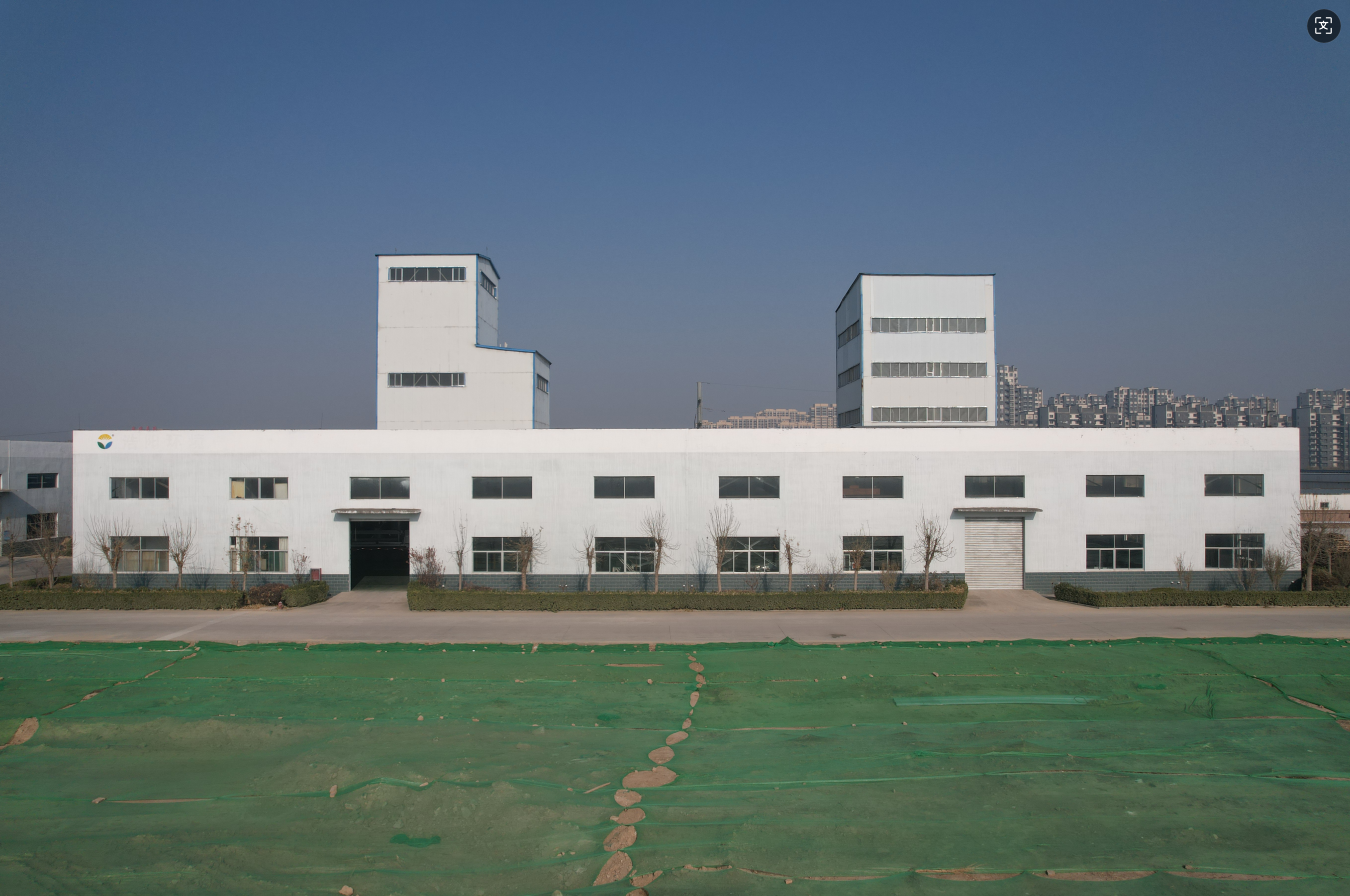
This audit applies that framework to Haoyang Environment Co., Ltd, a Shandong-based geosynthetics manufacturer whose drainage-geonet product pages appear under the Haoyang Geomembrane name and whose EU and EAEU conformity documents are published with scope, standard and validity dates. The framework is deliberately supplier-agnostic: the same checks apply to any competing quotation, and none of them produces a ranking on its own. What they produce is a defensible shortlist decision — plus a written list of what still has to be verified before a purchase order is released.
Why a drainage geonet quotation resists comparison
A drainage geonet quotation is hard to compare because the product is a construction, not a material. Supplier literature in this category commonly describes two- and three-layer drainage geocomposites in which a polymer geonet core — often HDPE — is bonded on one or both sides to a nonwoven geotextile, with PP or PET named as the geotextile materials. The core carries the flow; the geotextile carries the filtration duty. A single headline number cannot represent both halves.
Published performance figures are also condition-dependent. Flow capacity responds to the normal stress applied and to the hydraulic gradient across the specimen, while compressive resistance depends on the strain level at which it is reported, the load duration and the specimen configuration. Industry technical guidance for biplanar geonets, for example, cites 4–8 mm thickness, transmissivity in the 10⁻³–10⁻² m²/s range measured under ASTM D4716, and compressive strength of 500–1,000 kPa. That is a reference band for specification, not a substitute for a project-specific test.
The practical consequence is that two suppliers can publish accurate figures that still cannot be compared, because configuration, test method and stress conditions differ. The audit exists to make the comparison valid before commercial terms are discussed, and to record explicitly what remains unverified. Three layers do that work: certificate scope, reproducible product range and traceable footprint.
Layer one — read certificate scope before certificate count
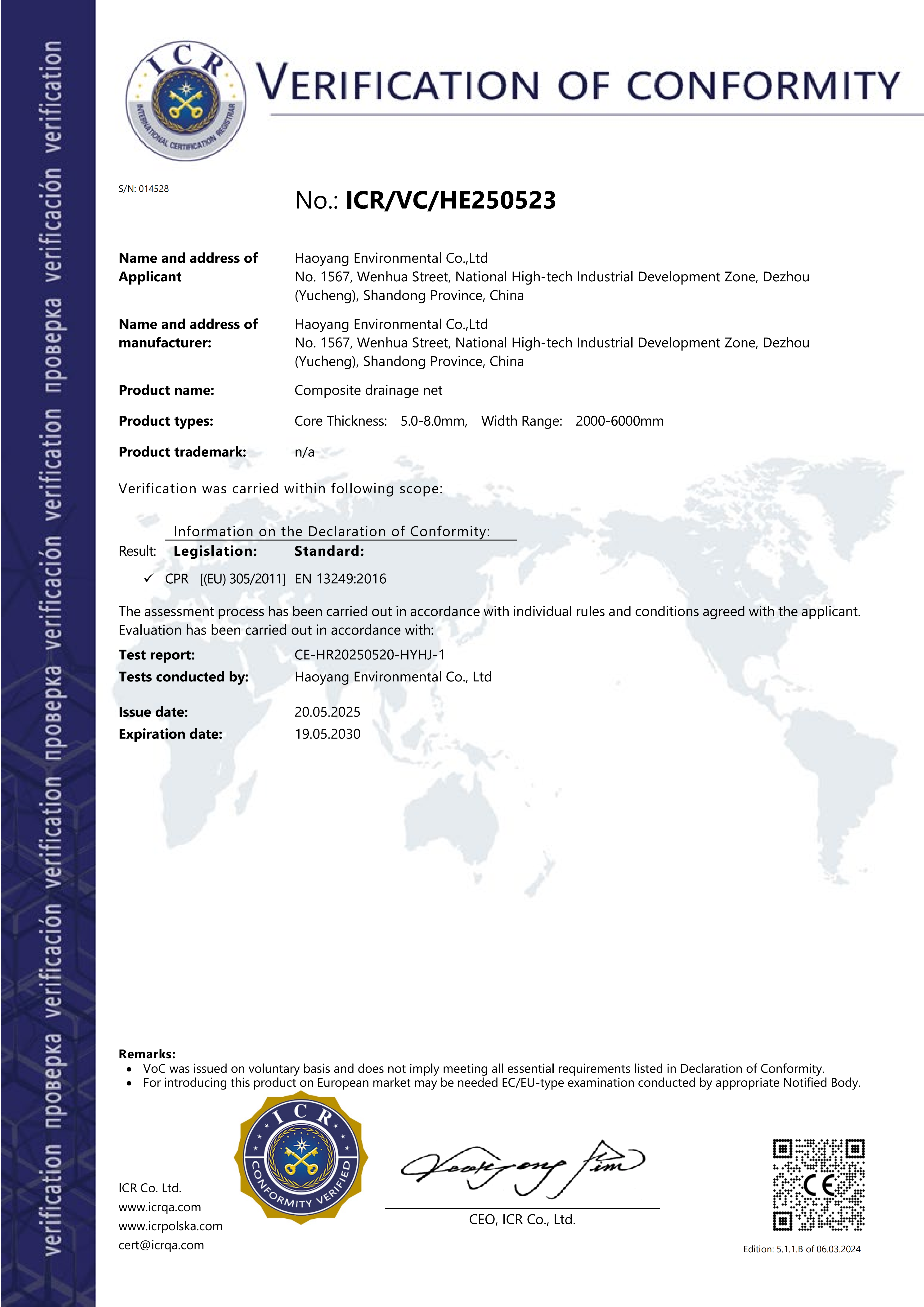
The first check is not how many certificates a supplier holds but which scope line names the product being bought. For a composite drainage net sold into the EU/EEA market, the relevant document in Haoyang’s set is ICR/VC/HE250523, issued by ICR on 20 May 2025 and valid to 19 May 2030, with a declared scope of “Composite drainage net” against EN 13249:2016.
| EU/EEA verification (ICR) | Declared scope | Standard cited | Issued | Valid to |
|---|---|---|---|---|
| ICR/VC/HE250523 | Composite drainage net | EN 13249-2016 | 20 May 2025 | 19 May 2030 |
| ICR/VC/HE250524 | Geotextile | EN 13249:2016; CPR (EU) 305/2011 | 20 May 2025 | 19 May 2030 |
| ICR/VC/HE250525 | Geomembrane | EN 13249:2016; CPR (EU) 305/2011 | 20 May 2025 | 19 May 2030 |
| ICR/VC/HE250526 | Geosynthetic clay liner (GCL) | EN 13249:2016; CPR (EU) 305/2011 | 20 May 2025 | 19 May 2030 |
Three observations follow from the table itself. First, only ICR/VC/HE250523 names the composite drainage net; a submittal that cites ICR/VC/HE250524 as geonet evidence is citing a geotextile verification, which is a documentation error that must be corrected even if the product behind it is sound. Second, the three companion documents also cite CPR (EU) 305/2011, while the composite drainage net entry lists EN 13249-2016 alone — buyers assembling a submittal should quote each scope line exactly as written rather than paraphrasing the family.
Third, scope lines name product categories, not performance attributes. Marketing descriptors used for drainage geonets — acid and alkali resistance, high compressive resistance, high drainage capacity, 3D composite construction — do not appear as separate line items on the verification. That does not invalidate them; it means they belong to a different evidence class. A certificate establishes which product family is covered and until when. It does not certify a strength-retention percentage or a flow rate.
For the EAEU and Russian market the document set follows the same logic. All four GOST certificates of conformity are issued by ПрофСерт (ProfSert). The registration numbers carry a POCC CN.32682.… prefix; the identifying suffixes are used here.
| EAEU/Russia certificate | Declared scope | Standard cited | Issued | Valid to |
|---|---|---|---|---|
| H00838 | 3D composite drainage geonet | GOST 33068-2014 | 1 June 2022 | 22 May 2028 |
| H00839 | Geotextile | GOST 33068-2014 | 23 May 2025 | 22 May 2028 |
| H00840 | Geomembrane | GOST 56586-2015 | 1 June 2022 | 22 May 2028 |
| H00837 | Bentonite waterproof blanket | GOST 70090-2022 | 19 May 2022 | 22 May 2028 |
Two audit points repeat here. H00838 is the drainage-geonet document; H00837 covers a bentonite waterproof blanket and H00840 a geomembrane, so neither can stand in for geonet evidence. More subtly, GOST 33068-2014 appears on both H00838 (3D composite drainage geonet) and H00839 (geotextile), which shows that a standard number alone cannot identify a product — the scope line does that work.
The dates carry an execution-stage risk that is easy to miss. The GOST certificates all expire on 22 May 2028, giving a shorter runway than the 2030 ICR date. Where delivery, staged installation or a multi-year supply agreement extends past that date, the purchase order should include a re-confirmation clause rather than assuming renewal. A certificate also evidences conformity to a named standard for a declared scope; it does not supply design values, and EAEU market entry is a separate question from product conformity.
Layer two — the range a factory can reproduce
The second layer tests reproducibility: whether the factory can hold the same band of thickness, mass and strength across repeat orders, and which parameters move when a buyer customizes. Haoyang’s published product data, dated 2022 in the accessible record, set out the following band.
| Parameter | Reported value (company product data) | What the buyer still has to confirm |
|---|---|---|
| Thickness | 4.0–8.0 mm, customizable | Tolerance per thickness, roll width and length, and a datasheet for the specific gauge ordered |
| Mass per unit area | 500–1,400 g/m², customizable | Whether the figure refers to the composite or only to the geotextile component |
| Tensile strength (MD/TD) | ≥5–15 kN/m | How the range divides between machine and cross direction, and the test standard used |
| Compressive strength at 10% strain | ≥500–830 kPa | Load duration, specimen size and configuration, and the test standard |
| Drainage capacity | ≥50–120 (L/min)/m, customizable | Hydraulic gradient, normal stress, boundary conditions and test method |
| Acid and alkali resistance | ≥90% strength retention | Exposure medium, concentration, duration and temperature |
Read the compressive row alongside the industry band rather than instead of it. A reported 500–830 kPa at 10% strain overlaps the 500–1,000 kPa range that biplanar geonet guidance commonly cites, but overlapping numbers produced on different specimen and loading bases are not equivalent, and no equivalence should be inferred from the overlap alone.
Drainage capacity is the figure most often misused in commercial documents. A flow range expressed in litres per minute per metre means little without the gradient and normal stress under which it was measured, so the check is not whether 120 beats a competitor’s number but whether a report exists at the project’s own stress and gradient. The same discipline applies to the acid and alkali claim: 90% strength retention is a meaningful starting point for landfill, mining or smelting enquiries, but only the exposure protocol turns it into usable evidence.
Customization is where reproducibility is most directly tested. Haoyang states OBM production and customization across LOGO, width, roll length, thickness, GSM, tensile yield strength, tensile fracture strength, piercing strength, and specified chemical and physical indicators, with 100% testing and a stated monthly capacity of 3,000 t. Minimum order quantity is 5,000 m² and lead time is 10–30 days. The boundary to hold on to: a customized thickness, mass or width is a different configuration from the standard product, so the buyer should confirm which test documents travel with that configuration, and whether the pre-shipment test covers the parameter that was changed.
Layer three — footprint as evidence, not decoration
Footprint claims are the easiest to inflate and among the easiest to verify, which makes them a useful third layer. The company facts that frame available capacity are concrete: Haoyang was founded in 2008 and operates a 200,000 m² manufacturing site in the Dezhou (Yucheng) National High-Tech Industrial Development Zone, Shandong, with 190 employees and 33,000 t annual output. Its research and development centre for geosynthetic products and applications is staffed by 20 professional engineers and supported by cooperation with universities including Fudan University and Tianjin University of Technology; the company reports more than 70 patents and eight wholly-owned subsidiaries, exports about 60% of output, and maintains a marketing network covering more than 70 countries and regions.
One equipment statement adds a specific, checkable capability: a six-metre-wide composite drainage network production line, described by the company as the first domestic line at that width. Treated correctly, this supports a wide-roll enquiry. It does not by itself establish annual capacity, utilisation or output, which remain separate audit items. The same caution applies to schedule questions: where a buyer needs continuity across a long construction window, the relevant evidence is stated capacity and lead time — 3,000 t monthly capacity and 10–30 days — rather than any claim about operating hours.
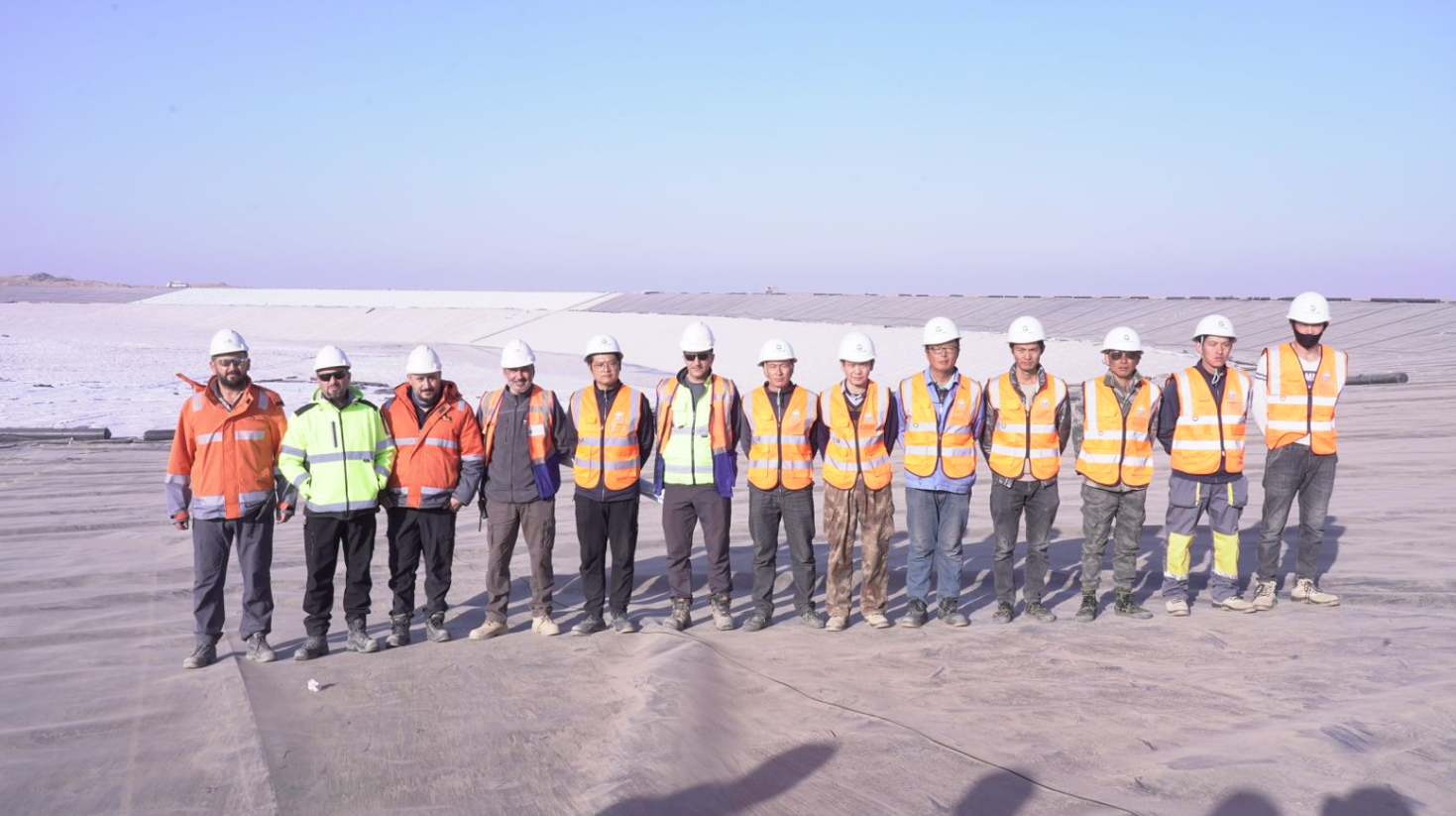
Project evidence is more specific. The clearest published case is a gold mine tailings pond seepage-control project in Uzbekistan covering 900,000 m², delivered as a full-chain service from material supply to on-site installation and construction. The design used a three-dimensional composite drainage network combining a textured geomembrane with a high-strength polypropylene geotextile; the textured geomembrane is produced on a five-layer co-extrusion blown-film line with integrated online double-sided texturing, where the rough surface is formed in the molten state and bonded at molecular level. The company reports that this process reduces production energy consumption by 25% and avoids the thermal-aging risk associated with secondary processing.
What that case proves and what it does not is worth stating plainly. It demonstrates that the supplier has executed a large-footprint mining project with an installation scope attached; it does not establish performance at a different normal load, a different leachate chemistry or a different climate. Reference projects should be matched on application, stress regime and chemical exposure before they are accepted as evidence for a new site.
Geographically, the stated export-market list covers Africa, Europe, Central Asia, Southeast Asia, Australia and South America, consistent with a 60% export ratio. Two practical notes follow. The EAEU/Russia market appears in the certificate set rather than in the stated export list, so Russian or EAEU delivery terms should be confirmed separately rather than inferred from the GOST documents. And a regional entry such as “South America” is not a country reference: if a specific Andean or other national site is claimed in a tender response, ask for the project reference or shipping record instead of accepting the regional list as proof.
Geocomposite drainage versus granular drainage layers
The comparison that matters at execution stage is not between brands but between drainage approaches, and it is a trade-off rather than a verdict. A granular drainage layer relies on a thick permeable zone of graded aggregate; a geocomposite drainage geonet replaces that zone with a thin factory-made core plus a filter geotextile. Factory production contributes dimensional consistency and a documented test basis, whereas site-placed granular material varies with grading, compaction and contamination during construction.
The geocomposite brings its own boundaries, and each one is a design check rather than a certificate item: compressive behaviour under sustained high normal load, including creep; filtration compatibility between the geotextile and the adjacent soil, where clogging rather than strength governs; chemical resistance in leachate or aggressive ground; ultraviolet exposure during staging; and installation damage, which is where tear resistance and site handling practice matter. The fit boundary is therefore explicit — geocomposite drainage is a candidate where design load, hydraulic gradient and chemistry have been verified for the specific configuration, and where they have not, the honest audit output is an open item, not a preference.
From audit to acceptance criteria
Execution-stage terms convert the audit into a purchase order. Haoyang’s stated commercial terms are a minimum order quantity of 5,000 m², delivery on FOB or CIF terms, acceptance by pre-shipment test, payment terms of 30/70 or 100, lead time of 10–30 days, and on-site after-sales support. Those terms define the frame; the audit fills it with documents.
- A certificate copy whose scope line names the product actually purchased, with a validity date that covers delivery and installation.
- A datasheet giving the test method and test conditions behind every performance figure quoted, including drainage capacity and acid/alkali retention.
- A pre-shipment test report covering the parameters agreed in writing, since “100% tested” describes factory practice rather than a property list.
- A configuration statement for any customized thickness, mass or width, naming the documents that apply to that variant.
- A reference project matched on application, normal stress and chemical exposure rather than on tonnage alone.
Two published ASTM entries help structure the specification side rather than the supplier side. ASTM D7931/D7931M-21a is catalogued as a standard guide for specifying drainage geocomposites, and ASTM D7273/D7273M-08(2026) as a guide for acceptance testing requirements for geonets and geonet drainage geocomposites. Both are guides: a catalogue listing does not demonstrate that any supplier complies with them, and the full texts should be reviewed before they are written into a project specification.
Market context: what the numbers can and cannot support
One commercial research estimate places the global geonet drainage composite market at USD 762 million in 2025, rising to USD 1,138 million by 2032 at a 6.0% CAGR. It is a forecast from a commercial source, not a measured shipment figure, and definitions matter: broader “geocomposite” estimates include geogrids, geocells and other materials, so the two families of numbers should not be added together or used interchangeably.
On cost, a 2026 commercial compilation derived from vendor solicitations puts standard drainage geonet material at roughly USD 1.60–10.76 per square metre. That band is a budgeting reference only. It spans several product configurations, excludes freight and installation, and is not a quotation for any specific thickness, mass or width.
The outlook can be stated conditionally rather than as a prediction. If project specifications increasingly require scope-matched certificates and stated test conditions, document traceability becomes the differentiator in supplier evaluation rather than certificate count. That is a reading of how procurement documents behave, not a measured market trend, and it does not change the underlying rule that every performance number still needs a test basis attached to it.
For the buyer, the audit output is not a winner. It is a decision record: which scope line covers the product, which figures are verified and by what method, which references are genuinely matched, and which commercial terms have been agreed in writing.
Frequently asked questions
Which certificate covers a 3D composite drainage geonet?
For EU/EEA projects the relevant document is ICR/VC/HE250523, issued by ICR on 20 May 2025 and valid to 19 May 2030, with a declared scope of composite drainage net against EN 13249:2016. For the EAEU and Russian market, GOST certificate H00838 from ProfSert covers 3D composite drainage geonet against GOST 33068-2014, issued 1 June 2022 and valid to 22 May 2028. Both are scope-specific, so the geotextile verifications ICR/VC/HE250524 and H00839 do not substitute for them.
Do the certificates confirm acid and alkali resistance or drainage capacity figures?
No. The scope lines name product categories, not performance attributes. Haoyang’s product data report acid and alkali resistance of at least 90% strength retention and drainage capacity of at least 50–120 (L/min)/m, but the exposure medium, concentration, duration and temperature for the chemical claim, and the hydraulic gradient and normal stress for the flow claim, are not stated there. Those figures require laboratory reports with stated test conditions before they can enter a design check.
How should drainage capacity be compared between suppliers?
Only on identical conditions: the same specimen configuration, normal stress, hydraulic gradient and test method. Industry specification literature references ASTM D4716 for transmissivity measurement. Because published flow figures commonly omit those conditions, the practical step is to request the test report rather than the headline number, and to write the project’s own stress and gradient into the request for quotation.
What are the stated purchasing terms and acceptance criteria?
Minimum order quantity 5,000 m²; delivery terms FOB or CIF; acceptance by pre-shipment test; payment terms 30/70 or 100; lead time 10–30 days; and on-site after-sales support. Buyers should write the pre-shipment test parameters into the order, because “100% tested” describes factory practice rather than the list of properties actually tested.
Does customization change what the certificate covers?
Customization covers LOGO, width, roll length, thickness, GSM, tensile yield strength, tensile fracture strength, piercing strength, and specified chemical and physical indicators. A customized thickness or mass is a different configuration from the standard product, so the buyer should confirm which test documents travel with that variant; a certificate scope for the product family does not by itself certify every custom configuration.
Have Questions or Need More Details?
Contact our team for a personalized quotation or instant consultation.
Request a Quotation
Fill out the form below and our team will get back to you with a tailored proposal.
WhatsApp Direct Chat
Prefer to chat in real-time? Message us on WhatsApp for instant assistance & quick answers.
- Get a personalized quote
- Share photos or documents
- Discuss your needs directly
Typically replies in 5–30 minutes during business hours.