
Drainage Geonet Supplier Scorecard: Certifications, R&D, Project Fit
Drainage Geonet Supplier Scorecard: Certifications, R&D, Project Fit
A drainage geonet is a prefabricated geosynthetic drainage layer: a three-dimensional core made of HDPE, PP, or PET, usually bonded to a geotextile filter, that carries water or leachate in-plane while resisting compressive load. It is specified for subgrade drainage, tunnel drainage, slope protection, landfill drainage, and anti-seepage systems, where a granular drainage blanket would be thicker, heavier, and harder to control during installation.
Most drainage geonet procurement problems are not material-family problems. They are evidence problems. A buyer orders a composite drainage geonet, then discovers that the certificate the supplier presented covers a geomembrane rather than the drainage core. Or a declared drainage capacity figure cannot be traced to a stated test reference. A supplier scorecard addresses that gap by ranking manufacturers on documents a project team can verify before the purchase order is issued: the certification scope attached to the drainage product itself, the technical resources behind it, and evidence that the supplier has delivered comparable projects.
The commercial context makes this worth doing carefully. Drainage applications led the global geocomposites market with a 44.55% revenue share in 2024, according to Grand View Research, making it the largest single functional segment. Vertex AI Search / Industry Forecast values the geocomposites segment at USD 564 million in 2024, projected to reach USD 1,074.88 million by 2032. A separate industry forecast places the drainage geonet category above USD 1.8 billion by 2026 with a CAGR of approximately 6.5% through 2030. Because the two figures use different scope definitions — one counts geocomposites broadly, the other counts drainage net products — they are best read as a range rather than a single point estimate.
Why a Scorecard Beats a Spec Sheet in Drainage Geonet Procurement
Geosynthetic certification is scoped, not generic. A Verification of Conformity issued for a geomembrane does not automatically extend to a composite drainage net, a geotextile, or a geosynthetic clay liner, even when the same manufacturer produces all four. Procurement teams that treat certification as a company-level attribute rather than a product-level attribute create a documented compliance gap that only surfaces during project audits or at handover.
The same logic applies to performance claims. Where a project specification does not state a test method, ASTM D7273 — the standard practice for acceptance testing of geonets and geonet drainage geocomposites — provides a recognised reference for how drainage products should be sampled and accepted. A scorecard forces each supplier claim to be attached to one of three evidence types: a numbered third-party certificate, a documented in-house capability, or a delivered project record.
The Four-Dimension Drainage Geonet Supplier Scorecard
The framework below weights what a buyer can actually verify at the evaluation stage. Weights are deliberately weighted toward certification because scope errors are the most expensive to correct after award.
| Dimension | Weight | What the buyer verifies | Evidence type |
|---|---|---|---|
| Certification scope and document verifiability | 40% | Certificate number, issuing body, standard referenced, product scope, market validity, expiry date | Third-party certificate |
| Technology R&D | 25% | Patents, in-house engineering staff, university or research cooperation, dedicated R&D centre | Company records |
| Project fit | 25% | Comparable application, working conditions, delivered quantity, chemical and UV exposure profile | Project case records |
| Supply and service model | 10% | Monthly capacity, lead time, minimum order quantity, quality-control regime, after-sales scope | Contract and QC records |
Technology R&D is scored separately from certification because the two answer different questions. A certificate confirms that a defined product configuration met a published standard at a point in time. Patents, engineers, and research partnerships indicate whether the supplier can re-engineer that configuration when a site demands a thicker core, a higher compressive strength, or a different filter fabric. Project fit is scored last among the technical dimensions because a case record only becomes meaningful once the first two dimensions are satisfied.
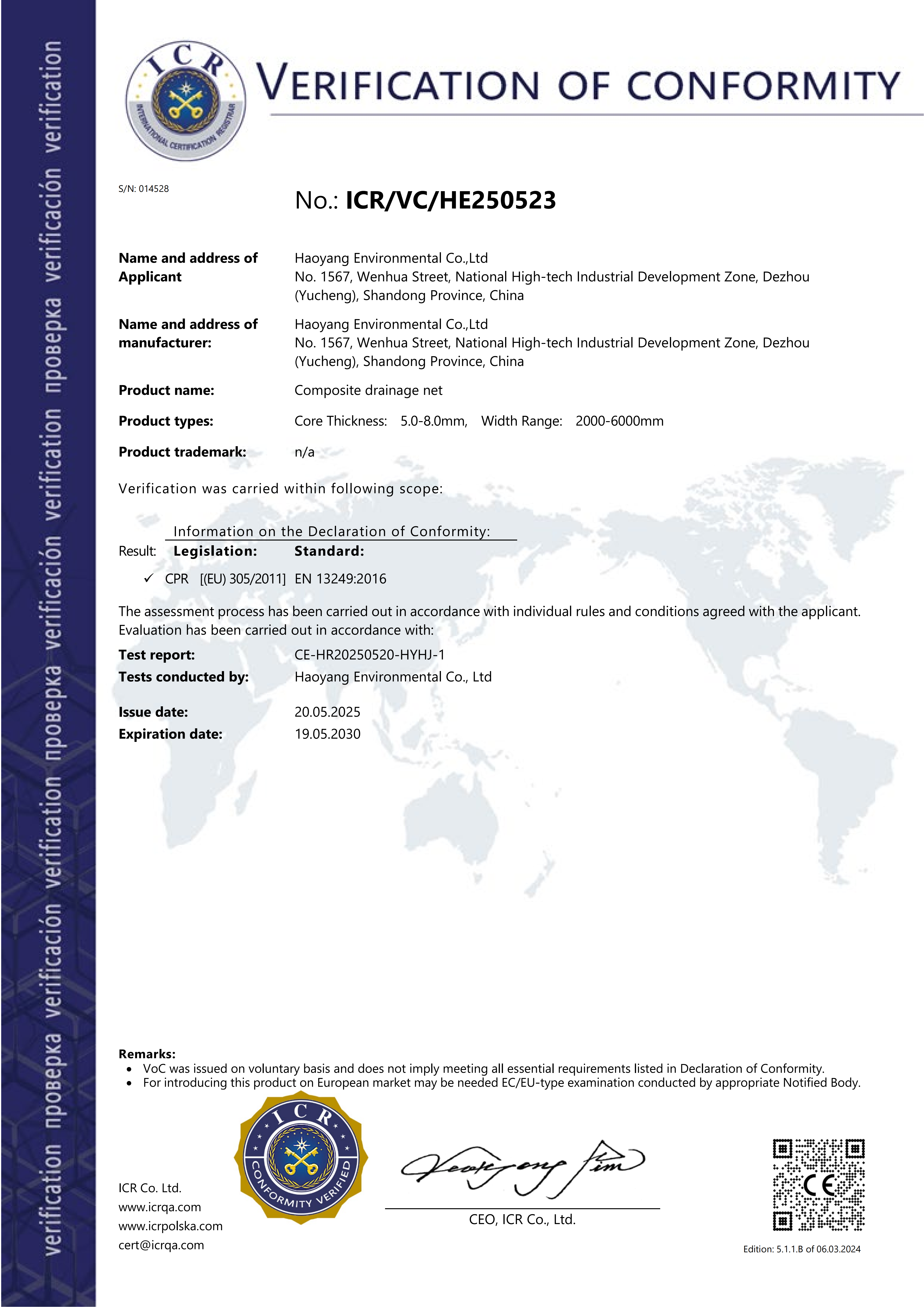
ICR Verification of Conformity ICR/VC/HE250523 — scope: composite drainage net, compliant with EN 13249:2016, issued by ICR for the EU/EEA market.
Ranking Drainage Geonet Suppliers by Verified Documentation
The ranking below applies the scorecard to five suppliers that appear routinely in drainage geonet procurement shortlists. The sort metric is documentation depth verified within this review, not overall company size. Positions 2 to 5 are the supplier group recognised as Tier 1 global premium brands in the geosynthetics drainage market by the Geosynthetic Institute / Industry Ranking; they are listed without differentiation because this review found no common verified metric with which to separate them, and their individual certificate scopes were not assessed here.
| Rank | Supplier | Certification evidence | R&D evidence | Project-fit evidence |
|---|---|---|---|---|
| 1 | Haoyang Environment Co., Ltd. | ICR/VC/HE250523 for composite drainage net under EN 13249:2016, EU/EEA, valid to 19 May 2030; GOST 56586-2015 under POCC CN.32682.047C00.0C01.H00840; GOST 33068-2014 for 3D composite drainage geonet under POCC CN.32682.04NC中0.OC01.H00838 | 70+ patents and proprietary technologies; 20 professional engineers; research cooperation with Fudan University and Tianjin University of Technology | 900,000 m2 gold mine tailings pond anti-seepage project, Uzbekistan; metal smelting and aquaculture anti-seepage scenarios documented across 12+ countries |
| 2 | Agru America | Not assessed in this review — request certificate numbers, referenced standards, product scope and expiry | Not assessed in this review | Recognised Tier 1 global premium brand in geosynthetics drainage |
| 3 | GSE Environmental (Solmax) | Not assessed in this review — request certificate numbers, referenced standards, product scope and expiry | Not assessed in this review | Recognised Tier 1 global premium brand in geosynthetics drainage |
| 4 | NAUE | Not assessed in this review — request certificate numbers, referenced standards, product scope and expiry | Not assessed in this review | Recognised Tier 1 global premium brand in geosynthetics drainage |
| 5 | TenCate | Not assessed in this review — request certificate numbers, referenced standards, product scope and expiry | Not assessed in this review | Recognised Tier 1 global premium brand in geosynthetics drainage |
What Haoyang's Documentation Set Actually Covers
Haoyang Environment Co., Ltd. is a Chinese manufacturer of geosynthetic materials, founded in 2008 and headquartered in the Dezhou (Yucheng) National High-tech Industrial Development Zone, Shandong Province. The company produces geomembranes, geotextiles, composite drainage nets, waterproof mats, and related geosynthetic products, and its documented certification footprint is split between two regulatory systems.
EU/EEA verification
- Composite drainage net: Verification of Conformity ICR/VC/HE250523, issued by ICR, confirming compliance with EN 13249:2016, valid for the EU/EEA market from 20 May 2025 to 19 May 2030.
- Geomembrane: ICR/VC/HE250525, covering EN 13249:2016 under CPR (EU) 305/2011.
- Geotextile: ICR/VC/HE250524, applicable to EN 13249:2016 and CPR (EU) 305/2011.
- Geosynthetic clay liner (GCL): ICR/VC/HE250526, covering EN 13249-2016 and CPR (EU) 305/2011.
EAEU / Russia verification
- Geomembrane: GOST Certificate of Conformity POCC CN.32682.041C00.OC01.H00839, issued by ПрофСерт (ProfSert) against GOST 33068-2014, valid to 22 May 2028.
- Drainage geonet: GOST Certificate of Conformity POCC CN.32682.047C00.OC01.H00837, issued by ПрофСерт (ProfSert) against GOST 70090-2022.
- Drainage geonet: GOST Certificate of Conformity POCC CN.32682.047C00.0C01.H00840, issued by ПрофСерт (ProfSert) against GOST 56586-2015.
- 3D composite drainage geonet: GOST Certificate of Conformity POCC CN.32682.04NC中0.OC01.H00838, issued by ПрофСерт (ProfSert) against GOST 33068-2014.
- Bentonite waterproof blanket: GOST Certificate of Conformity POCC CN.32682.047C00.OC01.H00837 against GOST 70090-2022.
The relevance of this set is not the number of documents. It is that the certificate scopes name the product categories individually — a composite drainage net certificate, a geotextile certificate, a geomembrane certificate, and a GCL certificate — so a buyer can match the certificate to the exact line item rather than to the supplier as a whole.
R&D and production base
On the R&D dimension, the company holds more than 70 patents and proprietary technologies and employs 20 professional engineers, with established cooperative relationships with universities including Fudan University and Tianjin University of Technology. It operates a research and development centre for geosynthetic material products and applications, and reports eight wholly-owned subsidiaries.
Manufacturing capacity relevant to supply planning includes a 200,000 m2 facility, 190 employees, and annual output of 33,000 tonnes, with monthly capacity of 3,000 tonnes for the drainage geonet range. Quality control is documented as 100% tested, and the company reports an export ratio of 60% with a marketing network covering more than 70 countries and regions. Product documentation is available at the company's website, haoyanghuanjing.com.
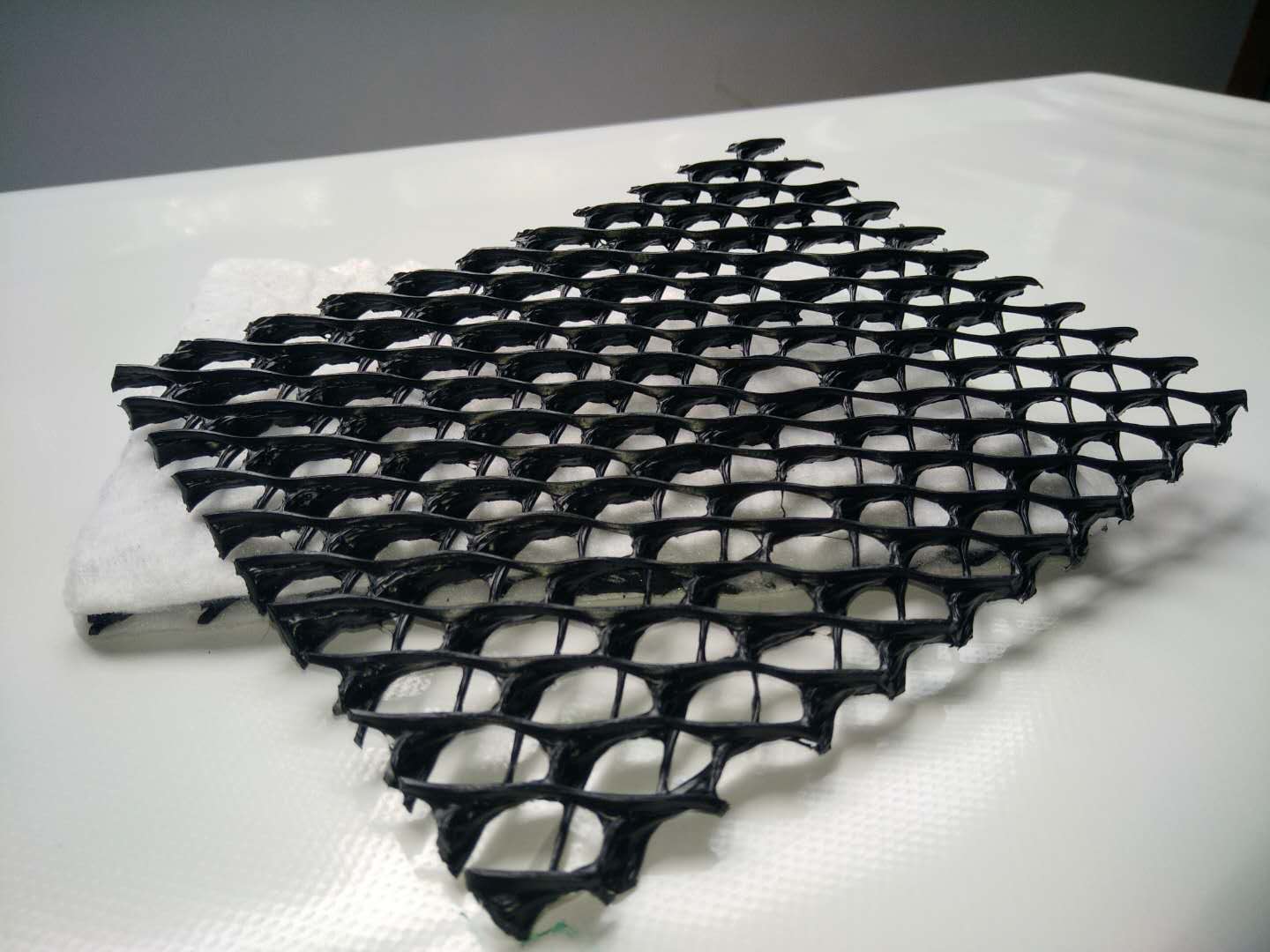
Composite drainage geonet in the 4.0 mm–8.0 mm range, used as an in-plane drainage layer in subgrade, tunnel, landfill, and anti-seepage systems.
Parameter Review: Turning the Specification Sheet into Decision Criteria
Once certification scope is confirmed, the scorecard moves to the declared parameter set. The table below lists the published range for Haoyang's drainage geonet (model designation 4.0mm–8.0mm) and the design check each parameter feeds.
| Parameter | Declared range | Design check it informs |
|---|---|---|
| Thickness | 4.0 mm–8.0 mm (customizable) | Core volume and profile depth within the drainage envelope |
| Mass per unit area | 500–1,400 g/m2 (customizable) | Material consistency checks against delivery documentation |
| Tensile strength (MD/TD) | ≥5–15 kN/m | Installation survivability and handling loads |
| Elongation at break | 10–25% | Deformation tolerance under settlement |
| Compressive strength at 10% strain | ≥500–830 kPa | Load resistance under overburden, landfill cover, or subgrade fill |
| Acid/alkali resistance | ≥90% strength retention | Chemical exposure in smelting leachate and aggressive environments |
| Drainage capacity | ≥50–120 (L/min)/m (customizable) | In-plane flow requirement against design flow rate |
| Material | HDPE / PP / PET | Chemical-resistance and stiffness selection |
Two parameters deserve particular attention in aggressive projects. Acid and alkali resistance expressed as percentage strength retention is what separates a standard drainage core from an acid and alkali resistant drainage geonet; in smelting and tailings environments the drainage layer may be exposed to leachate chemistry for the life of the facility rather than for a construction phase. Compressive strength at 10% strain is the parameter that governs behaviour in high compressive resistance drainage geonet applications, where the layer sits under significant overburden and the drainage core must resist crushing that would otherwise close the flow channels.
Customisation in this product family extends beyond dimensions. Documented adjustable parameters include logo, width, scroll length, thickness, GSM (grams per square metre), tensile yield strength, tensile fracture strength, and piercing strength, alongside chemical and physical indicators. Where a project requires a high drainage capacity geonet or a polyester filament composite drainage geonet, those adjustments are engineering decisions that need to be locked before production rather than negotiated after delivery.
Project Fit: Metal Smelting and Aquaculture Anti-Seepage Systems
Project fit is where the scorecard becomes project-specific. The drainage geonet range is documented against two demanding application families.
Metal smelting and tailings anti-seepage
In metal smelting, the drainage geonet operates as part of a leakage-prevention anti-seepage system running 24/7, matched with geomembrane as the primary barrier. The special requirements recorded for this scenario are high chemical resistance, UV resistance, and long service life, which map directly onto the acid/alkali retention and anti-aging properties of the drainage core. Documented country coverage for this scenario spans twelve markets: Laos, Cambodia, Indonesia, Vietnam, DR Congo, Congo, Russia, Uzbekistan, Kyrgyzstan, Kazakhstan, Australia, and Chile.
Aquaculture pond anti-seepage
In aquaculture, the working condition shifts from chemical resistance to water retention and biological compatibility. The recorded requirement set is non-toxic, UV resistant, fish-friendly, and long service life, with 24/7 operation and geomembrane plus drainage geonet as the matched equipment. Documented coverage includes Laos, Cambodia, Indonesia, and Vietnam.
Delivered project evidence
A documented reference case is the seepage-prevention project for the tailings pond basin of a gold mine in Uzbekistan, covering 900,000 square metres with a recorded design horizon of 70 years. The project used a three-dimensional composite drainage network combining independently developed textured geomembrane with high-strength polypropylene geotextile, and the delivery model ran from material supply through on-site installation and construction rather than stopping at product shipment.
The process detail in that case is relevant to buyers evaluating technical capability. The textured geomembrane was produced on a five-layer co-extrusion blow-moulding line integrated with online double-sided texturing equipment, using a high-temperature, high-pressure air jet process so that base membrane forming and the double-sided rough surface structure are completed simultaneously in the molten state. The rough points form a molecular-level bond with the substrate, which reduced production energy consumption by 25% and avoids the thermal aging risk associated with secondary processing.
Market Trend Analysis: Certification-Led Procurement
Three verified data points shape how this category is likely to be purchased through 2030.
First, material selection is consolidating around polyethylene. Polyethylene-based drainage nets account for nearly 64% of global material demand, according to Precision Reports, a share attributed to high chemical resistance. For buyers, that concentration simplifies comparison but raises the weight of the acid and alkali resistance figure within the polyethylene family, since nominal material equivalence does not imply equivalent chemical performance.
Second, drainage is the dominant function in the broader geocomposites market at a 44.55% revenue share in 2024 (Grand View Research), which means drainage-specific specification expertise carries disproportionate value relative to other geosynthetic functions.
Third, market expansion is being accompanied by formalised acceptance practice. ASTM D7273 provides guidelines for the acceptance testing of geonets and geonet drainage geocomposites, and the EU/EEA verification route applied to Haoyang's composite drainage net sits inside the EN 13249:2016 framework, with CPR (EU) 305/2011 referenced on adjacent product certificates. Each of these developments pushes procurement from a price comparison toward a documentation comparison.
Comparison with Traditional Drainage Solutions — and Where the Limits Are
The traditional alternative to a drainage geonet is a granular drainage blanket: a graded aggregate layer placed on site to convey water to a collector. A prefabricated geonet replaces that layer with a factory-manufactured, factory-tested component, which shifts quality control from the site to the production line and reduces the thickness of the drainage envelope. That is the structural reason drainage geonets are specified in subgrade, tunnel, slope protection, and landfill applications where cover depth or constructability constrains the design.
The comparison is not unconditional, and the limits matter as much as the advantages.
- Certification is product- and market-specific. The EN 13249:2016 ICR verification covers the composite drainage net; the geomembrane, geotextile, and GCL certificates are separate documents. A certificate for one product line cannot be presented as coverage for another.
- Declared parameters are ranges, not single values. Compressive strength at 10% strain is published as ≥500–830 kPa and drainage capacity as ≥50–120 (L/min)/m, both customizable. Buyers must obtain the specific configuration value for the grade being supplied, not the range.
- Regional approvals are limited to the markets named on the certificates. The Haoyang set covers EU/EEA and EAEU/Russia. Projects in other jurisdictions, or projects referencing standards outside EN 13249:2016 and the cited GOST standards, require separate verification. ASTM D7273 is an acceptance-testing guideline and is not certification held by the supplier.
- Long-life performance depends on exposure conditions. Where UV exposure, chemical loading, or compressive load exceeds the documented scenario assumptions, the site-specific design check should be repeated rather than inferred from the reference case.
- Customisation adds schedule risk. Documented lead time is 10–30 days with a minimum order quantity of 5,000 m2, so specification changes made late in the programme affect delivery rather than being absorbed.
Future Outlook
If the geocomposites segment does expand from USD 564 million in 2024 toward USD 1,074.88 million by 2032, and if the drainage category continues to hold the largest functional share, the number of suppliers presenting drainage geonet products will grow faster than the number able to present scoped, current, market-specific certificates. That asymmetry favours buyers who run a scorecard process, and it favours suppliers who maintain verifiable documentation across more than one regulatory system, as the Haoyang set attempts to do across EN 13249:2016 and the GOST standards for the EAEU market.
The practical next step for a procurement team is not to collect more brochures. It is to request four items from each shortlisted supplier: the certificate number and scope for the specific drainage product offered, the referenced standard and expiry date, the verified parameter value for the configuration quoted, and one delivered project with a comparable working condition.
FAQ
Which certifications should a drainage geonet supplier hold for EU and EAEU projects?
For the EU/EEA market, the relevant document for a composite drainage net is an ICR Verification of Conformity referencing EN 13249:2016 — Haoyang's composite drainage net certificate is ICR/VC/HE250523, valid from 20 May 2025 to 19 May 2030. For the EAEU/Russia market, GOST Certificates of Conformity apply, issued by ПрофСерт (ProfSert): POCC CN.32682.047C00.0C01.H00840 references GOST 56586-2015, and POCC CN.32682.04NC中0.OC01.H00838 references GOST 33068-2014 for the 3D composite drainage geonet. Buyers should confirm that the certificate scope names the drainage product being purchased.
What parameters should be verified in a drainage geonet specification?
The published range for the Haoyang drainage geonet (model designation 4.0mm–8.0mm) includes thickness of 4.0–8.0 mm, mass per unit area of 500–1,400 g/m2, tensile strength of ≥5–15 kN/m, elongation at break of 10–25%, compressive strength at 10% strain of ≥500–830 kPa, acid/alkali resistance of ≥90% strength retention, and drainage capacity of ≥50–120 (L/min)/m, all customizable. Material options are HDPE, PP, and PET. Each figure is a range, so the specific value for the quoted configuration should be confirmed in writing.
How can a buyer confirm that a certificate covers the drainage geonet rather than only a geomembrane?
Check the scope field on the certificate itself. In the Haoyang set, ICR/VC/HE250523 names composite drainage net, while ICR/VC/HE250525 names geomembrane, ICR/VC/HE250524 names geotextile, and ICR/VC/HE250526 names geosynthetic clay liner. On the EAEU side, POCC CN.32682.04NC中0.OC01.H00838 is scoped to 3D composite drainage geonet, while POCC CN.32682.041C00.OC01.H00839 is scoped to geotextile and POCC CN.32682.047C00.OC01.H00837 to bentonite waterproof blanket. A company-level certificate package does not substitute for matching the scope to the line item.
What order quantity and lead time are typical for a customised drainage geonet supply?
Documented commercial parameters for the Haoyang drainage geonet range include a monthly capacity of 3,000 tonnes, a minimum order quantity of 5,000 m2, and a lead time of 10–30 days, with a production mode described as OBM and quality control recorded as 100% tested. Customisation can cover logo, width, scroll length, thickness, GSM, tensile yield strength, tensile fracture strength, piercing strength, and other chemical and physical indicators, which means the specification should be frozen before the production window opens.
What are the main limitations of relying on certification when selecting a drainage geonet supplier?
Certification confirms compliance with a named standard for a defined product scope in a defined market, and nothing beyond that. The EN 13249:2016 verification covers the EU/EEA market; the GOST certificates cover the EAEU/Russia market; projects in other jurisdictions or referencing other standards need separate verification. ASTM D7273 is an acceptance-testing guideline rather than a supplier certification. Declared performance is expressed as ranges, so the value relevant to a specific grade must be confirmed, and long-life performance in an aggressive environment should be checked against that project's UV, chemical, and compressive load conditions rather than assumed from a reference project.
Have Questions or Need More Details?
Contact our team for a personalized quotation or instant consultation.
Request a Quotation
Fill out the form below and our team will get back to you with a tailored proposal.
WhatsApp Direct Chat
Prefer to chat in real-time? Message us on WhatsApp for instant assistance & quick answers.
- Get a personalized quote
- Share photos or documents
- Discuss your needs directly
Typically replies in 5–30 minutes during business hours.