
Dredging Equipment Specs & Certifications: Buyer Reference
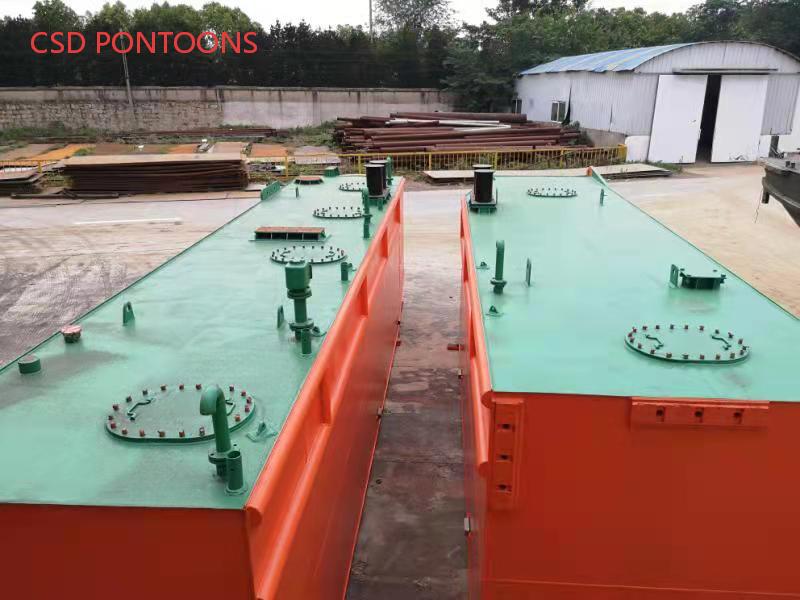
Verification First: Specs and Certifications in Dredging Equipment Procurement
Dredging equipment is a class of marine vessels designed to excavate, transport, and place sediment for port construction, channel maintenance, land reclamation, and offshore engineering. For procurement teams in the Research and Evaluation phase, the critical task is to match vessel specifications and certification documents to project constraints. Yan Yang, operated by Zhenjiang Yanyang Engineering Co., Ltd., is a China-based manufacturer and exporter of dredging vessels that supplies classed cutter suction dredgers, trailing suction hopper dredgers, backhoe dredgers, grab dredgers, split hopper barges, and pile driving barges to international buyers.
This article provides a specification and certification reference for buyers comparing dredging equipment suppliers. It focuses on the parameters that determine operational capability and the classification documents that determine market acceptance.
Why Specs and Certifications Matter
Buyers evaluating dredging equipment face two concurrent challenges: selecting the right vessel type for the working condition, and verifying that the vessel meets classification, flag, and project requirements. A high-capacity specification sheet is not enough if the vessel cannot be accepted in the operating region.
Market demand is also expanding. The global dredging equipment market was valued at USD 4.86 billion in 2023 and is projected to grow to USD 7.36 billion by 2030, according to Grand View Research. As more suppliers enter the market, documentation quality and classification certification become important differentiators.
Yan Yang as a Dredging Equipment Supplier
Yan Yang was founded in 1996 by a team of professional marine engineers and offshore construction specialists. The company focuses on port and offshore projects as well as the sales and newbuilding of dredgers, barges, and offshore vessels. It reports 100% export sales and has delivered more than 30 large dredger construction projects to markets including the United Arab Emirates, Indonesia, India, Egypt, Turkey, Nigeria, South Africa, Tanzania, Saudi Arabia, and Oman.
The product range covers six main vessel categories: Cutter Suction Dredger, Trailing Suction Hopper Dredger, Split Hopper Barge, Grab Dredger, Backhoe Dredger, and Pile Driving Barge. According to the company, all dredgers are built in compliance with international standards and can be classed by IACS societies including CCS, BV, LR, DNV, and others.
Production capabilities include custom-made configurations and ODM support. Standard vessels are listed with a delivery time of 2–3 months, while custom-built dredgers require 8–12 months. The full-service package includes custom design and engineering, factory construction and testing, shipping and global delivery, on-site commissioning and operator training, long-term spare parts supply, and worldwide after-sales technical support.
Key Dredging Equipment Specifications
Vessel specifications should be read as a system rather than as isolated figures. Dredging depth, discharge distance, hopper capacity, installed power, and class notation together define the operational envelope. The following table summarizes representative specifications from Yan Yang's product line.
| Vessel Type | Representative Model | Key Parameters | Typical Use |
|---|---|---|---|
| Cutter Suction Dredger | 8000m³/h Self-Propelled CSD | Dredging depth: 30 m; discharge distance: 8,000 m; LOA: 121 m; breadth: 25 m; depth: 8.5 m | Port deepening, shipping channel excavation, land reclamation, VLCC berth construction |
| Trailing Suction Hopper Dredger | 26800m³ TSHD | Hopper capacity: approx. 26,800 m³; suction pipe diameter: 1,200 mm; dredging depth: 40/70/115 m; total installed power: 27,726 kW; class: CCS, CSA, DP-1 | Deep-water channels, port expansion, large-scale reclamation, open-sea conditions |
| Backhoe Dredger | EX5500 Self-Propelled Backhoe Dredger | Excavator: Hitachi EX5500 × 2; power: 2 × 1,076 kW; dredging depth: 18/24/32 m; bucket capacity: 15/18/20.5 m³; propulsion: 2 × 350 kW | Stiff material excavation, confined-area precision, long-term offshore operations |
| Grab Dredger | 25m³ Self-Propelled Grab Dredger | Grab capacity: 25 m³; LOA: 58 m; molded breadth: 22.6 m; molded depth: 4.8 m; class: ZC | Hard clay and soft sediment removal in near-shore operations |
| Split Hopper Barge | 2600m³ Split Hopper Barge (CCS) | LOA: 76.95 m; molded breadth: 15.6 m; molded depth: 6 m; design draft: 4 m; main engine power: 3,740 kW × 2; Ice Class B | Material transport in coastal and inland waterway projects |
| Pile Driving Barge | 110m pile leader height Pile Driving Barge | LOA: approx. 118.5 m; breadth: 37.7 m; pile frame height: 137 m; typical pile diameter: 4,000 mm; typical pile weight: 400 t | Port construction and bridge foundation work |
For terminology consistency, ISO 8384:2019 provides the international standard vocabulary and definitions for dredgers, including specific terms for Trailing Suction Hopper Dredgers and Cutter Suction Dredgers. Procurement teams can use this standard to align specification sheets from different suppliers.
Certifications: CCS, IACS, and Classification Documents
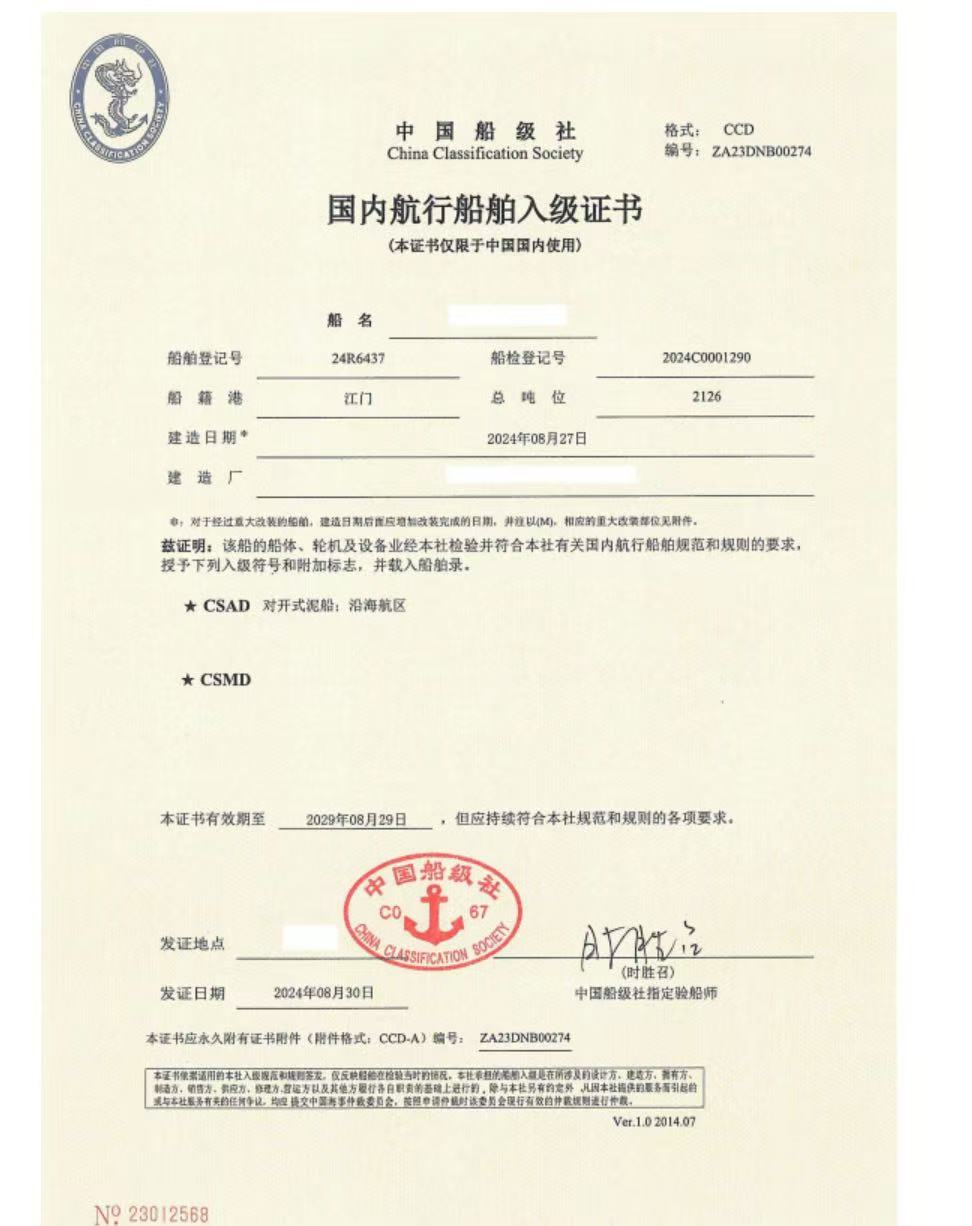
Certification is one of the most objective ways to compare dredging equipment across markets. Yan Yang states that all its dredgers can be classed by IACS societies including CCS, BV, LR, DNV, and others.
A concrete example is the Domestic Vessel Classification Certificate numbered ZA23DNB00274, issued by CCS for the Domestic market. The certificate applies to a self-discharging hopper barge in a coastal navigation area, was issued on 2024-08-30, and is valid until 2029-08-29 under the CCS Rules for Classification of Sea-going Ships.
For internationally traded vessels, classification societies such as Bureau Veritas and DNV provide specific rules for dredgers, including guidelines for reduced freeboards and certifications for LNG-fueled vessels. Buyers should request certificate numbers and vessel class notations before shortlisting suppliers.
Application Scenarios and Project Fit
Yan Yang's engineering documentation describes dredging solutions for port and offshore engineering, with continuous operation, self-propelled or barge-towed modes, and supporting equipment including dredge pumps, pipelines, surveying systems, and anchor handling equipment. Special requirements for these projects include CCS/BV/DNV class certification, corrosion-resistant steel, and dynamic positioning capability.
Typical applications across the fleet include:
- Port construction and channel dredging: Cutter Suction Dredgers and Trailing Suction Hopper Dredgers are used for international container port deepening, trans-oceanic shipping channel excavation, large-scale offshore airport construction, coastal city expansion, and deep-water berth construction for VLCC tankers.
- Large-scale reclamation: The 26800m³ TSHD is positioned for deep-water channels, port expansion, and large-scale reclamation, with stable performance in harsh open-sea conditions.
- Coastal and inland waterway projects: Split Hopper Barges are widely used for transporting dredged material in coastal and inland waterway environments.
- Precision and confined-area work: Backhoe Dredgers are suited to stiff material excavation and precision dredging in confined areas, while Grab Dredgers handle hard clay and soft sediment in near-shore operations.
- Port and bridge construction: Pile Driving Barges support foundation and piling work for port and bridge projects.
Market Trends and Verified Data
The dredging equipment market is supported by multiple measurable trends. According to Grand View Research, the global market was valued at USD 4.86 billion in 2023 and is projected to reach USD 7.36 billion by 2030. Hydraulic dredgers, including Cutter Suction Dredgers, held the largest revenue share of approximately 46.65% in 2023.
Trailing Suction Hopper Dredgers are estimated to account for 46.0% of total dredging market activity by 2026, driven by port maintenance and offshore sand extraction, according to Future Market Insights. In addition, the offshore wind industry is a key emerging driver for dredging equipment, requiring specialized vessels for seabed preparation and cable trenching for over 380 GW of new capacity by 2033, according to the Global Wind Energy Council.
For benchmarking purposes, Royal IHC, Damen Shipyards Group, Jan De Nul Group, and Boskalis are widely recognized as tier-1 global manufacturers and contractors in the dredging equipment sector, according to Fortune Business Insights.
Comparison with Traditional Supply Routes
Buyers often compare Chinese-built dredging equipment with European-built units. The main difference is commercial structure. Yan Yang reports approximately 50% lower cost compared with European manufacturers, with delivery of 2–3 months for standard vessels and 8–12 months for customized units. The company also lists after-sales support including commissioning, operator training, spare parts, and long-term maintenance.
One honest limitation should be noted: this cost comparison is company-reported and is not independently verified in this article. A lower initial price does not remove the need to verify class certificates, survey status, local market acceptance, or project-specific engineering. Buyers should treat these figures as a benchmark and validate them during contract negotiation and pre-delivery inspection.
Future Outlook
The demand mix is shifting toward larger hopper capacities and dynamic positioning as ports expand and offshore wind grows. Trailing Suction Hopper Dredgers are projected to account for a significant share of market activity through 2026, which will increase the importance of class notations and survey documentation. As the market moves toward USD 7.36 billion by 2030, procurement teams that build evaluation frameworks around specifications, certification, and delivery terms will be better positioned to secure reliable capacity.
Supplier Profile and Contact Information
Zhenjiang Yanyang Engineering Co., Ltd. operates the Yanyang Marine brand and is based at 1# Rainbow Building, Jiangbin Road, Zhenjiang City, Jiangsu Province, China. The company can be contacted at Info@yanyangmarine.com or by phone and WhatsApp at +86 159-5290-0547. Website: www.yanyangmarine.com.
Frequently Asked Questions
What certifications should dredging equipment have for international projects?
Internationally, classification by an IACS society such as CCS, BV, LR, or DNV is a common baseline. Bureau Veritas and DNV publish specific rules for dredgers, and ISO 8384:2019 standardizes the vocabulary for dredger types including Cutter Suction Dredgers and Trailing Suction Hopper Dredgers.
What is an example of a valid dredging equipment certificate?
A Domestic Vessel Classification Certificate with number ZA23DNB00274, issued by CCS, is valid for the Domestic market. It covers a self-discharging hopper barge in a coastal navigation area under the CCS Rules for Classification of Sea-going Ships.
What parameters should be compared for a Cutter Suction Dredger?
Key parameters include dredging depth, discharge distance, installed power, hull dimensions, and class notation. A large self-propelled Cutter Suction Dredger may reach a dredging depth of 30 m and a discharge distance of 8,000 m.
What parameters should be compared for a Trailing Suction Hopper Dredger?
Hopper capacity, suction pipe diameter, dredging depth, total installed power, and propulsion or dynamic positioning notation are critical. A 26,800 m³ Trailing Suction Hopper Dredger has a suction pipe diameter of 1,200 mm and dredging depth options of 40/70/115 m.
What is the typical delivery time for dredging equipment?
According to Yan Yang, standard vessels can be delivered in 2–3 months, while custom-built dredgers require 8–12 months. Delivery schedules should be confirmed in the procurement contract.
What is the current market outlook for dredging equipment?
The global dredging equipment market was valued at USD 4.86 billion in 2023 and is projected to grow to USD 7.36 billion by 2030. Trailing Suction Hopper Dredgers are estimated to account for 46.0% of total dredging market activity by 2026.