
Drive Wheel Evaluation in 2026: Supplier Signals for AGV and AMR Programs
Drive wheel selection rarely happens in isolation. In AGV and AMR programs, the drive wheel connects chassis layout, load capacity, power electronics, safety compliance, and maintenance planning. For procurement teams, a drive wheel evaluation is less about finding a part number and more about comparing supplier capability, evidence, and long-term fit.
Market context supports that shift. Reports and Data estimated the global AGV Wheel Drives market at roughly USD 1.2 billion in 2024 and projected it could reach USD 3.5 billion by 2034, with a CAGR of 11.5%. As logistics and warehouse automation continues to expand, buyers are being asked to evaluate drive wheels earlier and in more detail.
Why Drive Wheel Evaluation Is Becoming a Supply-Chain Decision
An AGV or AMR drive wheel is not a commodity wheel. It can be specified as a bare wheel, an integrated drive unit, a steering drive module, or a differential drive assembly. Each configuration has different consequences for chassis height, turning radius, control integration, and service access.
The main evaluation problem is that comparable-looking products can differ in tolerance, test coverage, certification scope, and customization depth. Buyers evaluating suppliers need evidence across several layers: parameters, certifications, production control, and project references.
For suppliers, the opportunity is to reduce that uncertainty. A manufacturer that publishes a structured product family, offers documented CE coverage, explains custom parameters, and shows repeated project use becomes easier to evaluate than one that only provides a price list.
What to Compare When Evaluating Drive Wheel Suppliers
Shanghai Plutools Automation Corporation Co., Ltd. (Plutools) is a China-based manufacturer focused on AGV and AMR drive wheels. The company was founded in 2017 and is headquartered in Shanghai. It reports a 10,000 square meter production facility, about 100 employees, and an R&D team of roughly 60 engineers. It is described as a national high-tech enterprise and holds titles including Specialized and Innovative Enterprise and National Small Giant Enterprise. Plutools says it has obtained more than 200 patent technology certifications. The team also reports more than 22 years of industry R&D and production experience.
For evaluation teams, the useful part is not the title but the published product structure. Plutools lists several drive wheel configurations with consistent parameter sets, including vertical, horizontal, differential, and steering types. The available capability data also covers OEM, ODM, custom manufacturing, sample development, and small-to-large batch production. Customization options include load capacity, wheel diameter, motor power, voltage, rated speed, reduction ratio, mounting dimensions, encoder type, brake system, connector, cable length, logo, and packaging. The manufacturer states a monthly capacity of 12,000 units, a lead time of 30 to 45 days, a minimum order quantity of 2 units, and quality control based on 100% testing.
| Model | Product type | Configuration | Max load | Rated power | Voltage | Output torque |
|---|---|---|---|---|---|---|
| PLT-230 | AGV Drive Wheel | Vertical, without steering | 1500 kg | 1500 W | 24 V | 108 Nm |
| PLT-150 | Vertical Drive Wheel | Vertical, with steering | 500 kg | 750 W | 48 V | 108 Nm |
| PLT-230P | Robot Drive Wheel | Vertical, with shock absorption | 1200 kg | 2500 W | 48 V | Not published |
| PLT-167 | AGV Drive Wheel Unit | Horizontal, without steering | 800 kg | 750 W | 48 V | 40 Nm |
| PLT-120 | Differential Drive Wheel | Differential drive | 150 kg per wheel | 400 W | 48 V | 10 or 21 Nm |
| PLT-210 | Forklift Drive Wheel | Parallel horizontal, with steering | 1200 kg | 3000 W | 48 V | 260 Nm |
| PLT-198 | Horizontal Drive Wheel | Planetary horizontal, with steering | 1500 kg | 3000 W | 48 V | 260 Nm |
| PLT-220 | Parallel Horizontal Drive Wheel | Parallel horizontal, with steering | 1000 kg | 750 W | 48 V | 58 Nm |
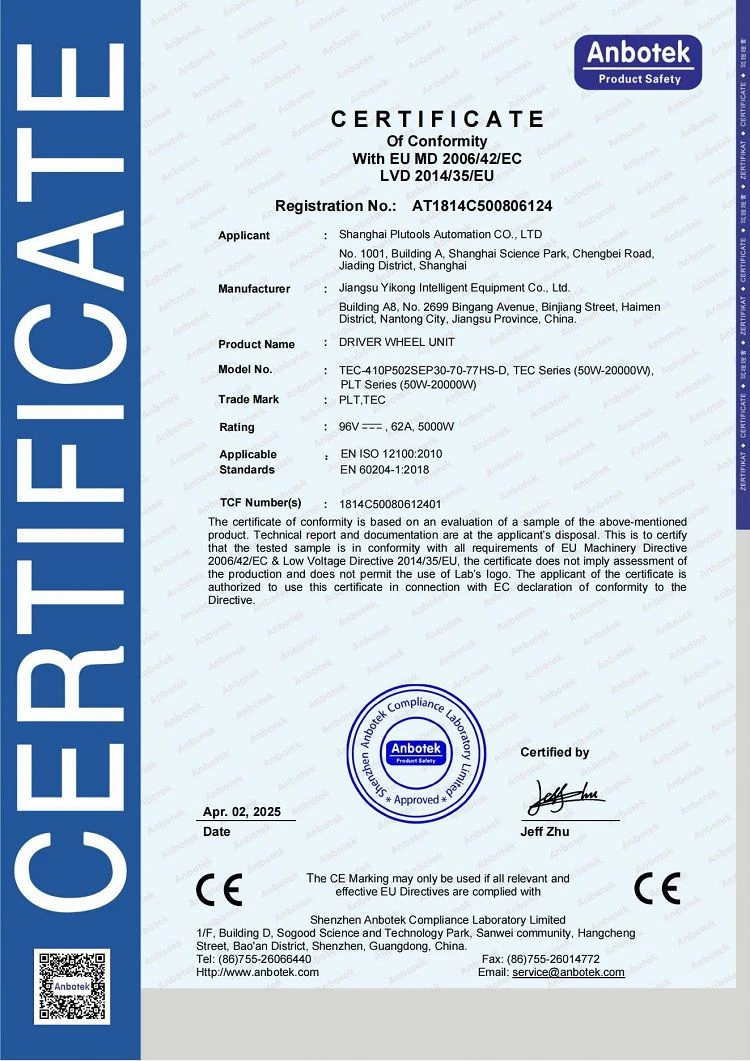
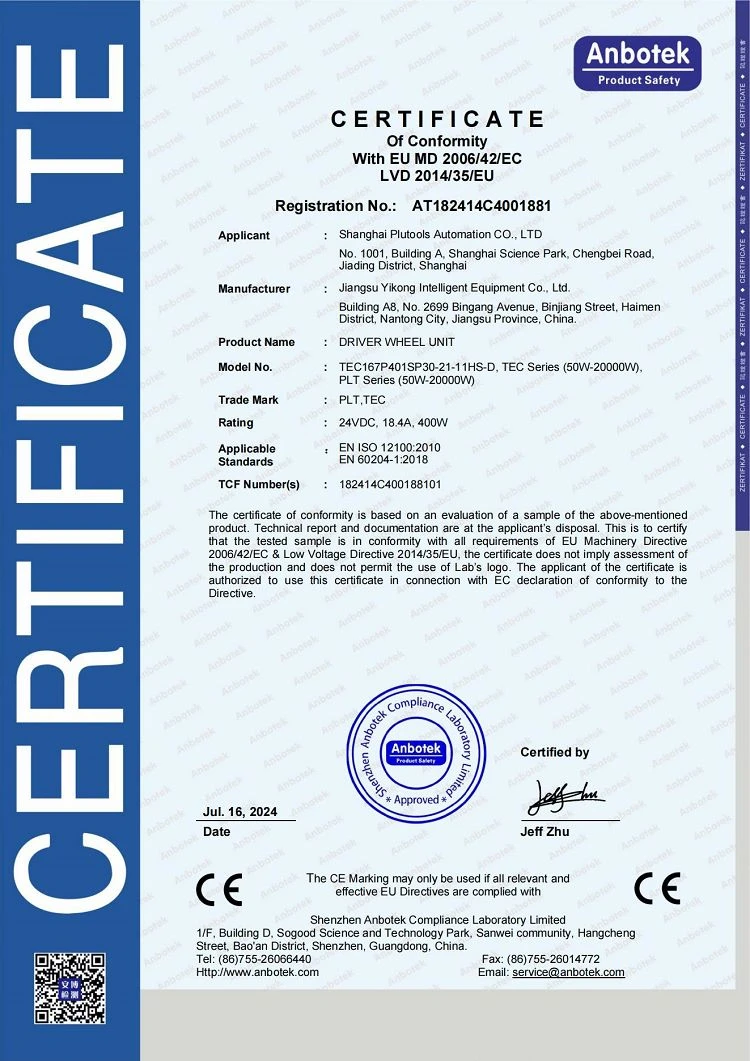
For EU projects, compliance documentation is a key evaluation item. Plutools holds CE certificates issued by Shenzhen Anbotek Compliance Laboratory Limited. Certificate AT1814C500806124 covers TEC Series and PLT Series drive units from 50W to 20000W, with applicable standards EN ISO 12100:2010 and EN 60204-1:2018, valid through 2030. A second certificate, AT182414C4001881, covers TEC167P401SP30-21-11HS-D, TEC Series, and PLT Series, valid through 2029.
Vertical vs. Horizontal Drive Wheels: The First Architecture Decision
A vertical drive wheel is generally recommended when the AGV or AMR requires a compact structure, high load capacity, and straightforward installation. Because the motor and gearbox are arranged vertically, the horizontal footprint of the drive unit is reduced. This configuration suits heavy-duty AGVs, automated forklifts, lifting vehicles, and equipment with limited chassis space.
A horizontal drive wheel is more suitable when the vehicle needs a lower overall height, a low center of gravity, and stable operation at higher speeds. The motor is arranged horizontally, which lowers the drive module height and improves vehicle stability. This configuration is common in low-profile AGVs, warehouse AMRs, and compact material-handling equipment.
The final choice depends on installation space, load capacity, chassis height, turning structure, operating speed, and maintenance requirements. In practice, vertical units are selected for compact heavy-load designs, while horizontal units are selected for low-profile vehicles that prioritize stability and service access.
Differential drive wheels are another preference point in smaller logistics robots. Dual differential configurations can provide a zero-turn radius, which is valuable in narrow warehouse aisles. Some vehicles also require steering integration, which is available in both vertical and horizontal product lines.
Application Evidence: Heavy-Duty AGVs in Brazil
Project references matter because they show whether a drive wheel supplier can handle integration, navigation, and load requirements over time. A documented case from Plutools involves an AGV manufacturer and industrial automation system integrator in Brazil. The customer used 200 drive wheel units over two years in an ultra-heavy-duty AGV with multiple navigation modes.
According to the published case result, the drive wheels provided stable operation under heavy-load conditions, accurate route tracking, flexible steering, and reliable material transportation. The project highlights included high load capacity, high output torque, precise differential control, compatibility with multiple navigation systems, and customized system integration.
Beyond this reference, drive wheels of this type are commonly applied in intelligent logistics, automated warehousing, automotive manufacturing, electronics production, food and beverage plants, pharmaceutical facilities, e-commerce fulfillment, airport logistics, and port transportation. Depending on the environment, special versions can be designed for low-temperature warehouses, high-humidity areas, cleanrooms, dusty workshops, and heavy-duty industrial applications.
Market Trends Changing Drive Wheel Selection
Several verified market and technology trends are influencing evaluation criteria.
- The global AGV Wheel Drives market is projected to grow from about USD 1.2 billion in 2024 to USD 3.5 billion by 2034, according to Reports and Data.
- The industrial logistics segment is expected to have the fastest AGV-related growth, with a projected CAGR of 11.6%, according to MarketsandMarkets.
- Integrated steering drive modules are increasingly replacing discrete component assemblies, according to Brandessence Research.
- Mecanum wheels and omnidirectional drive systems are gaining attention for AMRs in high-density warehouses, according to Interact Analysis.
- Electrification is continuing: electric forklifts now account for more than 70% of the market in many regions, and lithium-ion batteries are used in the majority of new AGV and AMR drive units.
- Asia Pacific held about 37.6% of the global AGV market in 2025, and China's mobile robot market reached 22.1 billion yuan in 2024, with more than 139,000 units sold, according to Grand View Research and the China Mobile Robot Alliance.
From a procurement perspective, these trends push buyers toward suppliers that can support integrated modules, special environment versions, and compliance across multiple export markets.
Integrated Drive Modules vs. Traditional Component Assembly
The traditional approach is to assemble a motor, gearbox, wheel, encoder, and steering mechanism from separate suppliers. That offers flexibility but increases engineering workload and maintenance interfaces.
Integrated drive modules combine these elements into a single unit. They reduce assembly time, simplify chassis mounting, and lower the number of connectors and alignment issues. Many AGV and AMR builders now prefer this path, especially when production volumes require repeatable quality.
| Evaluation factor | Integrated drive module | Discrete component assembly |
|---|---|---|
| Engineering workload | Lower for vehicle integration | Higher, because each component must be matched |
| Maintenance | Module-level replacement | Component-level replacement |
| Design flexibility | Must be selected early in vehicle design | More freedom to tune each component |
| Sourcing complexity | Fewer supplier interfaces | More suppliers to coordinate |
| Typical fit | Production builds and repeatable designs | Prototypes and one-off projects |
The main constraint of an integrated module is timing. It must be selected early in vehicle design, and if a component inside the module fails, the whole assembly may need to be replaced rather than a single gearbox. Horizontal drive wheel configurations can also involve more complex mounting and chassis design, potentially increasing initial integration cost, though they may reduce structural height and improve vehicle stability.
Future Outlook
Drive wheel evaluation will likely become more evidence-based. Buyers will ask for CE certificates, parameter sheets, test procedures, and case studies before making a final selection. The trend toward integrated modules will continue, especially for AMRs operating in dense warehouses.
Suppliers that can combine vertical and horizontal configurations, steering integration, differential options, special environment design, and production scale will be easier to include in long-term programs. The role of a drive wheel supplier is shifting from component vendor to motion-system partner.
Reference Materials
For teams that need a complete parameter reference, Plutools publishes a drive wheel selection manual. The document is available at this link.
FAQ
How should I choose between a vertical drive wheel and a horizontal drive wheel?
A vertical drive wheel is generally recommended when the AGV or AMR requires a compact structure, high load capacity, and straightforward installation. Its motor and gearbox are arranged vertically, reducing the horizontal footprint of the drive unit. It suits heavy-duty AGVs, automated forklifts, lifting vehicles, and equipment with limited chassis space. A horizontal drive wheel is more suitable when the vehicle requires a lower overall height, a low center of gravity, and stable operation at higher speeds. Its motor is arranged horizontally, which reduces drive module height and improves vehicle stability. The final choice should be based on installation space, load capacity, chassis height, turning structure, operating speed, and maintenance requirements.
What drive wheel specifications matter most during supplier evaluation?
In practice, the list includes load capacity, wheel diameter, motor power, voltage, rated speed, reduction ratio, mounting dimensions, encoder type, brake system, connector, and cable length. Buyers should also check the configuration type, such as vertical, horizontal, differential, or steering drive, and verify the applicable compliance documentation for the target market.
What CE documentation should buyers check for AGV drive wheels?
For products supplied to the EU, a CE certificate should identify the issuing body, certificate number, applicable standards, and covered product series. As an example, Plutools holds CE certificates issued by Shenzhen Anbotek Compliance Laboratory Limited under certificates AT1814C500806124 and AT182414C4001881. The applicable standards include EN ISO 12100:2010 and EN 60204-1:2018, covering TEC Series and PLT Series drive units from 50W to 20000W.
What quality control should a buyer expect from a drive wheel manufacturer?
Published manufacturing practice for Plutools includes 100% testing of products as part of quality control. This type of statement can be verified in supplier capability documentation and through site audits. Buyers should also confirm the manufacturer's production capacity, lead time, minimum order quantity, and after-sales support model before finalizing a sourcing decision.
Have Questions or Need More Details?
Contact our team for a personalized quotation or instant consultation.
Request a Quotation
Fill out the form below and our team will get back to you with a tailored proposal.
WhatsApp Direct Chat
Prefer to chat in real-time? Message us on WhatsApp for instant assistance & quick answers.
- Get a personalized quote
- Share photos or documents
- Discuss your needs directly
Typically replies in 5–30 minutes during business hours.