
Drive Wheel Qualification Checklist: IP65, Specs, Sign-Off
Drive Wheel Qualification Checklist: IP65, Specs, Sign-Off
A drive wheel is approved on paper before it turns on a floor
A drive wheel qualification checklist converts a datasheet into a decision. It does that by tying every published rating to three things a buyer can hold: a document, a test basis and a purchase-order clause. Without that chain, an impressive specification is only a claim, and a claim cannot be audited after a vehicle programme has been released to production.
The Plutools PLT-120 differential drive wheel from Shanghai Plutools Automation Corporation Co., Ltd. gives a workable example, because its published record is compact enough to check line by line. The datasheet describes a 400 W, 48 V unit rated at 11.2 A and 3000 rpm, protected to IP65, with a drive wheel load of 150 kg, a total drive wheel weight of 5±2 kg, a PU tread and a carbon steel construction. Each of those values has a different evidence burden and a different place in a purchasing agreement.
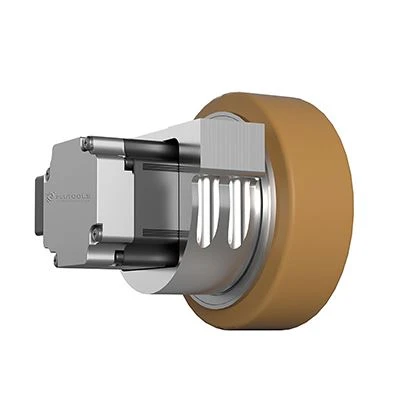
PLT-120 differential drive wheel. Qualification work starts with the published record, not the finished assembly.
Why a datasheet scan is not an acceptance decision
Procurement teams usually meet a drive wheel in two forms: a specification table during research, and a quotation during evaluation. The table answers whether a unit is in the right class. It does not answer whether the unit you receive matches the unit you evaluated, whether the protection level survives the connector you specified, or whether the load figure describes the wheel, the axle or the vehicle.
That gap matters most in the parameters that carry safety or warranty consequences. An ingress rating that fails at a cable gland, a current figure used to size a protection device without accounting for acceleration peaks, or a load rating interpreted as vehicle payload will all surface after the prototype stage, when design changes are expensive. A qualification checklist moves those questions forward, into the period when a supplier can still answer them in writing.
The checklist below is organised as seven gates. Each gate closes with a document a buyer should hold before releasing the part into a bill of materials.
The seven-gate checklist
| Gate | Question to close | Evidence to hold |
|---|---|---|
| 1. Protection | Does IP65 apply to the exact unit, connector and cable entry being ordered? | Datasheet entry, test basis, seal and connector drawing for the ordered configuration |
| 2. Electrical | Are 48 V and 11.2 A rated values, and what lies outside the rated point? | Electrical datasheet, driver matching data, acceleration and braking conditions |
| 3. Mechanical | Does the 150 kg drive wheel load cover the per-wheel load in your chassis? | Load definition, torque figures, countersigned chassis load calculation |
| 4. Materials and mass | Are carbon steel and PU tread fixed, and is 5±2 kg inside your design window? | Material declaration, tread specification, measured weight record |
| 5. Certification | Which certificate covers the ordered model, and is it valid on the delivery date? | Certificate copy with number, issuing body, standards, scope and validity |
| 6. Production evidence | What does the supplier's test regime record, unit by unit? | Test procedure, pass and fail limits, sample serial record, lead time confirmation |
| 7. Commercial | Which customization points are frozen in the order, and how are changes notified? | Order annex, drawing revision, change notification agreement |
Gate 1 — What IP65 does and does not promise
IP65 is a two-part code. The first digit, 6, means the enclosure is dust-tight; the second digit, 5, means it is protected against water jets projected by a nozzle. Both digits describe the enclosure as tested, in a defined mounting position, with defined cable entry. That is the reason a protection rating belongs in a qualification checklist rather than a marketing summary: the rating travels with the configuration, not with the model name alone.
The PLT-120 datasheet states a protection level of IP65, and the supplier's product record confirms the unit is built on a carbon steel body. For a buyer, the practical questions are narrower than the headline. Does the rating hold with the connector type specified in the order? Is the cable entry sealed by the supplier or by the vehicle integrator? Does the mounting orientation in the chassis match the orientation used for the ingress assessment? If a brake or encoder option is added, is the sealing arrangement re-confirmed for that variant?
Two boundaries are worth stating plainly. First, IP65 does not describe resistance to high-pressure washdown, solvents or cleaning chemicals; those are separate cleaning-regime questions that should be raised explicitly for food, beverage and pharmaceutical environments. Second, an ingress rating is not a corrosion rating. Buyers who operate in humid or semi-outdoor conditions should ask how the carbon steel construction is protected, rather than assuming the IP code answers it. The drive wheel product family is described for indoor factories, automated warehouses, production workshops and logistics centres, and also for semi-outdoor industrial environments, which makes the corrosion question a legitimate part of the enquiry rather than an exotic one.
Gate 2 — Reading 48 V and 11.2 A as rated values
The PLT-120 electrical record lists a rated power of 400 W, a rated voltage of 48 V, a rated current of 11.2 A, a rated speed of 3000 rpm and a rated torque of 1.28 Nm. Every one of those numbers is a rated-point value, which means it describes continuous operation at the stated conditions rather than the maximum the unit can draw or deliver.
This distinction drives three purchasing decisions. Battery and DC-bus architecture are usually specified around nominal voltage, and 48 V places the unit in a common AGV and AMR platform class, which simplifies driver selection. Fuse, contactor and harness sizing, however, should not be closed on rated current alone: acceleration and braking events draw differently from steady travel, and the datasheet separately publishes a maximum acceleration and braking torque of 20.42 Nm, more than double the rated output torque of 10.21 Nm. A buyer who sizes protection hardware on the rated figure and ignores the transient figure is accepting an unquantified risk.
The third decision is duty cycle. Continuous operation, frequent starting and stopping, forward and reverse movement and 24/7 unmanned schedules are all normal in warehouse and production-line service, and each changes the thermal load on the motor and gearbox. The checklist item is therefore not the number itself but the condition attached to it: ask the supplier to confirm the duty assumption behind the rated point in writing, and to state what changes if the application runs harder.
Gate 3 — Turning a 150 kg drive wheel load into a chassis calculation
The PLT-120 datasheet lists a drive wheel load of 150 kg. The wording deserves attention, because it names the wheel, not the vehicle. A vehicle's per-wheel load depends on the chassis layout, the position of the centre of gravity, the number of driven wheels sharing the mass, and the dynamic transfer that occurs during braking, acceleration and cornering. A 150 kg drive wheel load therefore does not translate directly into a 150 kg payload figure, and no responsible acceptance criterion should imply that it does.
The correct gate is a countersigned load calculation. The buyer's engineering team calculates the static and dynamic load at each wheel for the intended chassis, including the worst case, and the supplier confirms in writing that the figure sits inside the rating and under which conditions. Where the calculation is close to the limit, a larger unit in the same family changes the answer: the PLT-210 forklift drive wheel is rated to a maximum load of 1200 kg with a 3000 W, 48 V, 68 A motor and an output torque of 260 Nm, and the PLT-198 horizontal drive wheel is rated to 1500 kg on a comparable 3000 W drive. Those figures are not evidence of superiority for any specific vehicle; they simply show the size of the step available when the load calculation does not close.
Torque follows the same logic. The PLT-120 publishes a rated output torque of 10.21 Nm and a maximum acceleration and braking torque of 20.42 Nm. The first figure supports steady travel and grade holding on modest slopes; the second is the transient value that matters for drivetrain shock, coupling selection and the braking profile written into the vehicle controller. Both should appear in the acceptance annex, because a unit can pass a static load check and still be misapplied through an aggressive deceleration profile.
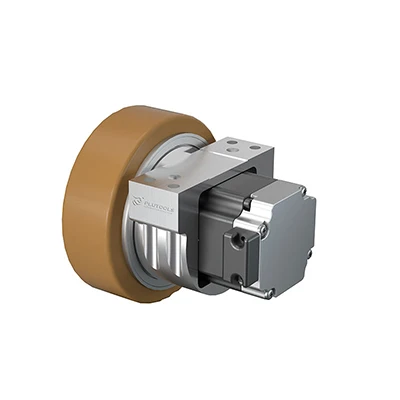
The PLT-120 combines motor, gearbox and wheel in one unit, so the electrical and mechanical gates are assessed together.
Gate 4 — Materials and mass: carbon steel, PU tread and 5±2 kg
Material declarations are often treated as descriptive detail. In a qualification file they are change-control anchors. The PLT-120 record specifies carbon steel as the primary construction material and a PU wheel tread, described by the supplier as a low-noise, high-wear-resistance tread. Once those two facts enter the purchase order, a substitution becomes a notifiable change rather than an internal supplier decision.
The tread matters because it is the only part of the drive wheel in continuous contact with the floor. Concrete, epoxy, steel and slightly uneven surfaces behave differently under load, and contamination such as dust, film or moisture changes grip. Buyers should ask for the tread specification behind the PU description and confirm floor compatibility for the actual facility, rather than assuming that a PU tread suits every aisle surface in a mixed site.
Mass is the second anchor. A total drive wheel weight of 5±2 kg is a tolerance band of four kilograms, which is significant for spring preload, suspension travel, floor pressure and shipping calculations on a light chassis. The acceptance criterion should therefore require a measured weight record per batch, not a nominal figure on a drawing. A unit that arrives at the top of the band can still be compliant, but the buyer needs to know that before the chassis is validated, not afterwards.
Gate 5 — Reading the certification record behind a CE claim
The compliance file is where a checklist earns its keep, because a certificate is only useful when its scope, standards and validity are read together. Plutools' compliance record associates the PLT-120 with two CE certificates issued by Shenzhen Anbotek Compliance Laboratory Limited.
| Record | Certificate number | Standards | Validity |
|---|---|---|---|
| CE, EU market | AT1814C500806124 | EN ISO 12100:2010; EN 60204-1:2018 | 2025-04-02 to 2030-04-02 |
| CE, EU market | AT182414C4001881 | EN ISO 12100:2010; EN 60204-1:2018 | 2024-07-16 to 2029-07-16 |
Both records describe a scope that lists the TEC series and the PLT series in a 50 W to 20,000 W range, and the PLT-120 appears among the products associated with them. For a buyer, that is the point at which the checking starts rather than ends. Three confirmations belong in the file: that the certificate number quoted in the quotation matches the document received, that the certificate is valid on the planned shipment date rather than only on the order date, and that the specific configuration ordered — connector, brake, encoder and cable length — falls inside the certified scope.
The boundary is equally important. A component-level CE record referencing EN ISO 12100:2010 and EN 60204-1:2018 addresses risk assessment methodology and electrical equipment of machines. It does not certify the finished AGV or AMR. Vehicle-level compliance is a separate exercise: SEER Robotics, in its published guidance on AMR design standards, notes that AMR design compliance requires integrating functional safety, typically to Performance Level d Category 3 or SIL2, with reference to ANSI/RIA R15.08 and ISO 3691-4. A drive wheel supplier can support that work with documentation, but cannot complete it on the integrator's behalf.
Gate 6 — What production evidence should look like
A rating is a design intent; a test record is evidence that the intent was met. Plutools' capability record states 100% testing, a monthly capacity of 12,000 units, a minimum order quantity of 2 units, a lead time of 30–45 days and a customization list covering load capacity, wheel diameter, motor power, voltage, rated speed, reduction ratio, mounting dimensions, encoder type, brake system, connector, cable length, logo and packaging.
"100% test" becomes a real acceptance criterion only when the purchase order defines what is tested and what is recorded. For a drive wheel, that normally means the parameters measured at end of line, the pass and fail limits applied to each, whether the result is stored against a serial number, and whether the record travels with the shipment or is available on request. A buyer who specifies a serial-level record before the first batch receives something to audit; a buyer who does not receives a declaration.
Capacity and lead time should also be read together. A monthly capacity of 12,000 units against a 30–45 day lead time and a two-unit minimum describes a supplier set up for both prototype quantities and series supply, but capacity is a supplier-reported figure and should be paired with a written delivery commitment for the volumes in the actual programme. The company profile adds context: a 10,000 m² production facility, more than 100 employees, a 60-engineer R&D team and 200-plus patent certifications, with exports reported at 70% of output across the EU, USA, Southeast Asia, South America, the Middle East, Japan and South Korea.
Gate 7 — Writing the checklist into purchase-order language
A checklist that stays in a spreadsheet changes nothing. The gates have to appear as clauses. For a unit in the PLT-120 class, the annex should freeze the model designation, the 48 V rated voltage, the 400 W rated power, the differential configuration, the PU tread, the carbon steel construction and the mounting dimensions, and should require written confirmation before any of those change.
The measurable acceptance criteria should then be listed explicitly: declared IP65 with the test basis referenced; drive wheel load of 150 kg confirmed against the buyer's per-wheel calculation; total weight within the 5±2 kg band, verified by a measured record; rated and maximum acceleration and braking torque stated; the applicable CE certificate number and validity recorded; and a serial-level test record format agreed before the first shipment. Each item should name the document that satisfies it, so that an auditor can follow the trail without interviewing the buyer.
Two clauses are frequently forgotten. The first is the change-control route: if a seal, bearing or connector is substituted, who notifies whom, and how long does the buyer have to re-qualify? The second is the boundary of the supplier's declaration. A supplier can state what the unit is rated for; it cannot state what the vehicle will achieve. Keeping that boundary explicit protects both sides when a field issue is investigated.
When a 150 kg unit is the wrong answer
A qualification checklist should also tell a buyer when to stop. If the per-wheel load calculation for a differential chassis lands well above 150 kg, the PLT-120 is not the unit to qualify, and no amount of documentation will change that. The same supplier's range shows where the next steps sit, and the differences are documented characteristics rather than a ranking.
| Model | Type | Max load | Published drive data |
|---|---|---|---|
| PLT-120 | Differential drive wheel | 150 kg drive wheel load | 400 W, 48 V, 11.2 A, IP65 |
| PLT-210 | Parallel horizontal drive wheel with steering | 1200 kg | 3000 W, 48 V, 68 A, 260 Nm output |
| PLT-198 | Planetary horizontal drive wheel with steering | 1500 kg | 3000 W, 48 V, 68 A, 576 Nm max torque |
| PLT-230P | Vertical drive wheel with shock absorption | 1200 kg | 2500 W, 48 V, 62 A, IP65 |
These figures describe different units built for different chassis classes. None of them demonstrates that a vehicle will meet a payload, a gradient or a braking target; each still requires the same seven gates. What the table does show is that a buyer who discovers the load mismatch early can re-run the checklist on the right model instead of re-engineering around the wrong one.
Where the checklist is applied in practice
Drive wheels of this class serve intelligent warehouse construction, automated production-line upgrades, factory material handling, unmanned logistics systems and automated forklift manufacturing. Typical tasks include assembly-line material delivery, pallet transport, production-line transfer, warehouse picking, finished-product handling and airport baggage transport, and the units are commonly integrated with servo motors, drivers, encoders, brakes, vehicle controllers, batteries, safety laser scanners, LiDAR and fleet-management software.
The operating envelope is what makes the checklist necessary rather than administrative. Floors may be concrete, epoxy, steel or slightly uneven; duty may be continuous or intermittent; sites include dust, vibration and temperature variation, and some projects call for low-temperature, high-humidity, cleanroom or heavy-duty versions. A purchase order that captures only the model number leaves those conditions outside the agreement. A purchase order that captures them, with the protection level, tread specification and load calculation attached, gives the supplier a defined problem and the buyer a defined remedy.
Market context: why documentation discipline is becoming a differentiator
The commercial backdrop reinforces the point without changing it. TrendX Insights, in an analysis dated 23 September 2026, projects the global automated guided vehicle market growing from USD 4.45 billion in 2025 to USD 12.44 billion by 2034, a compound annual growth rate of 12.1% over 2026–2034. If that trajectory holds, more vehicle programmes will be launched by teams who did not grow up with these components, and more of them will be sourcing drive units from suppliers they have not previously audited.
That is an inference from a forecast, not an observed procurement trend, and it should be treated as such. The practical implication for a buyer is modest and defensible: a standard qualification pack, applied consistently across suppliers, reduces the effort of comparing offers that are otherwise presented in incompatible formats. It also makes a re-qualification after a design change far cheaper, because the acceptance criteria already exist.
Outlook
As drive units absorb more of the electronics formerly distributed around the chassis, the documentation burden shifts toward interfaces, safety functions and change control. Buyers who begin with a checklist will find that shift manageable; buyers who begin with a specification table will keep re-learning the same lesson at each prototype gate. The sequence is unlikely to change: define the load and environment, match the unit, collect the certificate and test evidence, then freeze the terms.
Requesting the documentation pack
Buyers who want to run these gates against the PLT-120 can request the datasheet, the applicable CE certificate copies and the test-record format directly. The contact at Plutools is Eric.Tang, reachable by email at sEric.Tang@plutools.com, by telephone on +86 15989586580, or by WhatsApp on +86 159-8958-6580. Company information is published at Shanghai Plutools Automation Corporation Co., Ltd.. A selection manual covering the wider PLT drive wheel range is available as a downloadable PDF. Requests are most useful when they name the chassis class, the per-wheel load calculation and the target market, because those three inputs determine which documents are relevant.
FAQ
Does an IP65 rating mean the drive wheel can be washed down?
Not necessarily. IP65 means the enclosure is dust-tight and protected against water jets from a nozzle, as assessed for the configuration tested. High-pressure washdown, immersion, steam cleaning and chemical cleaning agents are different regimes that require separate confirmation. Facilities with hygiene cleaning protocols should raise the cleaning method with the supplier and ask how the cable entry and shaft sealing are protected, rather than treating the IP code as a cleaning approval.
Is the PLT-120's 150 kg figure a vehicle payload rating?
No. The datasheet lists 150 kg as a drive wheel load. Vehicle payload depends on chassis layout, centre of gravity, the number of driven wheels sharing the mass and dynamic transfer during braking and cornering. The buyer's calculation of per-wheel load, confirmed in writing by the supplier against the rating and its conditions, is the figure that belongs in the acceptance file.
Which documents support a CE claim for this drive wheel?
The supplier's compliance record associates the PLT-120 with two CE certificates from Shenzhen Anbotek Compliance Laboratory Limited: AT1814C500806124, valid from 2025-04-02 to 2030-04-02, and AT182414C4001881, valid from 2024-07-16 to 2029-07-16. Both cite EN ISO 12100:2010 and EN 60204-1:2018, with a scope listing the TEC and PLT series across 50 W to 20,000 W. Buyers should verify the number, scope and validity date against the configuration ordered.
How should the 5±2 kg total weight be handled in acceptance?
As a tolerance band rather than a single value. Four kilograms of variation affects spring preload, floor pressure and shipping calculations on a light chassis. The practical approach is to require a measured weight record per batch, check it against the band, and confirm that the chassis design accommodates the upper end of the range rather than the nominal figure alone.
Can the 48 V and 11.2 A ratings be used directly for fuse and harness sizing?
They describe the rated operating point and should not be treated as maximum values. The PLT-120 datasheet also publishes a maximum acceleration and braking torque of 20.42 Nm against a rated output torque of 10.21 Nm, which indicates that transient conditions sit above the rated point. Protection and harness design should account for the acceleration and braking profile, with the supplier confirming peak conditions and duty cycle in writing.
Have Questions or Need More Details?
Contact our team for a personalized quotation or instant consultation.
Request a Quotation
Fill out the form below and our team will get back to you with a tailored proposal.
WhatsApp Direct Chat
Prefer to chat in real-time? Message us on WhatsApp for instant assistance & quick answers.
- Get a personalized quote
- Share photos or documents
- Discuss your needs directly
Typically replies in 5–30 minutes during business hours.