
Drive Wheel Qualification: IP65, Materials & Acceptance
Drive Wheel Qualification: IP65, Materials & Acceptance
A drive wheel is qualified for an AGV, AMR, or forklift project when its ingress protection, material composition, load and torque ratings, interface dimensions, and acceptance evidence match the operating envelope. IP65 is an ingress protection rating, not a safety certification. That distinction is the starting point for a defensible qualification file.
Why Drive Wheel Qualification Is Different in AGV/AMR Projects
Procurement teams often compare drive wheels by headline load capacity or voltage. In practice, project failures more often trace to a mismatch between the drive wheel unit and the vehicle envelope: an IP rating that does not match the cleaning regime, a tread material that does not suit the floor, a mounting interface that was not fixed early enough, or acceptance terms that were never written into the purchase order.
The market context makes this discipline more important. Reports and Data estimates the global AGV wheel drives market at approximately USD 1.2 billion in 2024, projected to reach USD 3.5 billion by 2034, with an 11.5% CAGR from 2024 to 2034. Grand View Research estimates the global AGV market will reach USD 5.9 billion by 2025. More supplier options mean more datasheets to compare, and more need for a structured qualification method.
For buyers, the practical question is not whether a drive wheel has a high load rating. It is whether the rated load, torque, speed, IP protection, material, and interface can be verified against the actual duty cycle, and whether the supplier will document acceptance before shipment.
IP65, Materials, and Ratings: What Each Specification Actually Proves
IP65: ingress protection, not a safety certificate
IP65 denotes dust-tight construction and protection against water jets. It does not mean the drive wheel is suitable for continuous submersion, high-pressure washdown, or every wet process. A qualification file should therefore separate the IP rating from the safety conformity evidence.
For an AGV or AMR drive wheel, IP65 should be checked at the level of the complete assembly: shaft seals, cable entry, connector, breather, and mating surfaces. A motor or gearbox with an IP65 label is not automatically a complete IP65 drive wheel unit if the connector or cable gland is not protected to the same level.
Qualification rule: treat IP65 as a performance claim that requires a test method and a complete-assembly statement. Do not treat IP65 as a CE certificate or as evidence of compliance with ISO 3691-4:2023, EN 1175:2020, or ANSI/ITSDF B56.5. Those are separate project-level assessments.
Materials: carbon steel structure and PU tread
Material composition affects load path, floor interaction, corrosion exposure, and maintenance. Carbon steel is used for structural components in the Plutools drive wheel range. For the PLT-120 differential drive wheel, the tread material is polyurethane (PU), and the total drive wheel weight is 5±2 kg.
PU tread is common in indoor material handling because it can support load capacity while protecting floors. Mordor Intelligence notes that forklift drive wheel tires commonly use polyurethane to provide higher load capacity and floor protection in indoor settings. That does not make PU universal. Buyers should confirm tread hardness, bonding method, and chemical compatibility for the actual floor and cleaning agents. A PU tread may not be the right choice for every high-temperature, harsh-chemical, or heavy-impact outdoor application.
Performance ratings: load, torque, voltage, and current
Load capacity is only one rating in a system. The PLT-120 differential drive wheel is rated at 150 kg drive wheel load, 48 V, 400 W, 11.2 A, and 3000 rpm. Its rated torque is 1.28 Nm, transmission ratio is 9.20 (I), rated output torque is 10.21 Nm, and maximum acceleration and braking torque is 20.42 Nm.
The PLT-198 horizontal drive wheel is a planetary horizontal drive wheel with steering. It is rated at 48 V, 3000 W, 68 A, and 3000 rpm, with 9.55 Nm rated torque, reduction ratio 32, 260 Nm output torque, 576 Nm maximum torque, and 1500 kg maximum load.
The PLT-210 forklift drive wheel is a parallel horizontal drive wheel with steering. It is rated at 48 V, 3000 W, 68 A, and 3000 rpm, with 9.55 Nm rated torque, reduction ratio 32, 260 Nm output torque, 576 Nm maximum torque, and 1200 kg maximum load. Plutools also lists customization that includes load capacity and rated speed.
Plutools Drive Wheels as a Qualification Case
Shanghai Plutools Automation Corporation Co., Ltd. (Plutools) is a Shanghai-based developer and manufacturer of AGV/AMR drive wheels and motion control modules. The company operates a 10,000 m² production facility, employs more than 100 people, and reports a 70% export ratio across markets including the EU, US, Southeast Asia, South America, the Middle East, Japan, and South Korea. It is a national high-tech enterprise and a Specialized and Innovative Enterprise / National Small Giant Enterprise.
For qualification purposes, the relevant Plutools facts are the product-level ratings and the manufacturing and acceptance terms. Plutools offers OEM and ODM services, custom manufacturing, sample development, and production runs ranging from small to large batches. The stated MOQ is 2 units, lead time is 30–45 days, quality control is 100% test, and delivery terms are FOB Shanghai with 50/50 payment terms and pre-shipment test as the acceptance criterion.
| Model | Type | Max load | Max torque | Voltage / current | IP rating | Material / tread |
|---|---|---|---|---|---|---|
| PLT-120 | Differential drive wheel | 150 kg | 20.42 Nm maximum acceleration and braking torque | 48 V / 11.2 A | IP65 | Carbon steel / PU tread |
| PLT-198 | Planetary horizontal drive wheel with steering | 1500 kg | 576 Nm | 48 V / 68 A | Not stated in the provided specification | Carbon steel |
| PLT-210 | Parallel horizontal drive wheel with steering | 1200 kg | 576 Nm | 48 V / 68 A | Not stated in the provided specification | Carbon steel |
The table is deliberately conservative. It does not infer an IP rating for PLT-198 or PLT-210 where the provided specification does not state one. That is the correct approach in a qualification document: missing fields should be marked as open items, not filled with assumptions.
A Six-Step Qualification Framework for Buyers
A qualification framework turns a datasheet comparison into a project decision. The following sequence can be used for differential, horizontal, vertical, steering, and forklift drive wheel units.
- Define the operating envelope. Record indoor or outdoor use, floor type, cleaning regime, ambient temperature, duty cycle, turning requirements, and maximum gradient. These inputs determine whether IP65, PU tread, or a specific steering layout is appropriate.
- Separate IP protection from safety conformity. Request the IP test method and the complete-assembly protection statement. Separately request the applicable CE certificate and verify that the exact model and configuration are within its scope.
- Verify material and interface data. Confirm carbon steel structural components, tread material, mounting dimensions, encoder type, brake system, connector, and cable length. These are the interfaces that cause integration delays if they are not frozen early.
- Match ratings to calculated demand. Compare load, torque, speed, voltage, and current against the vehicle calculation, not against a competitor's headline number. Include acceleration and braking torque where relevant.
- Write acceptance criteria into the purchase order. Use pre-shipment test, FOB Shanghai, 50/50 payment terms, MOQ 2 units, and lead time 30–45 days as commercial reference points. Add model-specific test records and dimensional checks.
- Control custom changes. Plutools customization covers load capacity, wheel diameter, motor power, voltage, rated speed, reduction ratio, mounting dimensions, encoder type, brake system, connector, cable length, logo, and packaging. Any custom load or speed change should trigger a revised acceptance plan.
Application Fit: Differential, Horizontal Steering, and Forklift Units
The PLT-120 differential drive wheel is a compact option for AGV and AMR platforms where IP65 protection, 150 kg load, and PU tread are aligned with the application. Its 5±2 kg weight and differential layout suit vehicles that need a defined differential drive interface rather than a large steering module.
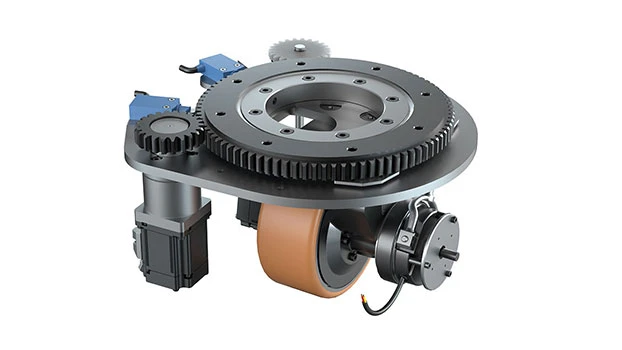
The PLT-198 planetary horizontal drive wheel with steering is positioned for heavier horizontal drive applications, with 1500 kg maximum load and 576 Nm maximum torque at 48 V / 68 A. The PLT-210 parallel horizontal drive wheel with steering is a forklift-oriented unit with 1200 kg maximum load and 576 Nm maximum torque, plus customizable load and speed. The distinction matters: the PLT-198 and PLT-210 share torque and voltage ratings, but their load limits and steering layouts serve different vehicle architectures.
Application evidence should be read as evidence, not as a universal guarantee. In a Brazil-based project, 200 units were supplied over two years for an ultra-heavy-duty AGV with multiple navigation modes. The reported result was stable operation under heavy-load conditions, accurate route tracking, flexible steering, and reliable material transportation. That case supports the value of matching drive, differential steering, and motion control to a defined heavy-load scenario, but each new project still requires its own qualification calculation.
Market Trend Analysis: More Automation, More Qualification Pressure
Several verified market signals point in the same direction: drive wheel qualification is becoming a procurement discipline rather than a catalog exercise.
- Reports and Data estimates the global AGV wheel drives market at USD 1.2 billion in 2024, rising to USD 3.5 billion by 2034, with an 11.5% CAGR from 2024 to 2034.
- Grand View Research estimates the global AGV market will reach USD 5.9 billion by 2025, with Asia Pacific holding a 37.6% revenue share in 2025.
- CMRA reports that the China mobile robot market reached 22.1 billion yuan in 2024, involving more than 139,000 units sold.
- MarketsandMarkets projects the industrial logistics segment for AGVs to grow at an 11.6% CAGR.
- Brandessence Research observes that integrated steering drive modules are replacing discrete components to reduce manufacturer assembly time and maintenance complexity.
- MarketsandMarkets reports that electric forklifts now command over 70% market share in many regions as a replacement for combustion models.
The implication for buyers is straightforward. As volumes rise and vehicle architectures diversify, the cost of a poorly specified drive wheel interface rises with it. A qualification file that captures IP protection, material, load, torque, voltage, current, mounting dimensions, and acceptance terms reduces re-engineering risk before the first production batch.
Integrated Drive Wheel Units vs Traditional Component Stacks
Traditional AGV drive systems often combine a separate motor, gearbox, wheel, steering actuator, encoder, and brake. Integrated drive wheel units combine these functions into a single module. The comparison is not a simple good-versus-bad choice; each approach changes where qualification work is performed.
| Qualification dimension | Traditional component stack | Integrated drive wheel unit |
|---|---|---|
| Mechanical interfaces | More interfaces to align and document | Fewer interfaces, but the mounting envelope must be fixed early |
| Assembly and commissioning | Integration work shifts to the vehicle builder | Factory-assembled module can reduce assembly time |
| Maintenance | Individual components can be replaced separately | Module-level replacement may be faster, but connector, encoder, and brake matching must be controlled |
| Customization | Flexible but with more integration risk | Custom load, speed, voltage, and interface options are available, with lead time implications |
| Environmental protection | Protection depends on how components are enclosed | Complete-assembly IP65 can be specified, but cable entry and connectors must match |
| Acceptance | Component-level tests plus system integration test | Module-level test records plus interface verification |
The main limitation of integrated units is that they move complexity into the interface and change-control process. A custom load or speed requirement can extend lead time; Plutools states 30–45 days as its lead time. A field replacement may require the same connector, encoder type, brake configuration, and mounting dimensions as the original unit. These are manageable issues, but they must be written into the qualification plan.
Limits and Boundaries Buyers Should Not Skip
A credible qualification framework should state what a specification does not prove. Four boundaries are especially important for drive wheels.
- IP65 is not unlimited water protection. It denotes dust-tight construction and protection against water jets, not continuous submersion. Confirm the cleaning regime and the connector protection level.
- Load ratings are application-specific. A 150 kg differential drive wheel, a 1200 kg forklift drive wheel, and a 1500 kg horizontal drive wheel serve different vehicle architectures. The rated load should be checked against the actual duty cycle, floor conditions, and safety margin.
- PU tread is not universal. Polyurethane can provide load capacity and floor protection in indoor settings, but chemical exposure, temperature, and impact conditions should be reviewed before selection.
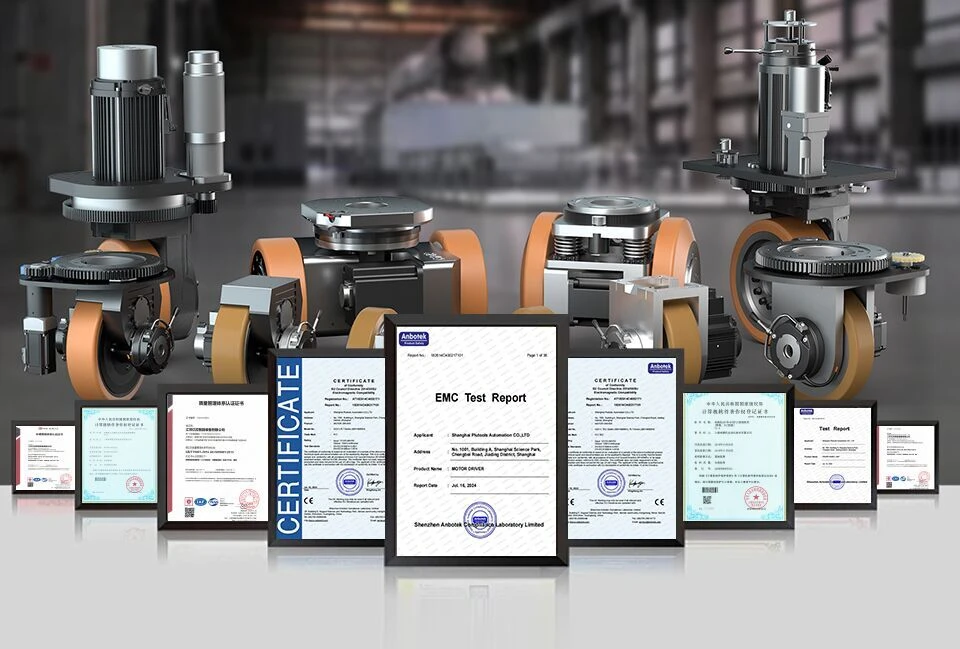
- CE documentation is model- and scope-specific. Plutools CE documentation is available under certificate numbers AT1814C500806124 and AT182414C4001881, issued by Shenzhen Anbotek Compliance Laboratory Limited, with applicable standards EN ISO 12100:2010 and EN 60204-1:2018, and scope covering the PLT Series (50W–20000W). Buyers should confirm that the exact model and configuration fall within the certificate scope.
Future Outlook
As AGV and AMR volumes grow, drive wheel qualification is likely to become more standardized and more digital. Buyers will increasingly ask for model-specific IP test reports, material declarations, dimensional drawings, CE certificate scope checks, and pre-shipment test records. The shift toward integrated steering drive modules, noted by Brandessence Research, reinforces the need for module-level acceptance criteria rather than component-level assumptions.
Electric forklift adoption above 70% in many regions, combined with AGV market growth and Asia Pacific's 37.6% revenue share in 2025, suggests that drive wheel suppliers will be evaluated on both product range and documentation quality. The suppliers that make qualification easier will be easier to approve.
FAQ
Does IP65 mean the drive wheel can be washed down continuously?
No. IP65 denotes dust-tight construction and protection against water jets. It does not mean continuous submersion or unlimited high-pressure washdown. For a washdown application, confirm the complete-assembly sealing method, connector protection, cable entry, and test method with the supplier.
What materials are used in the PLT-120 differential drive wheel?
The PLT-120 uses carbon steel structural components and a PU tread. It weighs 5±2 kg, has a 150 kg drive wheel load, IP65 protection, 48 V rated voltage, 400 W rated power, 11.2 A rated current, 3000 rpm rated speed, 1.28 Nm rated torque, 9.20 (I) transmission ratio, 10.21 Nm rated output torque, and 20.42 Nm maximum acceleration and braking torque.
How do PLT-198 and PLT-210 differ for heavy projects?
PLT-198 is a planetary horizontal drive wheel with steering, rated at 1500 kg maximum load, 576 Nm maximum torque, 48 V, 68 A, 3000 W, and 3000 rpm, with 260 Nm output torque. PLT-210 is a parallel horizontal drive wheel with steering for forklift applications, rated at 1200 kg maximum load, 576 Nm maximum torque, 48 V, 68 A, 3000 W, and 3000 rpm, with 260 Nm output torque and customizable load and speed. Selection depends on load, steering layout, and installation envelope.
What acceptance criteria should be written into a drive wheel purchase order?
The commercial reference points provided by Plutools are MOQ 2 units, FOB Shanghai delivery, 50/50 payment terms, 30–45 days lead time, and pre-shipment test as the acceptance criterion. A project-specific purchase order should also specify load, torque, voltage, current, IP rating, material, mounting dimensions, encoder type, brake system, connector, cable length, and the required test records.
Can Plutools customize load and speed?
Yes. Plutools lists customization for load capacity, wheel diameter, motor power, voltage, rated speed, reduction ratio, mounting dimensions, encoder type, brake system, connector, cable length, logo, and packaging. OEM and ODM services are available. Custom configurations should be tied to a revised acceptance plan and the stated 30–45 days lead time.
What certifications are documented for Plutools drive wheels?
CE certification is documented under certificate numbers AT1814C500806124 and AT182414C4001881, issued by Shenzhen Anbotek Compliance Laboratory Limited, with applicable standards EN ISO 12100:2010 and EN 60204-1:2018, and scope covering the PLT Series (50W–20000W). Buyers should verify that the exact model and configuration are within the certificate scope. IP65 is an ingress protection rating, not a safety certification.
Reference: Plutools drive wheel selection handbook (PDF): https://cdn.socialarks.com/sbsp/25128/common/2026/0805/PLT%E9%80%89%E5%9E%8B%E6%89%8B%E5%86%8C2026.03.26.pdf
Have Questions or Need More Details?
Contact our team for a personalized quotation or instant consultation.
Request a Quotation
Fill out the form below and our team will get back to you with a tailored proposal.
WhatsApp Direct Chat
Prefer to chat in real-time? Message us on WhatsApp for instant assistance & quick answers.
- Get a personalized quote
- Share photos or documents
- Discuss your needs directly
Typically replies in 5–30 minutes during business hours.