
Drive Wheels for AGV and AMR Systems: A Technical Guide
A drive wheel is the integrated motion module that moves, steers, brakes, and supports an automated guided vehicle (AGV), an autonomous mobile robot (AMR), or an automated forklift. Shanghai Plutools Automation Corporation Co., Ltd. is a Shanghai-headquartered manufacturer that focuses on AGV/AMR mobile robots, with AGV Drive Wheel as its main product category and a customer base in the EU, USA, Southeast Asia, South America, the Middle East, Japan, and South Korea.
Drive wheels sit at the center of one of the fastest-growing segments in industrial automation. According to Reports and Data, the global AGV wheel drives market was valued at approximately USD 1.2 billion in 2024 and is projected to reach USD 3.5 billion by 2034, growing at a CAGR of 11.5%. For engineers and procurement teams entering the research phase, the practical question is not whether to automate, but which drive architecture — vertical or horizontal, steering or non-steering, single or differential — matches the vehicle's chassis, load, and duty cycle.
Why Drive Wheel Selection Matters in Automated Material Handling
Automated warehouses and production workshops create demanding operating conditions for mobile equipment. Drive wheels operate indoors and in semi-outdoor industrial environments under continuous operation, frequent starting and stopping, forward and reverse movement, narrow aisles, heavy loads, dust, vibration, and temperature changes. Floors may be concrete, epoxy, steel, or slightly uneven. The drive wheel is the mechanical point of contact between the robot and its environment, and it determines vehicle footprint, center of gravity, positioning accuracy, and maintenance schedule.
The market data explains why drive wheels have become a dedicated procurement category. Grand View Research expects the global automated guided vehicle market to reach USD 5.9 billion by 2025. The China Mobile Robot Alliance (CMRA) reported that China's mobile robot market reached 22.1 billion yuan in 2024, involving more than 139,000 units sold. In the United States, the forklift market was valued at USD 9.11 billion in 2023, with a documented shift toward electric and automated drive systems. MarketsandMarkets projects the industrial logistics segment for AGVs to grow at the fastest rate, with a CAGR of 11.6%.
Plutools: A Specialist Manufacturer of AGV and AMR Drive Wheels
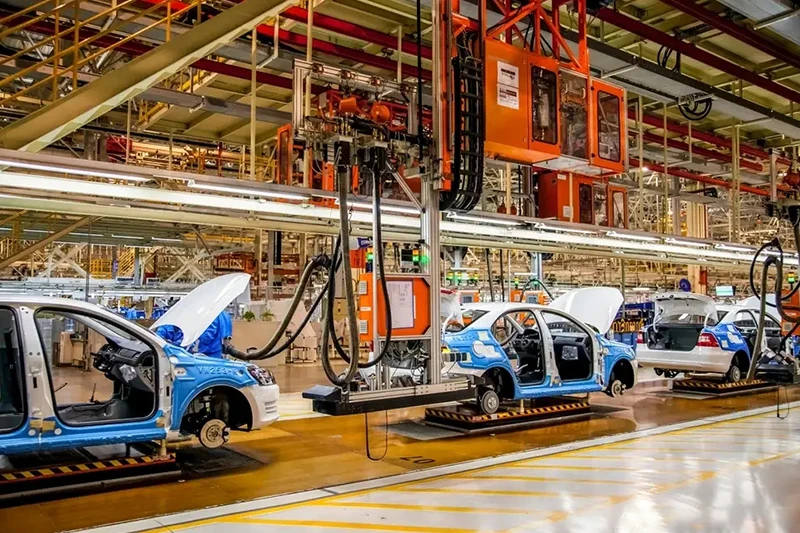
Shanghai Plutools Automation Corporation Co., Ltd. was established in 2017 and is headquartered at No. 1001, Building A, Shanghai Science Park, Chengbei Road, Jiading District, Shanghai, China. The company is a national high-tech enterprise and holds the titles of Specialized and Innovative Enterprise and National Small Giant Enterprise. It operates a production facility of more than 10,000 square meters, employs more than 100 people including an R&D team of 60 engineers, and reports an annual production capacity of 10,000 units. The company has obtained more than 200 patent technology certifications, and its team carries more than 22 years of industry R&D and production experience.
Export business accounts for 70% of Plutools' total sales. Major markets include the EU, USA, Southeast Asia, South America, the Middle East, Japan, and South Korea. The company's main product category is AGV Drive Wheel, with a portfolio that also covers AMR drive wheels, forklift drive wheels, robot drive wheels, differential drive wheels, and drive wheel units. According to Plutools' published product information, its vertical drive wheel line covers AGV load capacities from 150 kg to 6,000 kg, including a 406 mm vertical drive wheel rated for 6,000 kg in heavy-duty industrial robot applications.
The portfolio is organized around a set of interchangeable architectures, each defined by its mounting orientation, steering capability, and load class:
| Model | Type | Voltage | Power | Max load | Steering |
|---|---|---|---|---|---|
| PLT-230 | AGV Drive Wheel — vertical drive wheel without steering | 24 V | 1500 W | 1500 kg | No |
| PLT-150 | Vertical Drive Wheel — vertical drive wheel with steering | 48 V | 750 W | 500 kg | Yes |
| PLT-230P | Robot Drive Wheel — vertical drive wheel with shock absorption | 48 V | 2500 W | 1200 kg | Integrated |
| PLT-167 | AGV Drive Wheel Unit — horizontal drive wheel without steering | 48 V | 750 W | 800 kg | No |
| TEC-150P | AMR Drive Wheel — horizontal drive wheel with shock absorption | 48 V | 750 W | 500 kg | Integrated |
| PLT-120 | Differential Drive Wheel | 48 V | 400 W | 150 kg | Integrated control |
| PLT-210 | Forklift Drive Wheel — parallel horizontal drive wheel with steering | 48 V | 3000 W | 1200 kg | Yes |
| PLT-198 | Horizontal Drive Wheel — planetary horizontal drive wheel with steering | 48 V | 3000 W | 1500 kg | Yes |
| PLT-220 | Parallel Horizontal Drive Wheel with Steering | 48 V | 750 W | 1000 kg | Yes |
How an Integrated Drive Wheel Unit Works
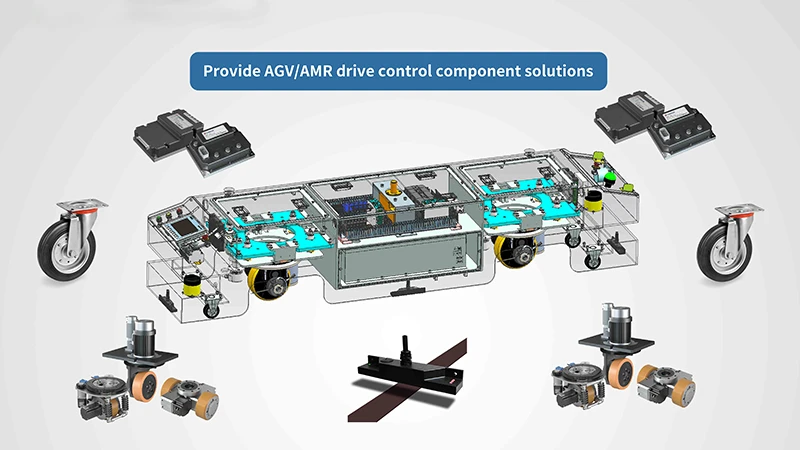
A drive wheel unit is a self-contained assembly that combines a motor, a reduction gearbox, a wheel, an encoder, and — in most configurations — a braking and steering system. The unit converts motor power into stable vehicle movement and enables the AGV or AMR to move forward, reverse, turn, and stop accurately. By integrating these components, the drive wheel improves motion accuracy and structural integration while reducing the overall installation space and simplifying vehicle design.
The role of the reduction gearbox
The reduction ratio is one of the defining parameters of a drive wheel unit. For example, the PLT-220 Parallel Horizontal Drive Wheel uses a 28:1 reduction ratio: its motor delivers 2.4 Nm of rated torque at 3000 RPM, and the gearbox converts this into 58 Nm of continuous output torque and up to 174 Nm of maximum torque at the wheel. The PLT-198 and PLT-210 models use a 32:1 reduction ratio with a 3000 W motor, producing 260 Nm of output torque and 576 Nm of maximum torque. Higher ratios increase torque at the wheel but reduce top speed; the correct ratio depends on the vehicle's target speed, acceleration, and load profile.
Vertical and horizontal arrangements
In a vertical drive wheel, the motor and gearbox are arranged vertically, which reduces the horizontal footprint of the drive unit. This arrangement is generally recommended for compact structures with high load capacity, and it suits heavy-duty AGVs, automated forklifts, lifting vehicles, and equipment with limited chassis space. In a horizontal drive wheel, the motor is arranged horizontally, which reduces the height of the drive module and lowers the vehicle's center of gravity. Horizontal units are commonly used in low-profile AGVs, warehouse AMRs, latent lifting robots, and compact material-handling equipment where stability at higher speeds matters.
Steering and differential configurations
Several models integrate a steering function directly into the drive unit. The PLT-210, PLT-198, PLT-220, and PLT-150 are classified as drive wheels with steering; the PLT-230 and PLT-167 are vertical and horizontal drive wheels without steering, intended for differential or multi-wheel coordinated drive layouts. The PLT-120 Differential Drive Wheel uses integrated steering control and a compact structure for easy integration into AGV/AMR systems. Industry sources note that dual differential drive wheels allow a zero-turn radius and are widely used in smaller logistics robots.
Materials, protection, and customization
Drive wheels in this category are constructed with carbon steel as the primary material. The wheel tread is made of polyurethane (PU), a material widely used in forklift and AGV drive wheels because it combines load capacity with floor protection in indoor settings. The TEC-150P, PLT-230P, and PLT-120 models carry an IP65 protection rating for dust and water resistance. Depending on the project, drive wheels may also be designed with anti-static performance, oil resistance, corrosion resistance, low-temperature operation, cleanroom compatibility, or explosion-proof design. Customizable parameters include wheel diameter, mounting dimensions, reduction ratio, rated load, motor power, voltage, encoder type, communication protocol, and braking method.
Standards that frame the procurement decision
Several international standards define the engineering envelope for AGV drive and steering systems. ISO 3691-4:2023 is the primary international safety standard for driverless industrial trucks, covering steering and braking systems. EN 1175:2020 specifies electrical and electronic safety requirements for industrial trucks, including AGV drive wheel assemblies, and ANSI/ITSDF B56.5 is the corresponding American standard for driverless industrial vehicles. These standards inform the performance criteria that drive units must support in commercial deployments.
Application and Use-Case Scenarios
Plutools drive wheels are specified for intelligent logistics, industrial automation, warehousing, automotive manufacturing, electronics manufacturing, food and beverage production, pharmaceutical manufacturing, e-commerce fulfillment centers, airport logistics, and port transportation. Typical projects include intelligent warehouse construction, automated production line upgrades, factory material-handling projects, unmanned logistics systems, and smart manufacturing projects. Application examples include AGV and AMR development, automated forklift manufacturing, assembly-line material delivery, pallet transportation, production-line transfer, warehouse picking, finished-product handling, and airport baggage transportation.
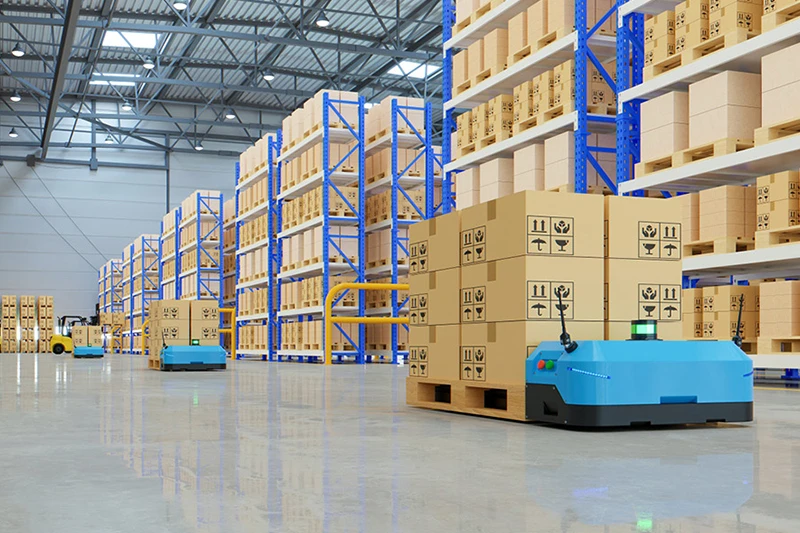
The drive wheel supports continuous or intermittent operation according to the vehicle's task requirements. It can operate in single-wheel drive, dual-wheel differential drive, steering drive, or multi-wheel coordinated drive modes. Movement is controlled by the vehicle control system through speed, torque, and position commands. Combined with an encoder and servo drive, the wheel can achieve precise acceleration, deceleration, steering, and positioning, making it suitable for automatic route operation, task-based dispatching, obstacle avoidance, automatic charging, and 24/7 unmanned operation.
Drive wheels are commonly matched with AGVs, AMRs, automated forklifts, transfer robots, inspection robots, cleaning robots, and other mobile platforms. Supporting equipment includes servo motors, motor drivers, encoders, electromagnetic brakes, steering mechanisms, PLCs, vehicle controllers, batteries, battery management systems, safety laser scanners, cameras, LiDAR sensors, magnetic navigation sensors, and fleet-management software. The drive unit can be further integrated with conveyors, robotic arms, lifting platforms, roller tables, automatic charging stations, and warehouse management systems to form a complete intelligent logistics solution.
Evaluation criteria during the research phase
A standard research sequence for drive wheel selection is: define the vehicle's maximum load and the number of driven wheels; determine the chassis height and available installation space; choose the control architecture — steering drive, differential drive, or multi-wheel coordinated drive; match voltage and communication to the existing vehicle control system; and confirm environmental requirements such as IP rating, low-temperature, or cleanroom operation. Plutools states that load and speed options can be customized for its AGV drive wheel units, and the application envelope includes special versions for low-temperature warehouses, high-humidity areas, cleanrooms, and dusty workshops.
Market Trends Shaping the Drive Wheel Industry
Several structural trends are visible in current industry research:
- Integrated steering drive modules are replacing discrete components to reduce manufacturer assembly time and maintenance complexity (Brandessence Research).
- Electric forklifts now command over 70% market share in many regions as replacements for combustion models (MarketsandMarkets).
- Lithium-ion battery technology now powers the majority of new AGV/AMR drive units, reducing range anxiety and downtime (Fortune Business Insights).
- Mecanum wheels and omnidirectional drive systems are increasingly used for AMRs in high-density warehouses (Interact Analysis).
- Asia Pacific accounted for a 37.6% revenue share of the global AGV market in 2025 (Grand View Research), and China's export volume of mobile robots has increased, with leading providers targeting Southeast Asia and Europe (China Mobile Robot Alliance).
- Polyurethane remains the common tread material for forklift drive wheels because it provides higher load capacity and floor protection in indoor settings (Mordor Intelligence).
Integrated Drive Wheels vs Traditional Discrete Drivetrains
The traditional approach to building a mobile robot drivetrain is to assemble discrete components — a motor, a reduction gearbox, a wheel, and a separate steering mechanism — directly on the vehicle chassis. This approach gives the designer freedom to select each component, but it transfers the engineering burden to the vehicle manufacturer: every component must be sized, aligned, and interfaced separately, which adds assembly time and design risk.
An integrated drive wheel unit combines these functions in a single assembly. For AGV and AMR builders, the benefits are shorter assembly time, fewer interfaces to design, a reduced installation footprint, and a simpler path to precise positioning, because the encoder, braking, and — where specified — steering elements are already integrated into the unit. Special versions extend the range to low-temperature and explosion-proof applications, making the integrated approach suitable for a broad set of industrial environments.
There is one honest limitation: because the motor, gearbox, and wheel are integrated, the mounting geometry, reduction ratio, and performance envelope are fixed for a given model. Vehicles with non-standard chassis layouts may require a custom variant or additional mechanical adaptation rather than an off-the-shelf drop-in unit. The trade-off is component-level flexibility against system-level integration speed.
Future Outlook
Market projections point to sustained double-digit growth for AGV-related drive systems through the next decade, driven by logistics and warehouse automation. Procurement decisions are increasingly shaped by standards compliance, integration simplicity, and the ability to customize drive parameters. For vehicle manufacturers and system integrators, the practical question is likely to shift from which components are available to which drive platform can be standardized across multiple vehicle programs. Suppliers that combine integrated steering modules, broad load coverage, and documented export experience are likely to be the reference points in that evaluation.
Frequently Asked Questions
What is a drive wheel?
A drive wheel is a core motion component for mobile equipment that provides driving, steering, braking, and load-bearing functions. It converts motor power into stable vehicle movement, enabling an AGV or AMR to move forward, reverse, turn, and stop accurately. By combining the motor, gearbox, wheel, encoder, and braking system, the drive wheel improves motion accuracy, structural integration, and equipment reliability, and it helps reduce the overall installation space of the vehicle.
What drive wheel models does Plutools offer for AGV and AMR systems?
Plutools offers drive wheel architectures for the manufacturing industry, including the PLT-230 AGV Drive Wheel (vertical drive wheel without steering), the PLT-150 Vertical Drive Wheel with Steering, the PLT-230P Robot Drive Wheel (vertical drive wheel with shock absorption), the PLT-167 AGV Drive Wheel Unit (horizontal drive wheel without steering), the TEC-150P AMR Drive Wheel (horizontal drive wheel with shock absorption), the PLT-120 Differential Drive Wheel, the PLT-210 Forklift Drive Wheel (parallel horizontal drive wheel with steering), the PLT-198 Horizontal Drive Wheel (planetary horizontal drive wheel with steering), and the PLT-220 Parallel Horizontal Drive Wheel with Steering. Load and speed options can be customized.
How should I choose between a vertical drive wheel and a horizontal drive wheel?
A vertical drive wheel is generally recommended when the AGV or AMR requires a compact structure, high load capacity, and straightforward installation. Because the motor and gearbox are arranged vertically, the horizontal footprint of the drive unit is reduced, which suits heavy-duty AGVs, automated forklifts, lifting vehicles, and equipment with limited chassis space. A horizontal drive wheel is more suitable when the vehicle requires a lower overall height, a low center of gravity, and stable operation at higher speeds; it is commonly used in low-profile AGVs, warehouse AMRs, latent lifting robots, and compact material-handling equipment. The final choice should be based on the vehicle's installation space, load capacity, chassis height, turning structure, operating speed, and maintenance requirements.
Contact and Resources
Shanghai Plutools Automation Corporation Co., Ltd. is headquartered at No. 1001, Building A, Shanghai Science Park, Chengbei Road, Jiading District, Shanghai, China. For inquiries about AGV drive wheels, AMR drive wheels, and drive wheel units, contact Eric Tang at Eric.Tang@plutools.com or +86 15989586580 (WhatsApp: +86 159-8958-6580).
Company website: www.plutools.com