
Driveye Multi Channel Dash Cam: Company & Product Analysis
Driveye Multi Channel Dash Cam: Company & Product Analysis
Multi-channel recording is now the fastest-growing configuration in the dashboard camera category. This independent analysis examines Driveye, a Hong Kong-based multi-channel dash cam brand, covering its product architecture, documented technical choices, real-world use cases, market context and the trade-offs a buyer should weigh before choosing a two, four or five-channel system.
What a Multi Channel Dash Cam Actually Records
A multi channel dash cam is an in-vehicle recording system that captures video from two or more cameras simultaneously, storing each camera view as a separate, time-synchronised channel. The channel number describes how many independent views the system records, not how many files a driver has to manage.
Three configurations dominate the category. A dual-channel system pairs a forward camera with a second camera aimed either at the road behind or at the cabin. A four-channel system extends coverage to the sides of the vehicle. A five-channel system keeps all four exterior positions and adds a dedicated interior camera positioned to monitor passengers, pets or a child seat.
The practical difference is evidentiary. A single forward view can show that another vehicle was nearby; a synchronised multi-channel file can show where that vehicle was, in what order events unfolded, and whether physical contact occurred. That is why fleet operators, rideshare drivers and parents arrive at the same specification question from different directions: how many angles does this vehicle actually need?
The Problem: One Camera Angle Is Rarely Enough
The gaps that multi-channel systems address are consistent across buyer groups. In dense traffic, a side-swipe or a lane cut-in frequently occurs outside the field of view of both a front and a rear camera. A documented commuting scenario describes exactly this: a vehicle squeezing into a narrow gap and scraping the side of the car, with the front and rear channels capturing the approach but neither recording the contact point clearly.
For rideshare and taxi drivers, the missing evidence is inside the vehicle. Drivers working long shifts meet unfamiliar passengers daily and may face disputes over route, conduct or interior damage. A road-facing camera cannot document an in-cabin interaction, and incomplete footage can leave a driver unable to support their account.
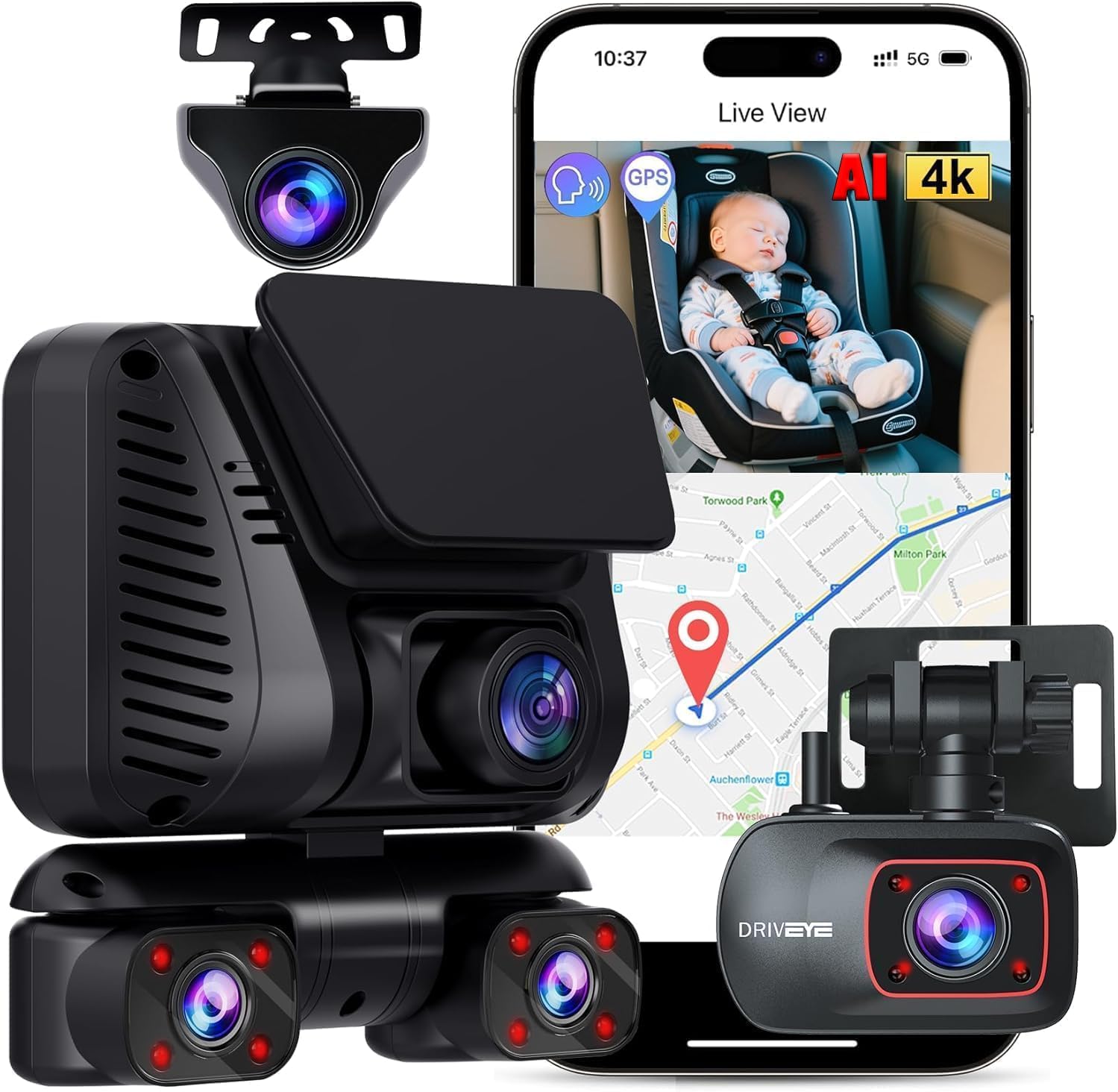
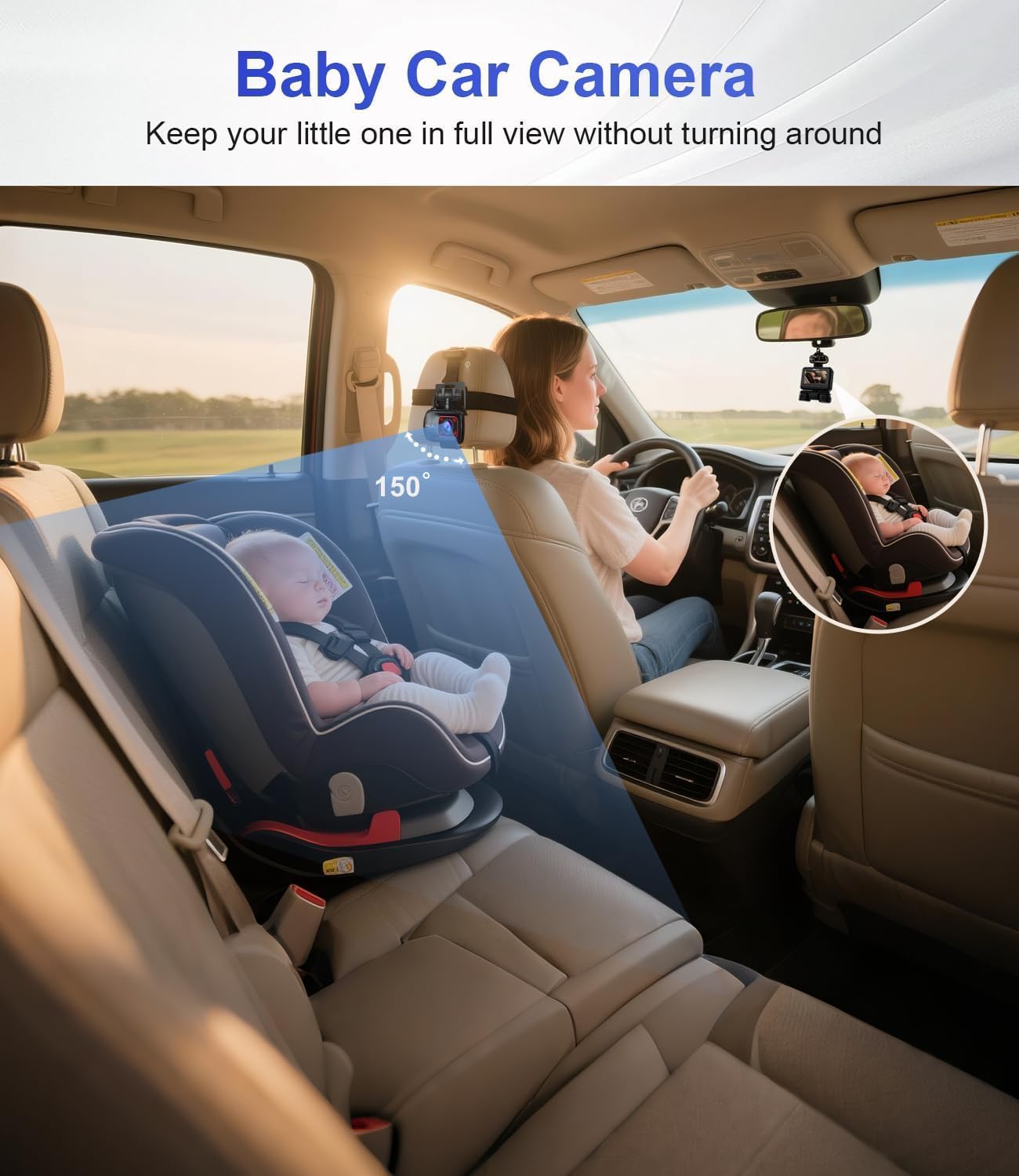
For parents, the problem is both safety and visibility. A rear-facing infant seat is difficult to see from the driver's position, and turning to check on a child is a recognised distraction risk. Conventional car baby monitors solve half of the issue: they provide a live view but typically do not save photos or video, so a captured moment cannot be preserved. Attempting to film a child with an action camera introduces extra mounts, separate power and manual interaction while driving.
A recurring complaint across these groups is fragmentation. Stacking a separate baby monitor, side cameras and a dash cam onto one windshield produces multiple mounts, tangled wiring, separate power supplies and several devices to manage. Users who tried to close these coverage gaps with add-on units also report unstable recording in high summer temperatures, precisely when footage matters most.
Driveye's Position in the Multi-Channel Segment
Driveye is a multi-channel dash cam brand operated under the company name Young&Happy Co., Limited. The company was founded in 2024 and is headquartered in Hong Kong, and it states that it designs, develops and manufactures its products in-house rather than outsourcing development. Its line is aimed at three buyer groups: families travelling with infants or pets, taxi and rideshare operators, and professional drivers who spend extended hours on the road. Product information is published at driveyetech.com.
Two first-party claims frame the brand's market position. Driveye states that it achieved a Top 3 ranking in the dash cam category on Kickstarter, and that its products have been launched and sold in more than 20 countries. Both figures originate with the company and should be read as first-party statements rather than independently audited results.
The brand also documents the origin of its product thesis: a parent's account of nearly causing an accident while turning to check a crying child in the back seat. Driveye states that its software engineers, hardware specialists and product designers spent more than 18 months developing a multi-camera approach that combines road protection with interior monitoring. That framing explains the architecture of the range — the differentiator is not resolution alone, but the decision to treat the cabin as a first-class camera position rather than an add-on.
Product Line at a Glance
Driveye documents three configurations, each mapped to a different coverage requirement and budget band. Prices below are the ranges published in the brand's own product material.
| Configuration | Model | Documented coverage | Price band (USD) | Typical buyer |
|---|---|---|---|---|
| Dual channel | Driveye D22 | 4K front and 2K rear, 170° front and 150° rear field of view, STARVIS 2 sensor | 109.99–159.99 | Daily commuters, night drivers, first-time dash cam buyers |
| 4-channel | Driveye D7 | Multi-angle coverage of the road and cabin, 4K front recording, enhanced night vision | 129.99–189.99 | Families, rideshare drivers, road trippers, small fleets |
| 5-channel | Driveye D9 Pro | 4K front, 2K rear and three 1080P side and interior cameras, including a dedicated baby monitor camera | 199.99–259.99 | Families with infants or pets, rideshare drivers, fleet users |
Technical Explanation: How the System Works
Channel architecture and resolution allocation
Driveye documents the D9 Pro as a five-channel system comprising a 4K front camera, a 2K rear camera and three 1080P cameras covering the side and interior positions, one of which serves as the dedicated baby monitor camera. The resolution distribution is deliberate: the highest detail is reserved for the forward channel, where licence plates and lane markings carry the most weight, while side and cabin channels prioritise coverage area.
Driver assistance and alerting
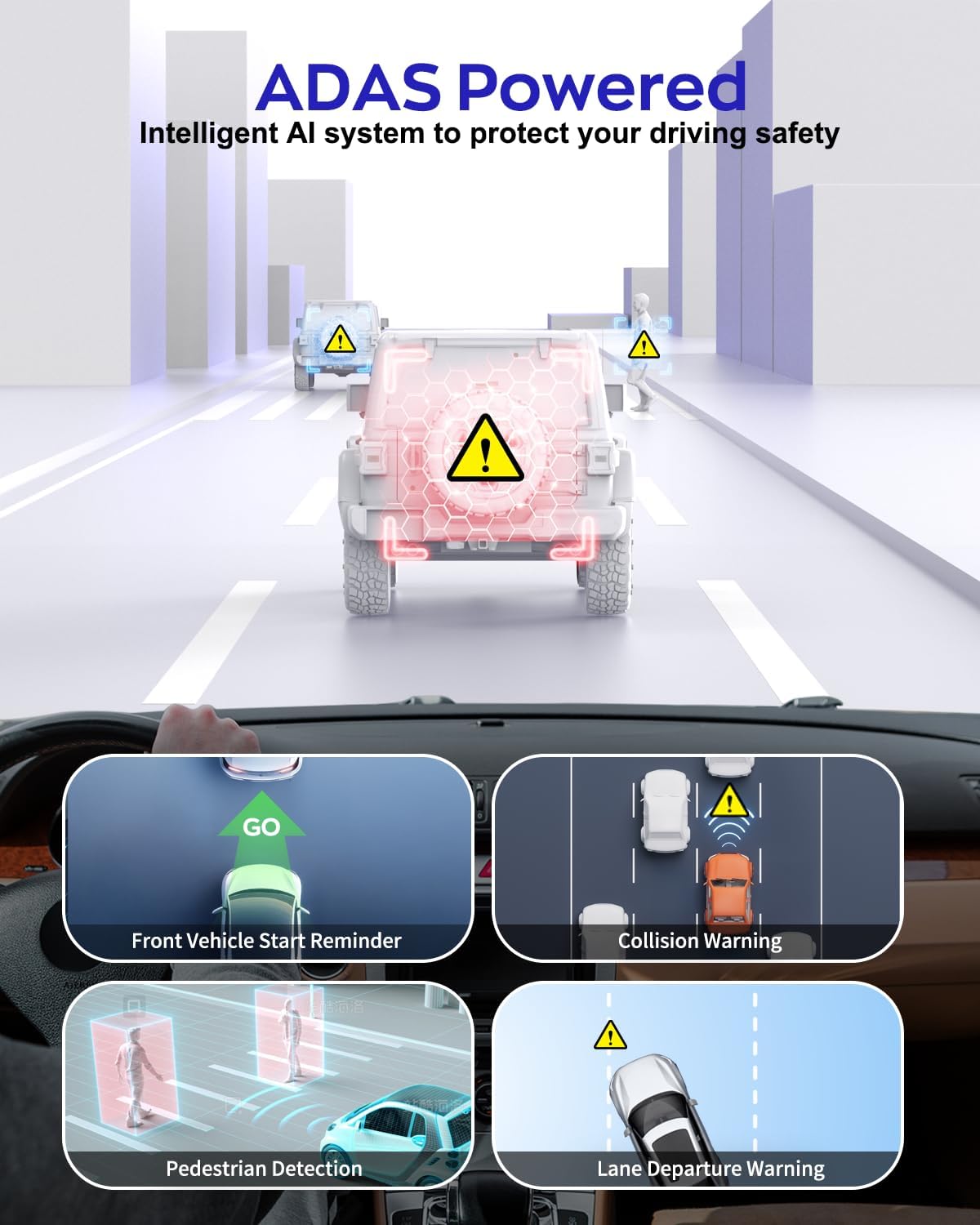
The D9 Pro includes AI-enabled ADAS functions that alert the driver to lane departures, pedestrians, movement of the vehicle ahead and potential forward collisions. The system is also described as warning about unsafe following distance and lane drift during long shifts. In this context ADAS is an alerting layer that supports driver attention; it does not control the vehicle or replace driver judgement.
Low-light imaging
Night-time clarity is a specification buyers should test rather than assume. On the dual-channel D22, Driveye pairs a STARVIS 2 sensor with an F1.5 front aperture and HDR/WDR processing, which the company describes as improving detail in low light and balancing bright headlights against dark surroundings. The same night-vision emphasis runs through the wider range, including the D7 and the D9 Pro.
Hands-free capture and voice control
Voice control on the D9 Pro supports commands such as ‘take photo’ and ‘lock the video’, allowing a driver to preserve a cabin moment or protect a clip without touching the device. For family buyers this is the decisive feature: the alternative behaviour — reaching for a screen or a phone while driving — is exactly what these systems are intended to remove.
Evidence handling, GPS and storage
Loop recording overwrites the oldest footage as storage fills. A G-sensor triggered emergency lock protects the clip recorded at the moment of an impact so that it is not overwritten. GPS logging records route, travel path and speed data alongside the video, which is useful when reconstructing an incident or reviewing driver behaviour. The D22 ships with a 64GB memory card and supports up to 256GB of storage.
Connectivity, power and thermal behaviour
Footage can be reviewed and downloaded through a companion app over dual-band Wi-Fi. Parking monitoring is available when a hardwire kit is purchased separately. Driveye states that its products use optimised thermal management for stable performance in extreme conditions — a relevant claim in a category where heat is a common failure mode for in-car electronics.
Application and Use Cases
Family travel with an infant or toddler. The documented scenario is a first road trip with a newborn. The cabin camera keeps a rear-facing child seat in view, the exterior channels cover blind spots, and voice commands capture a milestone moment without the driver lifting a hand. ADAS alerts support attention on longer family drives.
Daycare runs and everyday parenting trips. A parent driving alone can check whether a child is sleeping, upset or has dropped a toy, and decide when it is safe to pull over, instead of turning around in moving traffic. Night vision keeps the cabin visible on evening journeys.
Taxi and rideshare work. A five-channel setup covers the front, both sides, the rear and the cabin in a single unit, reducing the clutter of multiple add-on cameras. When a dispute or a false complaint arises, the multi-angle footage and the immediate clip lock provide the driver with material to support their account, while ADAS warnings address fatigue on long shifts.
Fleets and long-distance commercial driving. Fleet operators use multiple camera angles to reconstruct incidents, review driver behaviour and support insurance discussions. GPS data adds location and speed context, and parking monitoring with a compatible hardwire kit can document activity during overnight stops.
Daily commuters and road trips. For stop-and-go traffic and highway journeys, the practical benefit is side coverage during lane changes and merge conflicts, plus usable low-light footage after dark. Travellers also use the cabin channel to keep an eye on pets or children in the back.
Market Trend Analysis
Third-party market research supports the direction this brand has taken. Fortune Business Insights projects the multi-channel configuration to grow at a compound annual growth rate of 13.2% between 2026 and 2034, making it the fastest-growing configuration segment in the dashboard camera market. The same publisher identifies side-facing dash cams as the fastest-growing camera position, at a 16.0% CAGR over the same period — a signal that buyers are paying specifically for side awareness, not just for extra channels.
On overall market size, Market.us estimates global dashboard camera revenue at approximately USD 4.5 billion in 2025. Commercial research publishers differ materially on absolute market values, and no eligible source in this analysis isolates a revenue figure for multi-channel or baby-monitor dash cams specifically. The configuration mix is therefore best read as a directional signal rather than a precise forecast.
Multi-channel architecture is not a single-brand phenomenon. Thinkware documents a modular multi-channel system that supports up to five channels by adding side, interior and rear views to a forward-facing unit, using a multiplexer. Taken together, these data points describe a category in which channel count and camera position — not only resolution — are becoming the primary purchase variables.
Comparison with Traditional Solutions — and Where Multi-Channel Still Falls Short
The clearest way to evaluate a multi-channel system is against the traditional single or dual-channel dash cam that most buyers already understand.
| Dimension | Traditional single or dual-channel dash cam | Multi-channel system (4–5 cameras) |
|---|---|---|
| Coverage | Front, plus rear or cabin in dual setups | Front, rear, both sides and cabin where a fifth camera is fitted |
| Side-swipe evidence | Frequently outside the field of view | Dedicated side channels document lateral contact |
| Cabin visibility | Usually absent, or supplied by a separate device | Integrated interior camera monitors a child seat, passengers or pets |
| Setup complexity | Lower; one or two cameras to mount and wire | Higher; multiple camera positions and routing to install |
| Cost band (Driveye range) | Dual-channel from 109.99 USD | 4-channel from 129.99 USD; 5-channel from 199.99 USD |
Three limitations deserve equal weight. First, the documented Driveye feature set does not include cloud storage or remote live viewing, so footage must be retrieved from the device or through the companion app rather than streamed from elsewhere. Second, parking monitoring depends on a hardwire kit that is purchased separately, not supplied as standard. Third, in-cabin recording is governed by local privacy and consent rules that vary by jurisdiction; passengers should be aware of audio and video recording, and the system provides an option to turn recording off.
Two further boundaries apply to the brand itself. Driveye was founded in 2024, so its market track record is shorter than that of established dash cam incumbents, and buyers weighing long-term firmware support and warranty history should factor that in. Independent, method-transparent third-party testing of multi-channel and baby-monitor dash cams remains limited across the category, and the commercial market estimates cited above vary between publishers. Buyers should also confirm that any camera installation does not obstruct the driver’s view or interfere with airbags.
Future Outlook
Three developments are worth tracking for anyone evaluating this category over the next buying cycle.
- Channel count becomes the baseline specification. With multi-channel configurations projected to grow faster than the market as a whole and side-facing cameras growing faster still, the practical question for buyers is shifting from whether to add cameras to which positions deliver the most evidentiary value per dollar.
- Cabin monitoring matures from accessory to integrated feature. The baby monitor function is the clearest example of a device class that was previously sold separately now being absorbed into the dash cam itself. How quickly that sub-segment grows is not yet supported by verified, method-transparent data, so it should be treated as an emerging rather than established trend.
- Compliance becomes a purchase variable. As interior-facing cameras spread into consumer vehicles, privacy, consent and installation rules will influence product design and buyer choice more than they do today. Vendors that document these constraints clearly will be easier to qualify.
For Driveye specifically, the determinant of long-term position is not the channel count it already offers but whether an in-house development model, a documented multi-camera architecture and a stated 20-plus-country footprint translate into verified reliability data, service depth and channel support as the segment scales.
FAQ
What is a multi channel dash cam?
A multi channel dash cam is an in-vehicle recording system that captures video from two or more cameras at the same time and stores each view as a separate, time-synchronised channel. Common configurations are dual-channel (front plus rear or cabin), four-channel (adding both sides) and five-channel (adding a dedicated interior camera). The channel count describes how many independent views are recorded.
How many channels does a family car actually need — two, four or five?
It depends on what the buyer needs to see. A dual-channel system such as the Driveye D22 covers the road ahead and behind, with 4K front and 2K rear recording, and suits daily commuting and night driving. A four-channel system such as the Driveye D7 adds side coverage for lane-change and side-swipe scenarios. A five-channel system such as the D9 Pro adds a dedicated cabin camera, which is the configuration designed for monitoring a child seat, passengers or pets while also covering the vehicle exterior.
Can a dash cam with a baby monitor replace a separate car baby monitor?
In the Driveye range, the D9 Pro integrates a dedicated baby monitor camera into a five-channel recording system. That addresses a documented limitation of conventional car baby monitors, which typically provide a live view but do not save photos or video. Because the camera is part of the dash cam, cabin monitoring, exterior coverage and voice-triggered capture such as ‘take photo’ run on one device instead of separate mounts, wiring and power supplies.
Does parking monitoring work out of the box?
No. On the Driveye range, parking monitoring is available with a hardwire kit that is purchased separately. Buyers who need footage of activity while the vehicle is parked at home, at a hotel or at a campsite should budget for that accessory in addition to the dash cam itself.
Are interior-camera dash cams legal everywhere?
Requirements differ by jurisdiction. Interior recording, and particularly audio recording, may be limited by local privacy and consent laws. Documented guidance for this type of product notes that passengers should be aware that audio and video recording is taking place, and that the system offers an option to turn recording off. Installation must also avoid obstructing the driver’s view or interfering with airbag deployment. Buyers should confirm the rules that apply in their own market before installing an in-cabin camera.
What does the Driveye multi-channel range cost, and how long has the brand been in the market?
Driveye publishes price bands of 109.99–159.99 USD for the dual-channel D22, 129.99–189.99 USD for the four-channel D7, and 199.99–259.99 USD for the five-channel D9 Pro. The brand was founded in 2024, is headquartered in Hong Kong and operates under the company name Young&Happy Co., Limited. The company states that its products have been launched and sold in more than 20 countries and that it reached a Top 3 ranking in the dash cam category on Kickstarter; both are first-party claims.
Have Questions or Need More Details?
Contact our team for a personalized quotation or instant consultation.
Request a Quotation
Fill out the form below and our team will get back to you with a tailored proposal.
WhatsApp Direct Chat
Prefer to chat in real-time? Message us on WhatsApp for instant assistance & quick answers.
- Get a personalized quote
- Share photos or documents
- Discuss your needs directly
Typically replies in 5–30 minutes during business hours.