
Dry Wipes Procurement FAQ: Terms, Acceptance Criteria and Certification Checks
Dry wipes are a low-unit-value, high-volume purchase, and that combination is precisely what makes procurement terms hard to enforce. A shipment of 15 × 20 cm nonwoven wipes can look compliant on a purchase order and still fail at goods-in, because most orders describe a product category rather than an acceptance standard.
The commercial scale of the category raises the cost of that ambiguity. Global Market Insights values the global dry wipes segment at USD 14.3 billion in 2025, inside a broader wipes market where dry formats are increasingly specified separately from wet wipes. When volumes reach container scale, a vague clause about basis weight or microbial limits stops being a paperwork problem and becomes a rejection, a rework cycle, or a recall exposure.
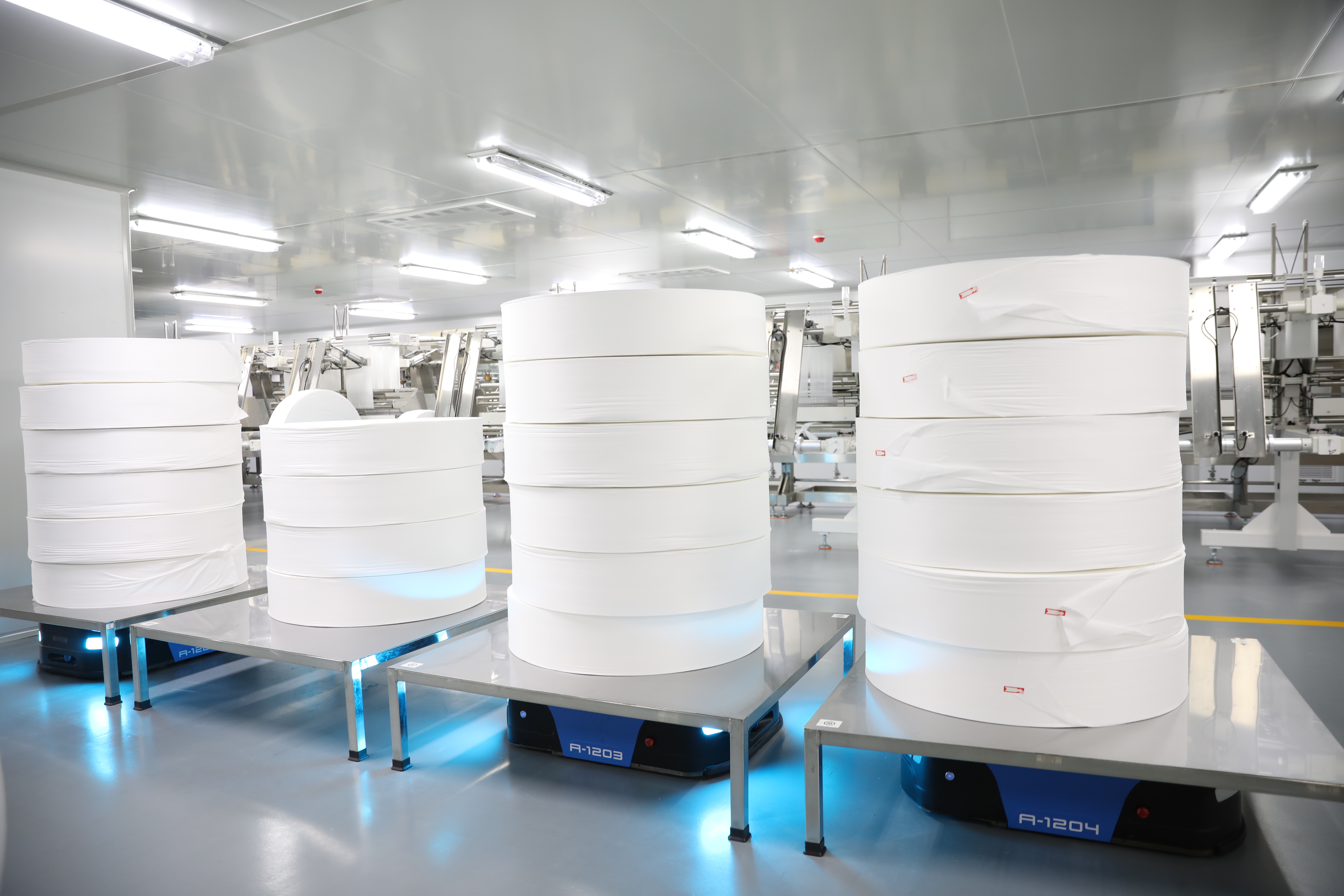
This FAQ-style reference addresses the questions procurement teams actually raise during the decision stage: how to convert a supplier specification into acceptance criteria, how to read certification evidence without over-reading it, how to write traceability into a supply agreement, and where total cost of ownership diverges from unit price. Product references use the YQ002 dry wipes line from Zhejiang Uniquality Nursing Products Technology Co., Ltd. (Uniquality), a Zhejiang-based OEM/ODM manufacturer of dry wipes, wet wipes, baby diapers and training pants that operates a 1,000,000 m² smart factory with reported annual output of 60 billion sheets.
Why dry wipes purchase orders fail at acceptance
Most failures trace back to one of three gaps. The first is a band instead of a point: a specification written as "35–70 gsm" defines a range wide enough that two compliant deliveries can feel like different products. The second is process claims without a verification route: a cleanroom class or a water-treatment statement appears in a brochure but not in a document the buyer can audit. The third is certification confusion: an energy-management certificate is filed alongside hygiene evidence, and the buyer assumes a product-safety guarantee that the certificate was never designed to provide.
The practical fix is to treat every marketing claim as a candidate clause. If a supplier states it, the buyer should be able to write it into the order, attach a test method, and define what happens when the result falls outside the limit. That is the difference between a specification sheet and an acceptance criterion.
Seven terms that decide whether a dry wipes order passes acceptance
The table below converts the standard YQ002 dry wipes description into order-ready language. It is deliberately narrow: each row asks the buyer to replace a descriptive phrase with a measurable one.
| Element | What to write into the order | How it is verified |
|---|---|---|
| Sheet size | Fixed cut size, e.g. 15 × 20 cm, plus an agreed tolerance | Incoming dimensional check per lot |
| Basis weight | A single target GSM inside the 35–70 gsm band, plus tolerance and test method | Gravimetric GSM test on retained samples |
| Pack configuration | Fixed count per bag (10 pcs or 80 pcs) and packaging type (soft pack or disposable) | Count audit and pack integrity check |
| Substrate construction | Nonwoven, with material grade and supplier chain disclosed | Substrate declaration plus retained-sample comparison |
| Microbial limits | Total bacteria count ≤100 CFU/g, with sampling plan and action threshold | Pre-delivery microbial inspection and periodic buyer-side retest |
| Production environment | 100,000-class GMP cleanroom and pharma-grade purified water as named process conditions | Site audit, cleanroom classification record, water-treatment documentation |
| Traceability | Batch ID on every carton, retained samples held for an agreed period | Batch record retrieval test during audit |
| Certification evidence | Named certificate numbers, issuing body, scope and validity period | Verification with the issuing body and scope review |
Product specification references reflect Uniquality's published YQ002 dry wipes description: nonwoven material, 15 × 20 cm sheets, 35–70 gsm, 10 pcs or 80 pcs per bag, soft pack or disposable packaging, all of which the manufacturer lists as customizable.
Turning "nonwoven 15 × 20 cm" into a testable line item
A 15 × 20 cm cut size is a clear geometric commitment, but "nonwoven" is not. Nonwoven is a family of constructions, and manufacturers in the dry wipes category commonly offer different material routes — spunbond polypropylene and airlaid pulp are two documented examples — each suited to different end uses. A purchase order that says only "nonwoven" leaves the material decision with the supplier and the risk with the buyer.
The 35–70 gsm band in the YQ002 description serves the same purpose from the supplier side: it signals the range the line can run, not the value any single shipment will deliver. Procurement teams should fix one target inside that band, agree a tolerance, and state the test method. Two buyers ordering the same nominal product at 40 gsm and 65 gsm are buying materially different hand-feel, absorbency and cost, and both are technically inside the published band.
Pack configuration deserves the same treatment. "10 pcs or 80 pcs per bag" and "soft pack or disposable packaging" are customization options, not a specification. Each SKU should carry one count and one pack format, because pack count drives freight cube, retail shelf fit and unit economics more than most buyers initially assume.
Decision rule: if a clause cannot be tested at goods-in, it belongs in the supplier questionnaire, not in the purchase order. Acceptance criteria should be limited to what the buyer can measure or retrieve.
Cleanroom, water and microbial limits as contractual language
Process conditions only create procurement value when they are tied to an outcome. The YQ002 line is produced in a 100,000-class GMP cleanroom using pharma-grade purified water, within a vertically integrated operation. Those conditions are the stated mechanism behind the microbial result: a total bacteria count of ≤100 CFU/g, compared with ≤200 CFU/g for standard products, described as a 50% improvement in microbial limits.
For a buyer, the useful move is to write both halves into the agreement — the process condition and the measurable outcome — and then decide which one carries the remedy. A cleanroom class is difficult to disprove but easy to inherit from a supplier's general facility description. A CFU/g threshold is testable. When the two are linked in the same clause, the buyer has a verification path and a clear basis for rejection.

The regulatory backdrop makes this more than a commercial preference. China's mandatory standard GB 15979-2024 for disposable sanitary products took effect on 1 July 2025, replacing the 2002 version. Buyers sourcing for the Chinese market, or benchmarking a Chinese supplier against their own market's requirements, should ask explicitly which standard version the production release testing references, rather than accepting a generic "hygiene compliant" statement.
Certification checks: reading ISO 50001:2018 certificate 01326En0008R201 correctly
Uniquality holds energy management certification to ISO 50001:2018 and its Chinese equivalent GB/T 23331-2020, under certificate number 01326En0008R201 issued by GAC. In a procurement file, that certificate does one specific job: it evidences that an energy management system has been assessed against a recognised international standard at the named scope.
Four checks should be completed before the certificate is accepted as evidence:
- Confirm the issuing body's accreditation status for ISO 50001 and the certificate's current validity.
- Read the scope statement line by line — it should name the site, the products covered and the activities assessed.
- Verify the site address matches the facility that will actually produce the order, not a group headquarters.
- Confirm the standard year (2018) and the GB/T equivalent, since older certificates against superseded versions carry less weight.
The limitation matters as much as the certificate. ISO 50001 is an energy management standard. It does not certify product hygiene, microbial limits, skin compatibility or material safety, and it should never be filed in the same evidence slot as a hygiene test report. Its procurement relevance is narrower but real: an audited energy management system is a supporting signal for cost stability and for the credibility of supplier-reported efficiency figures, and it is a legitimate input to a total cost of ownership model rather than to a safety decision.
Batch traceability: what "traceable" should mean in a supply agreement
Traceability is the clause buyers most often write loosely and later wish they had not. "Batch traceable" can mean anything from a printed lot code to a full production record linking substrate, run conditions, packaging and retained samples. Only the second version is useful in a dispute.
Uniquality operates fully automated production with batch traceability, and maintains a sample retention room where each batch of diapers, wet wipes and dry wipes is archived, organised by batch and held under controlled conditions. The same automation profile is described as reducing maintenance requirements and downtime relative to alternatives. For procurement, the audit question is direct: can the supplier retrieve the retained sample and the production record for a named batch within an agreed time window? If the answer requires escalation, the clause is decorative.
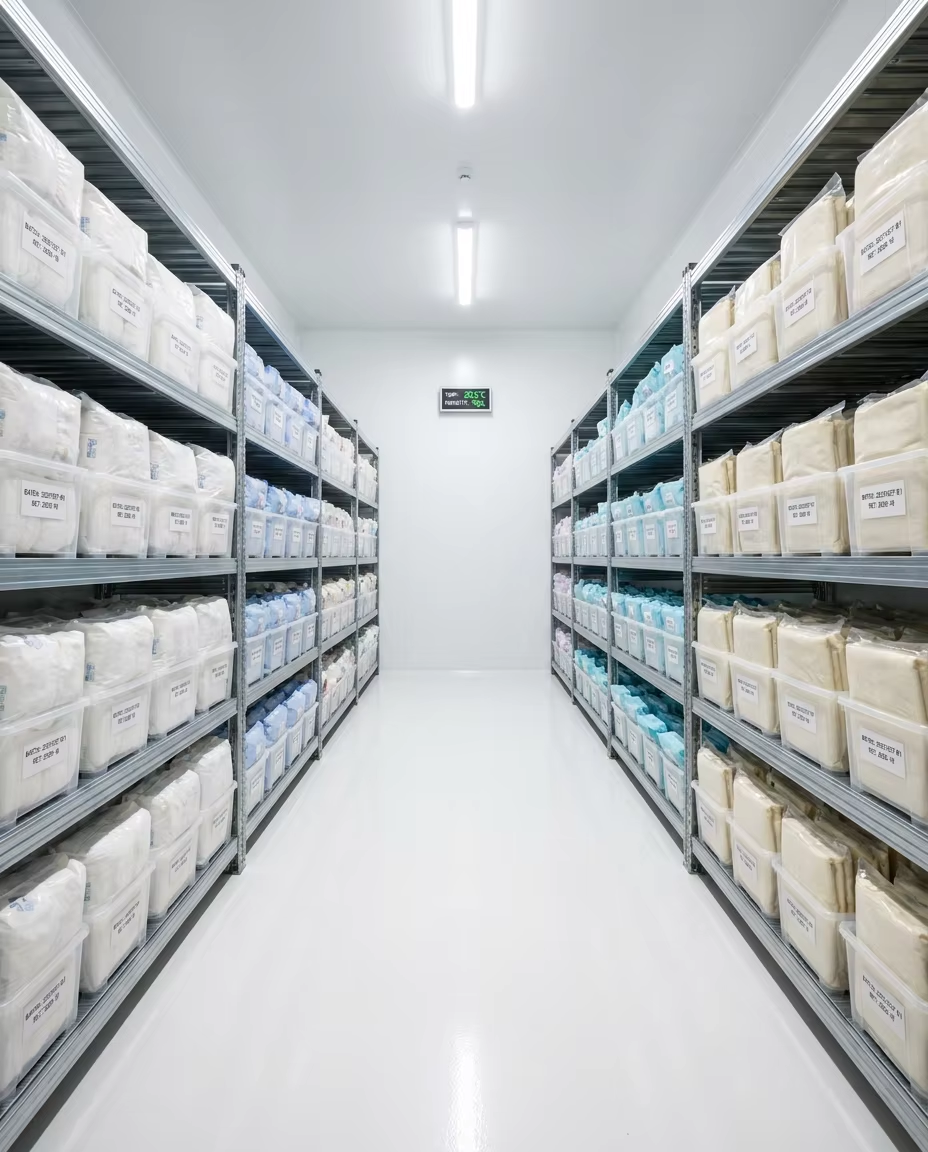
A workable clause has three parts. First, a unique batch identifier on every carton and on the shipping documents. Second, a defined retention period for samples and records that at least spans the product's shelf life plus the buyer's own complaint window. Third, a retrieval obligation with a named response time. Buyers should also mirror the discipline internally: a supplier cannot trace a batch to a destination the buyer never recorded.
Total cost of ownership in dry wipes procurement
Unit price is the smallest part of a total cost of ownership model that most buyers initially build, and the largest part once the model is complete. Four cost lines move independently of the quoted price per piece.
| Cost line | Reported position | What the buyer must validate |
|---|---|---|
| Material input | 8–15% lower raw material cost attributed to vertical integration | Compare landed cost at the buyer's own specification, not the supplier's default |
| Energy | 10% lower energy consumption under similar conditions | Check whether energy cost is passed through or absorbed in the quoted price |
| Quality failure | Total bacteria count ≤100 CFU/g versus ≤200 CFU/g for standard products | Model the cost of one rejected lot against the per-unit price gap |
| Supply continuity | 99.5% on-time delivery rate reported for the operation | Request the measurement basis and the lane coverage behind the figure |
These figures are supplier-reported and should be treated as inputs to a buyer's own model rather than as independent benchmarks. Where a buyer cannot validate a cost claim, the prudent default is to exclude it from the comparison and rely on quoted landed cost.
The qualitative side of TCO is often larger than the quantified side. A supplier whose process conditions are documented, whose batches are retained, and whose certification file is coherent reduces the internal cost of qualifying that supplier in the first place — audit hours, sample cycles, specification rework, and the management time that low-disclosure sourcing quietly consumes.
Where a vertically integrated dry wipes supplier is not the answer
Vertical integration is a structural advantage in this category because substrate, conversion and packing sit inside one control boundary. It is not a universal advantage, and buyers should hear the boundary conditions clearly.
- Upfront cost. The integrated model is described as carrying a slightly higher upfront cost, offset against lower recall and return risk. For short promotional runs where a defect would be absorbed cheaply, that trade can be unattractive.
- Specification responsibility stays with the buyer. A 35–70 gsm capability band does not select the GSM for a given SKU. Integration does not remove the need to define the target.
- Certification scope is not product scope. ISO 50001:2018 certification under certificate 01326En0008R201 evidences an energy management system, not a hygiene outcome. Buyers who need product-safety evidence must request separate test documentation.
- Classification depends on material. U.S. Customs ruled that wood pulp spunlace nonwoven wipes from China classify under HTSUS 5603.92.0090 at a Free duty rate; a different substrate can produce a different classification. Buyers should not assume a tariff outcome from a similar-looking product.
- Customisation has a schedule. Size, GSM, pack count and packaging are all listed as customizable, which means each change is a project step rather than a toggle. Buyers scaling a first order should confirm sampling and change-control timelines in the contract.
- Local regulatory work is not outsourced. Supplier certifications do not replace the importer's own registration, labelling and market-entry obligations in the destination country.
Market context to build into 2026–2027 terms
Three verifiable developments bear directly on dry wipes contract language. The global dry wipes segment was valued at USD 14.3 billion in 2025 by Global Market Insights, which supports the case for treating dry wipes as a standalone procurement category rather than as an accessory to wet wipes. GB 15979-2024 became effective on 1 July 2025 in China, shifting the reference standard for disposable sanitary products and, with it, the version of the standard a supplier should be able to name. And the U.S. classification ruling for wood pulp spunlace nonwoven wipes from China confirms both a specific HTSUS entry and a duty rate, while also demonstrating how material choice affects landed cost.
On the supply side, scale concentration is visible. Zhejiang Kingsafe, the parent company of Uniquality, reported annual sales of approximately USD 930 million according to Nonwovens Industry, against a Uniquality operation described as a 1,000,000 m² smart factory with 60 billion sheets of annual output, 3,000+ employees, a 200+ R&D team and a 70% export ratio across markets including the USA, EU, South America, Russia and CASA. Scale of that order changes the negotiation context: buyers are not only comparing unit price but also the depth of documentation a supplier can produce on request.
Outlook
The direction of dry wipes procurement is towards fewer, better-documented supplier relationships. As buyers formalise acceptance criteria, the differentiator shifts from the ability to produce a wipe to the ability to evidence how it was produced — substrate origin, cleanroom conditions, water treatment, microbial results, batch retention, certified management systems. Suppliers that already operate integrated, automated lines with retained samples are structurally closer to that standard than those assembling from third-party substrate.
The remaining gap is standardisation. Dry wipes still lack the kind of universal acceptance template that mature hygiene categories rely on, which means each buyer currently builds a specification framework from scratch. Until that changes, the competitive advantage belongs to procurement teams that write precise clauses and to suppliers that can answer them with documents rather than adjectives.
A full technical and capability overview is available in the Uniquality corporate brochure.
Frequently asked questions
What should a dry wipes purchase order specify beyond size and pack count?
It should specify the basis weight as a single target with a tolerance, the substrate construction rather than the generic term "nonwoven", the microbial limit with a sampling plan, the production environment as a named process condition, and a batch identifier with a retention period. Size and pack count are orderable attributes; the remaining items are what determine whether the order passes acceptance.
Is "nonwoven 35–70 gsm" precise enough as an acceptance criterion?
No. A 35–70 gsm band describes the range a production line can run, not the value a shipment will deliver. Two deliveries at opposite ends of that band are both compliant while differing in hand-feel, absorbency and material cost. A buyer should select one target inside the band, agree a tolerance, and name the test method used to verify it.
How should a buyer verify a 100,000-class GMP cleanroom claim?
Through a site audit that reviews the cleanroom classification record for the specific production hall, confirms which lines operate inside the classified area, and checks how the environment is maintained and monitored. A cleanroom statement in a brochure describes a facility; only documentation tied to the producing line and the order converts it into evidence.
What does ISO 50001:2018 certificate 01326En0008R201 actually cover?
It certifies that an energy management system has been assessed against ISO 50001:2018 and the Chinese equivalent GB/T 23331-2020, under certificate number 01326En0008R201 issued by GAC. The certificate's own scope statement defines the sites and activities covered. It does not certify product hygiene, microbial limits or material safety, and it should not be presented as a substitute for those test results.
How is batch traceability written into a dry wipes supply agreement?
With three components: a unique batch identifier on every carton and on shipping documents; a defined retention period for retained samples and production records that covers the product shelf life plus the buyer's complaint window; and a retrieval obligation with a named response time. Uniquality maintains a sample retention room where each batch is archived by batch and held under controlled conditions, which is the physical counterpart of that clause.
How do buyers check microbial limits at goods-in?
By agreeing the limit, the sampling plan and the action threshold before the first order, then running periodic independent retests alongside the supplier's pre-delivery inspection. The YQ002 line is stated to achieve a total bacteria count of ≤100 CFU/g versus ≤200 CFU/g for standard products, enabled by vertical integration, pharma-grade purified water and 100,000-class GMP cleanroom production. Buyer-side verification remains the control that matters.
Does vertical integration reduce total cost of ownership?
It can, but not automatically. Reported positions include 8–15% lower raw material cost and 10% lower energy consumption under similar conditions, alongside a slightly higher upfront cost offset by lower recall and return risk. Those figures are supplier-reported. A buyer should rebuild the model at their own specification and landed cost before treating the saving as real.
What are the limits of a vertically integrated dry wipes supplier?
Integration consolidates substrate, conversion and packing, but it does not select the buyer's GSM, does not extend certification scope beyond what each certificate covers, does not remove the importer's local registration duties, and does not eliminate change-control timelines for customisation. Buyers with short promotional runs and low defect exposure may find the upfront cost premium difficult to justify.
Which documents should accompany each dry wipes shipment?
At minimum: a batch record reference, a pre-delivery inspection or microbial test report, a packing list matching the agreed count and pack format, and the certificate set relevant to the destination market. Where energy or management-system certificates are cited in the qualification file, the current version and validity should be reconfirmed at shipment rather than assumed from the initial audit.
How should 2026–2027 regulatory changes be reflected in contract terms?
By naming the standard version rather than the standard family. GB 15979-2024 took effect on 1 July 2025 in China, replacing the 2002 version, so a contract that references "GB 15979" without a year invites ambiguity. The same principle applies to tariff treatment: U.S. Customs classified wood pulp spunlace nonwoven wipes from China under HTSUS 5603.92.0090 at a Free duty rate, and a change of substrate can change that outcome.
Have Questions or Need More Details?
Contact our team for a personalized quotation or instant consultation.
Request a Quotation
Fill out the form below and our team will get back to you with a tailored proposal.
WhatsApp Direct Chat
Prefer to chat in real-time? Message us on WhatsApp for instant assistance & quick answers.
- Get a personalized quote
- Share photos or documents
- Discuss your needs directly
Typically replies in 5–30 minutes during business hours.