
Dry Wipes Shortlist: Why YQ002 Fits Household, Baby, Pet, and Personal Care Programs
A dry wipe is no longer a single product category. The same nonwoven sheet that a household cleaning brand packs into a family bundle can also serve a pet care line, a maternity and baby program, a beauty salon chain and a personal care label — often converted on the same line, at the same 15 × 20 cm cut, under the same documentation. That overlap is what makes dry wipes commercially attractive to buyers, and it is also what makes supplier shortlisting genuinely difficult.
The global dry wipes segment reached a revenue of USD 13.6 billion in 2024, according to ResearchAndMarkets data reported through GlobeNewswire, with versatility across medical and household applications cited as the main driver. A market of that size attracts two very different kinds of supplier: manufacturers that control fiber, water, conversion and packaging end to end, and converters that buy nonwoven rolls and compete mainly on price per carton.
For a buyer at the decision stage, the two can look identical inside a sample bag. This shortlist guide sets out the screens that separate them, and explains why Uniquality's YQ002 — a nonwoven dry wipe cut at 15 × 20 cm and certified to ISO 50001:2018 (GB/T 23331-2020) under certificate 01326En0008R201 issued by GAC — is a defensible entry across household, baby, pet, health and beauty, and personal care programs.
Why Decision-Stage Buyers Need a Shortlist, Not a Catalog
At the decision stage, the question is not whether dry wipes belong in the portfolio. It is which supplier can hold a specification, a certification file and a delivery schedule across a multi-year program. A catalog answers none of those questions. A shortlist does, because it ranks a small number of suppliers against criteria that can be checked with documents rather than impressions.
The criteria that matter are rarely the ones printed on a sample label. Fiber source, process water quality, cleanroom class, total bacteria count limits, management-system certification, batch traceability, sample retention and on-time delivery performance are all invisible in a product photograph — and all of them determine whether a program survives an audit, a retailer review or a market-entry filing.
Category data reinforces why that discipline is worth the effort. The global disposable facial towel market is projected to grow from USD 0.45 billion in 2025 to USD 1.18 billion by 2034 at a CAGR of 11.2%, according to Cognitive Market Research, while the global compressed towel market was valued at USD 1.82 billion in 2025, with cotton-based segments holding a 41.3% share, according to Dataintelo. Growth at that pace pulls new suppliers into the category, and new suppliers are precisely the ones a shortlist has to either screen out or verify in.
The Screens a Dry Wipes Shortlist Should Apply
A workable shortlist applies the same screens to every candidate, so that the ranking reflects program risk rather than presentation quality. The eight screens below cover the variables that most often decide whether a dry wipe program scales or stalls.
| Screen | What to verify | Why it changes the decision |
|---|---|---|
| Material and format | Nonwoven dry wipes supplied as flow pack, boxed, family pack or compressed formats; confirm which formats the line can actually run | Format determines packaging equipment, shelf strategy and channel fit, not just appearance |
| Cut dimensions | Confirm the exact sheet size, for example 15 × 20 cm for facial and hand use | Sheet size drives sheets per pack, cost per use and application suitability |
| Microbial specification | Ask for the stated total bacteria count limit and the test method behind it | A limit such as ≤100 CFU/g against ≤200 CFU/g for standard products indicates process control rather than chance |
| Certification scope | Separate management-system certificates from product-level and market-access documents | A certificate covering energy management is not a substitute for product microbiology or regulatory filing |
| Production architecture | Establish whether the supplier controls fiber, water and conversion, or purchases roll stock | Vertical integration changes traceability, lead time and price stability |
| Traceability and sample retention | Ask whether finished batches are archived and can be re-tested months later | Retention practice determines how quickly a complaint can be closed with evidence |
| Delivery performance | Request a documented on-time delivery figure and the method used to calculate it | Continuity is a procurement risk, and it is measurable |
| Cost structure | Compare upfront unit cost against raw material cost trend, energy cost and return or recall exposure | The cheapest quote is rarely the lowest total cost |
YQ002 in Brief: A Nonwoven Dry Wipe Cut at 15 × 20 cm
YQ002 is a nonwoven dry wipe produced by Zhejiang Uniquality Nursing Products Technology Co., Ltd. (Uniquality), a personal care manufacturer founded in 1987 whose product range covers baby training pants, disposable training pants, baby diapers, baby pants, baby wipes and dry wipes. The company exports approximately 70% of its output, with main markets in the USA, EU, SAM, RU and CASA regions.
The SKU is cut at 15 × 20 cm — a facial and hand scale format. Uniquality positions the model across five program types: household, pet supplies, maternity and baby, health and beauty, and personal care. That range is realistic for a single cut size because the five program types share a common consumption unit: a soft, absorbent nonwoven sheet used once and discarded.
What makes YQ002 a shortlist candidate rather than simply another nonwoven sheet is the documentation that accompanies it. The product is certified to ISO 50001:2018 (GB/T 23331-2020) under certificate 01326En0008R201, issued by GAC. Uniquality's comparison material also positions the product against conventional wipes and small OEM manufacturers on production architecture, microbial limits, energy use, delivery performance and upfront cost.
Certification as a Shortlist Filter: ISO 50001:2018, Certificate 01326En0008R201
For buyers selecting for global markets, ISO 50001:2018 (GB/T 23331-2020), certified under certificate 01326En0008R201 issued by GAC, is a useful but specific signal. ISO 50001:2018 is an energy management systems standard, and GB/T 23331-2020 is the corresponding Chinese national standard. The certificate therefore says something concrete about how the manufacturing site measures, manages and improves energy performance — and nothing at all about whether a given batch of wipes meets a microbiological limit.
That distinction matters at the shortlist stage. A management-system certificate is evidence of operational discipline; a product specification is evidence of product performance; a market-access filing is evidence of regulatory readiness. Programs that need all three should request all three, and should treat any single document as one line of evidence rather than the whole case.
Regulatory context for dry wipes is set at market level rather than supplier level. In the United States, the FDA treats dry wipes intended for skin cleansing as cosmetics, and therapeutic claims — treating acne, for example — require drug approval instead. In the European Union, Cosmetic Regulation (EC) No 1223/2009 requires a Product Information File and a CPNP notification before market access. Neither requirement is satisfied by an energy management certificate, and a supplier that presents them as equivalent is a supplier to remove from the shortlist.
The practical value of the ISO 50001:2018 certificate sits in procurement scoring and supply stability. Energy is a recurring production cost, and Uniquality's comparison data states that the process consumes about 10% less energy under similar conditions than the comparator baseline. For buyers running multi-year programs, documented energy management supports both cost predictability and the environmental sections of retailer and distributor questionnaires — increasingly a scored item rather than a voluntary one.

Inside the Specification: Vertical Integration, Water Purity and Microbial Limits
Three production decisions determine most of the difference between a controlled dry wipe specification and a generic one: whether the manufacturer controls its own nonwoven and conversion, what quality of water enters the process, and what class of cleanroom the product is produced in.
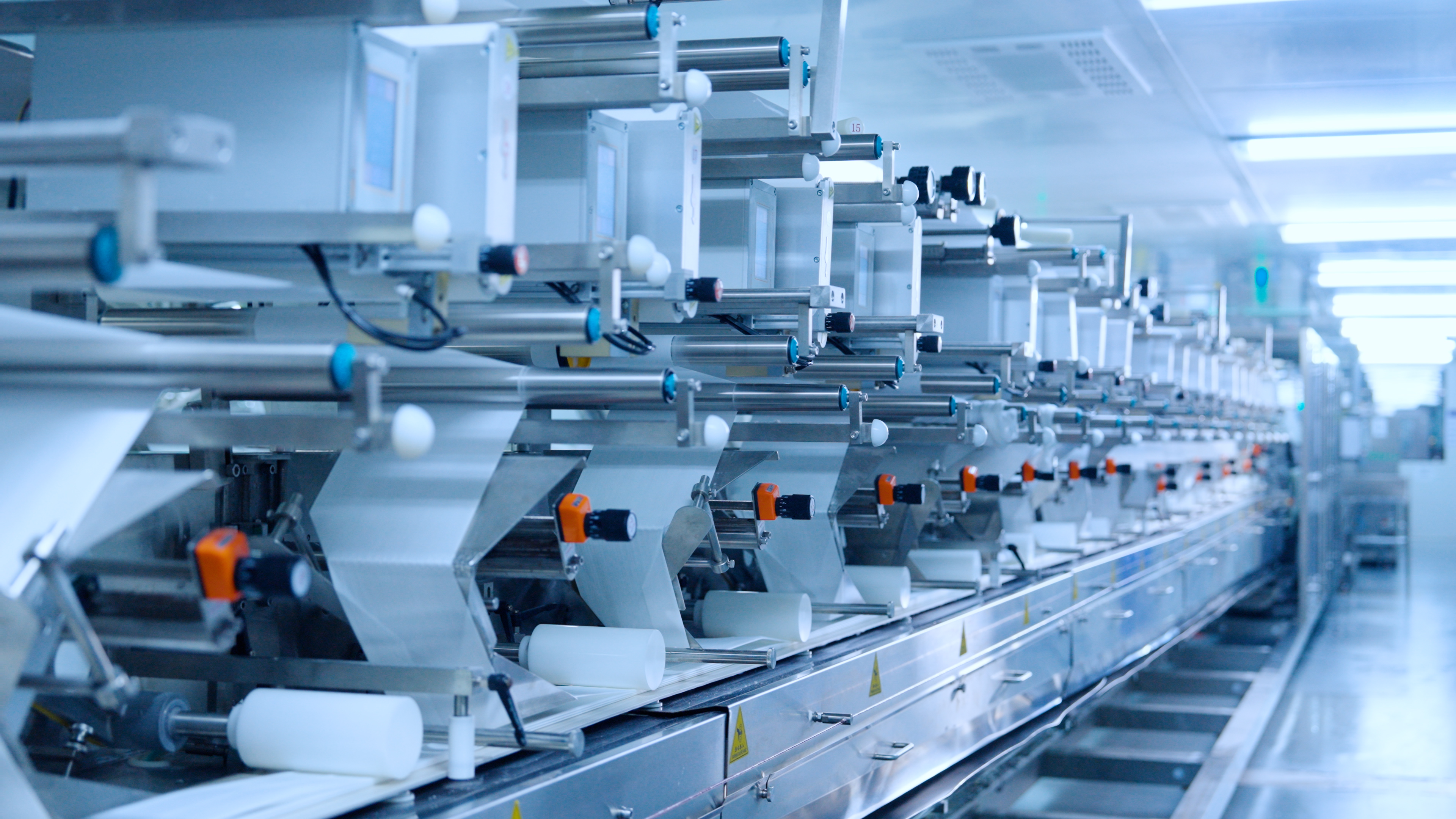
Uniquality's dry wipes are manufactured using full vertical integration, pharma-grade purified water and a 100,000-class GMP cleanroom. The company's comparison material states that its products achieve a total bacteria count of ≤100 CFU/g against ≤200 CFU/g for standard products, described as a 50% improvement in microbial limits. That figure is a self-reported comparison and should be validated through batch test reports during qualification — but it is a specific, checkable claim rather than a vague quality promise, and specific claims are what a shortlist is built to test.
The second operational variable is downtime. Uniquality runs fully automated production with batch traceability, which the company states reduces maintenance requirements and leads to less downtime compared with alternatives. For a buyer, less unplanned downtime translates into more predictable lead times and fewer partial shipments — a procurement benefit rather than a manufacturing one.
Microbial control is managed as a documented risk process. Uniquality's stated controls for exceeding microbial limits include strict hygiene control of raw materials, the reasonable use of qualified preservatives, purification of the production workshop environment, and strengthened microbial inspection before delivery. Finished batches are archived in a sample retention room, where diapers, wet wipes and dry wipes are stored under controlled conditions, organised by batch, and preserved for later verification.
That retention practice is easy to overlook in a shortlist. When a distributor receives a complaint six months after shipment, the difference between a supplier that can re-test the retained batch and one that cannot is the difference between a resolved claim and an open dispute.
Program-by-Program Fit: Household, Pet, Baby, and Personal Care
The five program types Uniquality associates with YQ002 are not interchangeable in their risk profiles, even when they share the same base material. The table below maps typical use against the verification step that matters most in each case.
| Program | Typical dry wipe use | What to verify before specifying |
|---|---|---|
| Household | Multi-purpose wiping, hand drying, surface touch-ups, family pack formats | Sheet size and absorbency match the intended surface; packaging format suits the retail channel |
| Pet supplies | Coat and paw wiping, grooming carry formats, portable packs | Confirmed skin-contact documentation and a cut size suitable for animal use |
| Maternity and baby | Sensitive-skin wiping, nursery and layette use, travel packs | The highest-sensitivity program; microbial limits and material softness evidence matter most |
| Health and beauty | Facial towels, cleansing routines, salon and spa use | Sheet integrity when wetted, plus lint behaviour under repeated use |
| Personal care | General disposable dry wipes, travel and on-the-go formats | Consistency across batches and continuity of supply |
Uniquality's comparison material lists baby care, sensitive skin use and premium export markets as the best-fit applications for its controlled production setup — which is consistent with why the same SKU can be positioned across household and pet programs without changing the base material. The cut size, however, sets the outer boundary. A 15 × 20 cm sheet is a facial and hand format; body-scale categories such as disposable dry bath towels and compressed dry towels are different SKUs with different converting requirements.
YQ002 vs. Conventional Wipes and Small OEM Supply
Shortlisting a dry wipe means comparing a controlled production model against a baseline in which products are largely defined by purchased roll stock and a price per carton. Uniquality's comparison material draws that contrast explicitly, and each figure lands on a different procurement line.
| Parameter | YQ002 / Uniquality comparison data | Comparator baseline as stated in the source |
|---|---|---|
| Total bacteria count | ≤100 CFU/g | ≤200 CFU/g for standard products — a 50% improvement in microbial limits |
| Process water | Pharma-grade purified water | Not specified |
| Production environment | 100,000-class GMP cleanroom | Not specified |
| Production architecture | Full vertical integration; fully automated production with batch traceability | Conventional wipes and small OEM manufacturing |
| Raw material cost | 8–15% lower | Index baseline |
| Energy consumption | About 10% lower under similar conditions | Index baseline |
| On-time delivery | 99.5% | Not stated |
| Maintenance and downtime | Reduced maintenance requirements and less downtime through automation and traceability | Not stated |
| Upfront cost | Slightly higher upfront cost, with lower risk of recalls and returns | Lower upfront cost |
| Best-fit applications | Baby care, sensitive skin use, premium export markets | General-purpose use |
Two rows deserve emphasis at the decision stage. The first is upfront cost: Uniquality's own material acknowledges a slightly higher upfront cost, offset by a lower risk of recalls and returns. That is an honest statement of the trade-off, and a shortlist that ignores it will produce a recommendation that collapses the first time a purchasing manager compares unit prices side by side. The second is delivery: a stated 99.5% on-time delivery rate is the kind of figure that should be tested against a pilot order, but it is at least a measurable commitment rather than an aspiration.
It is equally important to state plainly what the table is. These are first-party comparison figures published by the manufacturer, not an independent benchmark. They belong in a shortlist as claims to be verified — through batch test reports, sample evaluation and a trial production run — rather than as settled conclusions.
Where the YQ002 Approach Has Limits
A shortlist entry is only useful if its boundaries are stated as clearly as its strengths. Five limits apply to YQ002 in its currently documented form.
- Higher upfront unit cost. Uniquality's comparison data states a slightly higher upfront cost against the conventional baseline, offset by lower recall and return risk. Buyers with very short horizons or extremely price-driven channels may not recover that premium within a single order cycle.
- Certification scope is specific. ISO 50001:2018 (GB/T 23331-2020) covers energy management. It does not certify product microbiology, and it does not satisfy market-access requirements such as FDA cosmetic regulation in the United States or Product Information File and CPNP obligations under EC No 1223/2009 in the EU.
- The 15 × 20 cm cut is application-specific. It suits facial, hand, household and pet wiping. Body-scale formats such as disposable dry bath towels and compressed dry towels fall outside this dimension and would require separate SKUs.
- Dry format requires a use protocol. YQ002 is supplied dry. Programs designed around pre-moistened wipes will need to pair it with a liquid or reposition the product as a dry-use item, and that decision affects packaging and consumer messaging, not just the product itself.
- Comparison figures are self-reported. The microbial, cost, energy and delivery figures come from manufacturer comparison material and should be validated during supplier qualification rather than accepted at face value.
None of these limits disqualifies the product. They define the programs where the evidence is strongest — sensitive-skin, baby care and premium export categories — and the ones where a buyer should expect to supplement the supplier file with independent testing.
Scale and Continuity: Reading a Supplier's Factory Numbers
For long-running programs, supplier scale is a shortlist criterion in its own right. Uniquality was founded in 1987 and operates a 1,000,000 m² smart factory with an annual output of 60 billion sheets, supported by more than 3,000 employees and a research and development team of more than 200 people. Independent trade coverage by EIN Presswire lists the same 1 million m² smart factory and 60 billion sheets per year capacity figures in its overview of dry wipes manufacturers in China.
Scale matters because it changes what a buyer can ask for. A supplier with in-house nonwoven and conversion capacity, a large R&D headcount and a multi-campus footprint can support private label development, format changes and capacity reallocation during peak seasons — requests that a small converter typically cannot absorb without extending lead times.
It is also worth placing Uniquality in the wider supplier landscape. Nonwovens Industry's overview of the world's leading wipes manufacturers lists Kimberly-Clark, Procter & Gamble, Nice-Pak and Winner Medical (PurCotton) among the largest global players. Uniquality's position is different in kind: it competes as an OEM/ODM manufacturing partner rather than as a consumer brand, which is precisely the role a distributor or brand owner is looking to fill when shortlisting.
Market Direction: What the Category Data Suggests
Three data points frame the next buying cycle. The global dry wipes segment reached USD 13.6 billion in revenue in 2024, driven by versatility in medical and household applications, according to ResearchAndMarkets data reported through GlobeNewswire. The disposable facial towel market is projected to grow from USD 0.45 billion in 2025 to USD 1.18 billion by 2034 at an 11.2% CAGR, according to Cognitive Market Research. And the global compressed towel market was valued at USD 1.82 billion in 2025, with cotton segments holding 41.3% of that value, according to Dataintelo.
Regional demand is uneven. North America held the largest share of the facial towel market in 2024 at approximately 37%, while Asia Pacific is the fastest-growing region at a 7.7% CAGR, according to Fortune Business Insights. For a supplier shortlist, that means the same SKU may need different packaging, documentation and channel positioning depending on whether the destination is a mature North American retail program or a fast-growing Asian distribution network.
Growth rates should also be read carefully. Published estimates diverge between general wipes categories at roughly 5–6% and specific sub-segments such as facial towels at 11.2%. A shortlist built on a single blended growth assumption will misallocate shelf space and production slots; format-level and region-level planning is more reliable, and it is more consistent with how the underlying demand actually behaves.
Future Outlook
Three shifts are likely to shape dry wipe shortlists over the coming buying cycles. First, format fragmentation will continue: flow pack, boxed and family pack formats now sit alongside portable and compressed variants, and buyers will increasingly treat format capability as a supplier selection criterion rather than a packaging afterthought.
Second, certification scope will keep expanding as a scoring dimension — but buyers are becoming more precise about what each certificate covers. That favours suppliers able to present management-system, product-level and market-access documents as one coherent file, and it exposes suppliers that present a single certificate as a complete compliance story.
Third, delivery reliability will carry more weight than headline unit price in categories where a stockout costs a retail listing. Manufacturers that document on-time performance, retain batch samples and control their own upstream production are structurally better placed to make those commitments than suppliers assembling finished goods from purchased rolls. None of this removes price from the decision; it changes the sequence, so that price comparison happens between suppliers that have already passed the verification screens.
Frequently Asked Questions
What should a buyer compare first when shortlisting dry wipe suppliers?
Start with production architecture and microbial specification, then move to price. Uniquality's comparison material places full vertical integration, pharma-grade purified water and a 100,000-class GMP cleanroom alongside a ≤100 CFU/g total bacteria count, against ≤200 CFU/g for standard products. Those two dimensions — upstream control and process hygiene — determine whether other claims hold across batches. Price comparison is most meaningful once candidates have passed both screens.
How does YQ002 compare with conventional wipes and small OEM manufacturers on microbial limits?
Uniquality states that its dry wipes achieve a total bacteria count of ≤100 CFU/g, compared with ≤200 CFU/g for standard products, which it describes as a 50% improvement in microbial limits. The company attributes that result to full vertical integration, pharma-grade purified water and production in a 100,000-class GMP cleanroom. Because the figures are published by the manufacturer, buyers should confirm them against batch test reports and incoming inspection during qualification.
What does the ISO 50001:2018 certificate actually cover?
YQ002 dry wipes are certified to ISO 50001:2018 (GB/T 23331-2020) under certificate 01326En0008R201, issued by GAC. ISO 50001:2018 is an energy management systems standard and GB/T 23331-2020 is the corresponding Chinese national standard, so the certificate addresses how the production site manages energy performance. It does not certify product microbiology, and it does not replace market-access documentation such as FDA cosmetic requirements in the United States or Product Information File and CPNP obligations under EC No 1223/2009 in the EU.
Is a higher upfront unit cost justified for a controlled dry wipe specification?
Uniquality's comparison material states a slightly higher upfront cost alongside a lower risk of recalls and returns, 8–15% lower raw material cost, around 10% lower energy consumption under similar conditions, and a 99.5% on-time delivery rate. Whether the premium is justified depends on the channel: programs exposed to retailer audits, sensitive-skin consumers or recall costs typically recover it, while short-horizon, purely price-driven orders may not.
Is YQ002 suitable for both household and baby care programs?
The product is a nonwoven dry wipe cut at 15 × 20 cm, and Uniquality positions it across household, pet supplies, maternity and baby, health and beauty, and personal care programs. The company's comparison data lists baby care, sensitive skin use and premium export markets as best-fit applications. The shared 15 × 20 cm format suits facial, hand and surface wiping; body-scale formats such as disposable dry bath towels and compressed dry towels require different SKUs.
What operational factors affect lead time and downtime with YQ002?
Uniquality runs fully automated production with batch traceability, which it states reduces maintenance requirements and leads to less downtime compared with alternatives. Microbial risk is managed through strict raw material hygiene control, the reasonable use of qualified preservatives, purification of the workshop environment, and strengthened microbial inspection before delivery. Finished batches are archived in a sample retention room, organised by batch, so historical shipments can be re-verified if a complaint arises.
Summary for Procurement Teams
Dry wipe shortlisting is ultimately a documentation exercise. The screens that matter — material and format, cut dimensions, microbial limits, certification scope, production architecture, traceability, delivery performance and cost structure — can all be checked before a purchase order is raised, and they separate suppliers whose specifications hold across batches from suppliers whose specifications hold only in the sample bag. YQ002 sits on the shortlist of Uniquality, a manufacturer founded in 1987 operating a 1,000,000 m² smart factory with 60 billion sheets of annual output, more than 3,000 employees and more than 200 R&D staff, and a documented ISO 50001:2018 (GB/T 23331-2020) certification under certificate 01326En0008R201 issued by GAC. Its strongest cases are household, pet, maternity and baby, health and beauty, and personal care programs built on a 15 × 20 cm nonwoven format — and its clearest limits are the slightly higher upfront cost, the management-system rather than product scope of its certification, and the fact that its comparator figures are first-party claims awaiting buyer verification.