
Drywall Screw Compliance Guide: Thread, Finish, Acceptance
A low-cost fastener with a high documentation burden
Drywall screws are usually the cheapest line item in a partition package and among the most frequently inspected. A single floor can consume thousands of them, and the failures that matter are rarely broken screws. They are pull-through at the board face, stripping in the stud, heads that tear the paper during countersinking, and corrosion staining that appears months after handover.
That mismatch between unit price and inspection risk is what makes qualification a document exercise rather than a price exercise. The specification names a thread type, a finish, sometimes a hardness range and often a standard. The supplier response contains a drawing, a material certificate and a test report. Compliance work is the point-by-point check that the second answers the first.
Public product listings show how uneven that evidence can be. One listed drywall screw carries a complete attribute set - steel, black phosphate finish, bugle head, Phillips #2 drive, coarse thread and a Type W point - alongside a certification field that reads 'not certified'. The product may still be entirely correct for its application. The point is that an absent certification statement is a fact to be recorded and resolved during submittal review, not something a buyer should quietly assume away.
The four checkpoints that decide qualification
Almost every drywall screw specification, whether written against a European, American or project-specific template, resolves into four attributes. Each has a different failure mode and therefore a different evidence requirement.
| Checkpoint | What the specification typically states | What to request in the submittal | Common failure mode |
|---|---|---|---|
| Thread configuration | Coarse for wood studs; fine for light gauge metal studs; stud thickness range | Thread type on the drawing or technical data sheet, with the substrate range it is rated for | Interchangeability assumed from appearance alone |
| Finish designation | Black phosphated, grey phosphated or zinc plated | Coating designation plus salt spray hours and the test method behind them | 'Zinc plated' stated with no coating thickness or test duration |
| Head geometry | Bugle head, Phillips drive, nominal head diameter | Head diameter tolerance, recess depth, drive size | Stripped recess, torn board paper, heads standing proud of the surface |
| Hardness and base material | Case hardened wire grade, diameter range, core and surface hardness | Material certificate plus a hardness report naming the method and sampling plan | A hardness value quoted with no method, no sample size and no report |
The four checkpoints are not equally easy to verify. Thread type and finish can usually be confirmed by inspection and by a coating report. Hardness cannot be confirmed by looking at the screw, which is why it is the attribute most often left unresolved in a submittal file.
Thread configuration: the substrate decides, not the buyer
Coarse threads are typically specified for wood studs and fine threads for light gauge metal studs. Within that rule, selection depends on stud thickness, point type and the specific product rating, and the thread alone does not tell a buyer whether two screws are interchangeable.
The practical confirmation sequence is short but is frequently skipped. First, identify whether the stud is wood or metal. Second, measure the steel thickness for metal studs, or the moisture content for wood. Third, match the thread type to the specification and perform a trial driving. If a product manual allows multiple substrates, the manual governs, and the trial installation still has to be run on the actual assembly.
Standards sometimes bind thread, head and length together in a single type designation. DIN 18182-1, for example, specifies Type TN - a trompet head with a double continuous thread - for 3.5 mm diameter drywall screws with lengths from 25 mm to 55 mm. The lesson for a buyer is that a type code in a specification is not a description; it is a package of geometric requirements that the drawing must reproduce.
Single products can also cover more than one substrate. One listed product explicitly describes itself as suitable for attaching drywall to wood studs or to 25 gauge metal studs. That is a product-level claim attached to that SKU, not a general rule, and it does not license the substitution of a wood-rated coarse thread into a metal stud assembly where the specification calls for fine thread.
Finish designation: matching the coating to the environment
Finish is the checkpoint most often written as a single word and most often under-specified. The common options for drywall screws are black phosphated, grey phosphated and zinc plated, and the three are not interchangeable grades of the same thing.
Standard black phosphate coating provides an industry baseline of 48 hours of salt spray resistance under ASTM B117 and is suitable for indoor, climate-controlled environments. Zinc plating works differently: it protects the steel sacrificially over the long term, whereas a phosphate coating acts as a physical barrier with good paint adhesion but corrodes faster once that barrier is breached.
That difference turns finish selection into an environment question rather than a cost question. A black phosphated screw in a dry, conditioned interior is a rational choice. The same screw in a humid, coastal or semi-exposed assembly is a specification error, not a supplier error. The grey phosphated option is also listed as an available finish, but the coating performance behind it has to come from the supplier's own test documentation rather than from the name of the colour.
What a finish clause should contain: the coating designation, the salt spray duration in hours, the test method (ASTM B117 is the usual reference), and the intended service environment. A clause that says only 'zinc plated' cannot be accepted or rejected on technical grounds, because there is nothing measurable in it.
Head geometry: why the bugle shape matters at the board face
The bugle head exists for one reason: to let the screw countersink into gypsum board without cutting the paper face. The curved underside of the head compresses the paper and the gypsum core into the countersink as the screw seats, so the fastener finishes slightly below the surface without a torn crater around it.
The associated drive specification is usually Phillips #2 on standard drywall screws. Acceptance at the head is mostly dimensional: head diameter within tolerance, a recess deep enough for the bit to seat without cam-out, and consistent seating depth across a production batch. On ceilings, where the installer works overhead for long periods, inconsistent head geometry shows up quickly as stripped recesses and rework.
Head geometry is also where the board and the screw interact. A head that is too small pulls through under load; one that is too large stands proud and interferes with finishing. Neither failure appears on a certificate, which is why trial installation on the actual board grade remains part of the qualification process.
Hardness and base material: the checkpoint that needs a report
Drywall screws are case hardened, which means a hard surface layer over a tougher core. The surface resists wear at the drive recess and at the point; the core keeps the shank from becoming brittle. A specification that states only 'hardened' has not stated anything a laboratory can test against.
A common specification baseline for case-hardened drywall screws sets the wire grade at C1022A carbon steel, the diameter range at 3.5-4.8 mm, core hardness at 300-450 HV and minimum surface hardness at 550 HV. These values are specification inputs, not measured results. Their function in a submittal is to give the supplier something specific to answer, and to give the buyer something specific to reject.
The evidence package that answers them has three parts: a material certificate naming the wire grade and heat number, a hardness test report stating the method and the number of samples, and a dimensional report covering diameter and length across the shipment. A supplier who returns a single hardness figure without a method has not answered the clause, even if the figure happens to sit inside the range.
Building the acceptance criteria for submittal review
Submittal review works best when the specification has already been converted into a response matrix. The matrix does not need to be elaborate; it needs to make each claim traceable to a document.
- Decompose the clause. Break each specification line into a measurable attribute - thread type, coating designation, salt spray hours, head diameter, core and surface hardness - so that every line has a yes, a no or a document reference against it.
- Require a line-by-line response. A general statement of compliance cannot be checked. A response table that cites page and paragraph of the test report can.
- Separate standard, certification and conformity. A standard reference describes a requirement, a certificate describes a management system, and a test report describes a product. The three are different evidence types and one does not substitute for another.
- Verify the standard edition before quoting it. A standards-reference page describes DIN 18182-2 as specifying requirements for fasteners used with gypsum plasterboard according to DIN EN 14566, but the official text, edition and current status require confirmation from the standards body. Citing an unverified edition in a specification creates a clause nobody can comply with.
- Sample and drive. A trial installation on the project's actual stud and board combination is the only step that tests thread, point and head together under real conditions.
- Record deviations rather than absorbing them. Where a supplier cannot answer a clause, the gap belongs in the submittal record, not in an assumption made during installation.
The same discipline applies to product literature. Dimensional ranges published by manufacturers - for example a stated range of 3.5, 3.9, 4.2 and 4.8 mm diameters with lengths from 13 mm to 150 mm - are useful for planning a SKU list, but they are supplier-reported claims until drawings and inspection records confirm them for the specific order.
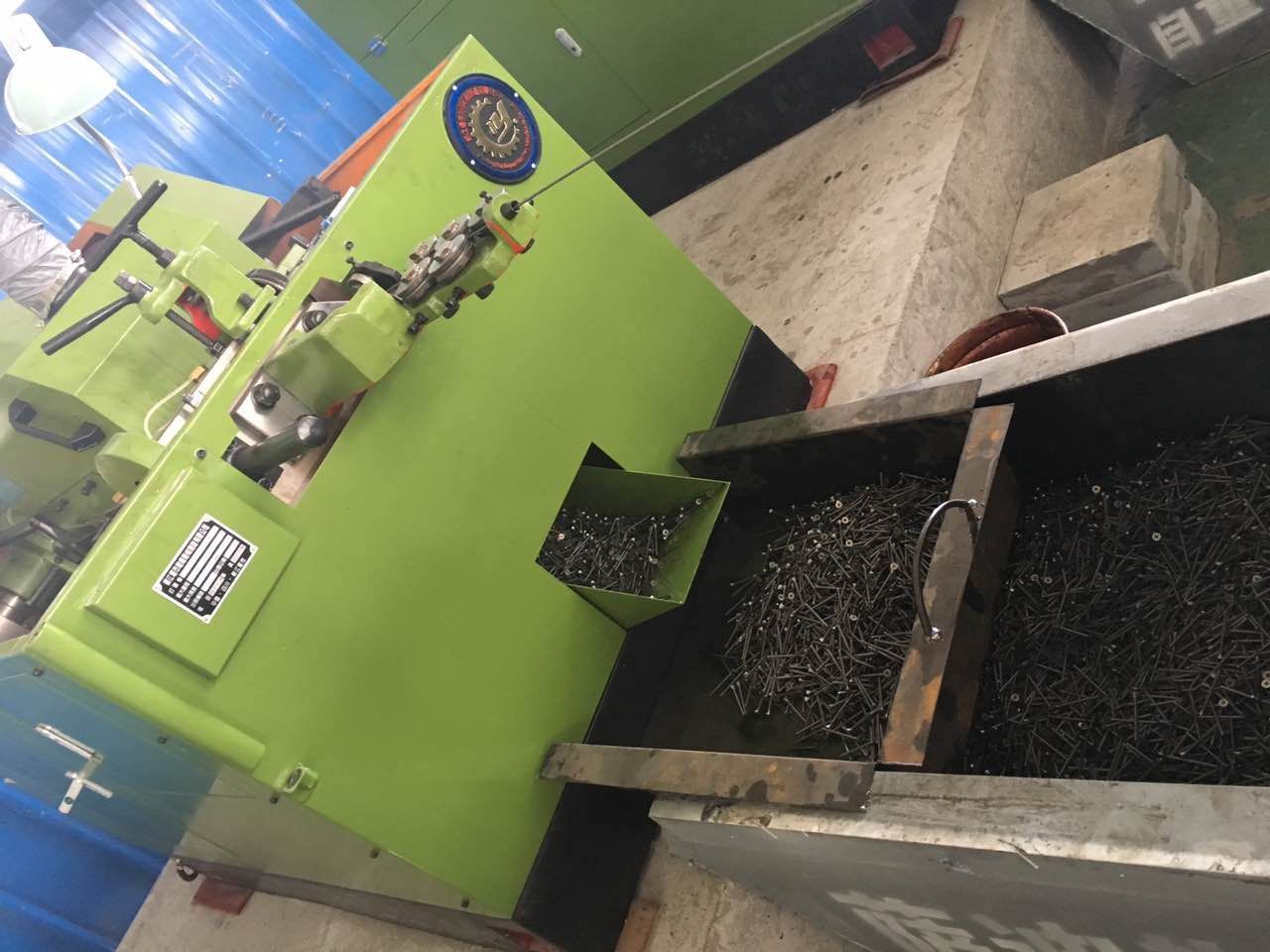
Thread rolling and heading equipment determines whether a batch can hold the thread geometry and case depth its specification claims.
Application fit: partitions, ceilings and prefabricated assemblies
The application determines which checkpoints carry the most weight.
Gypsum board partitions
Partition work is where the coarse-versus-fine decision is made, and where getting it wrong is most visible. Coarse thread for wood studs, fine thread for light gauge steel studs, with the stud thickness range written into the specification rather than left to the installer.
Ceiling installation
Overhead work amplifies head and drive quality. Consistent recess depth and a clean countersink reduce rework, and the finish requirement is normally the indoor baseline because the assembly sits inside the building envelope.
Light gauge steel stud assemblies
Fine thread engagement in thin steel depends on point type and thread pitch matching the gauge. A screw rated for a heavier gauge will not necessarily hold in a thinner one, which is why the product rating - not the appearance of the thread - governs selection.
Prefabricated and modular construction
Prefabrication shifts the question from individual screws to feeding method. Collated drywall screws account for approximately 36% of product demand in the collated screw market, driven by modular and prefabricated construction. For a project using auto-feed tools, collation compatibility and collation consistency become acceptance criteria alongside thread and finish.
Where Weifeng Fastener fits into a qualification file
Ningbo Weifeng Fastener Co., Ltd. is a fastener manufacturer based in Yuyao, Zhejiang, China, producing screws, bolts, nuts, washers, anchors and wood screws, with approximately 90% of output exported to South America, Africa and Russia. The company operates a 7,000 m² facility with annual output of about 6,000 tons and holds ISO 9001 and CE certification.
For a buyer assembling a submittal package, the relevant capability is not the product range but the evidence structure behind it. Weifeng describes internal laboratory verification, full batch traceability and high dimensional accuracy, with material traceability covering the full batch and a stated defect rate of 0.05%. Those are the attributes that let a supplier answer a hardness or dimensional clause with a document rather than a statement.
Supply-side factors also enter the acceptance decision, because an unqualified supplier is a delivery risk even when the sample passes. As a direct factory rather than a trading company, Weifeng reports a 98% on-time delivery rate, lead times shortened by 15-20 days, and a response time within 12 hours for technical and order inquiries. Packaging uses reinforced moisture-proof cartons with palletized shipping, which matters for a fastener whose coating is the attribute most exposed to a humid container.
None of this removes the buyer's obligation to test. It changes what the buyer can reasonably ask for at the submittal stage: a material certificate, a hardness report with method, a coating report with salt spray hours, and a dimensional record tied to the shipment.
Comparison with traditional supply routes, and where the limits sit
A qualification comparison is only useful if it states boundaries as clearly as advantages.
| Supply route | Reported difference | What it means for qualification |
|---|---|---|
| General trading companies | Direct factory production shortens lead time by 15-20 days; 98% on-time delivery; 12-hour response on technical and order inquiries | Faster document turnaround during submittal review, but the technical response still has to be checked line by line |
| Small workshops without laboratories | Internal lab verification, full batch traceability, stated defect rate of 0.05%, 100% material traceability | Hardness and dimensional clauses can be answered with reports rather than assertions |
| Plain standard packaging | Reinforced moisture-proof cartons and palletized shipping, at roughly 5% higher packaging cost | Coating condition at arrival is part of finish acceptance, not a separate logistics question |
The limits deserve equal space. First, a black phosphated finish at the 48-hour ASTM B117 baseline is an indoor specification; neither phosphate nor a standard zinc coating should be treated as a substitute for a corrosion grade chosen for a humid or exposed assembly. Second, supplier-published dimensional ranges and material grades - including C1022A wire and the 3.5-4.8 mm diameter span - remain claims until drawings, material certificates and inspection records are attached to the order. Third, standard references require edition-level verification: the DIN 18182-2 description available from a secondary standards page is explicitly flagged as needing confirmation of the official text and current status, and no verified ANSI drywall screw standard was available in the reference set used here. Fourth, tighter acceptance has a cost: internal laboratory verification adds roughly 10% to inspection cost, offset by a reported 90% reduction in failure-related loss - a trade that only pays if the reports are actually read during submittal review.
Market context behind the documentation pressure
The commercial backdrop explains why qualification standards are tightening rather than loosening. The global drywall screws market is projected to grow from USD 2.18 billion in 2025 to USD 3.04 billion by 2033, and residential construction housing starts drive 58% of global demand. Residential work is precisely the segment where inspection records are demanded by insurers, main contractors and handover documentation, not only by the buyer.
Prefabrication reinforces the same direction. When panels arrive pre-assembled, the fastener is no longer visible at inspection, so the only remaining record is the paperwork attached to the batch.
Future outlook
Three shifts are likely to affect how drywall screws are qualified over the next several years. Collation is moving from a convenience to a specification item as modular construction spreads, which pulls feed reliability into the acceptance criteria. Coating clauses are becoming environment-specific rather than generic, because a single 'zinc plated' line no longer survives a technical review. And submittal files are becoming document-linked, so a supplier's ability to produce a heat number, a hardness method and a salt spray duration on request will matter as much as the price per thousand pieces.
For buyers, the practical response is unchanged: convert the specification into a response matrix, require the evidence per line, verify the standard edition, and drive a sample into the real assembly before approving the batch.
FAQ
What is the difference between coarse thread and fine thread drywall screws?
Coarse threads are typically for wood studs; fine threads are for light gauge metal studs. Selection depends on stud thickness, point type and specific product ratings. If a product manual allows multiple substrates, follow the manual. Do not assume interchangeability based on thread appearance alone.
How do I confirm which thread type a project actually needs?
Confirm stud material and thickness, check the screw specification, then perform a trial installation. Step 1: identify whether the stud is wood or metal. Step 2: measure thickness for steel studs, or moisture content for wood. Step 3: match the thread type to the specification and perform trial driving.
Which finish should a drywall screw specification call for?
Finish options for the drywall screw include black and grey phosphated and zinc plated. Selection depends on stud thickness, point type and specific product ratings, and the finish decision additionally depends on the service environment: standard black phosphate provides an industry baseline of 48 hours of salt spray resistance under ASTM B117 and suits indoor, climate-controlled conditions.
Is a black phosphated finish sufficient for humid or exposed conditions?
Standard black phosphate is described as suitable for indoor climate-controlled environments, with a 48-hour ASTM B117 salt spray baseline. Zinc plating generally offers superior long-term corrosion protection through sacrificial action, whereas a phosphate coating acts as a physical barrier with good paint adhesion but corrodes faster once the barrier is breached. A humid or exposed assembly therefore requires a coating selected for that environment, supported by test documentation, rather than a phosphate finish carried over from an interior specification.
For buyers who need the full product and specification reference in one document, the Weifeng Fastener catalogue is available for download: Ningbo Weifeng Fastener catalogue (PDF).
Have Questions or Need More Details?
Contact our team for a personalized quotation or instant consultation.
Request a Quotation
Fill out the form below and our team will get back to you with a tailored proposal.
WhatsApp Direct Chat
Prefer to chat in real-time? Message us on WhatsApp for instant assistance & quick answers.
- Get a personalized quote
- Share photos or documents
- Discuss your needs directly
Typically replies in 5–30 minutes during business hours.