
Dual Cooling Vest Scenario Fit: Traffic Control and Vending
Dual Cooling Vest Scenario Fit: Traffic Control and Vending
A dual cooling water-circulation vest fits traffic-control and street-vending work when three conditions hold together: one cooling cycle covers the interval between breaks, the wearer keeps both hands free while working, and the carried weight does not interfere with the task itself. The COOLWAVE Water-Circulation Cooling Vest — sold under the Shokunin brand by Feng Shang Precision Co., Ltd. of Taiwan — is built around a backpack-style water reservoir, two ice packs, and a pump rated 5V, 150 mA (max) with a stated maximum flow of 320–370 ml/min. Its published listing states 3–4 hours of cooling, a weight within 2 kg, and a suitable-temperature condition of below 10°C.
Both occupations appear explicitly in the product's applicable-industry list, alongside construction workers, outdoor workers and metal-sheet factories. What follows is a scenario-fit assessment rather than a field report: it takes the published figures at face value, explains what each one changes for a traffic-control or vending shift, and marks the points where a buyer needs written confirmation instead of an assumption.
Why Traffic Control and Vending Stress Cooling Gear Differently
Construction work is usually organized around a site with shade, water points, tool stations and a defined rotation. Traffic direction and street vending are organized around a position that cannot easily be abandoned. That difference, more than ambient temperature alone, determines whether a wearable cooling system is practical.
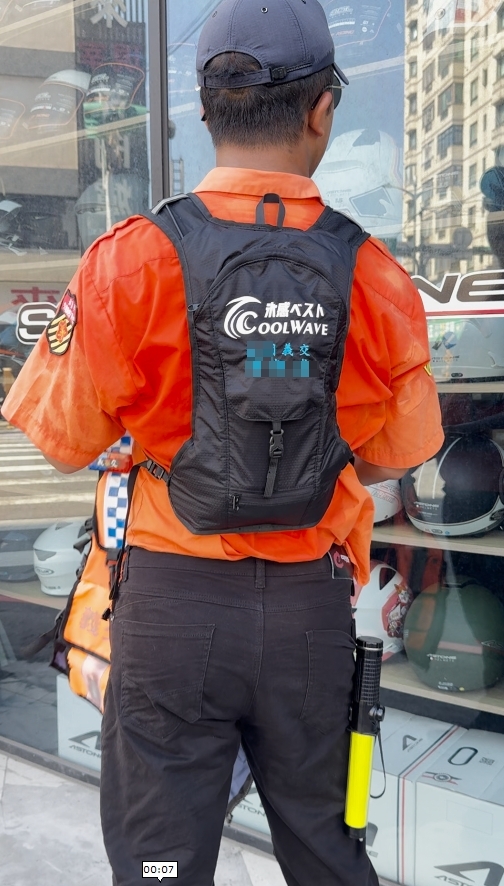
In traffic control, the worker's hands are occupied by signalling, a stop paddle, a whistle or a radio, and the body stays in roughly one place for long stretches while vehicles pass. The vest layer must sit under or beside high-visibility clothing without obscuring it, and the worker must be able to reposition quickly. In street vending and food-stall work, the body is again largely stationary, but the immediate surroundings add another heat source — cooking equipment, fryers, griddles or steamers — inside a footprint of only a few square metres. The worker bends, reaches and handles food, so anything worn on the hands, wrists or forearms is a hygiene problem before it is a comfort problem.
Three requirements follow for both groups, and they are the criteria this article uses throughout:
- Hands stay free. Cooling must operate without being held, waved or repeatedly adjusted.
- The kit survives a shift longer than one cycle. Both occupations commonly run beyond the 3–4 hour figure the product states, so the practical question is what happens at the changeover, not only how long cycle one lasts.
- Nothing on the body interferes with the task's own clothing or hygiene rules. For traffic duty that means high-visibility layering; for vending it means food-contact cleanliness and a stall footprint with no room for a charging station.
What Ships in the COOLWAVE Kit
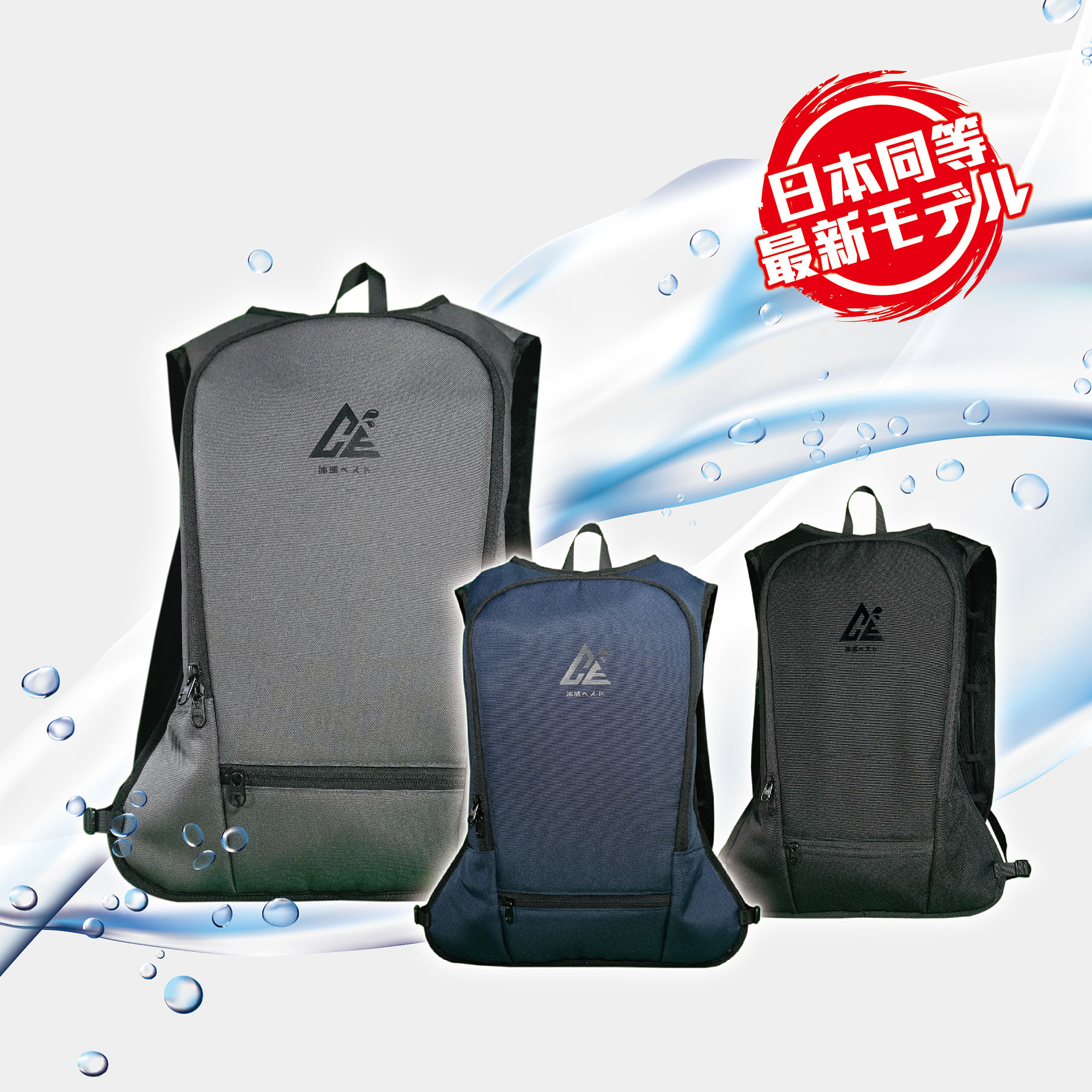
The product is sold as a water-circulation vest with a wearable backpack reservoir: the listed contents are one water-cooled vest backpack and two ice packs. Component materials are specified at a level of detail that helps a buyer check durability and cleaning: 600D polyester shoulder straps, a PEVA vest body, a TPU water bag with a polypropylene cap, and a black sand-rubber cooling tube. The pump is rated 5V and 150 mA maximum, and the stated maximum flow rate is 320–370 ml/min.
The architecture is dual in a specific, limited sense: the ice packs provide the cold source, and the pump moves chilled water through the vest tubing so that cooling is distributed rather than concentrated where a pack touches skin. That distinction matters in both target scenarios, because a worker who cannot shift a pack around inside a hi-vis harness or behind a stall counter gets uneven cooling from a passive design.
Four Stated Numbers and What They Do and Do Not Establish
The published figures are useful for screening, but each one carries an unstated condition. Reading them precisely prevents a buyer from over-committing before a sample arrives.
1. Cooling duration: 3–4 hours
This is the figure that decides shift planning. The listing does not state the ambient temperature, humidity, workload, clothing layers or measurement method behind it, and no test report accompanies the published value. For a vending or traffic shift, treat 3–4 hours as the manufacturer's stated envelope and verify it inside your own working conditions before scaling a purchase.
2. Weight: within 2 kg
The listing gives an upper bound rather than a measured figure, and it does not say whether the number covers the vest alone, the backpack with an empty reservoir, or the full kit with water. Because the load sits on the shoulders for the whole shift, the basis of the weight figure is worth confirming in writing; an upper bound is not the same as an as-worn weight.
3. Pump: 5V, 150 mA (max), flow 320–370 ml/min
The electrical rating defines what the pump draws, and the flow figure is explicitly a maximum given as a range, which means the measurement conditions — tubing length, head height, reservoir level — are not disclosed. The supplied specification also does not name the power source, although secondary product descriptions of this vest refer to a power bank. A buyer planning a vending or traffic deployment should confirm the intended power source, its capacity per cycle, how it is carried, and whether spare power units are part of the order.
4. Suitable temperature: below 10°C
This is the line most likely to cause a misunderstanding, and it is treated separately below.
The Ambient-Temperature Condition Needs Clarification First
The listing's stated condition reads “suitable temperature: below 10°C.” As written, it does not define whether the figure refers to ambient air temperature, the temperature of the chilled water in the reservoir, the ice-pack storage condition, or something else. For a hot-weather deployment, that ambiguity matters more than any other single line in the specification, because the two target scenarios both operate well above 10°C ambient for most of the year.
Practical reading: the published condition cannot be interpreted as a hot-weather operating envelope without written clarification from the supplier. Until the basis of the figure is confirmed — ambient air, water temperature, or storage — buyers should treat the vest's hot-weather suitability as something to be established by their own sample trial, not by the spec sheet alone. This is a documentation gap, not evidence that the product fails in heat, and it should be closed before an order is placed.
The same discipline applies to the cooling-duration claim. A 3–4 hour statement and a below-10°C statement pulled from the same table cannot both be applied to a 33°C roadside without knowing what each one describes.
Traffic Control: What Fit Looks Like
For traffic direction, the vest's strongest fit signal is the hands-free circulation loop. Because the reservoir is carried on the back and the pump runs the loop continuously, the worker's hands stay on the signalling task, and cooling does not depend on remembering to reposition a pack. That is the specific problem a passive ice vest struggles with at a junction where the worker is managing vehicles rather than managing gear.
The second fit signal is that the design does not require a fixed power outlet at the post. Traffic duty moves between junctions during a shift, so any cooling system tied to a stationary power point fails on logistics alone.
Two fit questions remain open and should be answered with a sample rather than assumed:
- Layering and visibility. How the reservoir and tubing sit relative to a high-visibility vest or harness is not described in the specification. The buyer needs to confirm that reflective panels remain fully visible and that the shoulder straps of the 600D polyester backpack do not slide under load.
- Changeover at the post. Swapping ice packs at a junction is a different operation from swapping them in a workshop. If the shift exceeds one cooling cycle, the deployment plan needs a vehicle-based resupply point and a defined rotation interval.
Street Vending and Food Stalls: Ice Logistics Decide the Shift
Vending and food-stall work puts the decision in a different place. The vest body itself is workable — nothing is worn on the hands, and the under-2 kg upper bound is carried on the shoulders rather than held. The constraint is the cold supply chain behind it. The kit contains two ice packs, and re-freezing time is not stated anywhere in the published specification, which means a vendor planning a 10-hour market day is really planning freezer capacity, not vest capacity.
That is the practical fit test for this scenario: count how many cooling cycles the shift needs, then check whether the stall or the vendor's home freezer can return packs to frozen state before the next cycle. Two ice packs cover a 3–4 hour cycle with a margin only if the refreeze window fits the break structure — and whether both packs are used simultaneously or one is a spare is not specified, so the answer changes the arithmetic.
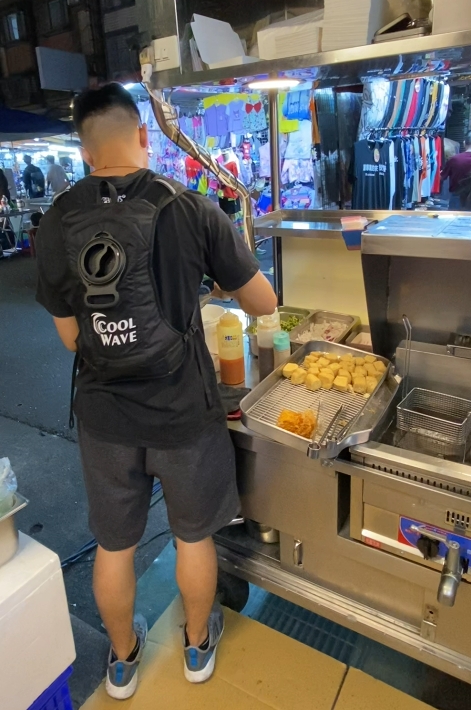
Hygiene is the second consideration. The vest body is listed as PEVA with a TPU water bag and a polypropylene cap. Those materials are cleanable in principle, but the specification does not state a cleaning protocol, and a food handler needs a written routine covering the reservoir, tubing and outer surface before the garment is worn in a food-preparation area. The reservoir should also be kept clear of the counter surface where food is handled, which is a layout decision at the stall rather than a product one.
Fit Map: Requirement, Vest Property, What to Verify
| Scenario requirement | What the listing shows | What the buyer should verify |
|---|---|---|
| Hands free during signalling or food handling | Backpack reservoir with pump-driven circulation; nothing worn on hands or wrists | Whether tubing routing interferes with reaching, bending or signalling |
| Coverage of a shift longer than one cycle | 3–4 hours stated cooling duration; two ice packs included | Actual cycle length in your ambient conditions; refreeze time; whether both packs run at once |
| All-day wearability | Weight within 2 kg (upper bound) | As-worn weight of the full kit; basis of the stated figure |
| Compatibility with high-visibility clothing | 600D polyester shoulder straps; vest body material not described as a visibility garment | Whether reflective panels stay fully visible and the harness stays stable |
| Operation away from mains power | Pump rated 5V, 150 mA (max); power source not named in the specification | Intended power source, capacity per cycle, carriage method, spare units |
| Food-area cleanliness | PEVA body, TPU water bag, polypropylene cap | Written cleaning routine for reservoir, tubing and outer surface |
| Deployment across a rotating team | One-size-fits-all adjustable design described in the case record | Range of body sizes covered; strap adjustment limits |
| Ordering and replacement planning | MOQ 10 units; lead time 7–14 days; 6-month warranty on the water-cooled vest | Spare ice packs, tubing and pump availability for a multi-season program |
What the Taiwan 100-Unit Record Supports
The case material supplied for this product records a Taiwan deployment of 100 units used for cooling in high-temperature environments, across a user base that includes construction sites, outdoor work, metal-sheet factories and street vendors. The record describes the outcomes as effective body cooling, heatstroke prevention, and improved work efficiency and comfort, and it lists a duration field of 10 years.
Those claims come from the case record itself. No ambient measurements, workload data, comparison group or measurement method accompanies them, and none of the published figures in this article were independently re-measured. What the record therefore supports is a deployment footprint: 100 units have been placed into hot outdoor work in Taiwan, and the product has been used in the field over a sustained period. What it does not establish is a quantified reduction in heat-stroke incidence, and it should not be presented to a safety committee as if it did.
Separately, the product is described as having received the Disaster Prevention Product and Service Certification Award from the Taiwan Disaster Prevention Industry Association. That is a specific award from a specific association; it does not by itself demonstrate conformity with any particular occupational PPE standard, and buyers operating under a regulated PPE regime should confirm the applicable requirements for their own market independently.
Where the Fit Is Weaker
A useful fit assessment has to include the boundaries. The COOLWAVE vest is a weaker match in four situations.
- Shifts requiring continuous cooling beyond the stated cycle without a refreeze point. If a worker cannot return to a freezer or a spare-pack supply within the cycle window, runtime becomes the binding constraint regardless of how well the vest performs earlier in the shift.
- Work where the wearer must be identified primarily by reflective clothing. Any additional layer over or under a high-visibility garment needs a visibility check, and the specification does not address this.
- Environments where the ambient-temperature condition has to be resolved before procurement. Until the below-10°C line is clarified, a buyer with a formal specification requirement cannot close that clause.
- Food-preparation areas without an agreed cleaning routine. The materials are listed but the cleaning protocol is not, so hygiene sign-off depends on the buyer's own procedure.
The same logic applies to customization. The supplier's capability listing shows ODM production with customization listed as unavailable, along with a MOQ of 10 units, a 7–14 day lead time and a 6-month warranty on the water-cooled vest. Any expectation of branding, colour change beyond the listed Basic and Professional variants in blue, grey and black, or a modified reservoir should be confirmed in writing rather than assumed from the ODM label.
Circulating Water Versus a Plain Ice-Pack Vest
For a traffic or vending buyer, the realistic alternative is a passive ice-pack vest with no pump and no reservoir. The two designs can be compared on documented characteristics, but not on measured cooling performance, because no comparative thermal test is published for either configuration under matching conditions.
Mechanically, a passive vest cools by conduction where the pack contacts the body, and the wearer redistributes packs by hand as cooling fades. A circulating design adds a pump that moves chilled water through tubing, which spreads the cold source over a larger area and removes the need for repeated manual adjustment — the specific advantage that matters when both hands are committed to signalling or to food handling. The trade is added complexity: a reservoir to fill and clean, tubing to route, a pump with an electrical rating, and a second component family that can fail and needs spare-part support.
NIOSH heat-stress guidance classifies water-cooled garments, air-cooled garments, cooling vests and wetted overgarments together as personal cooling systems, which is a useful framing for procurement: the category question is settled, and the decision turns on the specific configuration, runtime and logistics rather than on the principle of wearable cooling.
Industry Context: Why Industrial Buyers Anchor This Category
The commercial research firm Dataintelo, in a 2025 cooling-vest market report published in May 2026, estimated the global cooling-vest category at USD 342 million in 2025 and put industrial applications at 34.5% of revenue. Both figures are third-party estimates with their own methodology, and they should be read as category context rather than as a forecast for any single product.
The implication for a traffic-control or vending buyer is narrower than the market number suggests. Industrial share indicates that the category's centre of gravity is workwear for heat-exposed labour rather than leisure apparel, which is why specifications like MOQ, warranty, spare parts and refreeze logistics carry as much weight in the decision as the cooling claim itself. A vending operator buying ten units and a municipal traffic contractor buying a hundred are in the same category but not in the same procurement process.
A Sample-Test Plan Before a Larger Order
The gap between a published specification and a workable shift is closed by testing, not by reading. A structured sample stage for either scenario should record the following:
- Weigh the kit as worn. Confirm the as-worn weight against the stated upper bound of 2 kg, and note whether the figure includes water.
- Time a full cycle in your own conditions. Run the vest through the shift temperature, humidity and activity level, and log when the wearer first notices cooling fading.
- Measure the refreeze window. Record how long the two ice packs need to return to frozen state, then compare that against your break structure.
- Confirm the power source and consumption. Establish which power source the pump is intended to run from, its capacity per cycle, and whether spares are needed for a full shift.
- Check the layering question on site. Have a traffic controller wear the vest under the actual high-visibility configuration used at the post.
- Agree the cleaning routine in writing. Cover the TPU water bag, the polypropylene cap, the tubing and the PEVA body before any food-area use.
- Confirm the commercial terms. MOQ 10 units, 7–14 day lead time, 6-month warranty on the water-cooled vest, and the availability of spare ice packs, tubing and pumps for a multi-season program.
- Close the ambient-temperature clause. Obtain a written definition of the below-10°C condition and of the cooling-duration test basis before the specification is signed off.
What Would Change This Assessment
The verdict on scenario fit is conditional, and it can move in either direction. It would strengthen if the supplier published a cooling-duration test with defined ambient temperature, humidity and workload, clarified the below-10°C condition, and documented refreeze time and as-worn weight. It would weaken if a buyer's own cycle test showed materially shorter runtime under roadside or cooking-adjacent heat than the stated 3–4 hours, or if the refreeze window proved longer than the available break.
For now, the defensible position for a traffic-control or street-vending buyer is this: the COOLWAVE vest matches the two hardest structural requirements of both jobs — free hands and no fixed power point — and its stated 3–4 hour cycle and under-2 kg weight fall inside the range those shifts can absorb, provided the changeover logistics and the ambient-temperature clause are resolved first. That is a fit worth testing with a sample, not a fit that a spec sheet alone can close.
FAQ
Is a water-circulation cooling vest suitable for traffic-control duty?
It matches the structural requirements of the job: the pump-driven loop runs without occupying the hands, and the backpack reservoir removes the need for a fixed power point at the post. Whether it suits a specific post depends on three checks — confirmed runtime under local heat, a defined ice-pack changeover point if the shift exceeds one cycle, and confirmation that reflective clothing remains fully visible over the harness.
How long does the COOLWAVE vest cool, and does that cover a vending shift?
The listing states 3–4 hours of cooling per cycle, without specifying ambient temperature, workload or measurement method. Many vending and market shifts run longer than that, so the practical answer depends on how many cycles the shift needs and whether the two supplied ice packs can be refrozen in the available break. Refreeze time is not stated in the published specification and should be measured during a sample trial.
What does the “suitable temperature: below 10°C” specification actually mean?
The listing does not define whether this figure refers to ambient air temperature, chilled-water temperature, ice-pack storage or another condition. Because both target scenarios operate well above 10°C ambient, the basis of the figure should be clarified in writing by the supplier before it is used as a hot-weather operating envelope.
Does the pump need a power bank, and what should a buyer confirm?
The supplied specification states the pump's electrical rating as 5V, 150 mA (max) with a maximum flow of 320–370 ml/min, but it does not name the power source; secondary product descriptions of this vest refer to a power bank. A buyer should confirm the intended power source, its capacity per cooling cycle, how it is carried during work, and whether spare power units are included in the order.
What does the 100-unit Taiwan deployment record establish about heatstroke prevention?
It establishes a deployment footprint: 100 units placed into hot outdoor work in Taiwan across construction, outdoor work, metal-sheet factories and street vendors, with the case record describing body cooling, heatstroke prevention and improved comfort and efficiency. It does not provide ambient measurements, a comparison group or a measurement method, so it should not be presented as a quantified reduction in heatstroke incidence. The product is also described as having received the Disaster Prevention Product and Service Certification Award from the Taiwan Disaster Prevention Industry Association, which is separate from conformity with any particular occupational PPE standard.
Shokunin is the professional tool and cooling-apparel brand of Feng Shang Precision Co., Ltd., a Taiwan-based manufacturer whose listed products also include air compressors, cut-off machines and cordless tools. A downloadable product brochure covering the COOLWAVE water-circulation vest range is available here: COOLWAVE product brochure (PDF).
Have Questions or Need More Details?
Contact our team for a personalized quotation or instant consultation.
Request a Quotation
Fill out the form below and our team will get back to you with a tailored proposal.
WhatsApp Direct Chat
Prefer to chat in real-time? Message us on WhatsApp for instant assistance & quick answers.
- Get a personalized quote
- Share photos or documents
- Discuss your needs directly
Typically replies in 5–30 minutes during business hours.