
Dual Cooling Water Cooling Vest: COOLWAVE Procurement FAQ
Dual Cooling Water Cooling Vest: COOLWAVE Procurement FAQ
A cooling vest is not a difficult product to buy until someone asks a precise question. How many millilitres per minute does the circulation pump move? What is the water bag made from? What actually arrives in the box? What is the minimum order quantity, and how many days does production take? In industrial purchasing, those questions — not the general idea of cooling — decide whether a purchase order is raised.
This reference answers them one by one for the COOLWAVE Water-Circulation Cooling Vest, an industrial cooling vest produced by Shokunin. Every figure below comes from the manufacturer's own specification and capability record for the product, so a procurement team can quote it directly in a comparison sheet or an internal approval note.
Shokunin is a professional tool brand launched by Feng Shang Precision Co., Ltd., a manufacturer based in Taoyuan City, Taiwan, and founded in 2009. The company runs a 1,000 m² production facility with approximately 30 employees, a five-engineer R&D team and an annual output of 10,000 units across a product line that includes air compressors, cut-off machines, water-cooled vests, lithium batteries, diamond saws, nail guns and screwdriver bits. Around 50% of production is exported, with the United States and Taiwan (ROC) recorded as the main markets. Within that portfolio, the water-cooled vest structure and cooling system are covered by patent certificate I886033, issued by the Intellectual Property Office of Taiwan's Ministry of Economic Affairs on 1 June 2025 and valid until 27 August 2044. The cooling vest line also carries a disaster prevention product and service certification issued by the Taiwan Disaster Prevention Industry Association.
Why Spec-Level Questions Decide Industrial Cooling-Vest Orders
Cooling apparel has shifted from an occasional comfort purchase to a line item in occupational heat management. Third-party research places the global cooling vest market at approximately USD 215 million in 2024, projected to reach USD 385 million by 2033 (Dataintelo). The broader personal cooling device market — which includes powered and handheld devices beyond vests — was valued at USD 25.16 billion in 2024 and is projected to reach USD 94.85 billion by 2035 (Market Research Future). The gap between those two figures is a scope difference rather than a contradiction: one measures cooling vests specifically, the other measures all personal cooling devices.
Inside the vest category, industrial applications such as construction and manufacturing accounted for the largest segment share at 34.5% in 2025 (Dataintelo). Asia Pacific is the fastest-growing region, driven by industrialisation and large outdoor work populations (Spherical Insights). Active circulatory mechanisms, including ice-water circulation, are increasingly deployed in industrial settings to reduce occupational heat stress (Strategic Market Research).
The procurement consequence is straightforward. Once cooling vests sit inside a heat-management programme, they are evaluated like other protective equipment: documented specifications, stated materials, a defined order quantity and a defined lead time. Electrical components in a cooling system are commonly expected to sit within ISO 9001:2015 quality management practice and to carry CE or UL marks where applicable. When a supplier cannot answer a question about pump rating, flow rate or material grade, that gap becomes a procurement risk rather than a minor detail.
What Ships With the COOLWAVE Water-Circulation Cooling Vest
The recorded configuration of the product is compact. The kit contents are a water-cooled vest backpack ×1 and ice packs ×2. The product type is listed as industrial cooling apparel / personal protective equipment, and its documented scope is cooling use in high-temperature environments.
Three performance figures frame how the vest is planned into a shift:
- Cooling duration: 3–4 hours per cycle.
- Weight: within 2 kg net.
- Suitable temperature: below 10°C.
Two design characteristics shape everything else on this page. First, the cooling energy comes from ice packs rather than from a powered refrigeration circuit — the assembly is recorded as a passive ice-pack cooling design that does not depend on a compressor or refrigerant loop. Second, the vest is described as lightweight, portable and adjustable in a one-size-fits-all fit, which is what allows a single stocked SKU to be issued across a mixed crew.
Pump and Flow Rate: Reading the 5V, 150 mA Specification
The circulation pump is rated at 5V DC with a maximum current draw of 150 mA. Its recorded output is a maximum flow rate of 320–370 ml/min. Two clarifications matter when those numbers are entered into a procurement document.
First, flow rate describes distribution, not endurance. The figure states how much chilled water the pump can move through the cooling circuit per minute. Flow rate and cooling duration are separate specifications: one describes how the chilled medium is spread across the body, the other describes how long the medium stays effective.
Second, the electrical rating describes the pump's load, not the source of cooling. The thermal work in this design is done by the two supplied ice packs; the pump circulates water through the cooling tube so that cooling is distributed rather than concentrated at the pack. The cooling tube itself is recorded as sand rubber in black. The pump's maximum draw of 150 mA at 5V is the figure to quote when a site plan or an internal electrical assessment requires a load figure.
Cooling Duration and the Below-10°C Rating
Recorded cooling duration is 3–4 hours per cycle. The range, rather than a single fixed figure, reflects the nature of an ice-based system: a fully frozen pair of packs at the start of a shift does not behave identically to packs that have partly thawed. For scheduling purposes this makes pack rotation — not pump performance — the practical constraint in a long working day.
The specification lists suitable temperature as below 10°C. It should be read as the condition of the cooling medium rather than as a limit on the ambient temperatures in which the vest can be worn; the product is documented for cooling in high-temperature working environments, including construction sites, outdoor work areas, metal sheet factories and street vending operations.
For a site that intends to keep crews cooled across an eight-hour shift, the planning implication is logistical: freezer or ice access between shifts, and enough spare pack sets to rotate. That is a supply-room decision as much as a purchasing decision, and it is worth settling before the order is placed rather than after the first hot week.
Materials Breakdown: TPU, Polypropylene, Sand Rubber, 600D Polyester, PEVA
Material questions are the ones that surface when a buyer is comparing two otherwise similar quotations. The COOLWAVE Water-Circulation Cooling Vest is recorded with the following material and component breakdown.
| Component | Recorded specification |
|---|---|
| Water bag material | TPU |
| Water bag cap | Polypropylene |
| Cooling tube | Sand rubber (black) |
| Shoulder strap material | 600D polyester |
| Vest body material | PEVA |
| Pump output | 5V, 150 mA (maximum) |
| Flow rate | Maximum 320–370 ml/min |
| Cooling duration | 3–4 hours |
| Net weight | Within 2 kg |
| Suitable temperature | Below 10°C |
| Kit contents | Water-cooled vest backpack ×1, ice packs ×2 |
Read together, the list describes a system built around a flexible water reservoir and a thick-walled rubber circuit. TPU is commonly selected for water bags because it is flexible and resistant to tearing and abrasion, which suits a component that is repeatedly filled, drained and folded into a backpack. Polypropylene is a common choice for caps and closures because it holds a thread well and resists cracking. The cooling tube is recorded as sand rubber in black, a thick-walled rubber hose rather than a thin polymer line. The shoulder strap uses 600D polyester, a standard heavy-duty webbing grade for load-bearing straps, and the vest body material is PEVA, a flexible film-type material commonly used where a water-resistant layer is required.
None of those material choices is exotic, and that is the point worth recording in a comparison sheet: the specification can be checked against the delivered goods component by component, which is exactly what a pre-shipment inspection is for.
Where the Vest Is Documented in Use
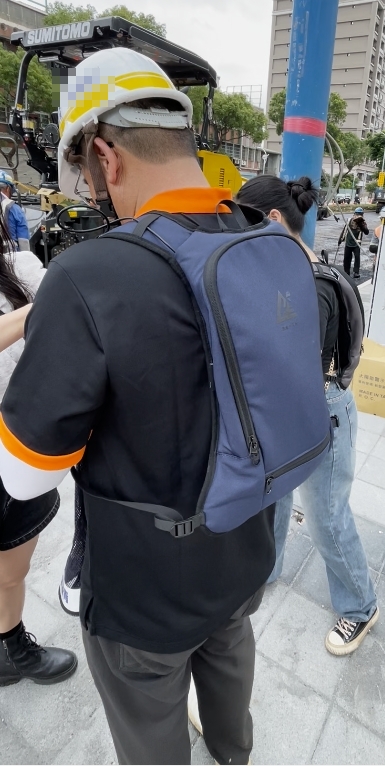
Applicable industries recorded for the product are construction workers, outdoor workers, food stall operators, street vendors, traffic controllers and metal sheet factories. The deployment record notes successful use across construction sites, outdoor work, metal sheet factories and street vending.
The common thread across those environments is not simply high air temperature. It is a combination of radiant heat, limited air movement and long exposure — a metal-roof or sheet metal workshop holds heat differently from an open site, and a traffic controller on a fixed post accumulates heat differently from a worker moving between tasks. Active circulation addresses the same underlying problem in all of them: keeping a chilled medium moving against the body rather than letting it sit and warm up in one place.
One recorded deployment involved 100 units supplied in Taiwan for cooling use in high-temperature environments. Reported outcomes from that deployment include effective body cooling, heatstroke prevention, and improved work efficiency and worker comfort. For buyers, the useful element in that record is the scale: a three-digit unit deployment is a fleet purchase, not a trial, which is consistent with the minimum order quantity and production capacity described below.
Procurement Logistics: MOQ, Lead Time, Capacity and Warranty
The commercial terms below are the ones a purchasing department typically needs before an order can be raised. They are recorded as follows.
| Commercial item | Recorded term |
|---|---|
| Production mode | ODM production service |
| Minimum order quantity | 10 units |
| Production lead time | 7–14 days |
| Monthly production capacity | 3,000 units |
| Warranty | 6-month warranty for the water-cooled vest |
| Export markets | Global |
| Delivery terms | Shipment after payment |
| Freight | Paid by buyer |
| Payment terms | Full payment |
| Acceptance criteria | Pre-shipment test |
The minimum order quantity of 10 units is low enough to support a pilot deployment on a single site or a single shift, which is how most industrial cooling programmes start. The typical production lead time of 7–14 days applies on top of that, so a buyer planning a seasonal rollout should treat three weeks from confirmation to delivery as a working assumption rather than a worst case.
Monthly production capacity is recorded at 3,000 units. That is the ceiling to check against in sequencing: an order well below that figure sits comfortably inside normal scheduling, while an order approaching it should be discussed and scheduled in advance rather than assumed. The manufacturer provides ODM production services, which means product development under an ODM arrangement rather than a purely transactional supply of a finished catalogue item.
The warranty term recorded for the water-cooled vest is six months. The acceptance criteria are a pre-shipment test, which places the verification step before the goods leave the factory. Payment terms are full payment, with shipment after payment and freight paid by the buyer. For buyers used to open-account terms, that structure is worth factoring into cash-flow planning at the point of order rather than at the point of invoice.
What the Specification Does Not Cover: Limits and Boundaries
An honest reading of the record includes what it does not say, because those points are where a purchase can go wrong.
- Duration is finite by design. The recorded 3–4 hour cooling duration is a single cycle, not a full shift. Sites that need continuous cooling must plan pack rotation and freezer access, which adds an operational task to the purchase.
- The pump's power arrangement is not part of the recorded kit list. The kit contents are the backpack and two ice packs. If a site plan depends on a specific way of powering the 5V pump, that should be confirmed in writing before ordering rather than inferred.
- Fit is adjustable but single-size. The one-size-fits-all adjustable design is what allows fleet-level issuance from one SKU, but buyers outfitting a crew with widely varying body sizes should validate fit on a sample before committing to volume.
- Order mechanics do not suit single-unit evaluation. A minimum order quantity of 10 units and a 7–14 day lead time are built for teams and sites, not for evaluating one vest in isolation.
- Customisation scope needs confirmation. The capability record for the product line lists ODM production but does not list product-level changes to the vest itself. A buyer who needs altered components — a different strap, a different bag configuration — should establish scope with the supplier instead of assuming it is included.
- Ambient operating limits are not stated. The single temperature figure in the specification, below 10°C, describes the cooling medium. No separate ambient upper limit appears in the record, so extreme-condition deployments should be discussed directly.
Against alternative approaches, the trade-off is also visible. Phase change material (PCM) vests accounted for 28.7% of category share in 2025 and represent the fastest-growing technology segment (Dataintelo); they remove water handling but introduce their own recharge and reconditioning cycle. Passive ice-pack-only vests avoid a circulation circuit entirely but distribute cooling less evenly. Powered air-conditioned garments solve a different problem at a different weight and power budget. Ice-water circulation occupies a specific position in that set: it uses a simple cooling medium, adds circulation to spread the cooling, and keeps the assembly within a 2 kg envelope.
Market Context: What Category Data Suggests for Buyers
Category-level data is worth including in a procurement rationale because it shows that the purchase is not idiosyncratic. The cooling vest market is estimated at approximately USD 215 million in 2024 and projected to reach USD 385 million by 2033 (Dataintelo), while the broader personal cooling device market is estimated at USD 25.16 billion in 2024 with a projection of USD 94.85 billion by 2035 (Market Research Future). The two figures measure different scopes, and the difference is a reminder to check what any market number actually counts before repeating it in an internal document.
Regional and segment data reinforce the direction. Asia Pacific is the fastest-growing region for cooling vests, driven by industrialisation and high outdoor work populations (Spherical Insights). Industrial applications held the largest share of the vest category at 34.5% in 2025 (Dataintelo). Among technology approaches, PCM vests held 28.7% of share in 2025 and are the fastest-growing segment (Dataintelo), while active circulatory mechanisms such as ice-water circulation are increasingly deployed in industrial sectors to mitigate occupational heat stress (Strategic Market Research).
The competitive landscape is populated rather than empty. Named participants in the global cooling vest market include Techniche International, Glacier Tek, Polar Products Inc. and Ergodyne (Spherical Insights). For a buyer, a populated field is useful: it means supplier comparison can be done on documentation — flow rate, materials, duration, MOQ, lead time, warranty — rather than on availability alone.
Future Outlook
The direction of the category is toward documented performance rather than claimed performance. As cooling apparel is absorbed into occupational heat programmes, the questions that close a purchase will be the ones this reference has answered: what is the flow rate, what is the cooling duration, what are the components made of, how long does production take, and what happens if a unit fails within the warranty period.
Two developments are worth watching. The first is the continued growth of alternative cooling technologies, particularly PCM, which will keep pressure on ice-based systems to justify their water handling and rotation logistics with clearly better duration or distribution. The second is documentation practice: as more buyers ask for pre-shipment test criteria and written component specifications, suppliers that already publish those details will be easier to shortlist, and suppliers that do not will be easier to eliminate.
For the COOLWAVE Water-Circulation Cooling Vest specifically, the recorded position is a defined one: a 5V, 150 mA circulation pump moving a maximum of 320–370 ml/min, a 3–4 hour cooling cycle, a sub-2 kg assembly in TPU, polypropylene, sand rubber, 600D polyester and PEVA, supplied at a 10-unit minimum with a 7–14 day lead time and a 3,000-unit monthly ceiling. Whether that fits a given site depends on freezer access, shift length and crew size — the same three variables that will decide any ice-based cooling purchase.
FAQ
The recorded kit contents are a water-cooled vest backpack ×1 and ice packs ×2. The product itself is classified as industrial cooling apparel / personal protective equipment, with a recorded net weight within 2 kg.
The circulation pump is rated at 5V DC with a maximum current draw of 150 mA, and the recorded maximum flow rate is 320–370 ml/min. Cooling energy is supplied by the ice packs; the pump circulates chilled water through the cooling circuit, which is recorded as a sand rubber tube in black.
The recorded cooling duration is 3–4 hours per cycle. The duration describes a single cycle rather than a full working shift, and because the cooling medium is ice, the packs need to be re-frozen between cycles.
The specification lists suitable temperature as below 10°C. This describes the condition of the cooling medium rather than an ambient operating limit. The product is documented for cooling in high-temperature environments, including construction sites, outdoor work areas, metal sheet factories and street vending operations.
The water bag is TPU, the water bag cap is polypropylene, the cooling tube is sand rubber in black, the shoulder strap is 600D polyester, and the vest body material is PEVA.
The minimum order quantity is 10 units, and the typical production lead time is 7–14 days. Monthly production capacity is recorded at 3,000 units, and the manufacturer provides ODM production services.
Recorded terms are full payment, shipment after payment, and freight paid by the buyer. Acceptance criteria are a pre-shipment test, meaning verification takes place before the goods leave the factory.
A 6-month warranty is recorded for the water-cooled vest.
The recorded applicable industries are construction workers, outdoor workers, food stall operators, street vendors, traffic controllers and metal sheet factories. A recorded deployment in Taiwan supplied 100 units for cooling use in high-temperature environments, with reported outcomes including effective body cooling, heatstroke prevention, and improved work efficiency and worker comfort.