
Dual Cooling Water Cooling Vest: Scenario Fit for Construction, Traffic Control, and Street Vending
Cooling apparel is usually purchased by product name and compared by price. It performs better when it is specified by work rhythm. This industry reference maps the COOLWAVE Water-Circulation Cooling Vest to the outdoor and semi-outdoor roles its manufacturer lists as intended users — construction, traffic control, street vending, food stalls and sheet metal factories — using verified product specifications and published market data only.
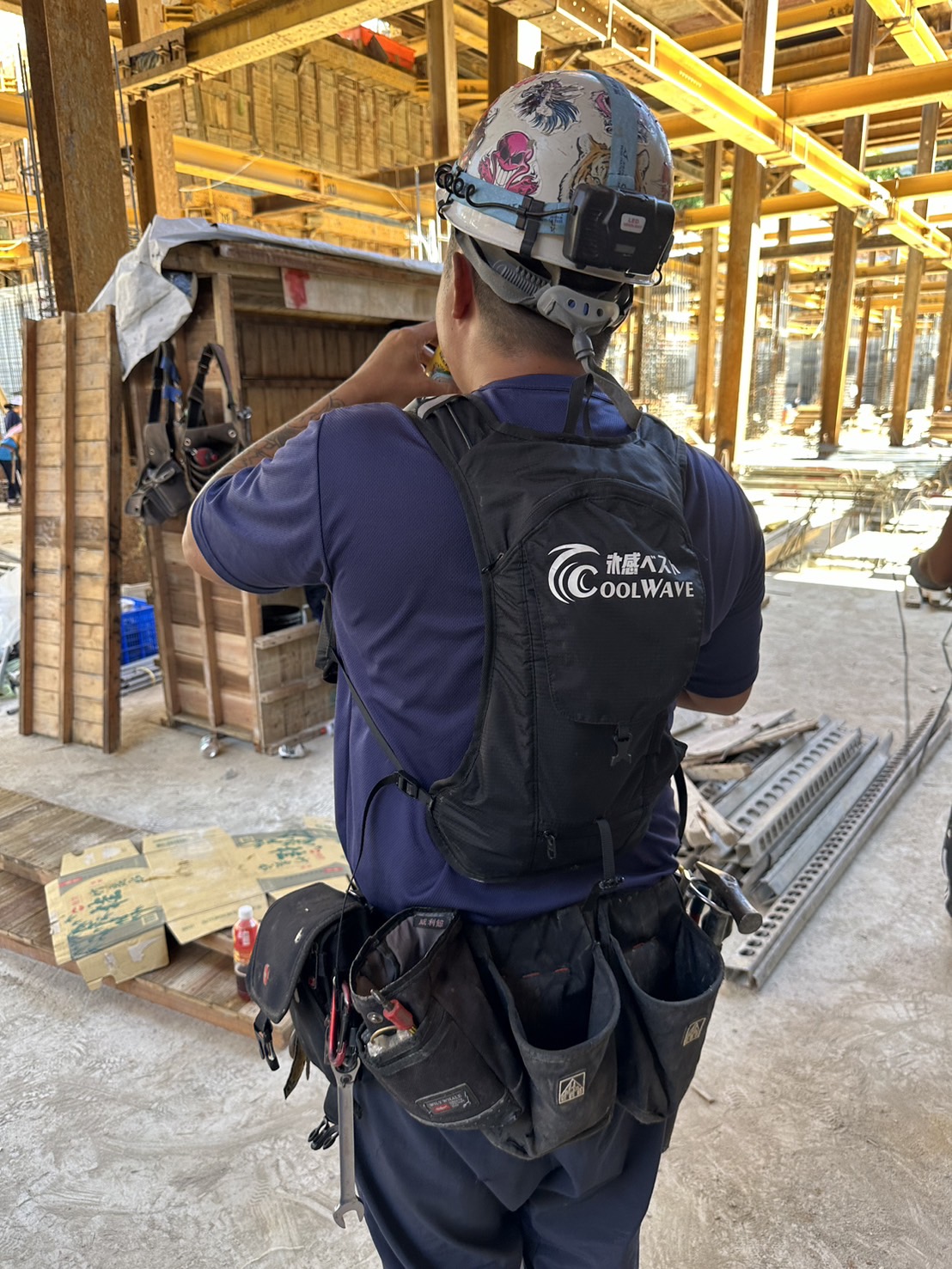
Cover image: outdoor construction work in high summer heat — one of the intended-use settings for water-circulation cooling apparel.
Heat exposure is a work-role problem before it is a temperature problem
Two workers can stand in the same 36 °C afternoon and need completely different cooling strategies. A construction crew member moving formwork generates internal heat and needs a cooling system that keeps working while the body is in motion. A traffic controller at a junction is largely stationary and absorbs direct solar radiation with almost no airflow across the body. A street vendor works from one position for hours, standing on pavement that re-radiates stored heat upward. The ambient number is identical; the exposure profile is not.
That gap is the reason cooling apparel is so often evaluated badly at the discovery stage. Buyers scan specification sheets, compare cooling durations, and end up with a shortlist that ignores the one variable that decides whether a vest actually gets worn: whether it fits the rhythm of the job.
This reference addresses that gap directly. It takes one product — the COOLWAVE Water-Circulation Cooling Vest — and maps it against the work roles the manufacturer lists as intended users, explaining what each verified specification means in those settings. It is written for safety officers, procurement teams and site managers who are still at the awareness and research stage: not yet choosing a model, but trying to understand which category of cooling apparel belongs on which job.
The discovery problem: a fast-growing category with thin application guidance
The commercial case for attention is straightforward. The specific global cooling vest market was valued at approximately USD 215 million in 2024 and is projected to reach USD 385 million by 2033, according to Dataintelo. The broader personal cooling device market — a wider basket that also includes handheld fans and comparable devices — was valued at USD 25.16 billion in 2024 and is projected to reach USD 94.85 billion by 2035, according to Market Research Future.
Those two figures differ by orders of magnitude because they measure different scopes. That difference is itself a practical warning: when a supplier quotes a “market size”, the definition behind the number matters as much as the number.
What the market data does not supply is application guidance. A buyer searching for a cooling vest for a street vendor typically lands on the same generic product page as a buyer searching for a vest for a sheet metal factory. Yet those two jobs have different heat pathways, different clothing constraints, and very different tolerance for a pack worn on the back.
Regional demand makes the gap more urgent. Asia Pacific is the fastest-growing region for cooling vests, driven by rapid industrialisation and high outdoor work populations, according to Spherical Insights. Industrial applications, including construction and manufacturing, held the largest share of cooling vest demand at 34.5% in 2025, according to Dataintelo. The largest slice of this market is therefore exactly the audience that needs scenario-level information rather than consumer-level promotion.
What the COOLWAVE Water-Circulation Cooling Vest is
The COOLWAVE Water-Circulation Cooling Vest is an industrial cooling apparel product classified under Personal Protective Equipment (PPE). It is manufactured and marketed under the Shokunin brand by FENG SHANG PRECISION CO., LTD., a precision tool manufacturer established in 2009 and headquartered in Taoyuan City, Taiwan. The product is designed for use in construction and outdoor work scenarios, and it is offered in a Basic Model and in a Professional Model in Black, Gray and Blue.
Its operating mode is water-circulation cooling. Each unit is supplied as a kit containing a water-cooled vest backpack and two ice packs. The stated cooling duration is 3 to 4 hours, the net weight of the vest is within 2 kg, and the listed suitable temperature is below 10 °C. Product listings and trade references frequently describe the product as a “dual cooling” water cooling vest; in the verified specification the cooling mode is stated as water-circulation cooling, and the two-part element refers to the kit itself — a pumped water circuit chilled by the supplied ice packs.
The intended-user list is short and specific, and it is worth reading before anything else in the specification: construction workers, outdoor workers, food stall operators, street vendors, traffic controllers and sheet metal factory workers.
Verified specification summary
| Specification | Verified detail |
|---|---|
| Product | COOLWAVE Water-Circulation Cooling Vest |
| Model designations | Basic Model; Professional Model — Black, Gray, Blue |
| Category | Industrial Cooling Apparel / Personal Protective Equipment (PPE) |
| Cooling mode | Water-circulation cooling |
| Cooling duration | 3–4 hours |
| Net weight | Within 2 kg |
| Listed suitable temperature | Below 10 °C |
| Pump | 5V, 150 mA (max) |
| Flow rate | Max 320–370 ml/min |
| Supplied contents | Water-cooled vest backpack ×1, ice packs ×2 |
| Shoulder strap material | 600D polyester |
| Water bag material | TPU (thermoplastic polyurethane) |
| Water bag cap | Polypropylene |
| Cooling tube | Sand rubber (black) |
| Additional listed material | PEVA |
| Intended work roles | Construction workers, outdoor workers, food stall operators, street vendors, traffic controllers, sheet metal factory workers |
How the water-circulation cooling mode works, and what that means on site
Circulatory cooling is an active approach. Two ice packs chill a water reservoir carried in the backpack. A small pump moves that chilled water through a tube network routed across the vest, and the water returns to the reservoir to be re-chilled. The cooling tube is specified as sand rubber in black; the water bag is TPU with a polypropylene cap; the shoulder strap is 600D polyester. The pump is rated at 5V and 150 mA maximum, with a flow rate of up to 320 to 370 ml per minute.
Three consequences follow from that architecture, and each one matters differently depending on the job.
Cooling is continuous for as long as the circuit runs. Unlike a static ice pack that delivers a strong initial chill and then decays against one contact area, a pumped circuit distributes chilled water across the torso while the ice packs retain capacity. The verified cooling duration is 3 to 4 hours.
The system depends on consumables and a low-voltage power supply. Ice packs must be frozen and the reservoir filled. The pump operates on a 5V circuit at a maximum of 150 mA. Because the power source for the pump determines whether the vest survives a full shift, buyers should confirm the intended power source, runtime expectation and any portable power specification directly with the supplier as part of the specification review.
The vest is light but not weightless. A net weight within 2 kg includes the carried backpack assembly. That is an ordinary backpack-class load, but for a worker already carrying tools or wearing a harness it is a real addition, and it should be trialled rather than assumed.
Market research supports the direction of travel without qualifying any single product. Active circulatory mechanisms using ice water circulation are increasingly deployed in industrial sectors to mitigate occupational heat stress, according to Strategic Market Research. Adoption and suitability are two separate claims, and only the first is well evidenced.
Scenario fit map: three work rhythms, one verified specification
The same specification behaves differently across work roles. Sorting intended users by movement profile — how much the worker moves, and how heat reaches them — produces a clearer picture than sorting by industry label.
| Work role | Movement profile | Dominant heat pathway | Fit against the verified specification |
|---|---|---|---|
| Construction workers | Continuous movement, lifting, intermittent shade | Internal heat generation plus solar load | Fits: the 3–4 hour cooling window maps onto a half-shift, and the backpack stays on the body while moving |
| Traffic controllers | Largely stationary, arms free, visibility clothing | Direct solar radiation, low airflow | Fits: stationary posture suits a pumped circuit; layering with high-visibility outerwear should be confirmed |
| Street vendors | Stationary for long stretches with short bursts | Radiant heat from pavement, canopies and surroundings | Fits with planning: the 3–4 hour duration means additional frozen ice packs across a long market day |
| Food stall operators | Semi-stationary, repeated bending and reaching | Convective heat from cooking equipment plus humidity | Fits: non-absorbent listed materials support wipe-down routines on a working stall |
| Sheet metal factory workers | Stationary to semi-stationary, indoor | Radiant heat from metal surfaces, roof heat load | Fits: an indoor radiant-heat setting where a backpack is normally acceptable |
| General outdoor workers | Mixed | Mixed | Fits: the broadest intended-use category; a trial is advisable |
Construction: cooling that keeps running while the body moves
Construction is the first name on the intended-user list, and it is the setting where the water-circulation design has the clearest logic. Building work rarely lets a worker stop and sit in shade; the cooling has to travel with the person. Because the reservoir and pump are carried in a backpack rather than held, the cooling loop keeps operating through carrying, climbing and kneeling. The 3 to 4 hour duration maps reasonably onto a morning or afternoon work block, and the 600D polyester shoulder strap is specified as the load-bearing element against the body.
The practical questions on site are not about chemistry but about routine: where the spare frozen ice packs live, who refills the water bag, and whether the backpack conflicts with a fall-arrest harness or a tool belt. Those are site-specific and should be trialled. A cooling vest is a supporting measure; it does not change work-rest schedules, hydration rules or shaded-break requirements.
Traffic control: stationary work in direct sun
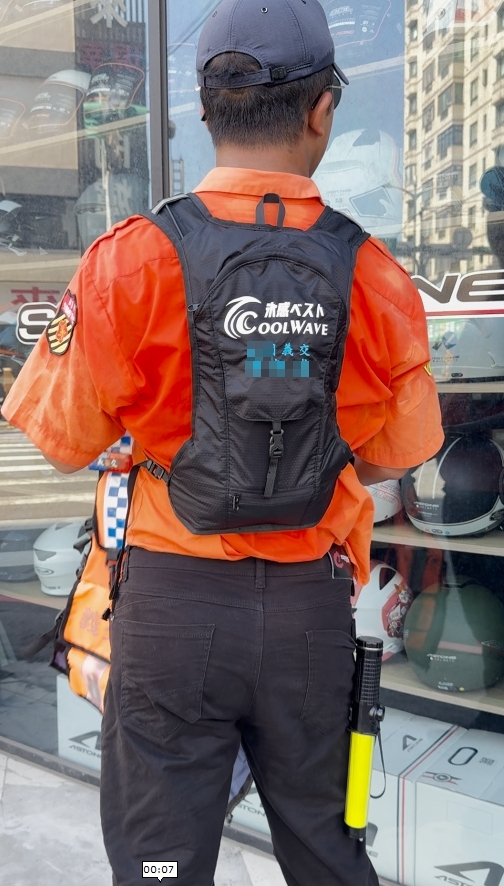
Traffic control duty under direct sun: a stationary role where pumped water circulation keeps working without body movement.
Traffic controllers occupy the least forgiving exposure profile on the list. The work is largely static, which means the body generates little of its own airflow, and the position is usually chosen for visibility rather than shade. Direct solar radiation is the dominant heat load.
A circulatory vest suits this profile because cooling is delivered by the pump rather than by movement. Water moves through the tube network whether the wearer is walking or standing still. The design also has to respect the clothing constraint that matters most in this role, namely high-visibility outerwear. Buyers should confirm how the vest layers relative to a reflective vest, and whether the backpack interferes with a radio or belt equipment.
One boundary is particularly relevant here. In full sun, a 3 to 4 hour cooling window can be consumed faster than the clock suggests if the ice packs are not fully frozen or the reservoir is underfilled. Traffic control shifts frequently run longer than a single cooling cycle, so the operating plan should include a spare set of ice packs and a refill point.
Street vending and food stalls: the long stationary shift
Street vending and food stall work combine two heat sources that rarely appear together in industrial settings: radiated heat from pavement and cooking equipment, and very long hours spent in one place. The work is stationary but not restful, and it usually runs far beyond four hours.
This is where the specification has to be read honestly. A 3 to 4 hour cooling duration covers a meaningful block of the working day, but not the whole of it. The kit’s two ice packs support one cooling cycle, so a market day at the longer end requires additional frozen ice packs or a second kit in rotation. Buyers who plan for that will find the vest practical; buyers who expect a single kit to cover a twelve-hour stall will not.
Material choice matters in food environments. The listed materials are 600D polyester for the shoulder strap, TPU for the water bag, polypropylene for the water bag cap and sand rubber for the cooling tube — non-absorbent surfaces that can be wiped down, which is relevant when a vest is worn close to food handling areas.
Sheet metal factories: radiant heat without the sun
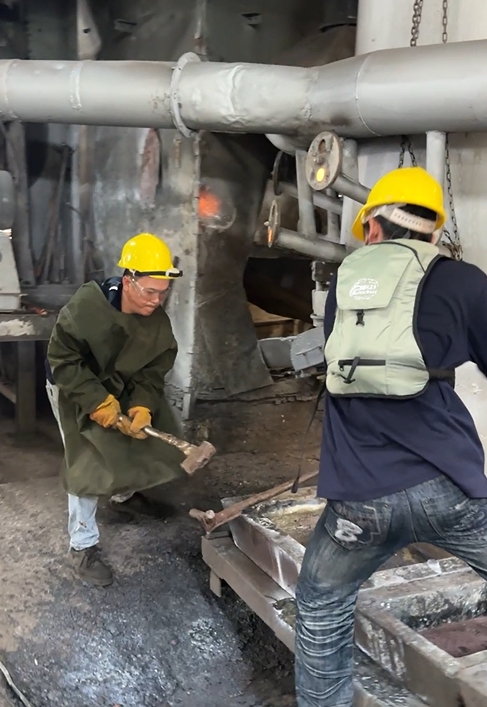
Metal sheet factory work: radiant heat indoors, where low airflow limits the effectiveness of purely passive cooling.
The sheet metal factory case is a reminder that heat stress is not exclusively an outdoor problem. Metal surfaces absorb and re-radiate heat, roof structures trap it, and the work is often stationary or semi-stationary. Workers in this environment appear on the intended-user list alongside outdoor roles.
Here the continuous circulation addresses a specific weakness of passive cooling. In low-airflow buildings a worker standing still generates little convective airflow, so a static ice pack chills a small contact area and little else. A pumped circuit distributes chilled water across the torso instead. The trade-off is that, in an enclosed workplace, the backpack assembly turns the vest into an item that is put on and taken off at defined locations rather than a garment worn continuously.
Comparison with traditional cooling approaches
Cooling apparel is a fragmented category, and different approaches suit different rhythms and different logistics. The comparison below is a decision aid rather than a ranking; each approach has conditions under which it is the reasonable choice.
| Approach | How it cools | Typical strength | Typical boundary |
|---|---|---|---|
| Passive ice-pack vest | Static ice or gel packs held against the body | Simple, no power requirement, low maintenance | Cooling is concentrated and decays; no circulation across the torso |
| Phase change material (PCM) vest | Packs absorb heat at a defined temperature | Stable temperature plateau; PCM vests captured 28.7% of market share in 2025 and were the fastest-growing technology segment (Dataintelo) | Packs must be regenerated between uses; cooling limited to contact area |
| Fan-cooled vest | Battery-powered fans move ambient air across the body | Effective where ambient air is dry | Moves warm air when ambient temperature is already high; fan noise; battery dependency |
| Water-circulation vest (COOLWAVE specification) | Ice packs chill water; a 5V pump circulates it through a tube network at up to 320–370 ml/min | Active, distributed cooling with a stated 3–4 hour duration and a carried reservoir | Requires ice, water and a power source; a 3–4 hour cycle needs a spare ice-pack set for longer shifts; adds a backpack load |
| Wet towel and hydration only | Evaporative cooling from soaked fabric | Zero equipment cost and universally available | Limited duration, fabric dries quickly, evaporative efficiency falls in high humidity |
The honest boundary for the water-circulation approach is logistics rather than performance. It is the only option in the table that depends on three consumables at once: frozen ice packs, water and a low-voltage power supply. Where those three are easy to arrange, the circulatory design delivers distributed cooling that static packs cannot match. Where they are not, a simpler passive vest may be the more reliable choice.
A second boundary applies to all cooling apparel, including this one. No cooling vest substitutes for a heat management programme. Work-rest cycles, hydration, acclimatisation and shaded recovery areas remain the primary controls; a vest is a supporting measure, not a standalone heat-stress control.
What buyers should verify before shortlisting
For teams at the research stage, the following checks convert a product page into a usable specification record. Each item below can be answered today from the verified data, or confirmed in writing with the supplier.
- Kit contents. The supplied configuration is a water-cooled vest backpack ×1 and ice packs ×2. Confirm this in writing, since the cooling duration depends on it.
- Pump power source and runtime. The rated pump values are 5V and 150 mA (max). Confirm the intended power source and the runtime expected from it for your shift length.
- Interpretation of the listed suitable temperature. The specification lists a suitable temperature of below 10 °C. Confirm how that figure should be read against your own site conditions and what ambient conditions the supplier supports.
- Cooling duration expectations. The stated figure is 3 to 4 hours. Confirm expectations for your conditions, and whether one cycle covers a shift or a shift segment.
- Worn weight. Net vest weight is within 2 kg. Add tools, harnesses and communications equipment before approving the load for a full shift.
- Layering compatibility. Check the vest against existing PPE: high-visibility vests, fall-arrest harnesses and tool belts.
- Cleaning and material suitability. For food environments, confirm that the listed materials — TPU, polypropylene, 600D polyester and sand rubber — match your hygiene routine.
- Quality and electrical documentation. Cooling systems are expected to comply with ISO 9001:2015 for quality management, and electrical components often require CE or UL marks, according to ISO and UL guidance. Request the relevant documents rather than assuming them.
- A role-specific trial. Run the vest with the actual work role before specifying it in bulk, particularly for stationary roles where a backpack is a new element.
Market trend: why scenario-level specification is becoming normal
Three published signals explain why buyers are moving from a single generic cooling vest to role-specific selection.
First, demand is concentrated in exactly the roles discussed here. Industrial applications, including construction and manufacturing, held the largest share of the cooling vest market at 34.5% in 2025, according to Dataintelo. That is not a consumer fashion category; it is an occupational one.
Second, the growth centre is Asia Pacific, identified by Spherical Insights as the fastest-growing region for cooling vests, driven by rapid industrialisation and large outdoor work populations. Regional conditions — humidity as well as temperature — push buyers toward solutions that do not depend solely on evaporation.
Third, the technology mix is shifting toward active and phase-change approaches. PCM vests held 28.7% of market share in 2025 and were the fastest-growing technology segment, according to Dataintelo, while active circulatory mechanisms using ice water circulation are increasingly deployed in industrial sectors to mitigate occupational heat stress, according to Strategic Market Research.
For buyers assembling a shortlist, the published competitor set for this category includes Techniche International, Glacier Tek, Polar Products Inc. and Ergodyne, as identified by Spherical Insights. That list is useful as a starting point for comparison, not as an endorsement or a ranking.
Future outlook
On current published projections, the cooling vest category is expected to roughly double in size between 2024 and 2033, from approximately USD 215 million to USD 385 million according to Dataintelo. If industrial applications continue to hold the largest share, the practical pressure will fall on specification quality rather than product variety.
Three developments are the ones worth watching for awareness-stage buyers. The first is runtime transparency: as more suppliers publish circulation rates and cooling durations, buyers will be able to compare on equal terms rather than on adjectives. The second is documentation, since compliance expectations for quality management and electrical components are already established for this class of product. The third is logistics, because the limiting factor for circulatory cooling is not the cooling itself but access to ice, water and power across a real shift.
For the work roles covered here — construction, traffic control, street vending, food stalls and sheet metal factories — the sensible expectation is that cooling apparel becomes a specified item with a defined duty cycle, rather than a discretionary purchase. That shift favours products whose specifications can be read, verified and planned around.
FAQ
What is the COOLWAVE Water-Circulation Cooling Vest, and which workers is it intended for?
It is an industrial cooling apparel product classified under Personal Protective Equipment (PPE) that operates on a water-circulation cooling mode. The manufacturer lists the intended users as construction workers, outdoor workers, food stall operators, street vendors, traffic controllers and sheet metal factory workers. Each unit is supplied with a water-cooled vest backpack and two ice packs.
How long does the cooling last, and what happens at the end of that period?
The stated cooling duration is 3 to 4 hours. Because the kit is supplied with two ice packs, one cooling cycle is supported per kit; a longer working day requires additional frozen ice packs or a second kit in rotation. The vest itself remains wearable after the ice packs lose capacity, but the cooling effect depends on the ice packs retaining their charge.
Does the vest require a power supply, and what are the electrical specifications?
Yes. The water-circulation cooling mode is driven by a pump rated at 5V and 150 mA (max), with a flow rate of up to 320 to 370 ml per minute. The intended power source and expected runtime for a given shift length should be confirmed with the supplier during specification review.
How much does the vest weigh, and does the weight limit its use?
The net weight is within 2 kg, which places it in the ordinary backpack range. For workers who already carry tools or wear a harness, the combined load should be trialled before the product is rolled out across a team.
Which model designations are available, and do they differ in cooling performance?
The COOLWAVE Water-Circulation Cooling Vest is offered as a Basic Model and as a Professional Model in Black, Gray and Blue. All configurations share the same listed cooling mode, the same stated 3 to 4 hour cooling duration, the same net weight of within 2 kg, and the same supplied contents of one water-cooled vest backpack and two ice packs.
A downloadable product brochure for the COOLWAVE Water-Circulation Cooling Vest is available here: COOLWAVE product brochure (PDF).
Have Questions or Need More Details?
Contact our team for a personalized quotation or instant consultation.
Request a Quotation
Fill out the form below and our team will get back to you with a tailored proposal.
WhatsApp Direct Chat
Prefer to chat in real-time? Message us on WhatsApp for instant assistance & quick answers.
- Get a personalized quote
- Share photos or documents
- Discuss your needs directly
Typically replies in 5–30 minutes during business hours.