
Dual Cooling Water Cooling Vest: Where It Fits on the Job
A dual cooling water cooling vest is wearable protective equipment that moves chilled water through tubing against the wearer’s body instead of relying only on static ice packs pressed into fabric pockets. The distinction matters on real job sites, because the limiting factor is rarely the idea of cooling — it is whether a specific vest can carry a worker through an entire outdoor shift in the heat. The COOLWAVE Water-Circulation Cooling Vest, produced by Shokunin — the professional tool brand of Feng Shang Precision Co., Ltd., a manufacturer founded in 2009 and based in Taoyuan, Taiwan — was designed around that brief. This article maps the product to the environments where it has actually been deployed: construction sites, traffic control points, street vending and food stalls, metal sheet factories, and other prolonged outdoor work.
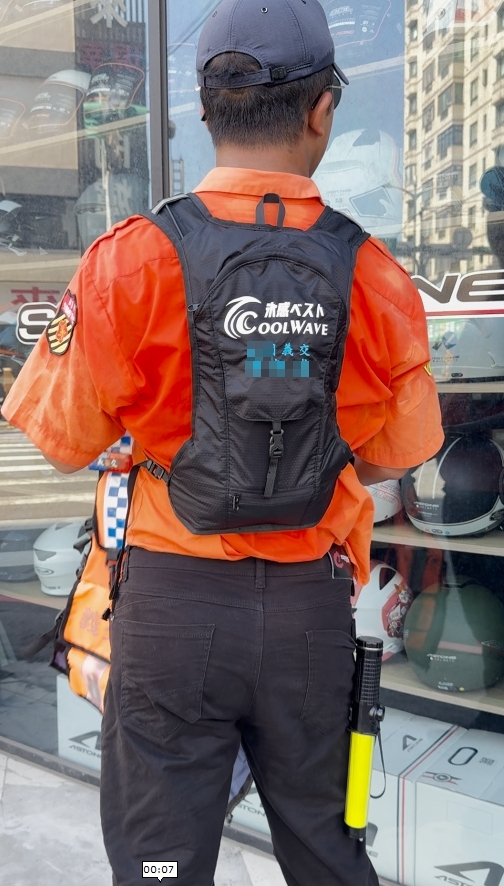
Traffic direction duty under direct sun — one of the deployment environments recorded for the COOLWAVE water-circulation cooling vest in Taiwan.
Why Outdoor Shift Work Creates a Cooling Gap
Heat exposure in industrial and outdoor work is not a single problem. It is a set of constraints that appear at the same time: the worker cannot leave the position, airflow is often poor, and the physical load of the task keeps internal heat generation high. A traffic controller standing at an intersection, a vendor working behind a hot griddle, and a worker handling metal sheet under a metal roof are all in different thermal environments, yet they share the same practical requirement — cooling that keeps working for hours without interrupting the job.
That requirement rules out several common answers. A cold drink or a shaded break helps, but neither is available on demand across a full shift. Wet towels and evaporative fabrics depend on airflow and dry air, and they lose effect quickly in still, humid conditions. Loose ice packs work at first and then fade as the ice melts, and the cooling is concentrated only where the pack touches the body.
The market data reflects how seriously this gap is now being treated. Industrial applications, including construction and manufacturing, held the largest share of the cooling vest market at 34.5% in 2025, according to Dataintelo. That figure is a useful signal for procurement teams: cooling apparel is no longer viewed as a seasonal convenience item but as equipment tied to occupational heat management at industrial scale.
What the COOLWAVE Water-Circulation Cooling Vest Is
The COOLWAVE Water-Circulation Cooling Vest is classified as industrial cooling apparel and personal protective equipment. It is supplied as a backpack-style water-cooled vest with two ice packs, and it is engineered around a circulating water loop rather than static cold contact alone. Shokunin, the brand behind the product, is the professional e-commerce brand of Feng Shang Precision Co., Ltd., a Taiwan manufacturer of tools and outdoor equipment whose product range also includes air compressors, cut-off machines, lithium batteries, diamond saws, nail guns and related hand tools.
The published specification sheet for the basic model is short enough to read in full, which is unusual in this category and useful for evaluation:
| Specification | Published value |
|---|---|
| Product type | Industrial cooling apparel / personal protective equipment (PPE) |
| Cooling duration | 3–4 hours |
| Weight | Within 2 kg |
| Shoulder strap material | 600D polyester |
| Vest material | PEVA |
| Water bag material | TPU |
| Water bag cap | Polypropylene |
| Cooling tube | Sand rubber (black) |
| Pump output | 5V 150 mA (max) |
| Flow rate | Max 320–370 ml/min |
| Supplied contents | Water-cooled vest backpack ×1, ice packs ×2 |
Two supporting facts sit alongside the spec sheet. The water-cooled vest structure and cooling system are covered by patent certificate I886033, issued by the Intellectual Property Office of the Ministry of Economic Affairs (ROC) on 1 June 2025, with an expiry date of 27 August 2044. Separately, the COOLWAVE vest has received the Disaster Prevention Product and Service Certification Award from the Taiwan Disaster Prevention Industry Association.
How the Water-Circulation Loop Works
The cooling principle is straightforward to describe, and understanding it makes the use-case fit easier to judge. Two ice packs chill the water held in a TPU reservoir. A 5V 150 mA pump then moves that chilled water at a maximum flow rate of 320–370 ml/min through sand rubber tubing routed against the wearer’s body. Water that has absorbed body heat returns to the reservoir, where the ice packs bring the temperature back down, and the loop repeats.
Three details matter more than they first appear:
- Circulation spreads cooling over a wider area. Because water keeps moving, the cold contact surface is continuously refreshed rather than warming up and staying warm at one spot.
- Flow rate sets the cooling sensation. A published maximum of 320–370 ml/min is the throughput that determines how quickly chilled water is delivered to the tubing and how quickly warmed water is carried away.
- Weight and form factor decide whether it gets worn. At within 2 kg, the system is carried as a backpack rather than as a heavy garment, which is the practical reason it can be used during active work instead of only during rest breaks.
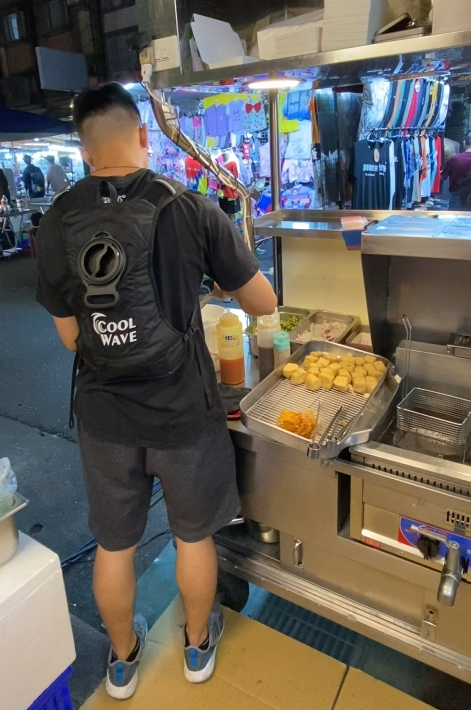
Street vending and night market stalls combine radiant heat from cooking equipment with long, uninterrupted standing time.
Field Use Cases: Where the Vest Fits
Construction Sites
Construction work produces the most demanding combination in this category: sustained physical effort, direct sun, and long shifts. Because the vest sits within 2 kg and is carried as a backpack, it does not interfere with tool handling or movement between levels. The adjustable one-size-fits-all design also matters on sites where vests are issued from a shared pool rather than assigned to individuals. The published applicable-industry list for this product places construction workers first, and the Taiwan case record includes construction sites among the deployment environments.
Traffic Control and Roadside Duty
Traffic direction is a low-airflow, high-exposure task. The worker stands in the open, often on hot pavement, and cannot step away from the position. Evaporative cooling performs poorly here because there is little air movement to drive it. A circulatory system does not depend on airflow, which is why traffic controllers appear among the recorded users of this product in Taiwan and among the listed applicable industries (traffic controllers).
Street Vending, Night Markets and Food Stalls
Food stall operators work in a different heat profile: ambient summer heat plus radiant heat from griddles, fryers and steam. Their position is fixed for hours, and stepping into air conditioning is rarely an option during trading hours. A wearable vest with a 3–4 hour cooling window maps well onto a trading session, and the night market deployment recorded in the case file confirms the product has been used in this environment. The published applicable-industry list includes food stall operators and street vendors.
Metal Sheet Factories and Metal-Roof Workplaces
Metal sheet factories and metal-roof buildings add radiant load to ambient heat: the metal surface itself becomes a heat source, and air movement indoors is typically limited. This is one of the more difficult environments for passive cooling because the worker is not only hot but surrounded by warm surfaces. The product’s listed applicable industries include metal sheet factories, and the Taiwan deployment record includes a metal sheet factory among its locations. The higher flow rate of a circulation system is an advantage in these still, radiant conditions because cooling delivery does not depend on wind.
Other Prolonged Outdoor Work
The same logic extends to other outdoor tasks where a worker holds a position for hours in the sun, including fishing and similar stationary outdoor activity. The case file for this product includes outdoor use of that type alongside the industrial environments. The common thread across all of these settings is not the industry name but the working conditions: limited shade, limited airflow, limited ability to leave the position, and a work period measured in hours rather than minutes.
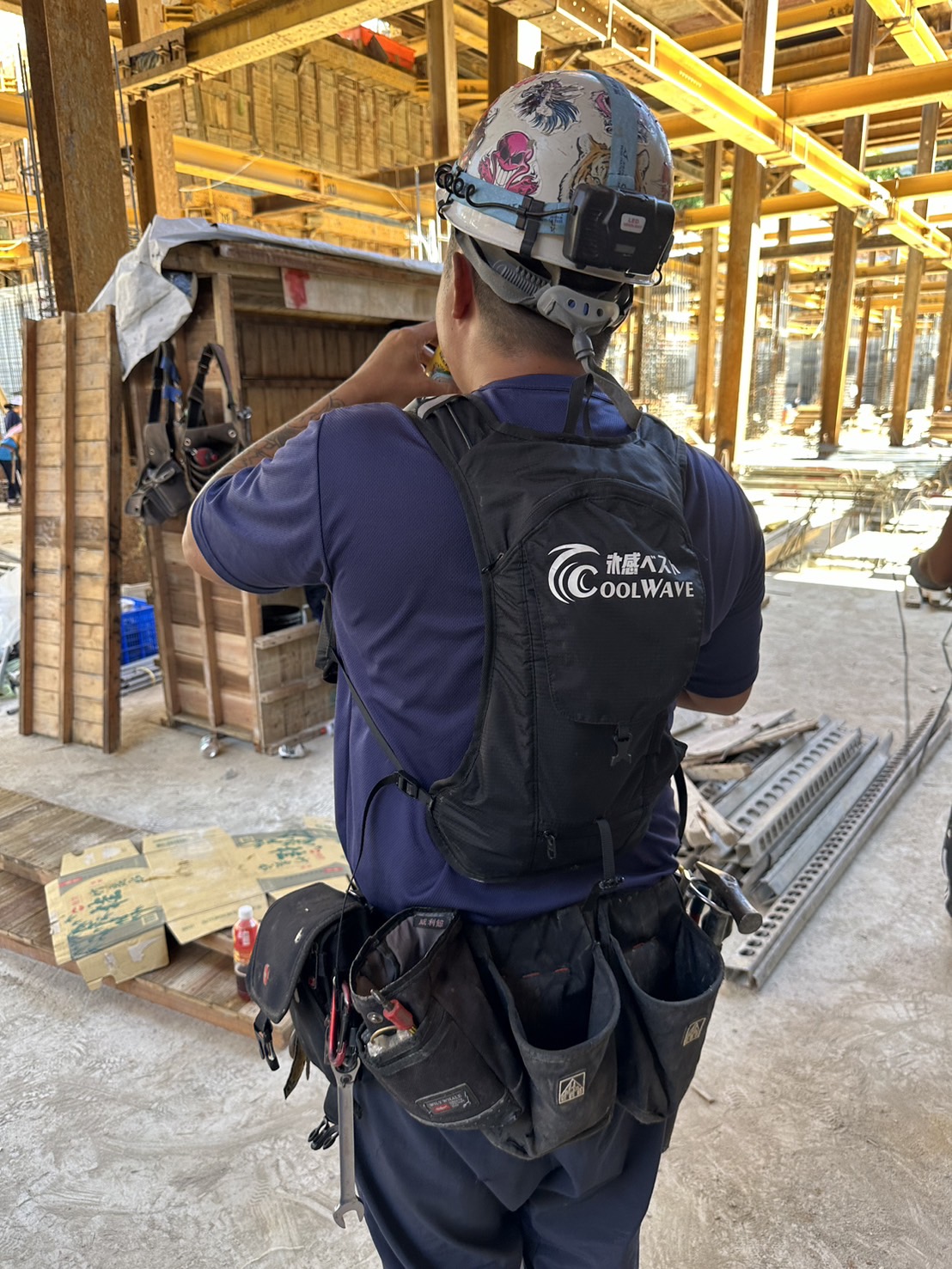
Construction work combines heavy physical load with direct sun — the environment where cooling duration and weight matter most.
What the Taiwan Deployment Record Shows
Field evidence for this product comes from a Taiwan deployment of 100 units used for cooling in high-temperature environments. The case record lists the participating client types as construction sites, outdoor work, metal sheet factories and street vendors. The reported outcomes were effective body cooling, heatstroke prevention, improved work efficiency and improved worker comfort.
The same record describes the deployment highlights as passive ice-pack cooling with no power requirement, lightweight and portable construction, an adjustable one-size-fits-all design, and certification as a disaster prevention product. For an evaluation-stage buyer, the value of this record is not the unit count alone but the combination it demonstrates: a single product configuration was issued across four different outdoor work types with no mains power available at any of them.
Market Trend Analysis: Cooling Apparel Moving Into Industrial Procurement
Several verified data points frame where this product category is heading.
At the broadest level, the global personal cooling device market was valued at USD 25.16 billion in 2024 and is projected to reach USD 94.85 billion by 2035, according to Market Research Future. The cooling vest segment specifically is far smaller: Dataintelo valued that market at approximately USD 215 million in 2024, projected to grow to USD 385 million by 2033. The gap between these two figures is a definitional one, since the broader personal cooling device category includes handheld fans, portable air conditioners and other devices. Buyers comparing market reports should confirm which product scope a given figure covers before using it in a business case.
Regionally, Asia Pacific is identified by Spherical Insights as the fastest-growing region for cooling vests, driven by rapid industrialization and high outdoor work populations — a description that matches the Taiwan deployment context for this product.
On technology, Dataintelo reports that phase change material (PCM) cooling vests captured 28.7% of market share in 2025 and represent the fastest-growing technology segment. At the same time, Strategic Market Research notes that active circulatory mechanisms, including ice water circulation, are increasingly deployed in industrial sectors to mitigate occupational heat stress. These two trends are not in competition; they describe a market splitting between passive material-based cooling and active circulation-based cooling, with industrial buyers choosing between them based on shift length, available cooling logistics and airflow conditions.
Compliance expectations are also hardening. Cooling systems must comply with ISO 9001:2015 for quality management and often require CE or UL marks for electrical components, per the International Organization for Standardization and UL. Because a circulating cooling vest contains a pump, an electrical component mark can become a relevant purchasing condition in regulated markets.
Finally, the competitive field is established rather than emerging. Key global participants identified by Spherical Insights include Techniche International, Glacier Tek, Polar Products Inc. and Ergodyne. Buyers evaluating this category are therefore comparing an active set of suppliers, not testing an unproven product class.
Comparison with Traditional Cooling Solutions
The most useful comparison is between cooling mechanisms, not between brand claims. Each approach solves a different part of the problem and carries its own constraint.
| Approach | How cooling is delivered | Typical strength | Typical constraint |
|---|---|---|---|
| Static ice-pack vest | Frozen packs placed in fabric pockets | Simple, low complexity, no moving parts | Cooling weakens as packs melt and is concentrated at contact points |
| Phase change material (PCM) vest | Packs that hold a transition temperature | More stable temperature plateau than plain ice | Requires freezer or refrigeration logistics; PCM held 28.7% of 2025 market share per Dataintelo |
| Evaporative fabric or wet toweling | Water evaporation driven by airflow | Light and inexpensive | Depends on air movement and low humidity; weak in still, humid conditions |
| Water-circulation vest (COOLWAVE) | Ice packs chill a water reservoir; a 5V 150 mA pump circulates through tubing at up to 320–370 ml/min | Cooling spread across a wider body area; independent of airflow; documented deployment without mains power | Bounded 3–4 hour cooling window; ice re-supply planning required; pump power configuration should be confirmed with the supplier |
Limits and Planning Considerations
A credible evaluation has to state where this product does not remove the buyer’s work. The following points are drawn directly from the published specification, certification and capability records for the COOLWAVE Water-Circulation Cooling Vest.
- Cooling duration is 3–4 hours, not a full shift. For an 8-hour outdoor shift, the buyer should plan a re-icing interval with spare ice packs and a cooler on site. The product buys productive time; it does not eliminate heat-management planning.
- One adjustable size is a compromise. A one-size-fits-all adjustable design simplifies shared-pool issuing, but fit should still be verified on individual workers, since comfort and tube contact affect how consistently the vest is worn.
- Production is ODM without customization. The capability record lists ODM production mode with customization marked as unavailable. Buyers who need altered branding, sizing or configuration should treat that as a boundary condition rather than an assumption.
- Order planning follows fixed parameters. The published figures are a minimum order quantity of 10 units, a lead time of 7–14 days, and monthly capacity of 3,000 units, with a 6-month warranty on the water-cooled vest.
- Deployment without power is documented, but should be confirmed. The case record emphasizes passive ice-pack cooling with no power requirement while the spec sheet lists a 5V 150 mA pump; confirming the ordered configuration removes ambiguity before a site rollout.
Future Outlook
Two directions look likely for this category. The first is a shift in how cooling vests are classified internally: with industrial applications already holding the largest market share and Asia Pacific identified as the fastest-growing region, more buyers are likely to treat cooling apparel as PPE with a specification, a warranty and an audit trail rather than as a seasonal purchase. That favors suppliers who can document patents, certifications and deployment records — which is the form the COOLWAVE evidence base currently takes.
The second is further segmentation between passive and active cooling. PCM growth and the increasing industrial use of active circulatory mechanisms suggest the market will not converge on one answer. Instead, buyers will select by shift length, airflow conditions and the availability of ice or refrigeration. For water-circulation products specifically, the practical development areas are longer useful cooling windows, lighter carried weight, and clearer documentation of pump power configuration so that site planners can specify with confidence.
FAQ
What is a dual cooling water cooling vest?
It is a wearable cooling garment in which chilled water is circulated through tubing against the wearer’s body, rather than relying only on static ice packs. The COOLWAVE Water-Circulation Cooling Vest is supplied as a backpack with one water-cooled vest and two ice packs, and uses a TPU water bag, polypropylene cap, sand rubber cooling tube and a 5V 150 mA pump with a maximum flow rate of 320–370 ml/min.
How long does the COOLWAVE water-circulation cooling vest provide cooling?
The published cooling duration is 3–4 hours per charge of ice packs. Work periods longer than that require a planned re-icing interval; the duration figure is a specification, not an estimate for a full workday.
How heavy is the vest, and can it be worn during active work?
The published net weight is within 2 kg, and the system is carried as a backpack. Shoulder straps use 600D polyester and the vest body uses PEVA. The design is adjustable and described as one-size-fits-all, which supports shared issuing across crews; individual fit should still be checked before a rollout.
Which work environments has this product been used in?
The Taiwan deployment record covers construction sites, outdoor work, metal sheet factories and street vendors, across 100 units used for cooling in high-temperature environments. The published applicable-industry list for the product also includes construction workers, outdoor workers, food stall operators, street vendors, traffic controllers and metal sheet factories.
What results were reported from the Taiwan deployment?
The reported outcomes were effective body cooling, heatstroke prevention, improved work efficiency and improved worker comfort. The deployment record also notes that the product does not require a power source, is lightweight and portable, uses an adjustable one-size-fits-all design, and holds disaster prevention product certification.
How does water circulation compare with ice-pack-only or PCM vests?
Static ice-pack vests are simpler but cool only at contact points and weaken as packs melt. PCM vests hold a more stable temperature plateau but need refrigeration logistics; PCM held 28.7% of 2025 market share per Dataintelo. A water-circulation vest distributes cooling across a wider body area and does not depend on airflow, at the cost of a 3–4 hour cooling window and ice re-supply planning.
What should a buyer confirm before ordering?
Confirm the power configuration of the circulation pump for the ordered version, since the deployment record describes passive ice-pack cooling with no power requirement while the specification sheet lists a 5V 150 mA pump. Also confirm the published commercial parameters: minimum order quantity of 10 units, lead time of 7–14 days, monthly capacity of 3,000 units, ODM production without customization, and a 6-month warranty on the water-cooled vest. Patent certificate I886033 covers the water-cooled vest structure and cooling system.
Summary
For evaluation-stage buyers, the COOLWAVE Water-Circulation Cooling Vest is best understood as a shift-length cooling tool rather than a full-day solution. Its fit is strongest where airflow is poor and the worker cannot leave the position: traffic control, construction, street vending and metal sheet environments. The published evidence — a 3–4 hour cooling window, a carried weight within 2 kg, a 320–370 ml/min circulation loop, patent I886033, disaster prevention product certification, and a 100-unit Taiwan deployment covering four outdoor work types — provides the basis for a site trial. The limitations, mainly the cooling window, the single adjustable size and the fixed ODM parameters, are equally part of that assessment.