
Dual Cooling Water Cooling Vest: Certification, Parameters, and Buyer Due Diligence
Heat stress has moved from an operational nuisance to a documented occupational risk. In response, procurement teams are no longer accepting vague marketing language for personal cooling gear. They are asking for the same level of evidence they would expect from any safety product: certifications, patent numbers, pump specifications, endurance data, and clear application limits. This article examines those constraints in the context of the dual cooling water cooling vest, using the Shokunin COOLWAVE as a reference example.
Why 'Dual Cooling' Demands More Than a Cold Pack
A dual cooling water cooling vest typically combines two elements: a cold source, usually ice packs, and an active water circulation system that moves chilled water through tubes in contact with the body. The term 'dual' refers to this pairing of passive cold storage and active circulation. For industrial buyers, the critical difference lies in the pump and the thermal management system—not just in how cold the vest feels at first touch.
This distinction is important because the two elements fail differently in the field. Ice packs alone lose their cooling capacity as they melt. An active circulation system, on the other hand, can maintain a steady flow of cold water as long as the cold source and power supply remain available. Therefore, when a vendor presents a vest as 'dual cooling,' the buyer should ask for proof of both the cold-source endurance and the circulation system's electrical and flow parameters.
The Procurement Problem: Unverifiable Heat Relief Claims
Many cooling vests on the market rely on phase-change material (PCM) packs that are frozen before use. While simple, their effective cooling window is often short, especially under direct sun or in metal-roof factories. Buyers who have experienced this shortfall are now looking for systems that maintain cooling over a full shift. But without standardized testing or clear parameters, comparing products is difficult.
That is why verifiable constraints become the real decision criteria. A stated cooling duration, a pump flow rate, a weight limit, and a documented patent are concrete data points that can be checked before purchase. The absence of these details should itself be treated as a warning signal in any industrial supply evaluation.
Shokunin COOLWAVE: A Verified Reference Point
Shokunin is a professional brand launched by Feng Shang Precision Co., Ltd., a Taiwan-based manufacturer founded in 2009. The company produces the COOLWAVE water-circulation cooling vest, which is available in a basic model and professional models in blue, gray, and black. The vest has received the Disaster Prevention Product and Service Certification Award from the Taiwan Disaster Prevention Industry Association, and the basic model is protected by Patent No. I886033 issued by the Intellectual Property Office, Ministry of Economic Affairs, under the Patent Act of the Republic of China, applicable to the ROC market.
In addition to these documented credentials, the manufacturer operates with an ODM model, reporting a monthly capacity of 3,000 units, a lead time of 7–14 days, a minimum order quantity of 10 units, and a 6-month warranty for the water-cooled vest. For procurement teams, these figures help assess supply continuity and after-sales support.
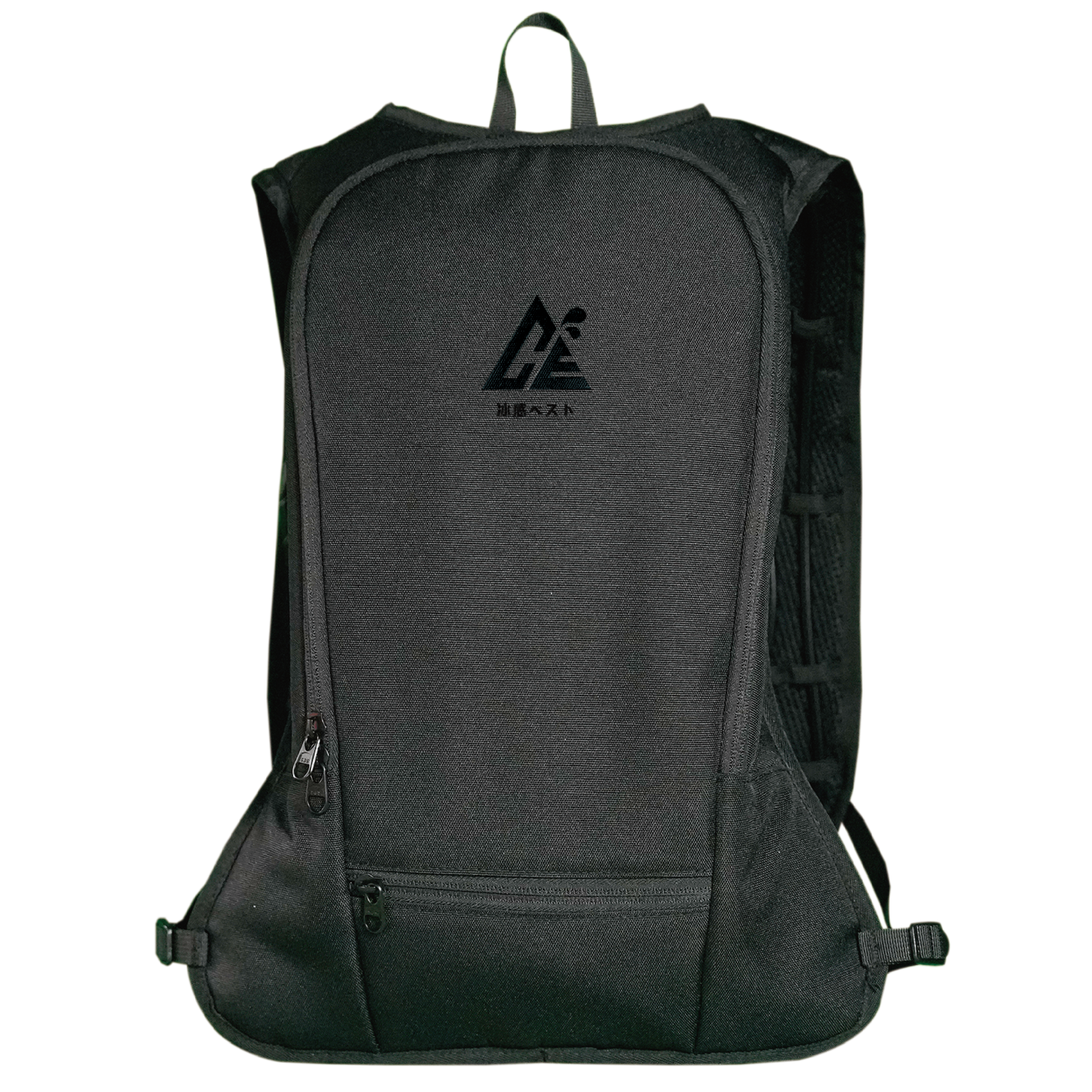
Shokunin COOLWAVE professional model in black. Image from product specification data.
Technical Parameters Buyers Should Validate
For a water-circulation cooling vest, the following parameters determine whether the system can meet real-world work-shift demands. The table below compiles the published specifications for the COOLWAVE vest.
| Parameter | Specification |
|---|---|
| Cooling duration | 3–4 hours |
| Weight | Within 2 kg |
| Suitable temperature | Below 10°C (coolant temperature) |
| Shoulder strap material | 600D polyester |
| Vest material | PEVA |
| Water bag material | TPU |
| Water bag cap | Polypropylene |
| Cooling tube | Sand rubber (black) |
| Pump output | 5V 150mA (max) |
| Flow rate | Max 320–370 ml/min |
| Package contents | Water-cooled vest backpack ×1, ice packs ×2 |
The pump output indicates that the circulation system is powered by a low-voltage DC source, which in field use typically translates to a power bank or another 5V supply. The flow rate of 320–370 ml/min is a useful reference for estimating how quickly chilled water moves through the tubes and how evenly the cooling effect is distributed.
Interpreting Endurance and Temperature Limits
The 3–4 hour cooling duration should be evaluated against the actual work schedule. For a half-day shift, a single charging of the cold source may suffice. For a full day, the crew may need a second set of ice packs or a scheduled break to replenish the cold source. The 'below 10°C' specification refers to the coolant temperature, which means the ice packs must be sufficiently frozen before use and, in extreme ambient heat, may need insulation during transport to the worksite.
Certification and Intellectual Property as Procurement Constraints
Documentation is a key constraint in safety-related purchasing. The COOLWAVE vest provides two types of documented evidence:
- Disaster Prevention Product and Service Certification Award from the Taiwan Disaster Prevention Industry Association, which validates the product's compliance with specific disaster prevention standards.
- Patent No. I886033 for the water-cooled vest structure and cooling system, issued by the Intellectual Property Office, Ministry of Economic Affairs, under the Patent Act of the Republic of China. This patent applies to the ROC market.
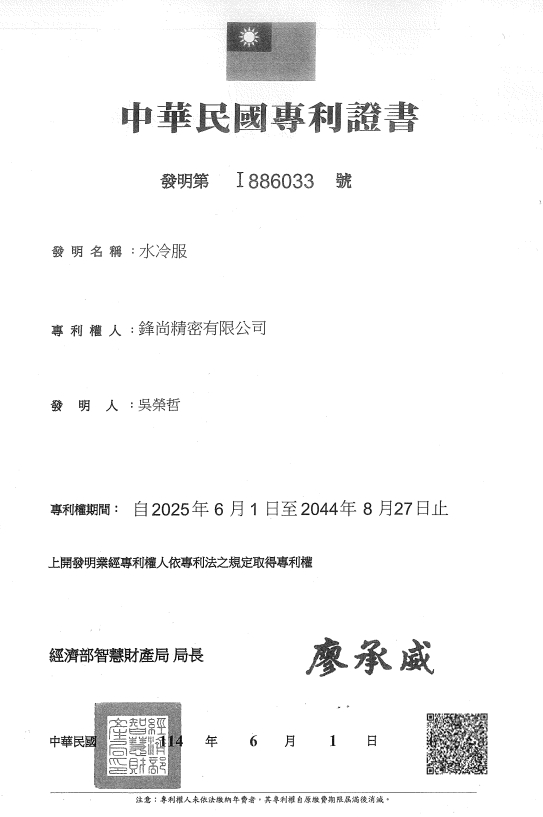
Patent certificate for the COOLWAVE water-circulation cooling vest.
Buyers should verify whether a patent covers the specific structure or cooling system they intend to source, since this can affect exclusivity and long-term supply stability. Certification from a recognized industry body also helps when the end customer is a government contractor or a large industrial employer with strict compliance requirements.
Application Scenarios and Field Evidence
The intended working environments for the COOLWAVE vest include construction sites, outdoor work, metal sheet factories, street vendors, food stall operators, traffic controllers, and similar heat-exposed roles. A documented application case reports the use of 100 units across these environments over a 10-year period, with outcomes described as effective body cooling, heatstroke prevention, improved work efficiency, and improved worker comfort.
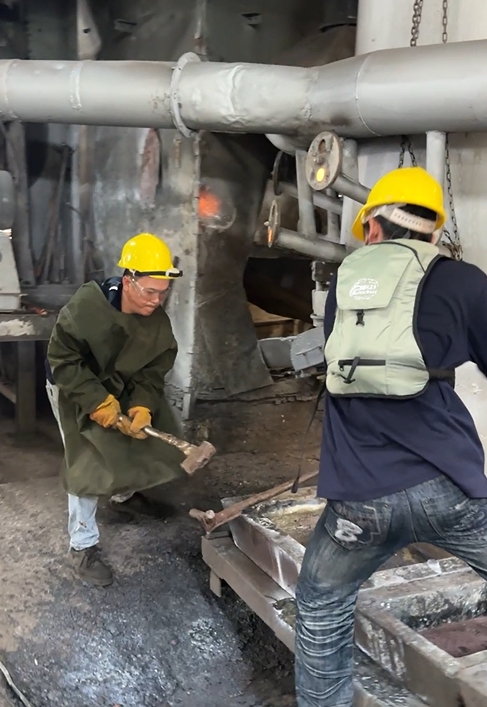
Water-cooling vest deployed in a metal sheet factory environment.
The vest is designed as a lightweight, portable system with adjustable straps and a one-size-fits-all approach. The passive ice-pack cold source means no continuous power is required for the cold generation itself, though the circulation pump does need a low-voltage power supply. This combination gives site managers flexibility: the ice packs can be prepared in a central location, and each worker only needs to carry the vest and a small power bank.
Market Context: Why Active Circulation Is Gaining Ground
Third-party market data supports the shift toward active and industrial cooling systems. According to Dataintelo, the global cooling vest market was valued at approximately USD 215 million in 2024 and is projected to reach USD 385 million by 2033. Market Research Future places the broader personal cooling device market at USD 25.16 billion in 2024, growing to USD 94.85 billion by 2035. Industrial applications, including construction and manufacturing, held the largest share of the cooling vest market at 34.5% in 2025, according to Dataintelo. Spherical Insights identifies Asia Pacific as the fastest-growing region for cooling vests, driven by rapid industrialization and large outdoor work populations.
Within technology segments, phase change material vests captured 28.7% of the market in 2025, making PCM the fastest-growing technology segment. At the same time, Strategic Market Research notes that active circulatory mechanisms, such as ice water circulation, are increasingly deployed in industrial sectors to mitigate occupational heat stress. This indicates that both passive and active approaches are expanding, but active circulation is becoming a practical option for continuous heat exposure.
Comparison with Traditional Cooling Vests and One Hard Boundary
Traditional passive cooling vests rely on phase change material or frozen gel packs without a pump. They are simple, quiet, and do not require electricity. Their limitation is that cooling intensity and duration are constrained by the amount of phase-change material and ambient temperature. Once the material is fully melted, cooling stops until the packs are re-frozen.
An active water-circulation vest such as the COOLWAVE addresses the duration issue by moving chilled water across the body, extending the cooling window to 3–4 hours per the specification. This comes with a trade-off that buyers must respect: the pump requires a 5V power source, and the coolant temperature must be kept below 10°C. That means field operations need access to ice packs or chilled water to maintain performance. In addition, the vest weighs within 2 kg, which is acceptable for many tasks but should be evaluated against job mobility requirements. For workers who need to climb, crawl, or move quickly, the weight and the backpack format may be a consideration.
Buyer Due Diligence Checklist
Before approving a dual cooling water cooling vest for industrial use, verify the following:
- Documented cooling duration (e.g., 3–4 hours) and the test conditions behind it.
- Weight and physical dimensions, including the backpack and water-filled state.
- Pump output and flow rate (e.g., 5V 150mA, 320–370 ml/min).
- Cold-source requirements (ice packs, coolant temperature below 10°C).
- Certification from a recognized body, such as the Taiwan Disaster Prevention Industry Association.
- Patent or intellectual property protection on the cooling structure or system.
- ODM/after-sales terms: monthly capacity, lead time, MOQ, and warranty.
Future Outlook: Evidence-Based Heat Relief
As occupational heat stress regulations harden in many regions, the procurement bar will continue to rise. Sellers that can document patent protection, third-party certifications, and measurable pump or endurance specifications will have an advantage in industrial tenders. Active circulation systems are likely to coexist with PCM products, with each serving different shift lengths and field conditions. For buyers, the key is to match the documented constraints to the actual environment—especially the availability of a cold source and power supply.
Frequently Asked Questions
What certifications does the COOLWAVE water-circulation cooling vest hold?
The COOLING water-cooled vest received the Disaster Prevention Product and Service Certification Award from the Taiwan Disaster Prevention Industry Association. This certification is issued for the product manufactured by Feng Shang Precision Co., Ltd. and validates compliance with specific disaster prevention standards.
What patent protects the COOLWAVE vest and where does it apply?
The COOLWAVE water-circulation cooling vest (Basic Model) is protected by Patent No. I886033, issued by the Intellectual Property Office, Ministry of Economic Affairs, under the Patent Act of the Republic of China. This patent is applicable to the ROC market.
How long does the COOLWAVE cooling vest provide cooling?
The published cooling duration is 3–4 hours. This is based on the vest's water circulation system combined with the included ice packs.
What is the weight of the COOLWAVE vest?
The vest weighs within 2 kg. This includes the backpack and the water circulation components, but the exact weight depends on the amount of water and the configuration.
What are the pump specifications of the COOLWAVE vest?
The pump output is 5V 150mA (max), and the maximum flow rate is 320–370 ml/min. The pump moves chilled water through the cooling tubes distributed across the vest.
What does the COOLWAVE vest package include?
The package contains a water-cooled vest backpack (with the circulation system) and two ice packs. The ice packs serve as the cold source for the circulating water.
Is the COOLWAVE vest available for ODM sourcing?
Shokunin, the brand under Feng Shang Precision Co., Ltd., offers ODM production. The monthly capacity is 3,000 units, the standard lead time is 7–14 days, and the minimum order quantity is 10 units. The water-cooled vest carries a 6-month warranty.
What materials are used in the COOLWAVE vest?
The shoulder strap is made of 600D polyester, the vest material is PEVA, the water bag is TPU, the water bag cap is polypropylene, and the cooling tube is sand rubber (black). These materials are specified for durability and contact safety in industrial environments.
For further technical documentation, the manufacturer's brochure is available for reference: Shokunin product brochure (PDF).