
Dual Side Opening Roof Cargo Box: A Buyer's Constraint Guide
A dual side opening roof cargo box changes how a driver loads and unloads rooftop storage, but the opening mechanism alone does not settle a purchase decision. The decisive questions sit inside a set of constraints: crossbar compatibility, vehicle roof load rating, external height clearance, shell thickness, sealing performance, locking behavior, and price band. For buyers in the Research-to-Evaluation stage — especially families, campers, and SUV owners preparing for long trips — those constraints determine whether a box works, not whether it looks good on a product page.
Visrack is a roof cargo box brand managed by Guangdong RICH Supply Chain Management Co., Ltd., a Zhongshan City-based cross-border e-commerce brand management company established in April 2022. The Visrack brand launched in 2024 and sells primarily into the US market through Amazon, Walmart, eBay, Wayfair, and Overstock. Its product line includes a hard-shell dual side opening roof cargo box built from ABS and PMMA, positioned in a $499 to $899 price band, with capacity spanning 13 to 26 cubic feet.
This guide is organized around constraints rather than promotional claims. Where a parameter cannot be verified from public documentation, the guide treats it as a question to raise with the seller — including certification status, which is often presented as a marketing phrase rather than a specific, checkable claim.
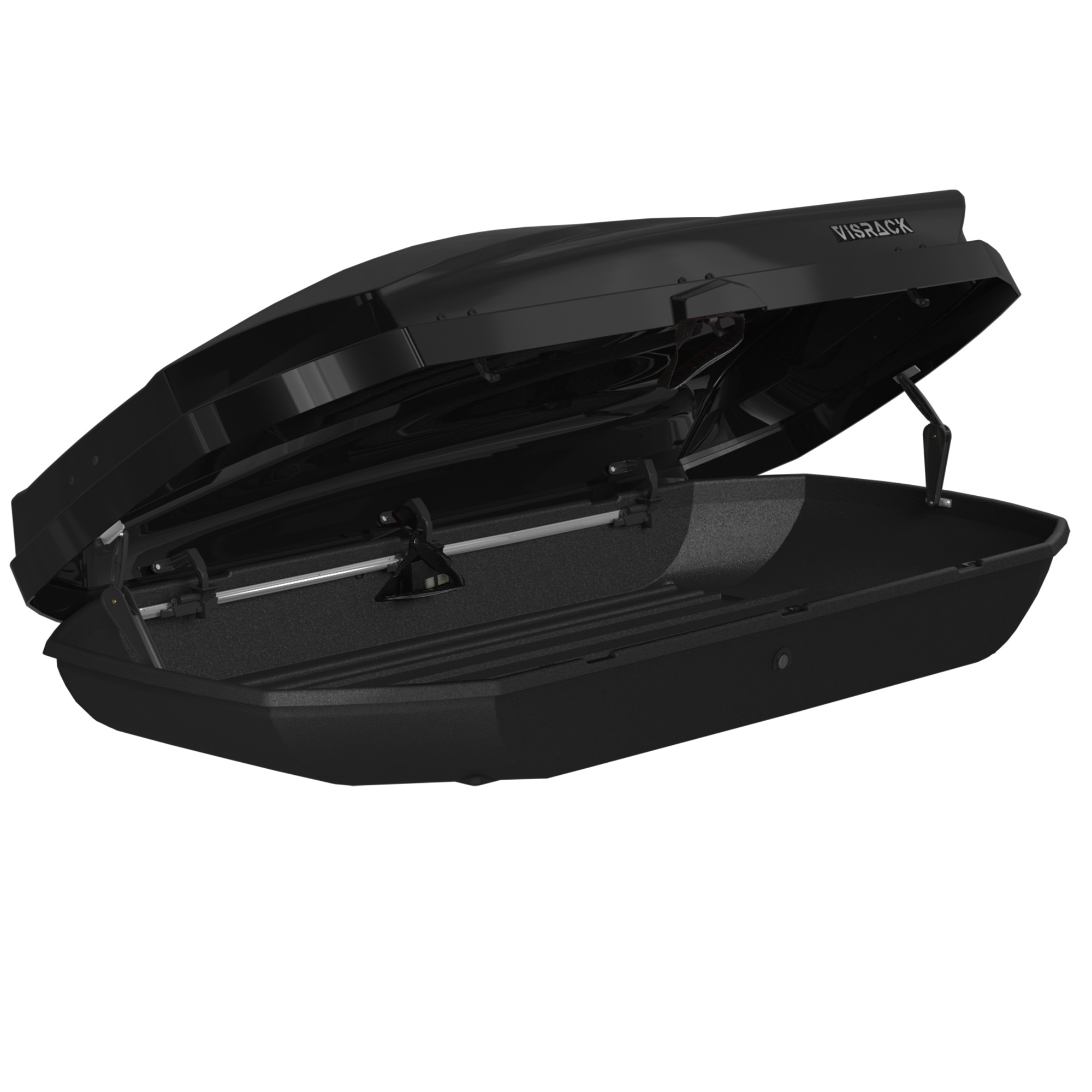
Dual side opening on a hard-shell roof cargo box — one feature among several constraints that determine everyday usability.
Why a Dual Side Opening Roof Cargo Box Creates a Constraint Problem
The dual side opening design solves a practical loading problem: reaching gear from the far side of the vehicle without walking around it or climbing onto a rear bumper. In a tight parking bay, a family unloading on the sidewalk side, or a camper with an uneven campsite, the value of opening from the nearer side is immediate. That is the opportunity side of the equation.
The constraint side is that a dual side opening mechanism introduces additional hinges, additional locks per side, and a shared lid that must remain sealed against both edges. For a buyer evaluating roof boxes in the Research and Evaluation stages, this converts a simple choice into a system-level decision. It is no longer sufficient to ask what the box does. The buyer must also confirm that the vehicle can carry it, that the crossbars can hold it under load, that the closed box will fit through the clearances the driver actually drives through, and that the specific shell material and sealing design will hold up across seasons.
Buyer reports sum up that tension in operational terms. Review records synced from Amazon for the Visrack roof cargo box list the dual side access, three-point locking on each side, and dry interior after heavy rainstorms as strengths. The same records note an installation manual that leans on pictures rather than text, a slight drop of about 1 MPG, and the need to remove the box before going through an automated car wash. None of those negatives are deal-breakers; each is a constraint the buyer should know about before purchase rather than after.
Documented Parameters: What the Visrack Roof Cargo Box Actually Specifies
The table below consolidates the parameters that are supported by Visrack product documentation and factory records. Where a value differs between the product line and a specific SKU, both are shown. This is deliberate: the product line carries a range, and specific SKUs carry their own figures, and buyers evaluating a SKU should confirm the SKU-level numbers before purchase.
| Parameter | Documented value | Source type |
|---|---|---|
| Shell material | ABX + PMMA dual-layer composite | Factory material record |
| Lid panel thickness | 4.5–5.0 mm | Factory material record |
| Base shell thickness | 4.5–5.5 mm | Factory material record |
| Factory-tested maximum load | 75 kg (≈150 lbs) | Factory laboratory record |
| Capacity range (product line) | 13–26 cubic feet | Brand product line |
| External dimensions (min–max) | 55.91″ × 29.53″ × 14.96″ to 87.20″ × 38.19″ × 17.36″ | Brand product line |
| W58 model capacity and load | 15.5 cubic feet / 130 lbs max load | Visrack W58 instruction manual (commercial) |
| Locking | Three-point lock per side, with spare key | Brand product line |
| Installation | Tool-free, requires compatible crossbars | Brand product line |
| Colorways (product media) | Black, white, gray, red variants shown | Product imagery |
| Price band | $499–$899 | Brand product line and scenario data |
A buyer reading the table should notice two things. First, the load rating is not the same as the capacity range: a larger box does not automatically carry more, and the SKU's own manual may state a lower maximum than the product-line ceiling. Second, the price band is wide because size varies; a $499 configuration and an $899 configuration do not carry the same decision weight on a vehicle roof.
Material and Construction: What the Numbers Should Change in a Buyer's Mind
The Visrack roof cargo box uses ABS combined with PMMA in a dual-layer construction. In material terms, ABS contributes impact resistance and structural stiffness, while PMMA contributes surface gloss, weathering performance, and color retention under UV exposure. On hard-shell carriers, the pairing is used specifically to keep the exterior from chalking, fading, or grazing under long outdoor exposure. The material pairing alone does not prove a specific durability figure; that role falls to the test record.
Shell thickness is the more useful constraint signal. Visrack documents a lid panel of 4.5–5.0 mm and a base of 4.5–5.5 mm. For a buyer comparing boxes, that is a parameter worth requesting from any brand being evaluated — it is easy to specify and easy to verify with the seller, and it separates carrier-grade hard shells from thinner molded showroom products.
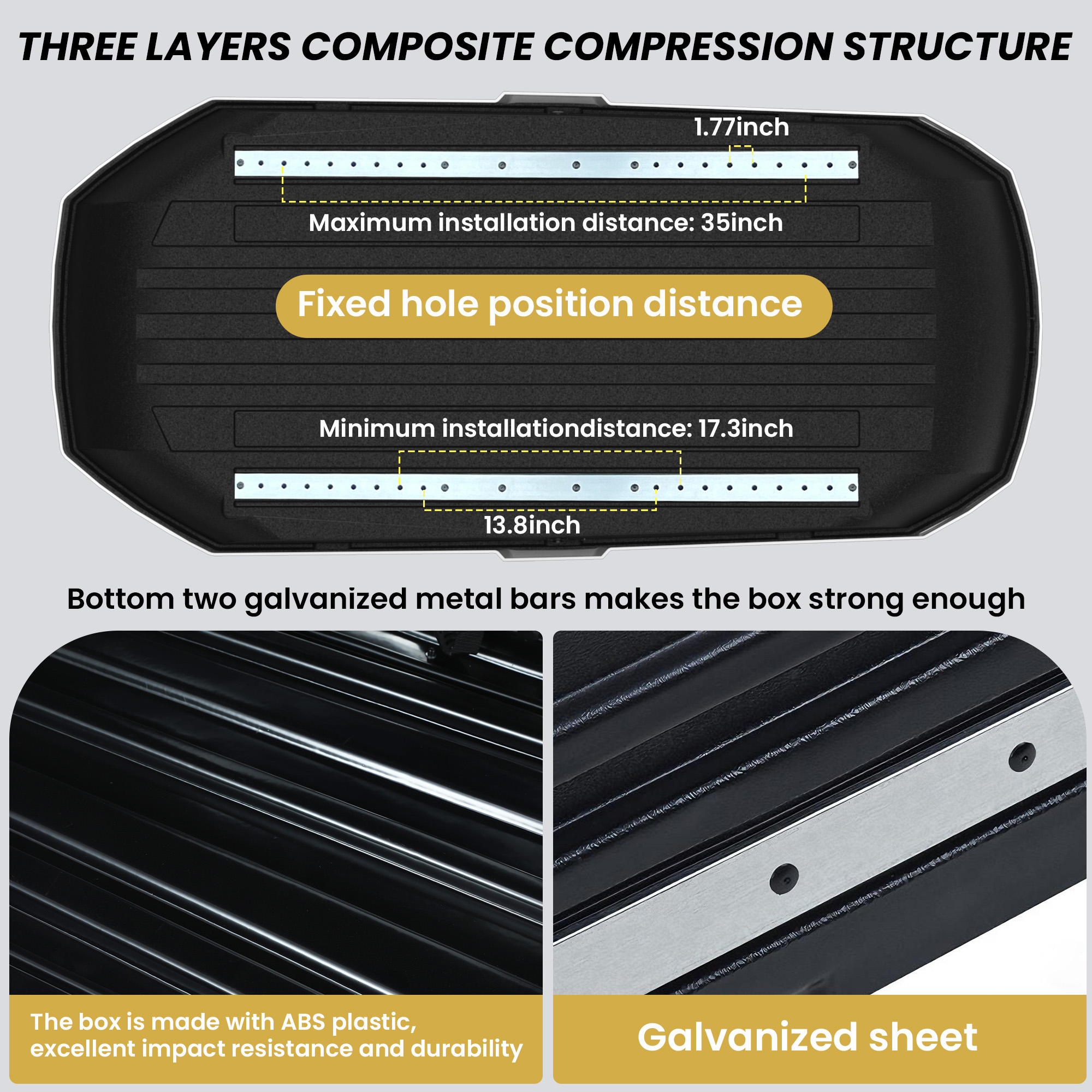
Three-layer composite shell build — the structural layer that ties impact resistance and sealing together.
The brand also documents a three-layer composite compression structure in the shell. For buyer decision purposes, the meaning is straightforward: the box is designed as a rigid, sealed shell rather than a welded or seamed panel assembly, and the lid edge is where sealing performance actually lives.
Factory Laboratory Testing: Thermal, Water, Vibration, and UV Evidence
Four factory laboratory tests are documented for the Visrack roof cargo box, and they map to the four failure modes buyers worry about most. Understanding each test is more useful than reading a single grade.
- Thermal shock: Chamer cycles between -30 °C and 65 °C, 8 hours per cycle, 2 cycles. Result: qualified, no warping or cracking. This addresses winter-to-summer range swings and hot rooftop exposure.
- Water spray (TF328B shower test): Water sprayed evenly for 30 minutes from nozzles positioned 1 m horizontally and 2 m vertically from the product. Result: no water ingress inside, fully qualified. This addresses rain deflection from road spray and sustained storm exposure.
- Bounce / vibration: Tested under a full 75 kg load simulating 500 km of rough-road driving. Result: no appearance or opening/closing faults, qualified. This addresses mounting integrity over long trips.
- Xenon (UV) aging: 400 hours at 60 °C ± 3 °C, 50% ± 3% relative humidity, black panel 60 °C ± 3 °C, radiation intensity 1000 W/m², with internal water spray. Result: no material color change, qualified. This addresses long-term sun exposure in open parking and camping environments.
These are factory laboratory tests conducted by Visrack, not third-party certification. For buyers evaluating a hard-shell roof cargo box, that distinction matters. Factory tests are useful operational evidence because they describe specific stresses and pass criteria. They are not the same as an independent safety certification, and a careful buyer should separate the two when comparing brands.
Fit and Installation: Where Most After-Sale Problems Begin
Crossbar compatibility is the single most common source of post-purchase friction in the roof cargo box category. The box is not a standalone fitting; it is the top layer of a three-part system of vehicle roof rails, crossbars, and the box itself. Each layer has its own load rating, and the system is limited by the weakest one.
Visrack states that the roof cargo box is designed for universal fit across most factory and aftermarket crossbars. Universal fit is a design intent, not a purchase guarantee. The two variables that determine actual fit are crossbar spacing (the gap between bars) and bar profile (the shape that the mounting clamps grip). Buyers should confirm both against their specific crossbars before purchase, and where possible request a written compatibility confirmation from the seller. For vehicles without factory roof rails, crossbars are an added cost that belongs in the total budget, not outside it.
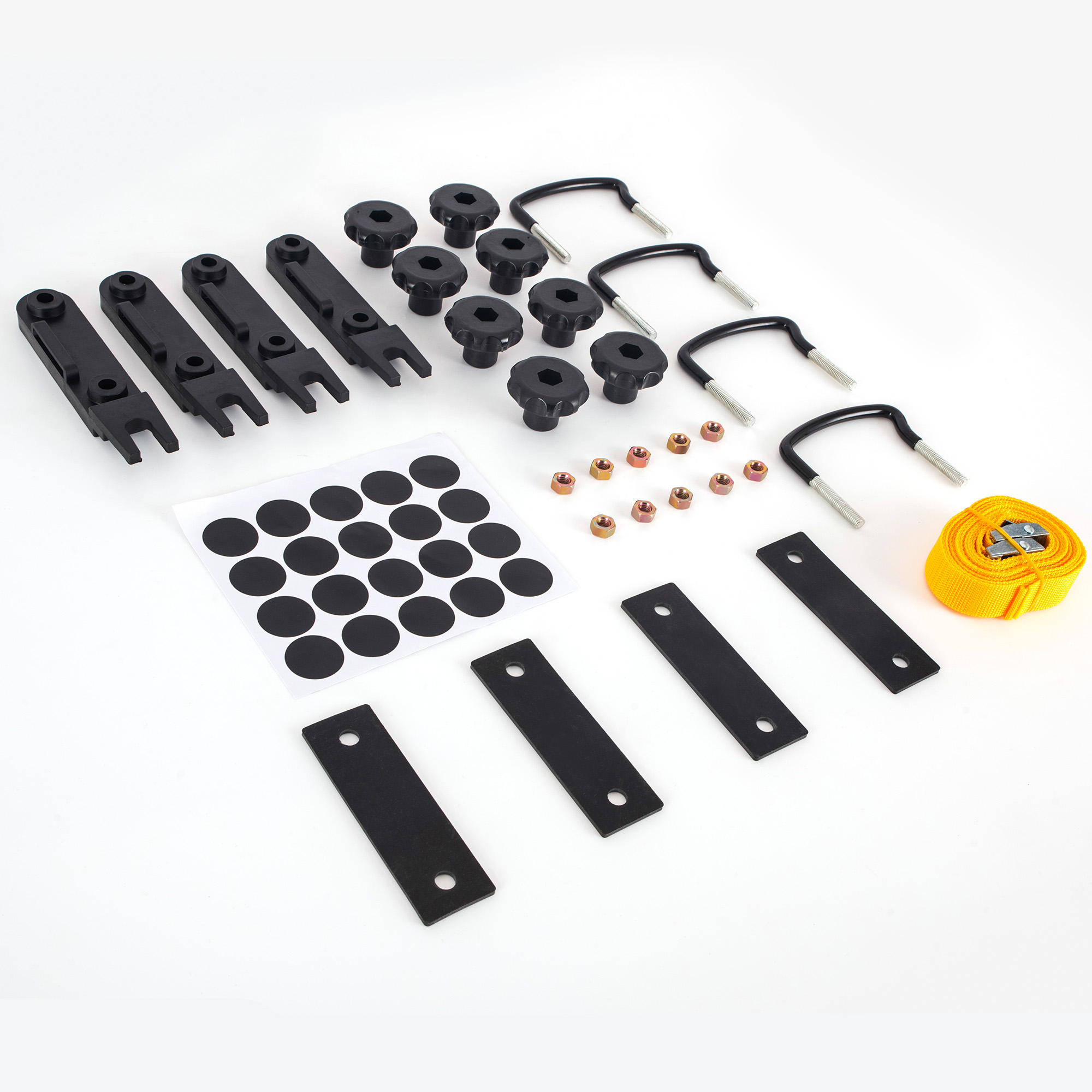
Installation accessories for the Visrack roof cargo box — mounting hardware attaches to compatible crossbars, and the crossbars must be rated for the loaded box.
Two practical installation constraints also surface from verified buyer feedback. The box arrives as a bulky pre-assembled unit, so two-person lifting is easier and reduces the chance of sliding the shell across a vehicle roof during mounting. And the installation instructions are primarily pictorial, which is workable but not ideal for buyers who prefer written steps. Neither constraint prevents installation; both change how much time a buyer should budget for the first mount.
Height clearance is the constraint most often overlooked. The loaded box adds a fixed amount of vertical height above the roof, and the driver must clear garages, drive-throughs, and covered parking. A quick measurement of the actual route clearance before purchase prevents the most expensive kind of return.
Capacity, Payload, and the Vehicle Roof Rating That Actually Governs
Capacity and payload are separate parameters, and buyers frequently conflate them. Capacity is internal volume in cubic feet; payload is the weight the box is rated to carry. A large box designed for bulky lightweight gear — duffels, sleeping bags, tents — may carry less weight than its volume suggests, and the combination of the two is what must sit under the vehicle roof limit.
The Visrack line spans 13 to 26 cubic feet. The brand documents a factory-tested load ceiling of 75 kg, roughly 150 lbs, across the line, while the referenced W58 SKU carries a 15.5 cubic foot capacity with a 130 lb maximum load in its own manual. The gap between product-line ceiling and SKU-level limit is normal in this category, and it is exactly why buyers should confirm the SKU file rather than assume the line figure.
The binding limit, however, is usually the vehicle. Roof load ratings are set by the vehicle manufacturer and apply to the combined weight of the box plus cargo plus any roof rack components. Where a buyer plans to fill a larger box with heavy gear, the vehicle rating will typically cap the load before the box does. Checking the vehicle roof rating first and sizing the box second is the decision order that avoids overloading the platform.
Security and Weatherproofing: Reading the Evidence Rather Than the Phrase
Security on a roof cargo box has three visible components: the lock mechanism, the anti-accidental-open behavior, and the difficulty of gaining access when the vehicle is parked overnight. On the Visrack roof cargo box, the documented configuration is a three-point lock on each side that requires a key to open, plus a spare key. Verified user reviews describe the lock as solid, and describe the anti-lockout design as preventing driving off with the lid open because the key cannot be removed while the lid is up.
Weatherproofing carries a similar evidence question. The Visrack box uses a tightly sealed overlapping lid, and the TF328B shower test described earlier provides specific evidence of water spray resistance. Buyers in regions with sustained rain or road-salt spray should still inspect seals on arrival and treat factory test results as supporting evidence rather than a guarantee for every operating environment. A material property worth noting: the ABS/PMMA shell is transparent to radio waves, so an antenna or cellular router placed inside the box retains signal access, and the device stays out of sight.
Dual Side Opening Compared with Soft-Shell Bags and Single-Side Boxes
The comparison that matters most for buyers in this category is not brand against brand but product structure against product structure. A hard-shell dual side opening box, a soft-shell cargo bag, and a single-side hard-shell box each suit different trip profiles, and each imposes different limits.
| Dimension | Dual-side hard shell (Visrack) | Soft-shell cargo bag | Single-side hard shell |
|---|---|---|---|
| Loading access | Either side; useful in tight parking | Typically top or rear access; needs reaching over | One side only; loads from one direction |
| Impact protection | Rigid ABS/PMMA shell | Fabric shell; contents depend on packing | Rigid shell |
| Weather sealing | Overlapping sealed lid with leak test | Fabric and zipper seals | Overlapping sealed lid |
| Empty stowage | Fixed size; does not collapse | Collapses flat when empty | Fixed size; does not collapse |
| Installed height | Fixed; requires clearance check | Lower and adjustable | Fixed; requires clearance check |
| Price band | $499–$899, varies by size | Generally lower entry cost | Varies by brand |
Within the 14–18 cubic foot hard-shell segment, commercial listings place the Visrack W58 alongside comparably sized boxes such as Thule Force 3 XL and Yakima SkyBox NX XL. Buyers comparing those options should verify each brand's current specification sheet directly rather than rely on category summaries; capacity labels, load ratings, and crossbar requirements differ by model and change by year.
Documented limitation: A dual side opening hard shell is a fixed-volume, fixed-shape product. It cannot be folded when empty, it adds permanent drag and weight to the vehicle, and its empty storage footprint is the same as its installed size. For buyers who need occasional overflow capacity only a few times a year, a soft-shell carrier may be the more proportionate choice; the rigid box's structural protection is worth its cost mainly when the trip profile is consistent.
Price Band and the Total Cost Hidden Around It
The Visrack roof cargo box is positioned between $499 and $899 depending on size. That band covers the box. It does not cover the surrounding system, and that system is what makes the true cost of ownership different from the sticker price.
Three constituents sit inside the total cost. First, crossbars: vehicles without factory roof rails need them, and the crossbars must be rated for the loaded box. Second, fuel: buyer records report roughly 1 MPG of fuel-economy drop when the loaded box is installed — a modest but persistent cost that scales with annual mileage. Third, care and storage: the box must be removed before automated car washes, and it needs somewhere to sit when not on the vehicle. None of these is unique to Visrack, but all are predictable operating costs, not surprises that should emerge after purchase.
In price-band terms, the box competes on features against higher-priced hard-shell options and on protection against soft-shell carriers. The buyer decision is therefore not “is $499–$899 reasonable for a box” but “is $499–$899 reasonable for a box plus its surrounding system, at the trip frequency and load profile I actually have.” That reframing generally produces calmer, better-aligned purchases.
Market Context: A USD 4.7 Billion Roof Rack Market, With Methodological Caveats
Third-party market research places the global automotive roof racks market at an estimated USD 4.7 billion in 2024, covering crossbars, roof boxes, and railing systems (Expert Market Research and associated commercial aggregators, as captured in the current research package). The same category is measured with different methodology across sources, and those differences are visible in the growth estimates: reported CAGR values for the cargo box category range from roughly 4.1% to 8.61% depending on whether soft-shell carriers are included in the measurement scope.
For buyers and channel partners, that range is worth reading as a signal rather than a specific forecast. The direction — steady growth in the hard-shell segment — is broadly consistent. The exact rate is not, because it depends on what each source counts. A buyer comparing product categories should treat CAGR claims as scope-dependent and focus on the parameters that affect the purchase decision directly.
Compliance and Standards: What Buyers Should Still Ask For
ISO 11154:2023 — Road vehicles — Roof load carriers, defines city crash testing at 30 km/h with 12g deceleration and remains the reference standard for roof load carrier safety. The standard matters because it separates tested designs from claimed ones. A buyer confirming a roof cargo box for high-speed travel or family use should be able to obtain specific test documentation, not only a design or material claim.
The Visrack roof cargo box documentation that is publicly available describes factory laboratory testing for thermal shock, spray waterproofing, vibration, and UV aging, as summarized earlier in this guide. It does not present ISO 11154:2023 certification as a completed claim, and a buyer for whom independent safety certification is a procurement requirement should request the specific test report or certificate from the seller rather than infer it from material or design language.
Future Outlook
The near-term direction for hard-shell rooftop storage is constraint-driven product refinement rather than feature-driven novelty. Dual side access, tool-free mounting, and radio-transparent shell materials are already being treated as baseline expectations by informed buyers. The next layer of differentiation is likely to sit in crossbar compatibility documentation, itemized payload ratings per SKU, and clearer separation between factory testing and third-party certification.
For a brand like Visrack, that shift favors buyers who plan their purchase around constraints. Where a manufacturer publishes SKU-level load ratings, states shell thickness, describes factory tests in detail, and keeps the total system cost visible, the brand reduces the friction that sends undecided buyers back to comparison pages. For the category as a whole, the practical test in the next cycle is whether compliance language moves from claim to certificate. Buyers actively asking for that certificate will accelerate the change.
Frequently Asked Questions
1. What should I verify first before buying a dual side opening roof cargo box?
Begin with three checks. First, crossbar compatibility — the box must attach to factory or aftermarket crossbars rated for the loaded weight, and the crossbars must themselves be rated for that load. Second, vehicle roof load rating — the combined box plus cargo weight must stay within the vehicle's stated roof limit. Third, external height clearance — the loaded box must clear garages, tunnels, and drive-throughs on the routes the vehicle actually drives. Only after those three are confirmed do material, capacity, and price become deciding factors.
2. How do I know whether a roof cargo box will fit my vehicle's crossbars?
Crossbar compatibility is a system question, not a single specification. Two variables determine fit: the distance between the bars and the profile of the bar that the mounting clamps grip. Visrack states that its roof cargo box is designed for universal fit across most factory and aftermarket crossbars, but universal fit is a design intent rather than an automatic guarantee. Buyers should confirm their specific bar spacing and bar profile against the product documentation, and where uncertain, request written compatibility confirmation from the seller before purchase.
3. How much capacity does a family actually need from a roof cargo box?
Usable capacity tracks the gap between what the vehicle interior cannot hold and the actual cargo set, not household headcount alone. A two-adult road trip with duffels typically fits a mid-range box; a family trip with strollers, tents, and coolers usually pushes toward the larger end of the range. The Visrack roof cargo box line spans 13 to 26 cubic feet, with the referenced W58 model configured at 15.5 cubic feet. The practical decision rule is to measure the actual cargo set and size one step up rather than two, since unused capacity adds drag and cost.
4. What load limit applies, and how does it relate to the vehicle's roof rating?
The box has its own rated maximum load, and the vehicle has a separate roof load rating. Visrack documents a factory-tested ceiling of 75 kg (about 150 lbs) across the line, while the W58 model manual lists a 130-lb maximum for that specific SKU. The binding limit, however, is usually the vehicle roof rating, which applies to the combined weight of the box plus cargo plus roof rack components. Buyers should confirm the vehicle's roof rating before assuming the box's stated maximum applies on their vehicle.
5. How is waterproofing actually tested on a hard shell roof cargo box?
Waterproof claims vary in rigor. The Visrack roof cargo box passed a TF328B shower test in the manufacturer's factory laboratory: water sprayed evenly for 30 minutes from nozzles positioned 1 m horizontally and 2 m vertically from the product, with no water ingress inside. That is a controlled spray test rather than an open-road rain simulation, and it is a factory test rather than a third-party certification. Buyers in heavy-rain regions should treat the result as supporting evidence and inspect seal condition on arrival before relying on it.
6. What is the difference between a hard shell roof cargo box and a roof cargo bag?
A hard shell roof cargo box uses a rigid shell, in this case ABS combined with PMMA, with a sealed overlapping lid and locking mechanism. A roof cargo bag is fabric, sealed by zippers and stitching, and collapses when empty. The trade-offs cut both ways. Rigid boxes protect gear from impact, stay open for loading, and provide predictable sealing, but they cannot be folded for storage and add fixed weight and drag. Bags store flat when empty but rely on fabric and stitching for weatherproofing. Families on frequent trips usually find the rigid shell's protection worth the cost; buyers who need occasional overflow storage may find a bag better proportioned to their use.
7. What is the price band, and what costs sit outside it?
The Visrack roof cargo box is priced between $499 and $899 depending on size. That band covers the box itself. Buyers should also budget for crossbars when the vehicle does not have them, and account for two secondary effects reported by users: a roughly 1 MPG drop in fuel economy when the loaded box is installed, and the need to remove the box before going through an automated car wash. Neither effect is unique to Visrack, but both are predictable costs of ownership rather than surprises discovered after purchase.
8. Does Visrack publish ISO 11154 certification for its roof cargo box?
Publicly available documentation for the Visrack roof cargo box describes factory laboratory testing for thermal shock, spray waterproofing, vibration, and UV aging. It does not present independent ISO 11154:2023 certification as a completed claim. ISO 11154:2023 defines city crash testing at 30 km/h with 12g deceleration and is one of the standards that separates tested designs from claimed ones. Buyers for whom independent safety certification is a procurement requirement should request the specific test report or certificate from the seller rather than infer it from material or design language.
Have Questions or Need More Details?
Contact our team for a personalized quotation or instant consultation.
Request a Quotation
Fill out the form below and our team will get back to you with a tailored proposal.
WhatsApp Direct Chat
Prefer to chat in real-time? Message us on WhatsApp for instant assistance & quick answers.
- Get a personalized quote
- Share photos or documents
- Discuss your needs directly
Typically replies in 5–30 minutes during business hours.