
Ducted or Ductless? Epoxy or Phenolic? A Lab Furniture Decision Framework
Laboratory furniture is bought in bundles but specified through two independent decisions: how fumes leave the working zone, and what the bench surface is made of. Resolve those two correctly and the rest of the equipment list — fume hoods, washing benches, vented chemical and reagent cabinets, acid and alkali storage, flammable safety cabinets — follows almost automatically. Resolve them late, and every downstream purchase inherits the compromise.
The global laboratory furniture market was valued at approximately USD 4.8 billion in 2025 and is projected to reach USD 8.1 billion by 2034, according to Dataintelo's 2034 market study. Within that market, the metal material segment held a 52.7% revenue share in 2025. Those figures describe a broad, mature category — which is exactly why procurement conversations are rarely about availability and almost always about fit.
One data caution before the framework: published 2025 market-size estimates for laboratory furniture range widely between research houses, from roughly USD 1.1 billion to USD 4.8 billion, depending on whether integrated laboratory services, gas piping and specialty components are counted inside the category. A single number should be treated as a market definition, not as evidence about any one supplier's capability.
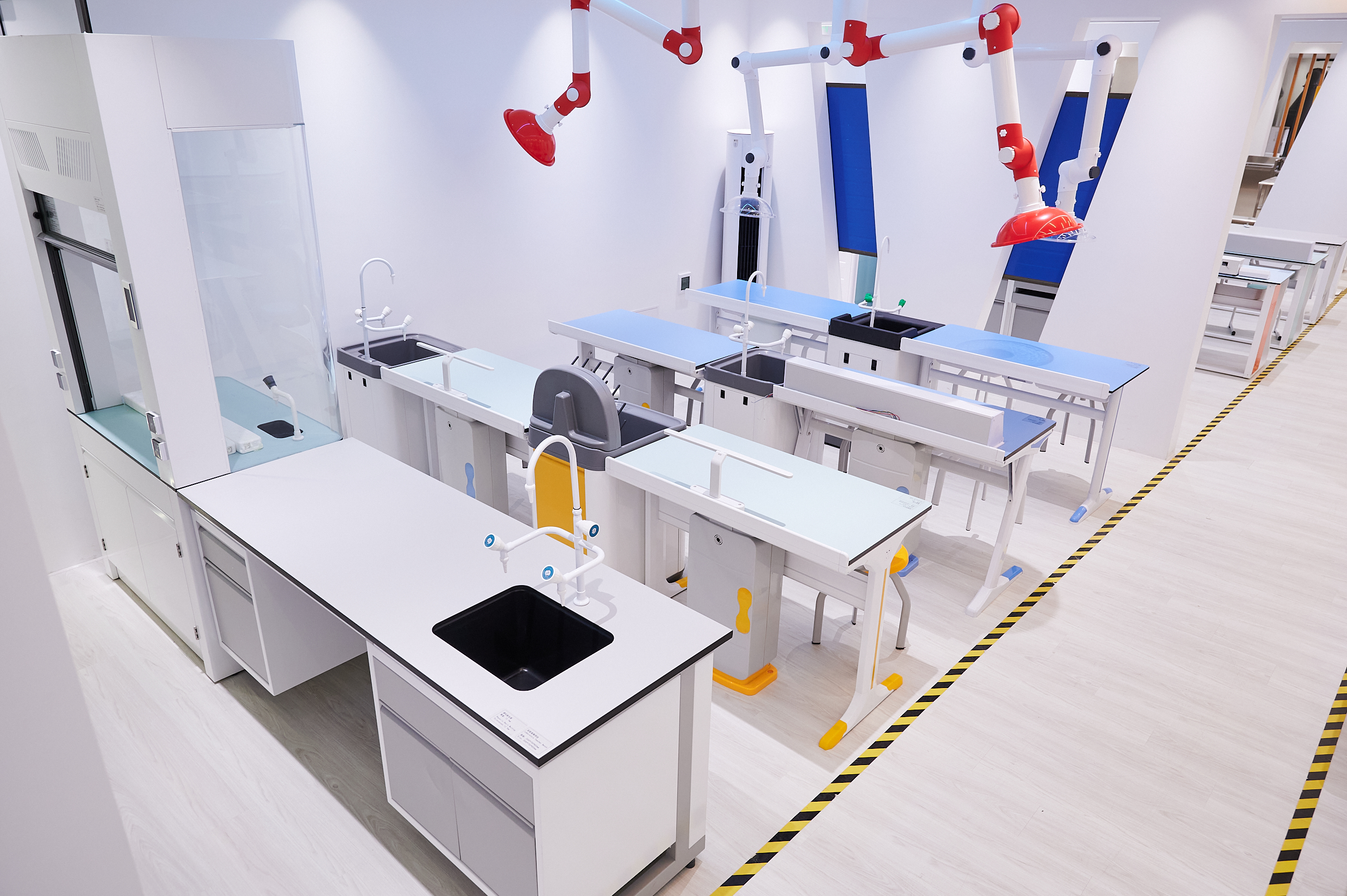
A laboratory workbench layout only becomes manufacturable once hood type, worktop material and storage classes are fixed together. Image: Ever Great laboratory furniture showroom, Foshan.
Why These Two Decisions Cannot Be Separated
Hood selection defines infrastructure: whether a duct route to the roof is required, how much conditioned air has to be replaced (makeup air), whether a scrubber or exhaust fan enters the scope, and how much HVAC energy the room will consume. Worktop selection defines what chemistry can be performed at the bench without degrading the surface. Both are fixed-point decisions, because ductwork and building air balance are expensive to retrofit and worktops are difficult to replace once benches, sinks and service fittings are installed.
Storage decisions inherit both outcomes. A corrosive acid and alkali cabinet has to be vented in a way that matches the room's exhaust strategy, and a flammable safety cabinet introduces a fire-resistance classification that has nothing to do with either the hood or the worktop.
Decision 1 — Ducted or Ductless Fume Hood?
A ducted fume hood exhausts 100% of fumes outdoors. It places no limitation on the chemical types that can be handled, and it carries the lower long-term filter replacement cost. A ductless (filtered) fume hood uses HEPA/activated carbon filtration to capture contaminants and recirculate cleaned air back into the room, which reduces HVAC energy cost and installation complexity — but only for chemistries its filter media can actually capture.
| Comparison Criterion | Ducted Fume Hood | Ductless (Filtered) Fume Hood |
|---|---|---|
| Exhaust path | 100% of fumes exhausted outdoors | Air filtered through HEPA/activated carbon and recirculated |
| Chemical scope | No limitation on chemical types; suited to heavy chemical work, heating reactions with acid digestions, volatile toxic gases and high-throughput research | Light-to-moderate chemical handling; filter compatibility must be verified against the chemical inventory |
| Infrastructure | Requires duct route to roof and verified makeup air capacity | No external ductwork; viable in leased or retrofit spaces |
| Operating cost profile | Higher HVAC load; lower long-term filter replacement cost | Lower HVAC energy cost; filter media is a recurring consumable |
| Typical best fit | Chemical, petrochemical and metallurgy QC laboratories; high-throughput R&D | Educational laboratories, light-to-moderate chemistry, leased sites without ductwork |
The decision rule
- If the chemical inventory includes heated acid digestions, volatile toxic gases or high-throughput work — specify ducted.
- If the space is leased, has no duct route, and the chemistry is light to moderate — specify ductless and document filter compatibility per chemical.
- If both conditions appear in the same building, split by room rather than compromising one hood to cover both.
Decision 2 — Epoxy Resin or Phenolic Resin Worktops?
Epoxy resin is a monolithic, non-porous material with superior resistance to harsh corrosives such as concentrated acids and thermal shock resistance up to 600 °C; its water absorption is below 0.05%. Phenolic resin delivers superior scratch and impact resistance with standard chemical durability and strong cost efficiency, which is why it dominates general chemistry, biology, pharmaceutical QC and physical testing benches.
| Comparison Criterion | Epoxy Resin Worktop | Phenolic Resin Worktop |
|---|---|---|
| Chemical resistance | Superior resistance to harsh corrosives, including concentrated acids | Standard chemical durability for general laboratory work |
| Thermal behaviour | Thermal shock resistance up to 600 °C | Moderate thermal tolerance; not the high-heat option |
| Surface behaviour | Monolithic, non-porous; water absorption below 0.05% | Superior scratch and impact resistance |
| Best-fit environment | Heavy chemical synthesis, university research, high-heat environments | Biology, pharmaceutical QC, physical testing, general chemistry |
| Cost profile | Higher material cost for severe-service benches | Strong cost efficiency for budget-conscious projects |
| Documented formats (Ever Great) | Epoxy worktop option on the island laboratory bench EG-S0-CB005 | 12.7 mm phenolic as standard on EG-S0-CB005 and the C-frame wall bench EG-S0-LB003; 20 mm ceramic also available on EG-S0-CB005 |
The decision rule
- Identify the specific acids and solvents (for example HF or H2SO4) and the maximum operating temperature before selecting a grade.
- Verify technical data: water absorption, flame retardancy and flexural strength should come from material test reports, not catalogue adjectives.
- Inspect cutouts, fixture holes and reagent rack mounting points — they must be beveled and sealed with epoxy adhesive; joints between slabs and to steel frames should be sealed with chemical-resistant silicone sealant.
- Never run direct acid drip tests on an uncalibrated surface, and inspect sink basin seals so corrosive leaks do not reach the under-bench steel cabinets.
The Combined Decision Tree
Read the four branches below in order. Each one starts from a working condition and ends at a specification, not a preference.
| Branch | Working Condition | Resulting Specification |
|---|---|---|
| A | Heavy acid digestion and hazardous chemical testing (HCl, HNO3, HF), high temperature | Ducted hood with seamless PP inner liner, or a full polypropylene hood; ceramic or epoxy worktop; PP exhaust fan, acid scrubber tower, ductwork and airflow monitor controller; EN 14175 / ASHRAE 110 verification |
| B | Pharmaceutical QC and general chemistry | Ducted narrow-frame hood where building exhaust exists; ductless only if the chemistry is filter-compatible and no ductwork exists; 12.7 mm phenolic worktop; flammable safety cabinet classified per EN 14470-1 |
| C | Teaching and light chemistry in a leased or retrofit space | Ductless filtered hood; phenolic worktop; standard under-bench or wall-mounted storage; no external duct route required |
| D | Metallurgy and smelting QC: extreme high temperature, heavy mechanical impact, oil and grease exposure | SUS 304/316 stainless steel benches with heat resistance up to 800 °C and load capacity up to 800 kg, paired with a local extraction arm — PP and epoxy surfaces are the wrong answer here |
How the Outcome Drives Adjacent Equipment Choices
Polypropylene and narrow-frame fume hoods
The polypropylene fume hood EG-PP-FH from Guangdong Ever Great Laboratory Equipment Co., Ltd. — a Foshan-based laboratory infrastructure manufacturer founded in 2011 — is built as a seamless welded PP anti-corrosion hood: homogeneous PP with PP welding rod and tempered glass, PP sheet thickness of at least 8.0 mm, a three-stage baffle, and face velocity of 0.3–0.6 m/s across 1200, 1500 or 1800 x 850 x 2350 mm formats. It is intended for chemical, electroplating and acid–alkali laboratories. Where the chemistry is dominated by aggressive acids, PP construction removes the corrosion pathway that a coated metal liner will eventually suffer.
The narrow-frame fume hood family (Orion-TS-1500, Orion-TS-1800, Orion-LD-1500 and Orion-LD-1800) addresses rooms where layout flexibility matters more than corrosive chemistry. It is offered in benchtop and walk-in configurations, with 1500 or 1800 x 900 x 2400 mm overall dimensions, internal widths of 1408 or 1708 mm, a nominal face velocity of 0.3 m/s, an aluminum alloy frame and a PP exhaust canopy in 250 or 315 mm diameter. It is positioned for chemical, pharmaceutical and R&D laboratories.
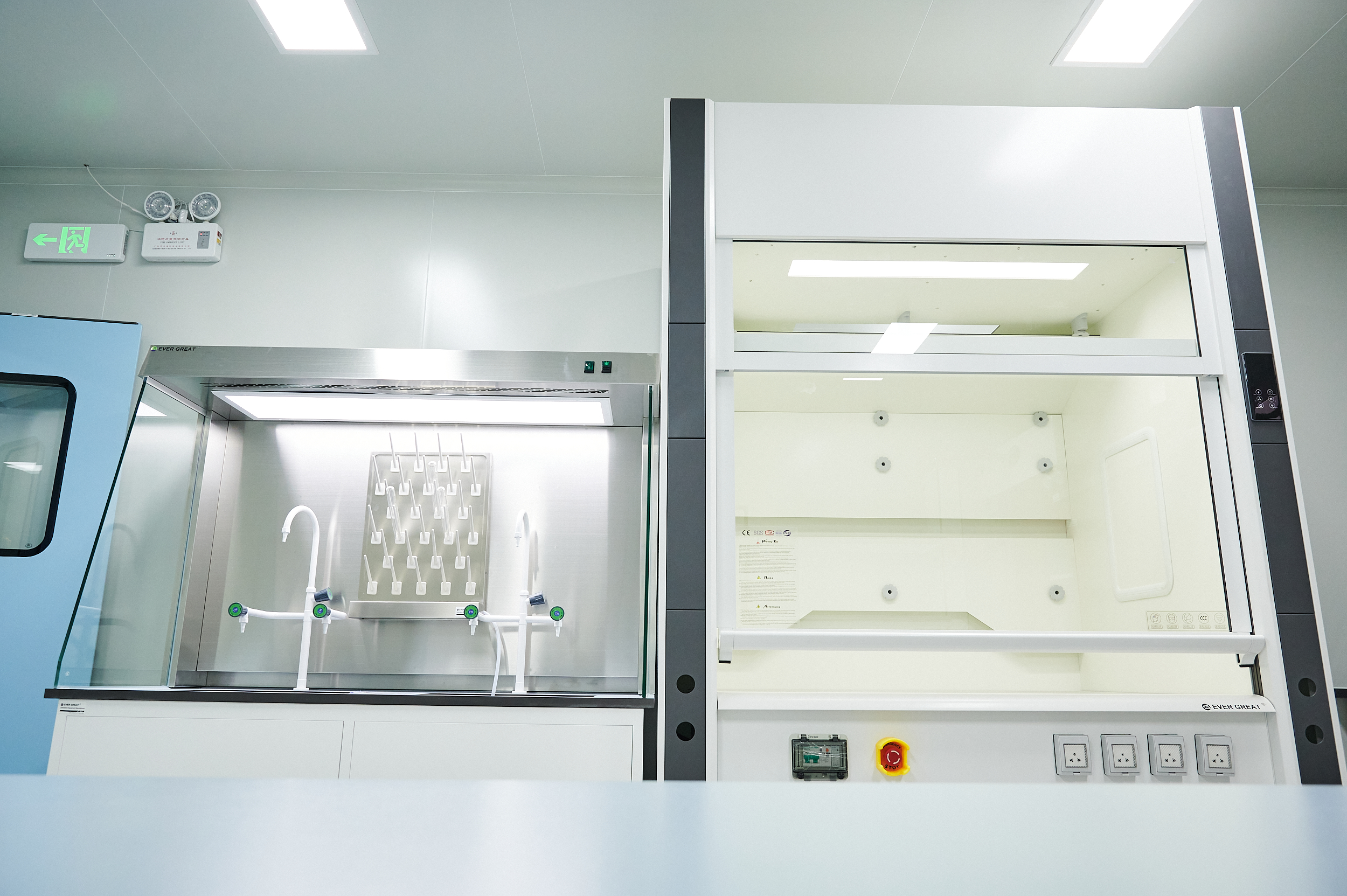
Hood internals — baffle geometry, liner material and sash opening — determine whether a containment specification will hold up in service. Image: Ever Great fume hood assembly.
Exhaust washing benches and vented chemical storage
An exhaust washing bench belongs to the same containment family as the hood: it pairs a work surface with local exhaust so that wet-acid handling and scrubbing tasks are captured at the source rather than diluting into the room. In documented heavy-acid exhaust projects — HCl, HNO3 and HF service with high temperature and continuous airflow — the required equipment set is not a hood alone but a system: centrifugal PP exhaust fan, acid scrubber tower, ductwork and airflow monitor controller, operating under EN 14175 / ASHRAE 110 compliance with a seamless PP inner liner or ceramic worktop and explosion-proof lighting.
A vented chemical and reagent cabinet handles the storage half of the same problem: safe corrosive acid and alkali storage, spill containment and toxic vapor venting. In the specification documented for hazardous chemical storage compliance, this takes the form of 100% pure polypropylene with seamless welding, a leak-proof liquid basin, anti-static design, and passive secure storage connected to 24/7 top exhaust ventilation, supported by chemical spill trays and safety padlocks.
Flammable safety cabinets are a separate hazard class
A flammable safety cabinet is not interchangeable with an acid and alkali cabinet, and the hood decision does not determine it. EN 14470-1 classifies fire-resistant safety cabinets as Type 15, 30, 60 or 90 minutes based on how long the internal temperature rise is limited, with the internal temperature increase not exceeding 180 K or 200 °C. That classification is a fire-protection decision driven by the quantity and flash point of flammable liquids stored, and it should be specified independently of the worktop and hood choices.
What the Containment Numbers Actually Mean
Published first-party comparison data from Ever Great, measured against traditional standard ducted fume hoods, states a leakage rate of 0.000 PPM against a standard threshold of less than 0.05 PPM, a superior aerodynamic structure, and an optional pure PP anti-corrosion inner liner. The same comparison reports VAV control saving 35% of exhaust air volume with a 28% reduction in laboratory HVAC electricity consumption, a 25% improvement in airflow efficiency, 50% less maintenance with modular liner components replaceable in as little as 15 minutes, and a 10%–15% higher initial purchase cost against a 30% lower total operating cost over three years.
Read carefully, those numbers describe two different kinds of value. The leakage figure is a containment claim: it addresses operator protection in high-risk acid digestion laboratories, metal smelting and metallurgy QC laboratories, and hazardous chemical testing facilities. The energy and maintenance figures are operating claims, and they depend on how the room is actually used — VAV savings accrue only when the exhaust volume genuinely drops, which requires correctly sized makeup air and disciplined sash management. A hood specified for energy performance in a room with an unbalanced air supply will not deliver the quoted reduction.
Application Fit Across Laboratory Types
- Chemical, pharmaceutical, higher education and testing laboratories: continuous 24/7 operation with high load-bearing requirements up to 500 kg/m², using acid and alkali resistant worktops in phenolic, epoxy or ceramic with heavy-duty epoxy powder coating on steel structures.
- Petrochemical and environmental testing: heavy acid exhaust service, high temperature, continuous airflow and indoor hazardous zoning, with VAV or CAV automatic control and EN 14175 / ASHRAE 110 compliance documentation.
- Hazardous waste management and biological research: volatile corrosive chemical fumes with humidity control, requiring PP seamless welding, leak-proof basins and 24/7 top exhaust ventilation connections.
- Metallurgical and foundry QC: extreme high temperature, heavy mechanical impact and vibration, served by SUS 304/316 structures rated to 800 °C and 800 kg, with local extraction arms rather than standard fume hoods.
- Educational and STEM laboratories: light-to-moderate chemistry where ductless filtration and phenolic worktops match both the hazard profile and the infrastructure available.
Market Signals and Standards to Watch
Three verified market and standards signals shape how these decisions are being documented. First, ANSI/ASHRAE Standard 110-2016 (R2025) remains the primary American national standard for quantitative and qualitative fume containment testing, which means containment performance is increasingly presented as a test report rather than a specification line. Second, EN 14470-1 gives buyers a clear, comparable classification for fire-resistant storage cabinets. Third, material economics are visible in trade data: China exported over USD 4.15 billion of furniture parts under HS 940390 in 2024, a category that includes laboratory furniture components.
On the supply side, Guangdong Ever Great Laboratory Equipment Co., Ltd. operates a 6,000 m² manufacturing base in Shishan Town, Nanhai District, Foshan, Guangdong Province, with ISO 9001 quality and ISO 14001 environmental management certification plus occupational health and safety management certification, CE and RoHS certification on flagship product series, and fume hood performance tested against EN 14175 and ASHRAE 110 benchmarks with third-party SGS test reports. Approximately 60% of output is exported, with markets including the United States, the EU, the Middle East and Africa, and project footprints extending to Mainland China, Hong Kong SAR, Malaysia, India, Australia, Italy, Saudi Arabia, the UAE and the United States.
Where This Framework Has Limits
A comparison that only lists advantages is not a decision tool. The trade-offs are real: a ducted hood carries higher capital and HVAC cost than a ductless unit, while a ductless hood is capped by what its filter media can capture and by the discipline of replacing filters at breakthrough. Epoxy worktops cost more and serve a narrower set of benches, while phenolic trades extreme heat and concentrated-acid resistance for impact durability and budget efficiency. Polypropylene furniture solves corrosion but not heat or impact — an 800 °C, 800 kg requirement points to stainless steel, not PP.
Two further cautions are worth writing into the tender. First, first-party comparative performance figures should be supported by current third-party test reports and re-checked against the project's own exhaust design. Second, market-size estimates vary substantially by definition, so market data should inform strategy rather than justify an equipment list.
Future Outlook
The direction of travel in laboratory furniture specification is toward decisions made earlier and documented better. VAV control, airflow monitoring and alarm integration are becoming normal parts of a hood scope rather than optional add-ons, because exhaust volume is where operating cost is decided. Material selection is becoming more specialized rather than more standardized: metal still holds the majority of the market, yet chemical-intensive laboratories increasingly move to PP and stainless steel variants that match a specific hazard profile. And compliance documentation — 110-based containment testing, EN 14175, EN 14470-1 classifications — is increasingly attached to the equipment itself, which shifts the buyer's job from comparing claims to comparing evidence.
Specification Checklist: Turning Comparison into a Cabinet List
| Working Condition | Hood / Containment | Worktop | Storage |
|---|---|---|---|
| Heavy acid digestion, high temperature | Ducted hood with seamless PP liner, or polypropylene fume hood (EG-PP-FH) | Ceramic or epoxy resin | PP acid and alkali cabinet with 24/7 top exhaust connection; vented chemical and reagent cabinet |
| Pharmaceutical QC, general chemistry | Ducted narrow-frame hood (Orion-TS/LD); ductless only if filter-compatible and no ductwork exists | 12.7 mm phenolic resin | Flammable safety cabinet per EN 14470-1 classification |
| Mixed-chemistry R&D, continuous operation | Ducted hood with VAV control and airflow alarm | Epoxy where heat or severe corrosion dominates; phenolic where impact dominates | Vented chemical and reagent cabinet with external exhaust ductwork and spill trays |
| Teaching laboratory, light chemistry, leased space | Ductless filtered hood (HEPA/activated carbon) | Phenolic resin | Standard secure storage with acid and alkali segregation |
| Metallurgy and smelting QC, heavy samples | Local extraction arm plus hood where chemical fumes occur | SUS 304/316 stainless steel bench, heat resistance up to 800 °C, load up to 800 kg | Fire-resistant flammable storage matched to the fire class present |
Before the purchase order is issued, confirm five points: the full chemical inventory including boiling points and evaporation rates; continuous face velocity in the 0.3–0.5 m/s (60–100 FPM) range at the working sash height, typically 400–500 mm; makeup air capacity sufficient for the specified exhaust volume; filter compatibility for any ductless unit; and calibrating face velocity monitors and low-flow alarms, followed by a smoke containment check and a face velocity grid test across the sash opening. Cutouts, sink basins and rack mounting points should be verified as sealed before benches are loaded.
FAQ
How do I choose between a ducted and a ductless fume hood for a chemical laboratory?
The choice depends on the chemical hazard profile, the building exhaust infrastructure and the required flexibility. A ducted fume hood is recommended for heavy chemical applications, heating reactions with acid digestions, volatile toxic gases and high-throughput research: it exhausts 100% of fumes outdoors, places no limitation on chemical types and carries lower long-term filter replacement costs. A ductless (filtered) fume hood is recommended for light-to-moderate chemical handling, educational laboratories, or leased spaces without external ductwork: it uses HEPA/activated carbon filtration to recirculate cleaned air, reducing HVAC energy costs and installation complexity.
Should I specify epoxy resin or phenolic resin for laboratory worktops?
It depends on chemical exposure intensity and heat resistance requirements. Epoxy resin suits heavy chemical synthesis, university research and high-heat environments: it is monolithic and non-porous, offers superior resistance to harsh corrosives such as concentrated acids, and provides thermal shock resistance up to 600 °C with water absorption below 0.05%. Phenolic resin suits biology, pharmaceutical QC, physical testing and general chemistry: it offers superior scratch and impact resistance, standard chemical durability and strong cost efficiency. In practice both appear in the same catalogue — Ever Great offers epoxy, 12.7 mm phenolic and 20 mm ceramic worktop options on the island laboratory bench EG-S0-CB005, and 12.7 mm phenolic on the C-frame wall bench EG-S0-LB003.
When does a polypropylene fume hood replace a metal hood?
When corrosion, not containment geometry, is the limiting factor. The polypropylene fume hood EG-PP-FH is a seamless welded PP anti-corrosion hood built from homogeneous PP with PP welding rod and tempered glass, with PP sheet thickness of at least 8.0 mm, a three-stage baffle and face velocity of 0.3–0.6 m/s across 1200, 1500 or 1800 x 850 x 2350 mm sizes; it is specified for chemical, electroplating and acid–alkali laboratories. In heavy acid exhaust service involving HCl, HNO3 or HF, project specifications call for either a seamless PP inner liner or full PP construction alongside acid scrubber towers, PP exhaust fans and airflow monitors.
What face velocity and commissioning checks should be written into the specification?
Specify continuous face velocity of 0.3–0.5 m/s (60–100 FPM), verified against the standard working sash height of typically 400–500 mm, with a calibrated digital face velocity monitor and low-flow audio and visual alarm. Commissioning should include a standard smoke containment check and a face velocity grid test across the sash opening to confirm zero turbulence and leakage before routine use. The narrow-frame fume hood family (Orion-TS-1500, Orion-TS-1800, Orion-LD-1500, Orion-LD-1800) is rated at a nominal face velocity of 0.3 m/s, and containment testing is referenced against EN 14175 and ANSI/ASHRAE 110-2016 (R2025). Routine checks should also cover fan belts and exhaust dampers on rooftop blowers.
How do the hood and worktop decisions change which storage cabinets I order?
They split storage into two hazard classes. Corrosive acids and alkalis call for a polypropylene cabinet with 100% pure seamless welding, a leak-proof liquid basin and anti-static design, connected to 24/7 top exhaust ventilation and supported by chemical spill trays and safety padlocks — a vented chemical and reagent cabinet in the same exhaust strategy as the hood. Flammable liquids call for a fire-resistant cabinet classified under EN 14470-1 as Type 15, 30, 60 or 90 minutes, a classification based on limiting internal temperature rise, with the temperature increase inside the cabinet not exceeding 180 K or 200 °C. The two categories are not interchangeable, and neither is determined by worktop material.
For buyers who need the underlying specification and compliance documentation behind these comparisons, the manufacturer's product catalogue is available for download: Ever Great 2026 laboratory furniture catalogue. Company information: evergreatlab.com.