
Ducted vs. Ductless Fume Hoods: R&D and Pharma Procurement FAQ
Ducted vs. Ductless Fume Hoods: R&D and Pharma Procurement FAQ
Fume hood procurement in R&D and pharmaceutical laboratories is decided by four constraints rather than by preference: the chemical inventory the hood must contain, the exhaust and makeup-air capacity of the building, the verification and certification path required by the destination market, and the physical configuration the work demands. Ducted and ductless fume hoods solve the same containment problem through different exhaust paths, and the procurement consequences of that difference are the subject of this reference.
Guangdong Ever Great Laboratory Equipment Co., Ltd. (Ever Great) is a laboratory infrastructure manufacturer founded in 2011 and located in Shishan Town, Nanhai District, Foshan City, Guangdong Province, China. The company operates a 6,000 m² manufacturing base, and its portfolio covers ducted and ductless fume hoods, laboratory workbenches, safety storage cabinets, and PP and stainless steel laboratory furniture, with approximately 60% of output directed to export markets including the USA, the EU, the Middle East, and Africa.
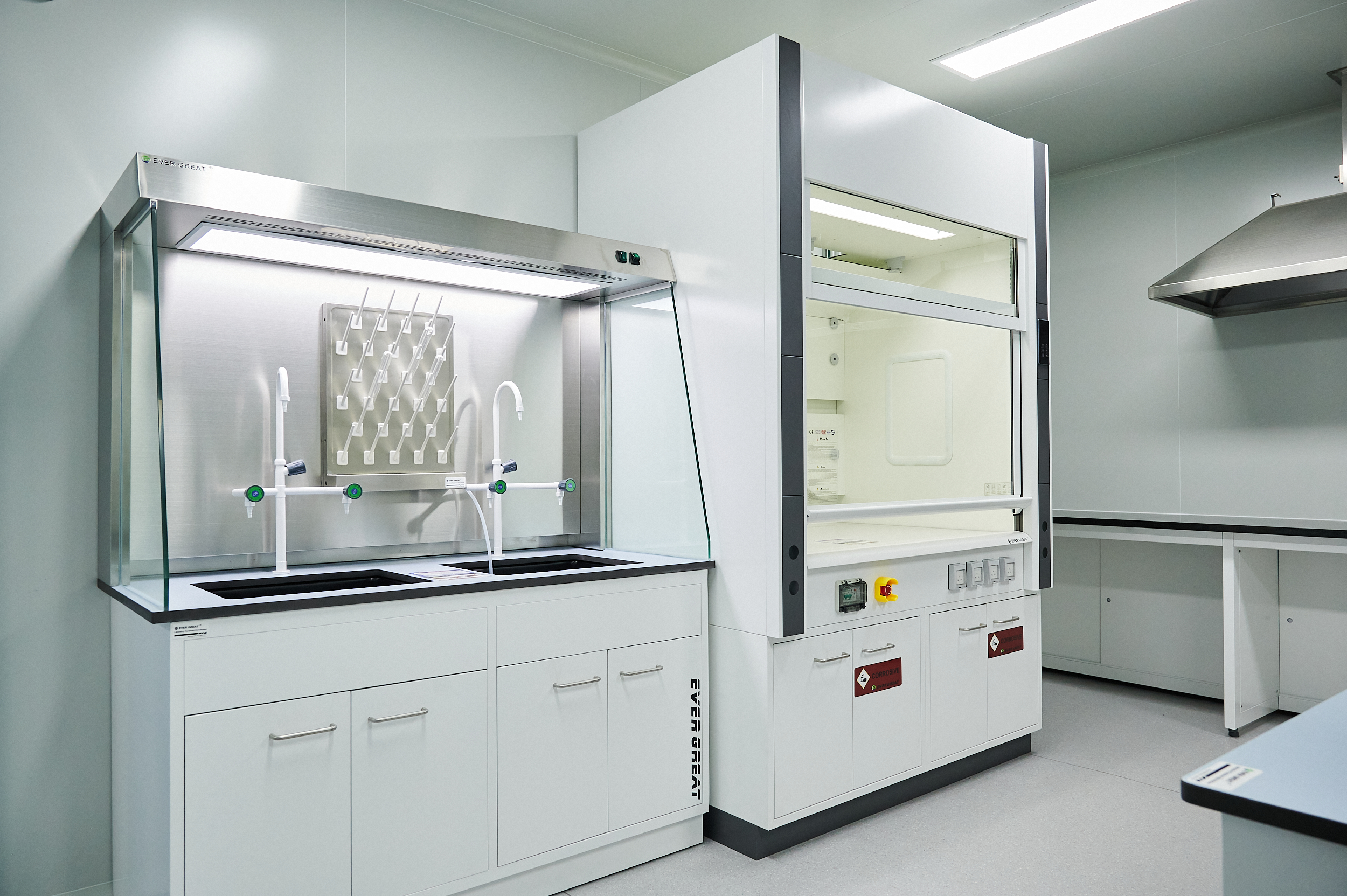
Fume hood close view: sash, work zone and exhaust canopy are the three elements that determine what a procurement specification can actually verify.
The containment principle behind both hood types
Every fume hood, ducted or ductless, works on one physical principle: air is drawn through the sash opening at a controlled face velocity so that airborne contaminants released inside the work zone are carried away from the operator rather than into the breathing zone. What changes between the two designs is where that air goes next.
A ducted fume hood exhausts 100% of the captured airstream outdoors through a duct route, normally to a rooftop blower. Because no filter medium sits between the work zone and the outdoors, the chemical scope of a ducted hood is not limited by filter compatibility, and recurring filter replacement cost does not apply. The trade-off is infrastructure: a duct route to the roof, an exhaust fan, and enough conditioned makeup air to replace what is exhausted from the room.
A ductless (filtered) fume hood passes the captured air through HEPA and activated carbon filtration and returns the cleaned air to the room. This reduces installation complexity and HVAC energy demand, which is why ductless hoods are commonly considered for light-to-moderate chemical handling, teaching laboratories, and leased spaces where an external duct route is not feasible.
Neither approach removes the need to verify containment on site. Commissioning guidance for these systems specifies a continuous face velocity in the range of 0.3–0.5 m/s (60–100 FPM), a standard working sash height typically between 400 mm and 500 mm, and both a smoke containment check and a face velocity grid test across the sash opening before routine use begins.
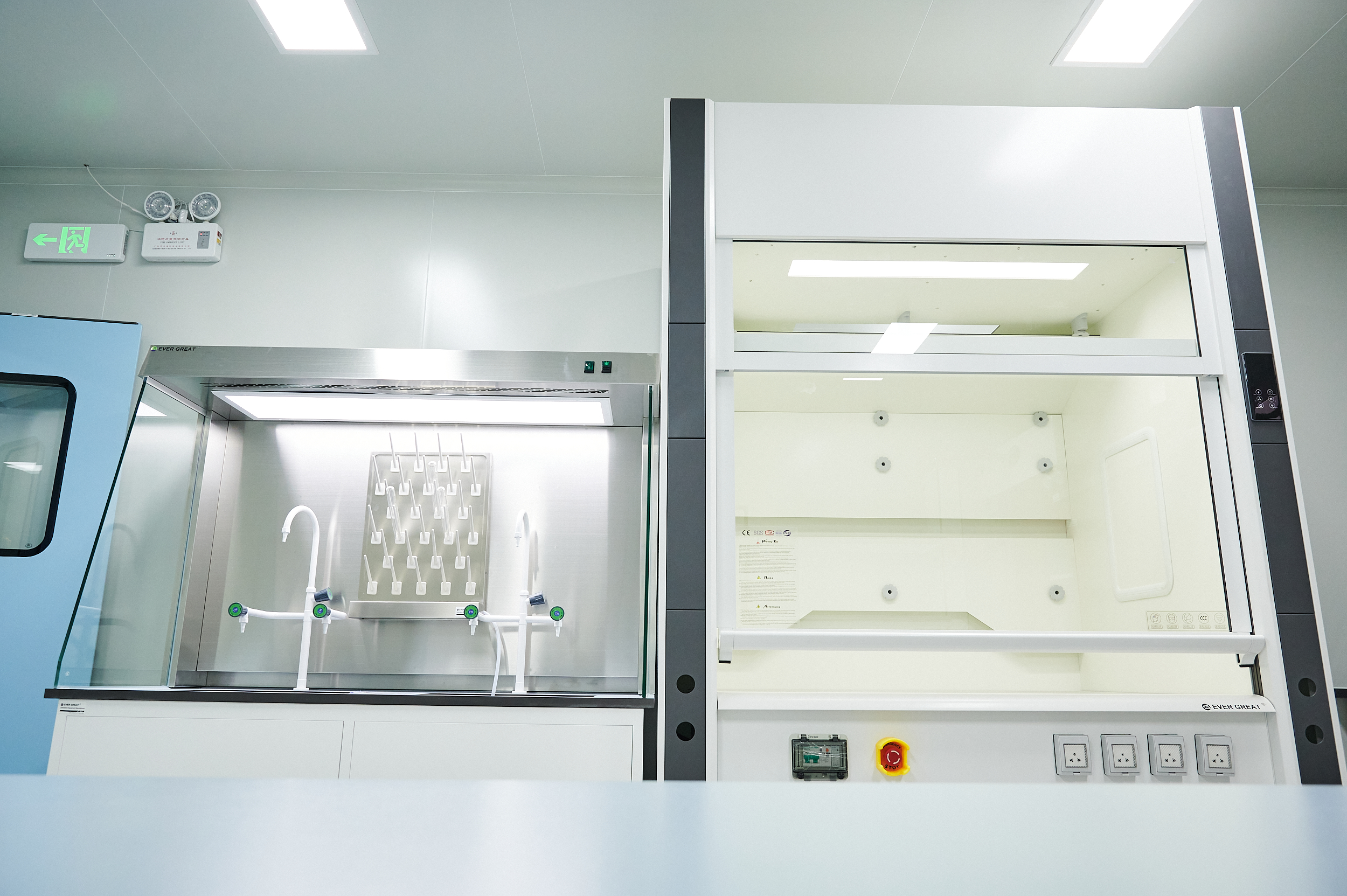
Fume hood interior detail: baffle geometry and work-zone depth directly affect how reliably a face velocity reading translates into real containment.
Four constraints to resolve before a quotation is issued
- Chemical inventory and hazard profile. Audit every chemical that will be handled in the hood, including boiling points and evaporation rates, to establish whether carbon filtration can safely capture them or whether outdoor ducting is mandatory. This audit, not the room size, decides the exhaust path.
- Building infrastructure. Measure ceiling clearance, confirm the duct route to the roof, and verify whether the lab makeup air system can support a continuous face velocity of 0.3–0.5 m/s (60–100 FPM) at the working sash height.
- Verification and certification path. Identify which market the laboratory serves and which conformity documentation must travel with the equipment, including test reports and certificate numbers with scope and validity dates.
- Footprint and configuration. Decide whether the work requires a benchtop or a walk-in configuration, and confirm that the internal working width and internal height can accommodate the tallest apparatus and the largest vessel used.
What Ever Great manufactures, in parametric terms
Ever Great's fume hood range is built around two platforms that map onto the ducted and ductless decision in different ways.
Narrow-frame fume hood — benchtop and walk-in configurations
The narrow-frame platform is offered under the model designations Orion-TS-1500, Orion-TS-1800, Orion-LD-1500, and Orion-LD-1800, in both benchtop and walk-in configurations. Overall dimensions are 1500/1800 x 900 x 2400 mm with internal widths of 1408 mm and 1708 mm. Nominal face velocity is 0.3 m/s. The frame is aluminum alloy and the exhaust canopy is polypropylene, with a duct connection diameter of 250 mm or 315 mm. A VAV/CAV-ready configuration path is available, and the platform is intended for chemical, pharmaceutical, and R&D laboratories.
Polypropylene fume hood EG-PP-FH — for corrosive service
The EG-PP-FH is a seamless welded polypropylene anti-corrosion fume hood with an overall size of 1200/1500/1800 x 850 x 2350 mm and a PP sheet thickness of 8.0 mm or greater. Face velocity is rated at 0.3–0.6 m/s with a three-stage baffle. Construction is homogeneous PP with PP welding rod and tempered glass. The model is designed for corrosive environments and is specified for chemical laboratories and for chemical, electroplating, and acid-alkali applications; a corrosion-resistant process area combined with an all-PP body also makes it relevant to petrochemical work.
Certification facts a buyer can quote in a tender document
Fume hood models EG-FH01, EG-FH04, EG-FH02, EG-FH03, and EG-FH06 hold a Certificate of Conformity under EMC Directive 2014/30/EU. The certificate number is CKEYS251020088, issued by Guangdong KEYS Testing Technology Co., Ltd., for the EU/EEA market, issued on 2025-10-20 and valid to 2035-10-20. The applicable standards listed on the certificate are EN IEC 61000-6-2:2019, EN IEC 61000-6-4:2019, EN IEC 61000-3-2:2019+A1:2021+A2:2024, and EN 61000-3-3:2013+A1:2019+A2:2021.
Adjacent laboratory storage equipment carries its own documentation. The Flammable Safety Storage Cabinet, Model FB-03, holds CE certification number TH2310049-C01-C01 and a RoHS Attestation of Conformity numbered TH2310049-C02-C01, both issued by Shenzhen Tian Hai Test Technology Co., Ltd. and both applicable to the EU market; the RoHS attestation references the (EU) 2017/2102 Restriction of Hazardous Substances directive. Management systems at the manufacturer cover ISO 9001 (quality), ISO 14001 (environment), and ISO 45001 (occupational health and safety).
On containment performance specifically, Ever Great states that its ventilation and containment systems, including high-performance laboratory fume hoods, are tested according to EN 14175 (the European standard for fume hoods) and ASHRAE 110 (the US containment performance standard), backed by third-party test reports from inspection bodies including SGS. For reference, ANSI/ASHRAE Standard 110-2016 (R2025) is the primary American national standard specifying a quantitative and qualitative test method for evaluating fume containment of laboratory fume hoods.
Ducted and ductless compared on procurement dimensions
| Procurement dimension | Ducted fume hood | Ductless (filtered) fume hood |
|---|---|---|
| Exhaust path | 100% of captured air is exhausted outdoors via duct route and blower | Air passes HEPA/activated carbon filtration and is recirculated to the room |
| Chemical scope | Not limited by filter media compatibility | Limited to chemicals the carbon filter media can capture |
| Building prerequisite | Duct route, rooftop blower, makeup air capacity | No external ductwork required |
| Recurring media cost | No filter replacement cost | Carbon filter replacement on chemical breakthrough |
| Installation complexity / HVAC demand | Higher: infrastructure and conditioned makeup air | Lower: reduced HVAC energy demand and simpler installation |
| Typical fit | Heavy chemical work, heated acid digestions, volatile toxic gases, high-throughput research | Light-to-moderate chemical handling, teaching labs, leased space without external ductwork |
| Primary limit | Cannot deliver stable face velocity where makeup air is insufficient | Cannot be specified as chemically universal |
Application fit: where each configuration is specified
Heavy acid exhaust is the clearest ducted case. In a documented Kazakhstan project profile covering metallurgical and smelting work, chemical analysis, petrochemical, environmental testing, and material science, the working condition is heavy acid exhaust (HCl, HNO3, HF) at high temperature with continuous airflow in an indoor hazardous zone. The operating mode is 24/7 continuous exhaust with VAV (variable air volume) or CAV control, matched with a centrifugal PP exhaust fan, an acid scrubber tower, a ductwork system, and an airflow monitor controller. The stated special requirement combines EN 14175 / ASHRAE 110 compliance with a seamless PP inner liner or ceramic worktop and explosion-proof lighting. The hood platforms built for this class of work are the narrow-frame and polypropylene models described above.
Corrosive storage is the adjacent layer. A separate compliance-upgrade profile for hazardous chemical storage in Argentina describes volatile corrosive chemical fumes with 24/7 top exhaust ventilation connection, 100% pure polypropylene seamless welding, a leak-proof liquid basin, and spill containment. The corresponding product family includes the PP acid and alkali storage cabinet EG-PP-CB003, built with 8.0 mm PP sheet, three adjustable spill-containment shelves, a bottom sump, and a 110 mm exhaust port.
High-temperature and heavy-load work changes the requirement again. A Brunei profile covering metal smelting and metallurgy, mining, heavy machinery testing, and industrial foundry work describes extreme high temperature with heavy mechanical impact, oil and grease exposure, and high vibration, requiring SUS 304/316 stainless steel, heat resistance up to 800°C, and heavy load capacity up to 800 kg with a local extraction arm. This is a case where the hood is only one element of a wider local-exhaust strategy.
Delivery scale is worth noting for schedule planning. Documented Ever Great project references include a 105-unit metallurgical and smelting laboratory project in the Philippines, a 255-unit university and educational research facility in India, a 200-unit clinical diagnostics and healthcare laboratory in China, a 45-unit food safety QA/QC laboratory in Australia, and a 30-unit chemical enterprise workshop laboratory in Tanzania.
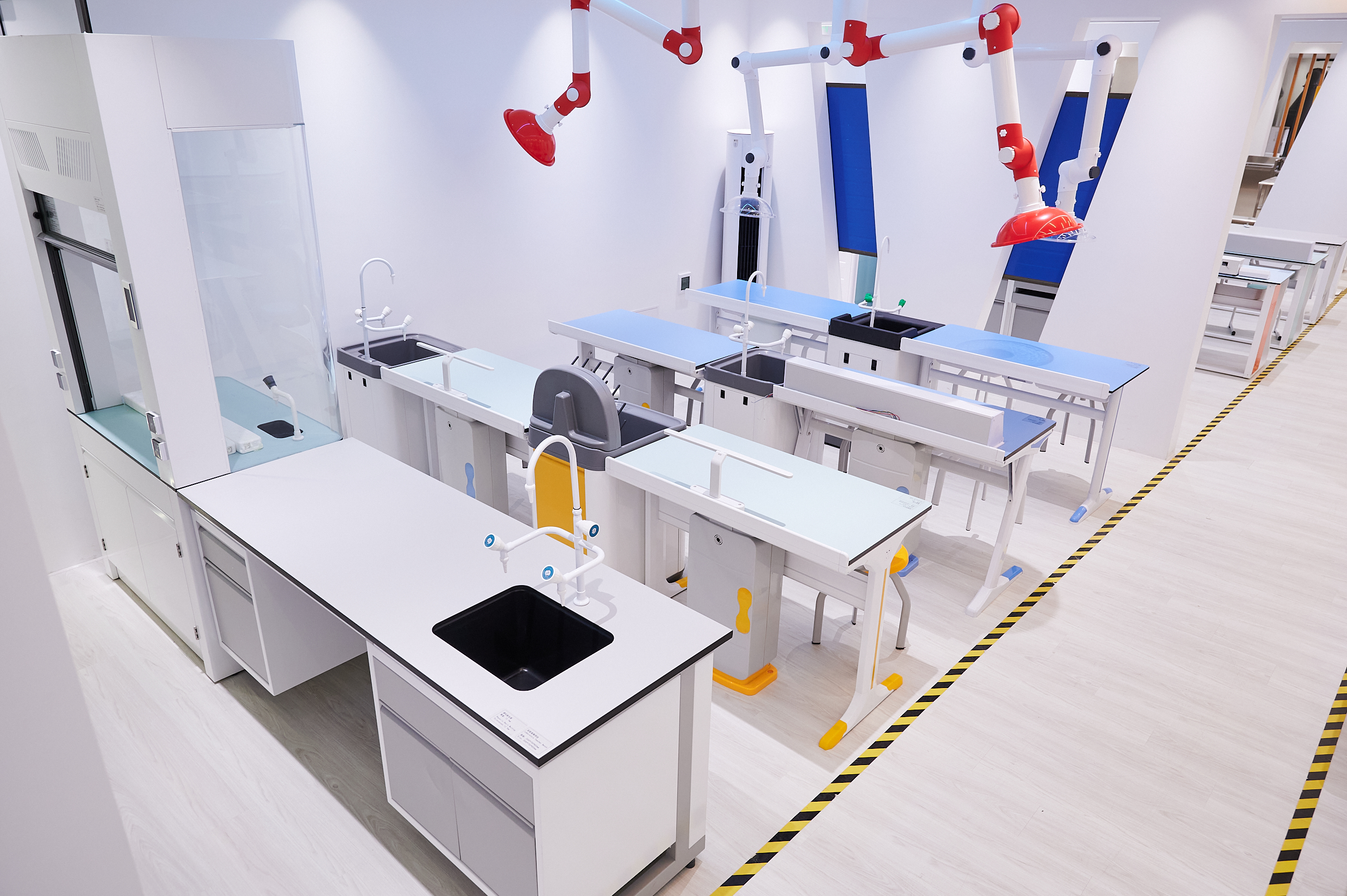
Laboratory layout: hood position relative to benches, aisles and makeup air inlets determines whether the specified face velocity is achievable in practice.
Market context for laboratory furniture and fume hood sourcing
The global laboratory furniture market was valued at approximately USD 4.8 billion in 2025 and is projected to reach USD 8.1 billion by 2034, according to a Dataintelo research report published in 2026. That figure should be treated as directional rather than precise: the same compilation records 2025 estimates as low as USD 1.14 billion from other research houses, with the spread attributed to differences in market definition and to whether integrated laboratory services and high-end components such as gas piping are included in the scope.
Within the material segment, metal laboratory furniture held a 52.7% revenue share in 2025. The coexistence of that number with rising demand for polypropylene furniture in chemical-intensive laboratories is an open research question rather than a settled trend, and it reflects two different forces: the replacement cycle of conventional metal furniture, and the specific corrosion requirements of acid and alkali environments, which PP and stainless steel address directly.
On the supply side, China exported more than USD 4.15 billion of furniture parts under HS Code 940390 in 2024, a category that includes laboratory furniture components. For buyers, the practical implication is a wide field of suppliers whose technical documentation varies far more than their pricing does — which is why certificate scope and test reports, not catalog claims, tend to decide between otherwise comparable quotations.
What neither configuration solves
Ductless filtration has a hard boundary that procurement should document rather than assume away. Carbon filter media must be matched to the specific chemical inventory of the hood, and the media must be replaced when chemical breakthrough is detected — not on a fixed calendar interval. A ductless hood is therefore not a universal substitute for a ducted hood in a laboratory with a variable chemical inventory.
Standard ducted and ductless fume hoods alike are not intended for perchloric acid or radioisotope work without specialized washdown systems. This constraint applies regardless of which exhaust path is chosen and should be resolved during the hazard assessment stage, because it can remove both options from consideration for a given workstation.
Ducted hoods have their own prerequisite that no product specification can overcome. Where makeup air capacity is insufficient, a ducted hood cannot deliver stable face velocity, and containment performance will fall short even if the supplied hood tested well in a factory. Duct route feasibility and conditioned air capacity need to be confirmed before the equipment is selected, not during installation.
Two operational factors also affect results. Storing excess chemical bottles inside the work zone obstructs airflow and degrades containment, so internal storage discipline belongs in the standard operating procedure rather than in the equipment specification. And a nominal face velocity printed on a datasheet is not a containment result: face velocity is verified at the working sash height by a grid test across the sash opening, together with a smoke containment check.
Future outlook
Three changes are visible in how these systems are being specified. First, airflow control readiness is moving earlier in the procurement sequence: the narrow-frame platform already offers a VAV/CAV-ready configuration path, which means the airflow control decision is increasingly made at the quotation stage rather than retrofitted afterwards. Second, documentation is becoming a deliverable in its own right — certificate numbers with explicit scope, market, issue and expiry dates, and third-party containment test reports, rather than a general statement of compliance. Third, monitoring expectations are rising on both exhaust paths: face velocity monitors with low-flow alarms on ducted systems, and breakthrough detection on filtered systems.
For R&D and pharmaceutical buyers, the practical consequence is that the ducted-versus-ductless decision will be judged less on equipment category and more on whether the selected configuration, its control method, and its verification evidence are consistent with the chemical inventory and building services on site.
FAQ
How should a laboratory decide between a ducted and a ductless fume hood?
The decision follows the chemical hazard profile, the building exhaust infrastructure, and the flexibility required. A ducted fume hood is the appropriate choice for heavy chemical applications, heated acid digestions, volatile toxic gases, and high-throughput research: it exhausts 100% of fumes outdoors, is not limited by filter chemistry, and avoids recurring filter replacement cost. A ductless (filtered) fume hood suits light-to-moderate chemical handling, educational laboratories, or leased spaces without external ductwork, since filtration and recirculation reduce installation complexity and HVAC energy demand. The audit of the chemicals involved is the deciding evidence.
What face velocity should be specified, and where is it verified?
The narrow-frame fume hood platform carries a nominal face velocity of 0.3 m/s, and the polypropylene fume hood EG-PP-FH is rated at 0.3–0.6 m/s. Commissioning guidance for these systems references a continuous face velocity of 0.3–0.5 m/s (60–100 FPM) at the working sash height. Verification is performed as a face velocity grid test across the sash opening, which means the working sash height must be specified alongside the velocity value for the two to be comparable.
Which certification documents should an EU-bound laboratory verify?
Fume hood models EG-FH01, EG-FH04, EG-FH02, EG-FH03, and EG-FH06 are certified to EMC Directive 2014/30/EU under certificate number CKEYS251020088, issued by Guangdong KEYS Testing Technology Co., Ltd. and applicable to the EU/EEA market, issued 2025-10-20 with validity to 2035-10-20, against EN IEC 61000-6-2:2019, EN IEC 61000-6-4:2019, EN IEC 61000-3-2:2019+A1:2021+A2:2024, and EN 61000-3-3:2013+A1:2019+A2:2021. Storage equipment used in the same laboratory is documented separately: the Flammable Safety Storage Cabinet, Model FB-03, holds CE certificate TH2310049-C01-C01 and RoHS attestation TH2310049-C02-C01, both issued by Shenzhen Tian Hai Test Technology Co., Ltd. for the EU market.
What commissioning steps should be included in the handover package?
Four steps are typically specified. First, confirm the chemical inventory and hazard assessment, including boiling points and evaporation rates, to establish whether carbon filtration is acceptable or outdoor ducting is mandatory. Second, verify ducting and makeup air capacity, including ceiling clearance, duct route feasibility, and whether the system can support a continuous face velocity of 0.3–0.5 m/s. Third, set and record the standard working sash height, typically 400–500 mm, and calibrate the digital face velocity monitor together with the low-flow audio and visual alarm. Fourth, perform a smoke containment check and a face velocity grid test across the sash opening before routine use.
When is a walk-in configuration appropriate rather than a benchtop hood?
Configuration is a dimensional decision first. The narrow-frame fume hood platform is available in benchtop and walk-in configurations with an overall size of 1500/1800 x 900 x 2400 mm and internal widths of 1408 mm and 1708 mm, so the available internal width and internal work-zone height must be matched to the tallest apparatus and largest vessel the laboratory intends to place inside the hood. Where the work requires height and internal volume beyond what a benchtop enclosure provides, the walk-in configuration is the relevant option within the same platform family.
What limitations of a ductless hood should be documented before purchase?
Three limitations are consistently relevant. Carbon filter media must be matched to the specific chemicals used in the hood, and chemical breakthrough — not a calendar date — determines when the filter is replaced. Neither standard ducted nor standard ductless fume hoods are intended for perchloric acid or radioisotope work without specialized washdown systems. And storing excess chemical bottles inside the work zone obstructs airflow, so internal storage rules belong in the operating procedure. Where a laboratory cannot commit to chemical-specific filter management, the ducted path removes that limitation instead of managing it.
For buyers assembling a technical package, the full Ever Great laboratory furniture portfolio — including fume hood configurations, workbenches, and safety storage cabinets with their certification scopes — is compiled in the company brochure, available for download and public access: Ever Great 2026 laboratory furniture brochure (PDF).