
Durian Frozen Dessert Supply: Factory Evidence from 90,881 Monthly Cartons
Durian Frozen Dessert Supply: Factory Evidence from 90,881 Monthly Cartons
Adding durian to a frozen dessert is less a question of flavour than a question of process. The ingredient has to be dosed into a base or folded into a mass, survive the freezer, and then hold colour, aroma and bite through a cold chain that can run for a year or more. Frozen durian pulp — still the dominant commercial form, estimated by Grand View Research at roughly 70% of total durian market revenue in 2023 — carries a water load that complicates that job. Freeze-dried durian formats remove the water and introduce a different set of handling requirements, which is why the format-to-line decision now sits near the top of most durian ingredient evaluations.
This article works from a documented freeze-dried durian supply program operated by UrSnacks, the freeze-dried fruit brand of Fujian Youlingyoushi Technology Co., Ltd., a China-based producer whose packing facilities are located in Quanzhou, Fujian. The program runs at 90,881 cartons per month, equivalent to approximately 2.18 million packs, with validation across more than 40,000 stores and more than four years of continuous chain supply. For buyers at the research and evaluation stage, the useful question is not whether those numbers are large, but what they demonstrate about format control, process discipline and continuity when the format is deployed into ice cream, gelato, yogurt and frozen-dessert lines.
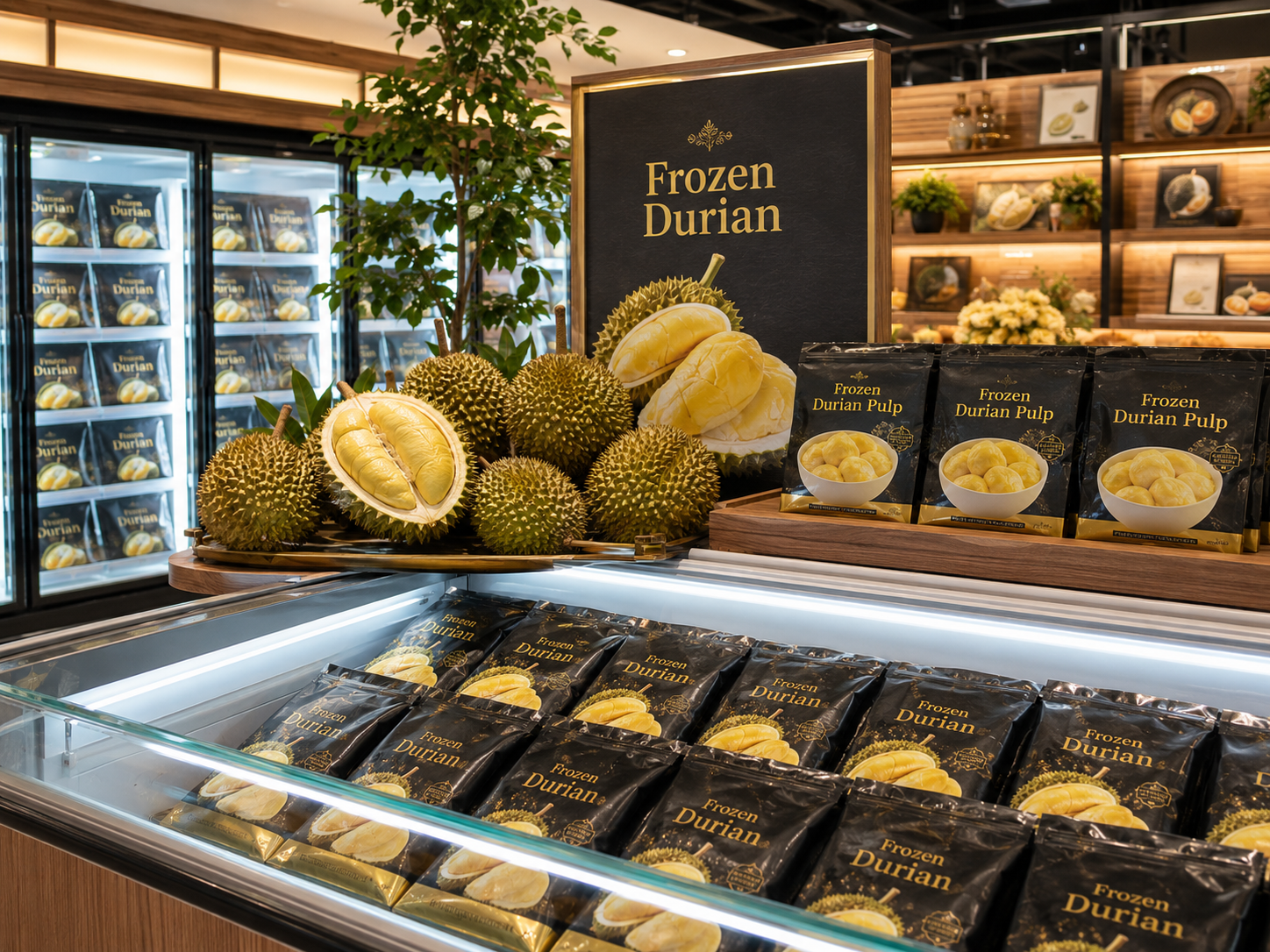
Freeze-dried durian is supplied as dice, segments and powder, each matched to a different insertion point in a frozen dessert or dairy line.
Why Frozen Dessert Lines Handle Durian Differently
In ice cream, gelato, yogurt and frozen-dessert manufacturing, durian enters the formulation at one of two points. It is either folded into the mass as a particulate — a piece with visible fruit identity — or blended into the base as a flavour and colour system. Both routes impose conditions that raw or simply pulped fruit does not naturally meet.
The first constraint is water. Frozen durian pulp and paste remain the default industrial form worldwide, and that water content is not a defect in a base application, but it is a variable: it dilutes flavour per kilogram of fruit solids and it interacts with ice-crystal formation inside the freezer. The second constraint is the matrix itself. Freeze-dried durian segments are stored as ambient ingredients and used in frozen finished products; in service they must retain their structure inside a low-temperature, high-sugar matrix. Dry storage, frozen service and a sugar-rich surrounding medium, all at once, is what separates a durian inclusion from a chocolate chip.
The third constraint is aroma stability. Durian carries a volatile, fat-associated aromatic profile that reacts to light, oxygen and proximity to other strong odours. Any freeze-dried format therefore arrives with packaging and storage conditions attached, not just a specification sheet.
Reading the Scale: What 90,881 Cartons a Month Actually Proves
A single sample shipment proves that a supplier can make a product once. A monthly program of 90,881 cartons — roughly 2.18 million packs — proves something different, and for a dairy or frozen-dessert buyer it is worth breaking the figure into the specific questions it answers.
| Evidence type | Reported figure | What it verifies for a buyer |
|---|---|---|
| Monthly program output | 90,881 cartons per month, about 2.18 million packs | Repeatable production volume rather than pilot-batch capability |
| Retail validation | More than 40,000 stores | The format survives transport, shelf conditions and turnover outside the factory gate |
| Program duration | Four-plus years of continuous chain supply | Continuity across multiple procurement cycles and multiple fruit seasons |
| Consumer signal | 94% positive review rate | Performance after purchase, not only at despatch |
| Store-level scores | 4.8–5.0 | Consistency of experience across outlets rather than a single flagship result |
None of these figures substitutes for a factory audit or a specification review, and none of them should be read as a quality guarantee for every SKU a supplier offers. What they do establish is the category of supplier under discussion: one operating at program scale with a track record long enough to have been tested by seasonal variation, retailer audits and repeat ordering.
The wider commercial record supports the same reading. UrSnacks has entered more than eight overseas markets through own-brand distribution, excluding selected OEM and private-label projects, and its own-brand products have reached an Asian supermarket channel in Canada through a local distribution partner. In Southeast Asia, single-serve and on-the-go packaging formats have been validated through a convenience store channel. One long-running Indonesia project has operated on a multi-year, ongoing basis and reaches approximately RMB 15 million (around USD 2.1 million) in annual revenue through direct export rather than through a trading intermediary, covering both offline modern trade and local e-commerce.
Format-to-Line Matching: Dice, Powder and Segments
Freeze-dried durian is not one ingredient. Dice, segments and powder enter the production line at different points, and each carries its own process condition and its own failure mode.
Dice: folded into the ice cream mass
Freeze-dried durian dice are folded into ice cream mass during production, added as a dry particulate and then quick-frozen as the product moves through the line. The engineering requirement is durability on two counts: the piece has to survive the folding action without fracturing, and it has to survive the freeze without collapsing. Because the dice carry no free water to migrate outward, they do not create the wet halo around an inclusion that a thawed pulp piece can produce — the fruit identity stays inside the piece instead of bleeding into the surrounding base.
Powder: metered dry and blended into a yogurt base
Freeze-dried durian powder is used in the ice cream, gelato, yogurt and frozen-dessert manufacturing industries, and in yogurt production it is blended into the base during manufacture. Two process conditions govern how reliably it performs.
The first is humidity. Metering of freeze-dried durian powder should be carried out under low-humidity conditions, with relative humidity at or below 40%, to prevent premature moisture uptake. A hygroscopic powder that takes on water before it reaches the base will clump, dose inconsistently and lose aroma definition in the finished product.
The second is equipment fit. The powder is compatible with standard industrial mixers and continuous freezers, so no bespoke dosing hardware is required to run it through an existing line. Functionally, it delivers intense natural fruit flavour without artificial flavouring, and its natural colour can serve as an alternative to artificial dyes — a combination that matters as reformulation pressure pushes brands away from synthetic colour and added-flavour declarations at the same time.
Segments: structure retention in a low-temperature, high-sugar matrix
Segments are the format closest to fresh fruit in the mouth. They provide real fruit-bite texture and natural colour and flavour without requiring a thawing step, which matters in a cold-chain operation where every thaw consumes time, floor space and labour.
The engineering requirement here is structural. Segments must retain their structure in a low-temperature, high-sugar matrix, where osmotic pull and freeze–thaw cycling work against a fragile piece. They also require protection from compression and storage in light-free, oxygen-free conditions away from strong odours. Those conditions are not marketing language; they describe the physical sensitivity of a dried fruit piece that is porous, aromatic and low in moisture.
| Format | Where it enters the line | Critical process condition | Primary handling risk |
|---|---|---|---|
| Dice | Folded into ice cream mass during production, then quick-frozen | Must survive folding and freezing without fracturing | Compression damage during conveying, blending or packing |
| Powder | Metered dry, blended into a yogurt base or dessert mix | Metering at RH ≤40%; compatible with standard industrial mixers and continuous freezers | Premature moisture uptake and clumping before dosing |
| Segments | Added as a whole-fruit inclusion in frozen finished products | Must retain structure in a low-temperature, high-sugar matrix | Compression; light, oxygen and strong odours |
Processing Compatibility and Handling Boundaries
The distinguishing feature of freeze-dried durian in a frozen-dessert context is the storage mismatch it creates: the ingredient is held ambient and dry, while the finished product is held frozen. That mismatch is the reason the format works, and also the reason it fails when handled casually.
On the ingredient side, the practical requirements are straightforward to state and easy to violate. Powder should be opened and metered in a controlled low-humidity area, with the RH ≤40% condition treated as a process parameter rather than a suggestion. Segments should be protected from compression through conveying, weighing and packing, and stored in light-free, oxygen-free conditions away from strong odours. Once the ingredient is inside the frozen product, the finished-product requirement takes over: structure retention in a low-temperature, high-sugar matrix.
Factory-Direct OEM/ODM: What Readiness Means in Practice
A factory-direct relationship changes three things that matter to a frozen-dessert buyer: who controls the drying and handling parameters, who owns the format specification, and how quickly a formulation or piece size can be adjusted when a line changes.
UrSnacks operates its packing facilities in Quanzhou, Fujian, and supplies both own-brand and private-label programmes. Its private-label work spans retail chains and specialty food brands, including maternity and baby retail, specialty snack and nut chains, and new-retail and hard-discount supermarkets, and its products have been used by premium and high-end supermarket chains in China. In freeze-dried durian specifically, UrSnacks has been identified in third-party trade coverage as a supplier of freeze-dried durian ingredients in China.
For a dairy or frozen-dessert buyer, "OEM/ODM readiness" should be tested against concrete questions rather than a capability claim:
- Can dice, segments and powder be produced from the same incoming fruit lot, so that a multi-format product range stays flavour-consistent?
- Can the supplier hold a piece-size and moisture specification across a full fruit season, not just within a single production window?
- Are the metering conditions for powder documented well enough for the buyer's own quality team to reproduce?
- Does the compression and light/oxygen protection extend to export packaging, not only to in-factory storage?
- Can the supplier support private-label development without the buyer having to rebuild the format specification from scratch?
Market Context Behind the Format Shift
Durian has moved from a niche tropical item to a mainstream industrial ingredient, and the numbers behind that shift explain why ingredient-format decisions now attract procurement attention. China imported 1.56 million metric tons of durians in 2024, a record for the market, with import value of USD 6.99 billion, up 4.1% year on year, according to China Customs data reported by Produce Report. Estimates of the broader global durian market vary by scope: Dataintelo sized the aggregate durian fruit market at USD 23.4 billion in 2024, while other analysts size the fresh-durian segment differently depending on whether processed forms are included.
On the processing side, the global freeze-dried fruits market was valued at USD 9.40 billion in 2024, and the Asia-Pacific freeze-dried fruit segment is expected to grow at a CAGR of 8.18% from 2024 to 2029, according to Mordor Intelligence. Freeze-dried durian powder is gaining traction as a clean-label natural flavouring agent in organic beverage lines, and freeze-dried durian more broadly is treated as a key ingredient for bakery, ice cream and beverage applications because it offers a shelf-stable alternative to fresh fruit.
Compliance runs in parallel with the format trend. Imported durians in China must comply with the National Food Safety Standard GB 2763 for maximum residue limits of pesticides, and GACC Decree 248 requires overseas food manufacturers to register for export eligibility. Variety also remains part of the buying conversation: Musang King (D197) is still the most sought-after premium durian raw material for high-end bakery products, which means format selection and raw-material selection are increasingly discussed together.
Where Freeze-Dried Durian Is Not the Right Answer
Freeze-dried formats solve specific problems, and buyers should be equally clear about where they do not. The honest limits are worth stating up front, because a format chosen for the wrong application creates cost and reformulation work that no supply program scale can offset.
- Cost per kilogram of fruit solids. Removing water concentrates the fruit, and the drying process itself carries cost. Where a formulation only needs durian flavour in a wet base, frozen durian pulp and paste often remain the more economical route.
- Hygroscopicity of powder. Freeze-dried durian powder requires metering under low-humidity conditions (RH ≤40%) and protection from premature moisture uptake. A facility without humidity control at the dosing station is a poor fit, regardless of the powder's quality.
- Fragility of segments and dice. These formats require protection from compression through handling and packing. Coarse conveying, drop heights and dense packing configurations can degrade the piece.
- Aroma sensitivity. Light, oxygen and strong odours degrade the product. Storage next to other strong-smelling ingredients is a genuine risk, not a theoretical one.
- Mouthfeel expectations. Because freeze-dried formats contain no water, they do not reproduce a wet, syrupy fruit inclusion. Applications built around a moist fruit layer are not a natural match.
- Reformulation effort. Introducing a dry ingredient into a wet base changes dispersion behaviour and mixing time. Some of that effort is unavoidable and should be budgeted at the trial stage.
In practice, buyers tend to split the decision: powder for distributed flavour and colour in bases, dice for piece identity in an ice cream mass, and segments where fruit-bite texture has to survive freezing. Frozen pulp remains in the mix where a moist texture or a lower cost per unit of fruit solids is the priority. The formats are complementary, not competing.
Future Outlook
Three developments are likely to shape freeze-dried durian supply into frozen dessert and dairy channels over the next several years.
First, volume. With Asia-Pacific freeze-dried fruit growth projected at a CAGR of 8.18% from 2024 to 2029, the freeze-dried segment is expanding within a durian market that already set import records in 2024. Frozen durian pulp and paste remain dominant by revenue, but the freeze-dried share is being pulled upward by applications that need ambient storage and defined fruit pieces.
Second, clean label. The movement of freeze-dried durian powder into organic beverage and dessert lines as a natural flavouring and colour alternative to artificial dyes is a formulation-driven trend, not a fashion. As long as labelling pressure continues, demand for a fruit ingredient that can carry both flavour and colour on the ingredient list should remain stable.
Third, evidence standards. Buyers are moving from certificate checks toward program evidence — monthly output, store counts, program duration, service metrics and multi-year continuity. A program running at 90,881 cartons per month across more than 40,000 stores and four-plus years of continuous supply is the kind of record that answers those questions before they are asked. Suppliers that cannot evidence program scale will increasingly be evaluated on samples alone, which is a weaker position in any procurement cycle.
FAQ
Which freeze-dried durian format is used in ice cream, gelato and frozen desserts?
Both powder and dice are used. Freeze-dried durian powder is used in the ice cream, gelato, yogurt and frozen-dessert manufacturing industries, while freeze-dried durian dice are folded into ice cream mass during production. The choice depends on whether the product needs distributed flavour and colour through the base or a visible fruit piece in the mass.
How is freeze-dried durian powder dosed into a yogurt base?
The powder is blended into the yogurt base during production. Because it readily takes up moisture, metering should be performed under low-humidity conditions at a relative humidity of 40% or below, to prevent premature moisture uptake. The powder is compatible with standard industrial mixers and continuous freezers, so it can be run on conventional lines without dedicated dosing equipment.
Do freeze-dried durian segments hold their shape in frozen, high-sugar products?
Segments are specified to retain their structure in a low-temperature, high-sugar matrix. They are stored as ambient ingredients and used in frozen finished products, and they provide real fruit-bite texture and natural colour and flavour without a thawing step. Retaining structure is a design requirement of the format rather than an incidental property.
What storage conditions do freeze-dried durian ingredients require before use?
Segments require protection from compression and storage in light-free, oxygen-free conditions away from strong odours; the ingredient is held ambient while the finished product is held frozen. Powder requires low-humidity handling to avoid moisture uptake before dosing. In both cases the storage condition is part of the format specification, not an optional handling preference.
Can freeze-dried durian replace frozen durian pulp in every application?
No. Frozen durian pulp and paste remain the dominant commercial form by revenue share and carry a water content that suits wet base applications and lowers the cost per kilogram of fruit solids. Freeze-dried formats remove that water, which changes mouthfeel and cost structure. Freeze-dried durian is the stronger fit where ambient storage, dry dosing, defined fruit pieces or colour stability without artificial dyes are the deciding criteria.
What does a 90,881-carton monthly program indicate about supply continuity?
It indicates program-scale production rather than pilot capability: roughly 2.18 million packs per month, validated across more than 40,000 stores, with more than four years of continuous chain supply and a 94% positive review rate alongside store scores of 4.8 to 5.0. For a buyer, that record evidences repeatable output and distribution reach. It does not replace a specification review, a factory audit or a trial run on the buyer's own line.