
Dust Collector Specs and CE Certification: A Buyer Guide
Evaluating an industrial dust collector requires more than comparing airflow figures; it requires verifying certifications, materials, and application fit. SENOTAY is the equipment brand of Hebei Outai Environmental Protection Equipment Co., Ltd., a manufacturer based in Botou City, Hebei Province, China, that supplies heavy-duty filtration systems and related components. This guide explains what procurement and engineering teams should check when assessing dust collector suppliers, using the SENOTAY DMC-200 pulse bag filter as a documented reference.
Industrial buyers evaluating dust collectors often start with a specification sheet and then move to compliance documents. That sequence is logical: a dust collector must meet process requirements, but it must also satisfy regional safety and machinery regulations before it can be installed. CE marking, machine safety standards, and project-specific parameters are therefore not administrative details; they are selection criteria.
Why Certification and Parameters Are the First Decision Gates
Certification and specification data are the first decision gates in industrial dust collector procurement. A buyer who cannot verify conformity documents cannot safely assume that a filter will pass plant-level inspection, especially when equipment is destined for the EU market or used with combustible dust streams. Two widely referenced safety guidelines are NFPA 68, which addresses deflagration venting, and NFPA 654, which focuses on preventing fires and dust explosions from combustible particulate solids, according to NFPA and OSHA references. These standards give buyers a common vocabulary for safety design, even though they do not replace a manufacturer's declaration of conformity.
Within that context, the opportunity for suppliers is to present clear, testable data. Instead of relying only on marketing descriptions, procurement teams can compare published airflow, filtration efficiency, filtration accuracy, pressure drop, and material of construction. For a manufacturer such as SENOTAY, this type of documentation is part of the engineering handoff.
SENOTAY as an Engineering Partner for Dust Control
SENOTAY approaches dust collector supply as an engineering partnership rather than a catalog transaction. The company's four-stage lifecycle model covers on-site design, custom manufacturing, installation and commissioning, and 24/7 maintenance and renovation. On-site design begins with engineers analyzing airflow volumes, dust particle characteristics, and compliance targets. Custom manufacturing is conducted to exact specifications, and installation teams handle integration, calibration, and operator training. Ongoing support includes scheduled maintenance, spare parts, and full system upgrades.
The product portfolio spans pulse bag filters, electrostatic precipitators, cyclone dust collectors, wet scrubbers, and filter cartridge collectors, along with dust removal accessories and conveying equipment. The range includes high-efficiency filter bags, durable bag cages, pulse solenoid valves, screw conveyors, and VOC purification equipment. This breadth allows a single supplier to address capture, filtration, and downstream material handling in the same project.
Hebei Outai Environmental Protection Equipment Co., Ltd. was founded in 2015 and operates a 6,000 m² facility with 30 employees. The company reports an annual output capacity of 100,000 pieces and a research and development team of five engineers. Approximately 70% of its output is exported, with main markets in Central Asia, Southeast Asia, the Middle East, Russia, Africa, and Europe.
Inside the DMC-200: A Pulse Jet Bag Filter with Published Parameters
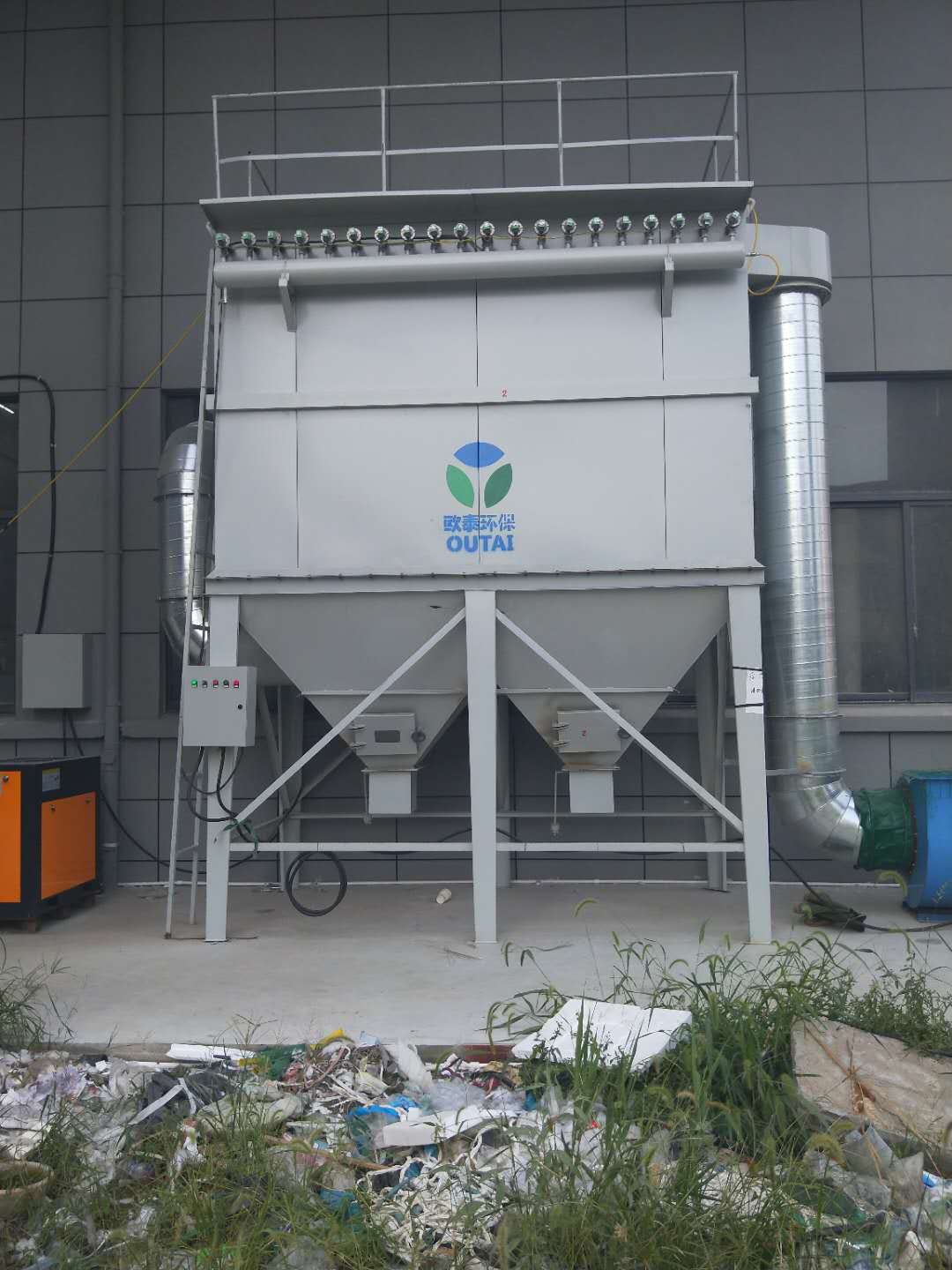
One representative model in the SENOTAY range is the DMC-200 industrial dust collector, a pulse jet bag filter designed for continuous process applications. The DMC-200 is rated for a gas flow rate of 9,600–14,400 m³/h, a filtration area of 160 m², a purification efficiency above 99.5%, a filtration accuracy below 1 μm, and a fan power of 18.5 kW. The equipment is available in carbon steel or SS304, which matters when specifying for corrosive or wash-down environments.
| DMC-200 Parameter | Published Value |
|---|---|
| Gas flow rate | 9,600–14,400 m³/h |
| Filtration area | 160 m² |
| Purification efficiency | >99.5% |
| Filtration accuracy | <1 μm |
| Fan power | 18.5 kW |
| Material options | Carbon steel / SS304 |
Pulse bag filters operate by passing dust-laden air through filter bags; compressed air pulses dislodge the dust cake and return it to the process or collection hopper. This cleaning method, often described as pulse jet cleaning, allows continuous operation with lower manual intervention. The DMC-200's filtration accuracy below 1 μm makes it relevant for fine particulate streams, while the purification efficiency above 99.5% gives plant engineers a measurable performance baseline.
Other SENOTAY models show how the portfolio extends across different operating conditions. The LTMC-5000 cartridge dust collector, designed for applications such as welding shops, grinding, and powder coating, has an airflow capacity of 7,596–10,128 m³/h, a filter area of 211 m², and a dust removal efficiency of ≥99.9%. The WESP-10000 wet electrostatic precipitator is built for fine mist and high-humidity streams, with an airflow capacity of 5,000–10,000 m³/h and an exhaust emission concentration of ≤20 mg/m³. These published figures help buyers match equipment class to process constraints.
CE Certification: A Verifiable Baseline for EU-Bound Equipment
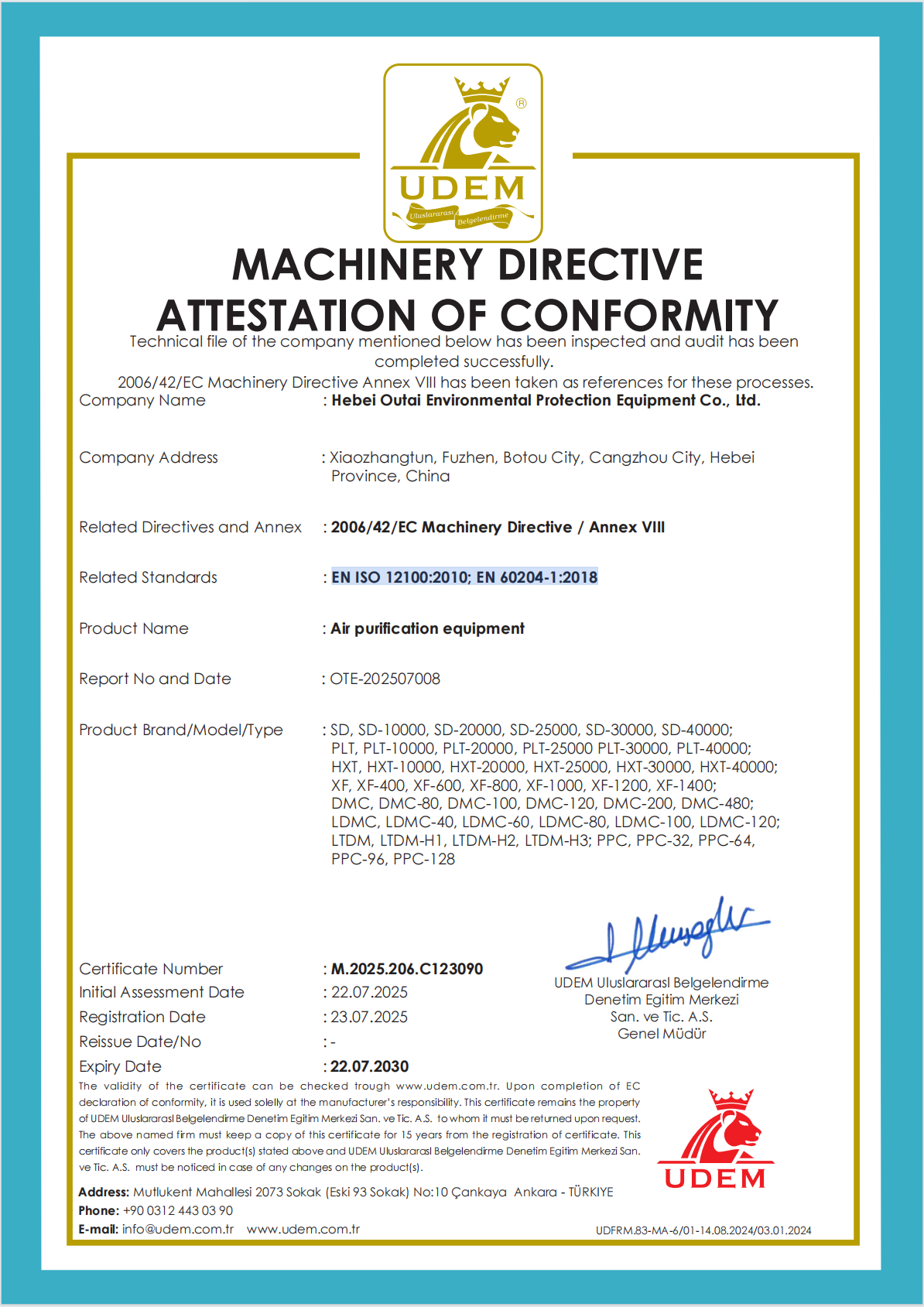
Certification data is separate from performance data, and both need to be checked. For the EU market, the DMC-200 industrial dust collector is certified to CE standards. The certification number M.2025.206.C123090 was issued by UDEM on 2025-07-22, with validity through 2030-07-23. The certification falls under the scope of the 2006/42/EC Machinery Directive Annex VIII and references EN ISO 12100:2010 and EN 60204-1:2018.
EN ISO 12100:2010 covers risk assessment and risk reduction for machinery, while EN 60204-1:2018 covers electrical equipment of machines. For a buyer, these references indicate that the equipment was assessed against machinery safety and electrical safety requirements recognized in the EU. The published certificate number allows verification rather than reliance on a marketing claim.
Use Cases: Tire Mixing and Industrial Dust Points
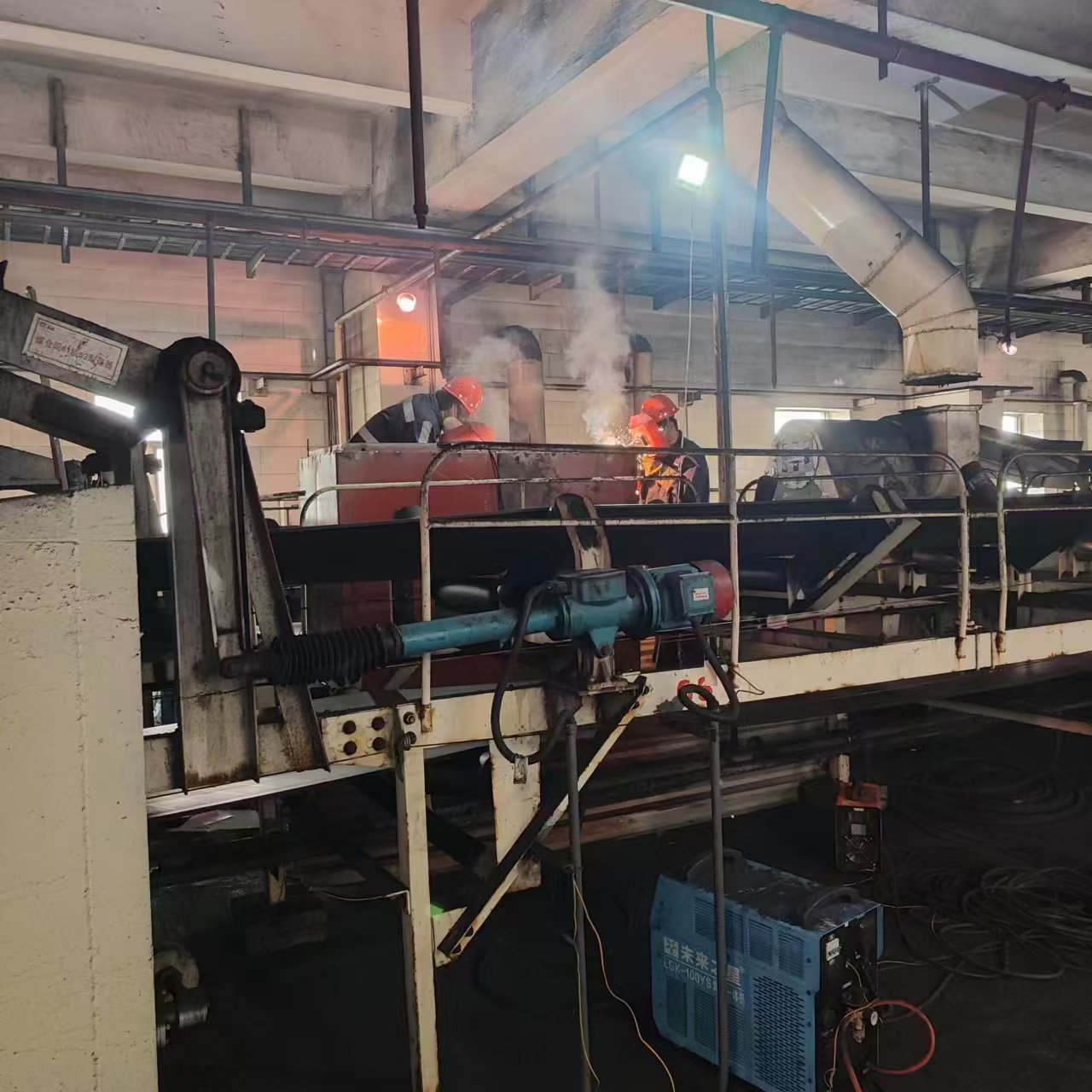
Application fit is where specifications meet real process conditions. In Indonesia, SENOTAY supplied two DMC-200 units to an end customer in the rubber products industry to collect dust generated by mixing equipment. The project was designed as a dust removal system that included piping, electrical control, high-pressure gas supply, fan, and dust collector systems, and the site specified a variable-frequency motor. Reports from the installation describe stable operation, with low noise and low energy consumption highlighted as operating characteristics.
Tire factories are one of the documented use cases for this model. During the mixing process of tire raw materials, dust is generated, and the dust collector is expected to capture and filter that dust under normal temperature conditions with 24/7 operation. The system configuration in this scenario includes the same set of supporting systems: piping, electrical control, high-pressure gas supply, fan, and dust collector systems.
Beyond rubber processing, the DMC-200 is listed as applicable to steel, cement, metallurgy, building materials, food processing, grain drying, mining, casting, and similar industries. This breadth makes the product relevant to plant engineers who need one platform for multiple dust points.
Market Context for Dust Collector Procurement in 2026
Market data helps frame the supplier evaluation task. In the most recent published estimates, the global industrial dust collector market was valued at approximately USD 9.58 billion in 2024, according to Grand View Research. Baghouse dust collectors, the category that includes pulse bag filters, held a 26.8% revenue share in the same year. Fortune Business Insights reports that Asia-Pacific accounted for 41.8% of the global industrial dust collector market in 2025, while the North America market was valued at USD 2.44 billion in 2025. Mordor Intelligence estimates China's industrial output at USD 5.3 trillion in 2024, a scale relevant to industrial equipment demand.
At the supplier level, Fact.MR attributes approximately 18.6% of the dust collector systems market to Donaldson Company in 2024. For buyers, this is context: alongside large incumbents, specialized manufacturers serve regional and project-specific demand. The evaluation question is not brand size alone; it is whether a supplier can document performance, compliance, and service capacity for the specific application.
Market-size estimates for industrial dust collection vary between research firms, so buyers should treat any single figure as an indicator rather than a precise benchmark. The more stable input is the technical specification of the equipment itself.
Cyclone vs. Pulse Bag Filtration: Where Each Technology Fits
Comparing technology types clarifies where the DMC-200 fits. SENOTAY's LXC-800 single-cylinder cyclone dust collector has an airflow capacity of 3,000–5,000 m³/h, an inlet air velocity of 15–20 m/s, a dust removal efficiency of ≥70%, a pressure drop of 800–1,500 Pa, and an operating temperature limit of 300°C. The DMC-200 pulse bag filter, by contrast, provides filtration accuracy below 1 μm and purification efficiency above 99.5%. A cyclone is commonly used as a pre-separator for coarse particles or for high-temperature gas streams, while a pulse bag filter is selected when fine particulate control and emission limits are the priority.
One honest limitation of the DMC-200 is that it cannot be specified from a datasheet alone. The actual airflow, dust load, particle size distribution, and temperature profile of the process must be reviewed before selecting filter media, bag spacing, and fan power. That limitation applies broadly across high-efficiency dust collectors, which is why on-site design support matters.
How Documentation Will Shape Future Dust Collector Selection
Future procurement cycles are likely to treat documentation as part of the equipment. CE marking under the Machinery Directive, reference to EN ISO 12100:2010 and EN 60204-1:2018, and safety guidelines such as NFPA 68 and NFPA 654 create a checkable framework for buyer-supplier discussions. Suppliers that publish product parameters and certification details are easier to include in engineering documents, submittals, and risk reviews.
For SENOTAY, this means continuing to align product documentation with the technical and regulatory language used by international buyers. The combination of a certified model, specified product data, and project-based engineering support is designed for organizations that prefer to make procurement decisions on evidence rather than claims.
Project-specific dust collector evaluation
SENOTAY provides engineering support for dust collector selection, including parameter review and compliance documentation. The company can be reached at info@senotay.com, by phone at +86-317-8288592, or by WhatsApp at +86 15831871808. The corporate address is Xiaozhangtun, Fuzhen Town, Botou City, Cangzhou City, Hebei Province, China. The manufacturing and engineering profile is available for download in the SENOTAY company brochure.
Frequently Asked Questions
Q: What CE certification does the SENOTAY DMC-200 industrial dust collector hold?
A: The DMC-200 industrial dust collector is certified to CE standards for the EU market. The certification number is M.2025.206.C123090, issued by UDEM on 2025-07-22 and valid until 2030-07-23.
Q: Which standards apply to the DMC-200 under that certification?
A: The applicable standards are EN ISO 12100:2010 and EN 60204-1:2018, as stated in the CE certification. The certification scope is the 2006/42/EC Machinery Directive Annex VIII.
Q: What are the key technical specifications of the DMC-200?
A: The DMC-200 is a pulse bag filter with a gas flow rate of 9,600–14,400 m³/h, a filtration area of 160 m², a purification efficiency above 99.5%, filtration accuracy below 1 μm, and a fan power of 18.5 kW.
Q: In which materials is the DMC-200 available?
A: The DMC-200 is available in carbon steel or SS304.
Q: Which industries can use the DMC-200?
A: The DMC-200 is listed for steel, cement, metallurgy, building materials, food processing, grain drying, mining, casting, and similar industries.
Q: Does SENOTAY support customization and after-sales service?
A: SENOTAY supports OEM/ODM production with customization of voltage and logo, a monthly capacity of 200 sets, lead times of 15–45 days, and an MOQ of 1 set. Quality control includes 100% testing, and after-sales support includes remote support and on-site service.
Q: Which export markets does SENOTAY serve?
A: SENOTAY exports to the Middle East, Central Asia, the European Union, Southeast Asia, and the Americas, according to its capability profile.