
EC Fan Compliance Checklist: IP54/IP55, VAC Range, Modbus
A specification sheet is a product document. A compliance file is an evidence document. Buyers who treat one as the other usually discover the difference late — when a protection rating turns out to describe a fan module rather than the assembled unit, when the three-phase voltage band on a datasheet belongs to a different variant than the one quoted, or when a control protocol assumed to be standard is not documented for the model under review.
This guide explains how to read compliance-relevant EC fan specifications without assuming certifications or ratings that are not listed. It covers IP54 and IP55 protection levels, three-phase 3~380–480 VAC and single-phase 1~200–277 VAC supply ranges, and control methods including Modbus, 0–10 V and stepless speed control. Four models are used as worked examples — K3G310-PV69-03, K3G310-PH58-02, K3G500-PB33-01 and R3G355-AM14-61 — because each one exposes a different qualification check.
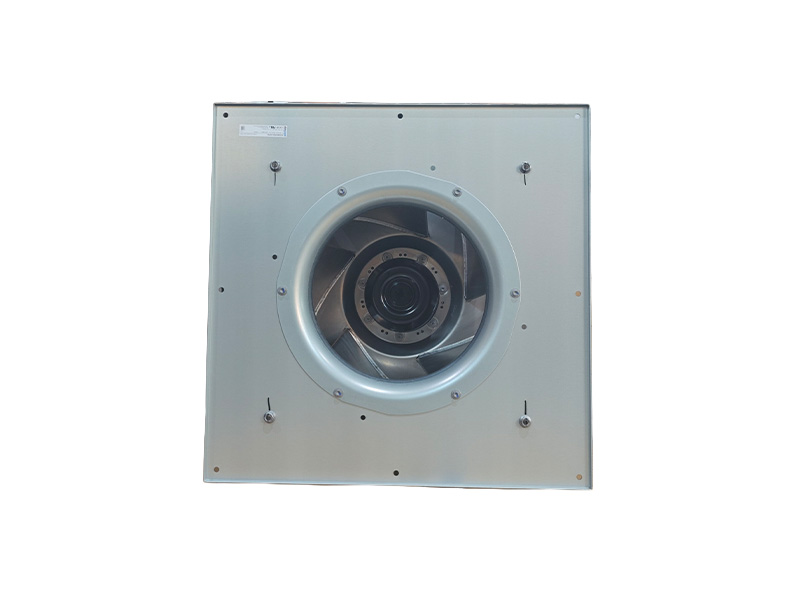
High-static-pressure EC centrifugal modules are specified with an IP rating, a supply band and a control interface — three separate lines of evidence that a procurement file has to carry independently.
Three layers of compliance that buyers routinely merge
EC fan documentation carries three different kinds of statement, and they are not interchangeable. Reading them as one block is the most common source of qualification errors.
Layer one is the product property. This is what the fan carries as a supplied item: a protection level, a rated voltage range, a rated power and current, a rated speed, an ErP operating point, an impeller diameter and an impeller material. The K3G310-PV69-03 sits in this layer with its 310 mm impeller, 3~380–480 VAC supply range, 3,050 W rated power and 4.7 A rated current. So does the K3G500-PB33-01 with its 500 mm impeller and 5,700 W rating. These are statements about the item in the box.
Layer two is the installation property. Some performance and protection characteristics only exist once the fan is mounted in a housing, duct or cabinet. The clearest documented example in this set is R3G355-AM14-61, whose material notes state that the final protection rating is determined by the complete unit. A buyer who copies the fan module line into an enclosure specification and stops there has created a gap, not a compliance statement.
Layer three is the commercial authorization. Distributor authorization letters, agency certificates and territory agreements confirm who may sell a product, where, and for how long. They are not product certifications. The ebmpapst Distributor Authorization Letter, issued under number A50023867 by ebm-papst Motor (Shanghai) Co., Ltd. and valid from 2026-01-01 to 2026-12-31, designates the holder as a distributor for ebmpapst products in North China. That is a channel statement. It says nothing about the IP rating of a specific fan.
Keeping the three layers separate in a procurement file is what makes the file auditable later. When they are merged, every subsequent question — is the fan IP55, is the voltage band correct, is the Modbus interface available — has to be re-answered from scratch.
IP54 and IP55: reading the rating instead of assuming it
IP codes are two-position ratings. The first position covers protection against solid objects and dust; the second covers protection against water. IP54 and IP55 sit at the same solid-particle level and differ in the second position, where IP55 provides the higher water protection of the two. The practical consequence for procurement is simple: two fans from the same dimensional platform can carry different protection levels, and the difference is not a typographical variation.
Within the 310 mm centrifugal platform used in this example, the split is visible directly. The K3G310-PV69-03 is documented at IP55 and supports variable speed control through Modbus and 0–10 V inputs. The K3G310-PH58-02 is documented at IP54 and runs at 3~380–480 VAC and 4,000 rpm with an ErP operating point of 4,505 m³/h at 1,479 Pa static pressure. Both are 310 mm EC centrifugal fans intended for in-row and precision cooling duty. Neither rating can be inferred from the other.
The same pattern repeats elsewhere in the range. The K3G500-PB33-01, a 500 mm high-static-pressure unit, is documented at IP55 with EC stepless speed control. The R3G355-RG56-01, a 355 mm RadiCal unit for in-row and precision air conditioners, is documented at IP54 and features passive power factor correction. The W3G800-KU21-05 800 mm EC axial fan for dry coolers and condensers is documented at IP55, with a rated power input of 2,900 W and a rated current of 4.4 A.
What a protection rating does not tell you
An IP rating does not describe corrosion resistance. Corrosion classification is a separate line in the documentation. The W3G800-LV05-03 EC axial flow fan is listed with both an IP55 protection level and an H2+C environmental classification; the W3G910-LV12-36 carries the same H2+C classification alongside IP55. Where a site has salt-laden, humid or chemically aggressive air — an outdoor dry cooler installation, for example — the corrosion line matters as much as the protection line, and it is frequently the line that goes missing from a quotation.
For the R3G355-AM14-61, the correct reading is deliberately narrower: the module is a single-phase fan with a rated voltage range of 1~200–277 VAC, a rated power of 350 W, a rated current of 1.5 A and an ErP operating point of 2,050 m³/h at 400 Pa static pressure, supporting adjustable speed control. Its material notes state that the final protection rating is determined by the complete unit. A purchaser can qualify the module on voltage, airflow, pressure and speed control. A purchaser cannot qualify it on an enclosure protection level until the housing design is fixed.
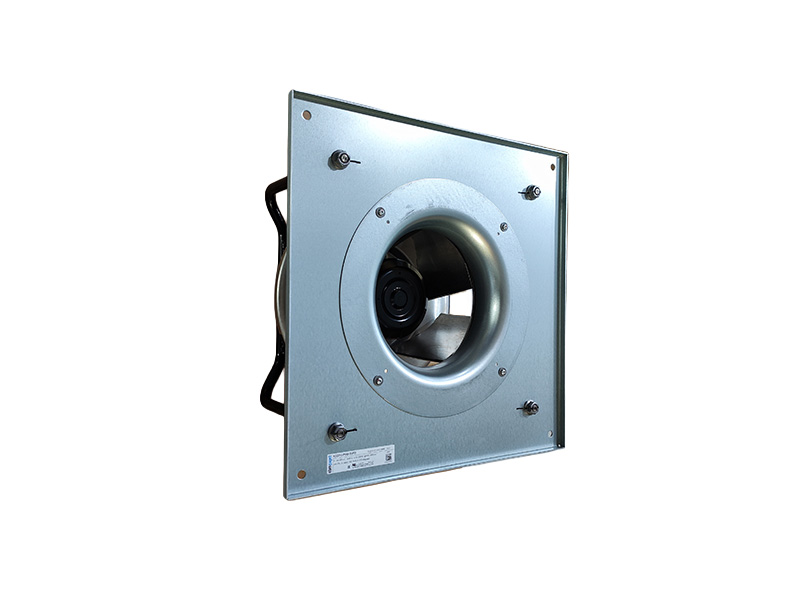
The K3G310-PV69-03 combines a 310 mm impeller with an IP55 protection level and Modbus / 0–10 V control — three separately documented properties that a specification should record on separate lines.
Voltage range as a qualification item, not a formality
Voltage notation in EC fan documentation carries three pieces of information at once: phase, nominal band, and the operating window the electronics are rated for. The prefix before the tilde indicates the supply type. A rating written as 3~380–480 VAC describes a three-phase fan; a rating written as 1~200–277 VAC describes a single-phase fan. Mixing the two within one bill of materials is a common consequence of copying line items between projects.
Three-phase 3~380–480 VAC is the dominant band in data center and process cooling equipment. The K3G310-PV69-03 carries it with a 310 mm impeller, and the documentation notes that this supply range covers the voltage levels used by HVAC and CRAC units — which is precisely the reason the band is so common in that equipment class. The K3G310-PH58-02 shares the band at 2,950 W and 4.6 A. The K3G500-PB33-01 shares it at 5,700 W and 9.0 A and an ErP operating point of 10,945 m³/h at 1,245 Pa. Higher on the same architecture, the K3G450-PB29-L1 is rated 3~380–480 VAC at 6,800 W, 10.3 A and 2,800 rpm, with an ErP point of 9,035 m³/h at 1,749 Pa, Modbus V6.3 control and a vibration sensor.
The band also appears on the larger air-moving platforms. The R3G630-FB32-03, a 630 mm RadiCal unit for large CRAH, AHU and fan wall duty, is rated 3~380–480 VAC at 3,300 W and 5.1 A, with IP55 protection, Modbus or 0–10 V speed control, soft start and electronic protection. The K3G560-FA28-03 is rated in the same band at 3,950 W and 6.0 A, with an ErP point of 11,970 m³/h at 831 Pa and an IP55 rating for dust and water resistance.
Single-phase 1~200–277 VAC serves a different segment. The R3G355-AM14-61 is rated in this band at 350 W and 1.5 A, and the wider voltage window is the reason the model is offered for equipment that cannot supply three-phase power. The R3G225-RE07-03 sits in a narrower single-phase window of 1~200–240 VAC at 170 W and 1.4 A, with an ErP point of 705 m³/h at 458 Pa static pressure and IP54 protection. For cabinets and communications equipment, the supply band moves to DC: the 2218F/2TDH4OR-227 is rated 48 VDC with a 36–72 V input range, and the AxiEco 200 platform (8317081096 / VWLH200CKLXS) is rated at a nominal 48 VDC within a 36–60 VDC supply range.
When a qualification file lists voltage, it should record the phase prefix, the band and the rated current together, and should not extrapolate from the band to an expected current at a different operating point. The datasheet current is a rated value at a defined operating point.
Control interfaces: Modbus, 0–10 V, PWM and stepless speed control
"Supports Modbus" and "is ready for this building management system" are different claims. The first is a product property that can be documented. The second is an integration outcome that depends on a register map, a points list and a commissioning test.
The documented control set across this range covers four methods. Modbus appears on the K3G310-PV69-03, which supports variable speed control through Modbus and 0–10 V inputs, and on the K3G450-PB29-L1, documented at Modbus V6.3. Modbus or 0–10 V as alternatives appear on the R3G630-FB32-03, alongside soft start and integrated electronic protection. 0–10 V / PWM with speed feedback appears on the 2218F/2TDH4OR-227, which supports any mounting orientation and a 36–72 V DC input range. Stepless or EC speed control appears on the K3G500-PB33-01 and on the W3G910-KU25-03, the low-power 910 mm EC axial fan for outdoor heat exchange duty.
The K3G310-PH58-02 is documented with EC speed control and TOP thermal protection. The R3G355-RG56-01 is documented with Modbus and 0–10 V control and integrated PID control. None of these statements should be read as a substitute for a interface specification: a Modbus-capable fan still requires the register list, the supported baud and parity configuration, and the feedback objects a controller will read.
The qualification question to answer in the document is therefore threefold. Which protocol does the specific model document? What feedback does it provide — speed feedback, status, alarm signalling? And which protection features are integrated inside the electronics rather than handled by the panel? Answering only the first question leaves the other two to be discovered during commissioning.
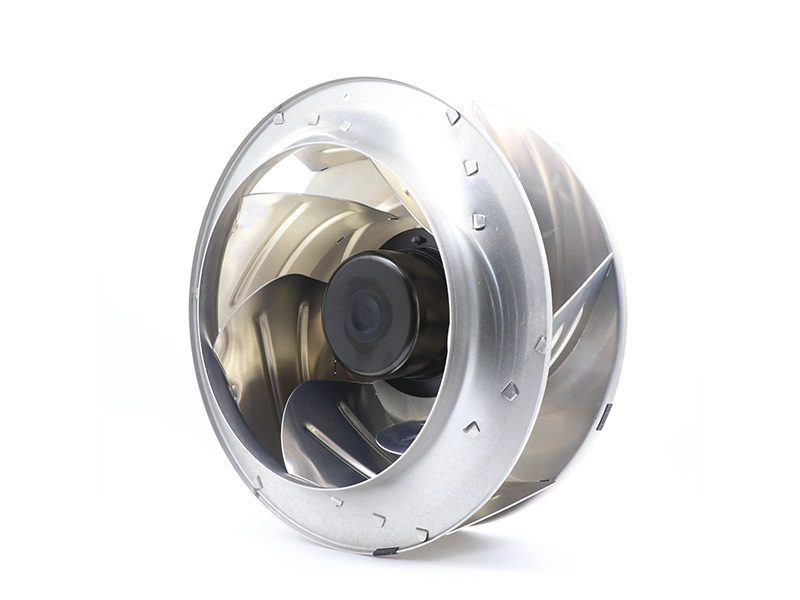
The R3G355-AM14-61 is a single-phase 1~200–277 VAC cleanroom FFU fan whose final protection rating is determined by the complete unit — a standard qualification boundary in FFU builds.
A qualification checklist for procurement documents
The following table converts the three-layer model into lines that can be attached to a purchase specification. Each row is written so that it can be answered with a document rather than an assumption.
| Verification item | What the document must state | Evidence to attach | Frequent failure |
|---|---|---|---|
| Protection level | The IP rating of the supplied module, and whether the final rating of the assembly is determined by the complete unit | Datasheet line plus a note on the assembly | Copying a module rating into an enclosure specification |
| Corrosion classification | Separate classification where relevant to the installation environment (for example H2+C on outdoor heat exchange units) | Datasheet line | Treating IP55 as a corrosion statement |
| Supply characteristics | Phase prefix, voltage band, rated power, rated current, rated speed | Datasheet | Mixing 3~380–480 VAC and 1~200–277 VAC variants in one bill of materials |
| Efficiency reference point | ErP operating point airflow and static pressure, stated as a defined point | Datasheet | Comparing models on maximum airflow instead of the ErP point |
| Control interface | Protocol, signal type and feedback capability for that specific model | Datasheet plus register or points list | Designing a BMS around a protocol the model does not document |
| Authorization | Certificate number, issuing body, validity period and territory | Certificate copy | Presenting a distributor letter as a product certification |
| Model-level coverage | Which models the authorization actually lists | Certificate annex | Assuming an entire portfolio is covered by a certificate that names a subset |
Two rows deserve emphasis because they are the ones most often handled verbally. The first is model-level coverage. The SUNON Distributor Certificate, number TW2025-001198, issued by Sunon Electric Industry Co., Ltd. (Taiwan) and valid from 2025-12-01 to 2026-11-30, covers sales of SUNON brand fans, motors, cooling modules, Fan Tray and related accessories. Its associated documentation names specific models, including the K3G310-PV69-03 EC centrifugal fan for in-row air conditioners and high-static-pressure cabinets, the R3G355-AM14-61 cleanroom FFU and air purification EC centrifugal fan, the K3G450-PB29-L1 high static pressure EC centrifugal fan for data center CRAH/FanGrid units, the R3G500-FA28-03 RadiCal EC centrifugal fan for data center CRAC/AHU units, the K3G450-PA31-03 EC backward-curved centrifugal fan for data center CRAH/AHU units and the W3G800-KU21-05 800 mm EC axial fan for dry coolers and condensers. The Delta 2026 Distributor Authorization Certificate, issued by Delta Electronics Enterprise Management (Shanghai) Co., Ltd. under number FM-MMXXVI 026, likewise covers named models rather than a whole catalogue. The WISTRO Certificate of Exclusive Authorization, number 06.10.26,W, issued by WISTRO Elektro-Mechanik GmbH, applies to a single named model.
The second is territory. The ebmpapst Distributor Authorization Letter applies to North China. The Soler&Palau Certificate of Exclusive Authorization, issued by S&P Sistemas de Ventilación S.L.U. on 2026-01-19, authorizes the holder as official agent for OEM ranges of S&P ventilation products in China. A territory-limited authorization is entirely normal; the failure is presenting it without the territory, which turns a precise document into a vague one.
Where these models are applied, and what that means for the checklist
The same qualification logic applies differently by application, and the application itself determines which specification line carries the most risk.
In-row and precision cooling. The K3G310-PV69-03 and K3G310-PH58-02 both serve in-row air conditioners, precision air conditioners and compact CRAC units, where the 310 mm impeller diameter supports installation in space-constrained equipment. Here the dominant constraint is the ErP operating point against a high system resistance — 4,020 m³/h at 1,583 Pa for the K3G310-PV69-03 and 4,505 m³/h at 1,479 Pa for the K3G310-PH58-02 — combined with the protection level difference between the two.
Data center CRAH, AHU and fan walls. The K3G500-PB33-01, the K3G560-FA28-03, the K3G560-PB31-03, the K3G450-PB29-L1 and the R3G630-FB32-03 all fall into this group, where high static pressure and parallel fan control dominate. The R3G630-FB32-03 documentation notes its suitability for large-scale CRAH, AHU, data center fan walls and ventilation system retrofits.
Cleanroom FFU and air purification. The R3G355-AM14-61 and the R3G225-RE07-03 serve cleanroom FFU/EFU, semiconductor, pharmaceutical and air purification equipment. In this segment, single-phase supply and the final-unit protection boundary drive the documentation requirements.
Dry coolers, condensers and chillers. The W3G800-KU21-05, the W3G800-GV01-01, the W3G800-LV05-03, the W3G910-KU25-03 and the W3G910-LV12-36 form the outdoor heat exchange group, where IP55, corrosion classification up to H2+C and back-pressure capability up to 260 Pa or higher are the defining specification lines.
Cabinet and communications cooling. The 2218F/2TDH4OR-227 and the AxiEco 200 platform cover DC-powered cabinets and compact installations, where the DC input range, mounting orientation flexibility and the listed UL, VDE, CSA and CCC certifications for the AxiEco 200 platform carry more weight than mains-phase characteristics.
Market and regulatory context behind the checklist
The reason this documentation discipline has become more consequential is regulatory. New EU ecodesign rules for industrial fans, Regulation (EU) 2024/1834, apply from 24 July 2026, setting stricter efficiency thresholds for fans rated from 125 W to 500 kW. Once a threshold is defined, the airflow and static pressure point at which efficiency is demonstrated becomes a documentable value rather than a marketing figure — which is why the ErP operating points cited throughout this article exist as discrete data lines.
The market context supports the same direction. Published market analysis places the global EC fans market at USD 3.5 billion in 2024 with a projection to USD 6.7 billion by 2030. On the trade side, China's fan exports under HS code 841459 reached 509 million units totalling USD 3.788 billion in 2024, up 6.96% in value. At manufacturer level, ebm-papst Group reported sales of EUR 2.098 billion for the 2024/25 fiscal year, a 13.1% decrease on the previous year, and Ziehl-Abegg reported 2024 revenue of EUR 893 million, a decline of 7% from EUR 955 million in 2023.
Read together, these figures describe a market where volume supply remains large while manufacturer-side revenue has contracted. In that environment, procurement teams tend to consolidate suppliers and lean more heavily on distribution partners for documentation, availability and matching. Consolidation raises the value of a documented model list; it also raises the cost of an unverified assumption.
EC fans compared with AC fan plus external speed control
The traditional alternative to an EC fan in HVAC and refrigeration equipment is an AC motor-driven fan paired with an external variable frequency drive, transformer or voltage controller. The trade-offs are real in both directions.
On the EC side, the electronics are integrated. That produces documented capabilities that a bare AC fan cannot state on its own: stepless speed control on the K3G500-PB33-01, speed control through Modbus or 0–10 V on the R3G630-FB32-03 together with soft start and electronic protection, integrated PID control on the R3G355-RG56-01, TOP thermal protection on the K3G310-PH58-02, and a vibration sensor on the K3G450-PB29-L1.
The limitations are equally concrete. First, the control interface is fixed by the model. Where a separate drive can be swapped or reconfigured independently of the motor, an EC fan's communication capability is whatever that model documents. Second, the protection rating is a module statement in some cases and an assembly statement in others. The R3G355-AM14-61 states explicitly that the final protection rating is determined by the complete unit, so a project that needs a defined ingress protection outcome has to qualify the housing, not only the fan. Third, protection levels are not uniform across a platform. IP54 on the K3G310-PH58-02 and the R3G355-RG56-01 against IP55 on the K3G310-PV69-03 and the K3G500-PB33-01 means a multi-model bill of materials can contain mixed ratings unless each line is checked. Fourth, very high static pressure requirements exceed what compact low-power models can deliver. A 310 mm unit rated at 4,020 m³/h and 3,050 W cannot be substituted into a duty that a 450 mm unit meets at 9,035 m³/h and 1,749 Pa; the sizing relationship is a hard boundary, not a preference.
A final boundary concerns sourcing rather than engineering. Distributor authorizations are territory-scoped and time-limited. An authorization valid in one region, or expiring within a project's delivery window, changes the documentation position even when the technical specification is unchanged.
Future outlook
Three directions look stable over the next planning cycle. Efficiency regulation will continue to make the ErP operating point a first-class procurement field rather than an appendix item, because a defined threshold requires a defined measurement point. Integration will continue to move toward network control: Modbus, 0–10 V and PWM appear across this range already, and the presence of features such as speed feedback, soft start and vibration sensing indicates that more diagnostic capability is being pushed into the fan module itself. And the single-phase wide-voltage band, represented here by the 1~200–277 VAC rating of the R3G355-AM14-61, addresses retrofit and light-industrial equipment that cannot justify a three-phase supply.
For buyers, the practical implication is that the qualification file becomes the deliverable, not a by-product of the purchase. A model list with protection levels, supply characteristics, control interfaces, ErP points and named authorizations attached is a document that survives contact with a site audit. A quotation without those lines is a starting point, not a compliance position.
Frequently asked questions
Do all EC fans carry an IP rating, and what changes between IP54 and IP55?
Not every EC fan statement is equally specific. Within the models referenced here, K3G310-PV69-03, K3G500-PB33-01, K3G560-FA28-03, R3G630-FB32-03, W3G800-KU21-05 and W3G800-LV05-03 are documented at IP55, while K3G310-PH58-02 and R3G355-RG56-01 are documented at IP54. IP54 and IP55 share the same level of solid-particle protection and differ in the water-protection position, where IP55 provides the higher level of the two. The distinction matters in outdoor and wash-down-adjacent installations, and it cannot be inferred from the model family or the fan diameter.
Can a fan rated 3~380–480 VAC be used on a 400 V supply?
The rating itself describes the supply window the fan is documented for, and a nominal 400 V system falls inside the 380–480 VAC band. The K3G310-PV69-03 documentation notes that its 3~380–480 VAC supply range covers voltage levels used by HVAC and CRAC units, which is the same equipment class in which 400 V systems are common. What should not be inferred from the band is a current value: the rated current stated for a model, such as 4.7 A for the K3G310-PV69-03 or 4.4 A for the W3G800-KU21-05, is a rated figure at a defined operating point, not a maximum across every condition.
Is a distributor authorization certificate the same as a product certification?
No. A distributor authorization documents who may sell a product, in which territory and for which period. The ebmpapst Distributor Authorization Letter, number A50023867, is valid from 2026-01-01 to 2026-12-31 and applies to the North China market. The Soler&Palau Certificate of Exclusive Authorization applies to the China market and authorizes the holder as official agent for OEM ranges of S&P ventilation products. Neither document establishes an IP rating, a voltage range or an efficiency level for a fan. Product properties and commercial authorizations belong on separate lines of a procurement file.
Why do two fans in the same 310 mm platform carry different protection levels?
Protection level is determined by the module's construction and sealing design, not by the impeller diameter. The K3G310-PV69-03 is documented at IP55 with Modbus and 0–10 V control, a 3,050 W rating and an ErP point of 4,020 m³/h at 1,583 Pa. The K3G310-PH58-02 is documented at IP54 with EC speed control and TOP thermal protection, a 2,950 W rating and an ErP point of 4,505 m³/h at 1,479 Pa. Both are 310 mm EC centrifugal fans for in-row and precision cooling applications. Each rating has to be read from its own datasheet line.
What does "final protection rating determined by the complete unit" mean in practice?
It means the fan module's protection level alone does not define the protection level of the finished equipment. The R3G355-AM14-61, a single-phase cleanroom FFU and air purification fan rated 1~200–277 VAC at 350 W, is documented in exactly these terms. A project that requires a defined ingress protection outcome has to qualify the housing or FFU assembly as the rated item, and record the module's own specification as an input to that assembly rather than as the final answer.
What should a procurement document require when a fan supports Modbus?
At minimum, three items: the protocol as documented for that specific model, the feedback the module provides, and which protection functions are handled internally. The K3G310-PV69-03 supports variable speed control through Modbus and 0–10 V inputs. The R3G630-FB32-03 supports Modbus or 0–10 V speed control with soft start and electronic protection. The K3G450-PB29-L1 is documented at Modbus V6.3 and includes a vibration sensor. The 2218F/2TDH4OR-227 uses 0–10 V/PWM control with speed feedback. A register map or points list for the exact model is the evidence that closes the loop between "Modbus-capable" and "integrated into this control system."
Documentation sources and supply context
Beijing Hengrui Hongsheng Mechanical & Electrical Equipment Co., Ltd., trading as Hengrui EC Fan, is a supplier integrating the sale, model selection and matching, and technical service of ventilation, heat dissipation and industrial control electromechanical products. The company was founded in 2011, reports a 100,000 m² facility footprint and approximately 700 employees, and states a 70% export ratio with the USA as a main market. It holds long-term agency and distribution relationships with brands including ebmpapst, Ziehl-Abegg, SANYO, DELTA, SUNON, Rosenberg, WISTRO, SODECA, NMB, ADDA and S&P.
For a compliance file, the relevant part of that profile is the documentation set rather than the profile itself. Authorization letters held include the ebmpapst Distributor Authorization Letter, the SUNON Distributor Certificate, the Soler&Palau Certificate of Exclusive Authorization, the WISTRO Certificate of Exclusive Authorization and the Delta 2026 Distributor Authorization Certificate — each with a stated number, issuing body, validity period and, where applicable, a named model list. Model selection and matching support is relevant to the qualification process described above because matching a fan to a duty point, a control interface and a protection requirement is the step where unverified assumptions are typically introduced. Product documentation is published at https://en.bjhengrui.com.