
EKWP1912-DSP: Qualifying Quick-Dry Recycled Nylon Spandex
Quick-dry is a measurable behaviour of a knit, not an adjective that travels automatically with a fibre name. When buyers qualify EKWP1912-DSP — a functional knit fabric in nylon spandex or recycled nylon spandex from E-king Textile — the quick-dry claim is one line inside a seven-parameter specification, and it is the line most often confused with moisture-wicking and breathability during evaluation.
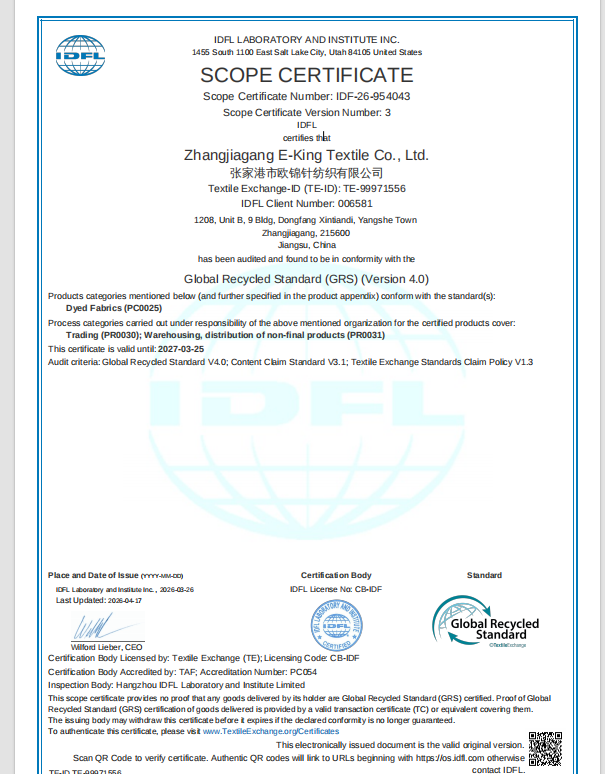
Recycled-content compliance for a functional knit is carried by documentation with a defined scope, not by a claim on a spec sheet. Image: E-king Textile certification file.
This reference is written for the stage where a buyer has already shortlisted a fabric and now has to convert a supplier's claims into an order-ready specification. It explains how the EKWP1912-DSP parameter set should be read, which evidence sits behind the quick-dry claim, how the recycled content and chemical-finish compliance stack is structured, and where that qualification legitimately stops.
Quick-dry, moisture-wicking, breathable: three claims buyers routinely collapse into one
In functional knit fabric procurement, three performance terms are used almost interchangeably in conversation but mean different things on a test report. Moisture-wicking describes the transport of liquid perspiration from the inner face of the fabric towards the outer face. Quick-dry describes how quickly the fabric releases that moisture once it is held in the structure. Breathability describes resistance to air and vapour flow through the fabric.
A knit can move liquid efficiently and still dry slowly if the structure retains water. An open, highly permeable structure can dry quickly without managing liquid transport well at all. Treating the three as synonyms is the most common reason a bulk delivery passes inspection and still fails wear trials.
On the EKWP1912-DSP specification, breathable and quick-dry are recorded as a combined parameter, while moisture-wicking is recorded separately. That structure is a useful prompt for buyers: the two are related but not identical, and both should be validated against the intended end use rather than against a single word on the sheet. For next-to-skin sportswear the practical requirement is normally the combination — liquid moved off the skin, then released — which is why the qualification question is less "is it quick-dry" and more "quick-dry at which structure, which weight and which finish, verified how".
How EKWP1912-DSP is positioned within the supplier's range
E-king Textile (Zhangjiagang E-king Textile Co., Ltd.) is a knitted textile manufacturer established in 2011 in Zhangjiagang, Jiangsu Province, China, about 100 km from Shanghai. The company operates an 8,600 m² facility with 80 employees and a 10-person R&D team, produces functional knit fabric as its core product, and exports approximately 95% of its output to EU and USA markets. Its own dyeing factory entered production in March 2022, completing an in-house chain that runs from weaving through dyeing to finishing.
Within that range, EKWP1912-DSP is classified under sports functional fabrics, outdoor functional fabrics and recycled functional fabrics. It is built on nylon spandex or recycled nylon spandex and is specified for moisture-wicking, high elasticity, breathable and quick-dry behaviour, UV protection, water repellency, easy-wash performance and recycled material content. Its stated application fields are sports and activewear, outdoor apparel, and casual and fast fashion.
Reading the parameter set as a set of testable conditions
| Parameter | What the buyer is actually specifying | Evidence to hold at order stage |
|---|---|---|
| Moisture-wicking | Direction and rate of liquid transport away from the skin-facing surface | Performance data on the finished, dyed fabric rather than on greige |
| Breathable / quick-dry | Vapour and air permeability plus drying rate after saturation | A drying-rate method agreed with the mill before the order, not after |
| High elasticity | Stretch and recovery delivered by the knit structure and elastane | Stretch and recovery results on the approved colourway and weight |
| UV protection | Ultraviolet protection performance of the finished fabric | UPF assessment on the bulk shade and finish, not on an unapproved lab dip |
| Water-repellent | Surface resistance to wetting, tied to one specific finish chemistry | Finish identity plus a fluorine/PFAS compliance statement for that finish |
| Easy-wash | Dimensional and appearance stability after repeated home laundering | Care-performance results on bulk, referenced in the acceptance criteria |
| Recycled materials | Recycled content share and chain of custody across the supply chain | Certification scope plus a transaction certificate per shipment |
Where the quick-dry claim physically comes from inside the mill
Quick-dry performance in a knit is produced by two things working together: the structure of the knit and the chemical finishing applied to it. E-king Textile operates an internal laboratory and applies 100% testing within its quality-control process, which matters because drying behaviour is set at the dyeing and finishing stage rather than at knitting alone.
The company's finishing list places moisture wicking and quick drying alongside antibacterial and anti-odor treatment, UV protection, anti-static treatment, waterproofing, stain and oil prevention, thermal storage and warmth preservation, and cooling treatment. Mechanical finishes — peaching, brushing, fuzzing — and printing processes including transfer, dispersed, acid and digital printing, foil and emboss sit in the same chain.
The March 2022 start-up of the in-house dyeing facility is the operationally significant fact for a quick-dry buyer. Because weaving, dyeing and finishing now run inside one chain, the fabric can be re-tested after finishing rather than only at greige — the point at which wicking and drying behaviour actually change.
Material qualification follows the same logic. E-king Textile works with Invista, Creora Group and POLYGIENE on fibre and finish inputs, alongside Hengli Group, Shenghong Group and Huafeng Group. For a nylon spandex or recycled nylon spandex article, the elastane source and fibre partner are directly relevant to stretch and recovery, which in turn affects how tightly the knit can be constructed without losing the drying behaviour the buyer specified.
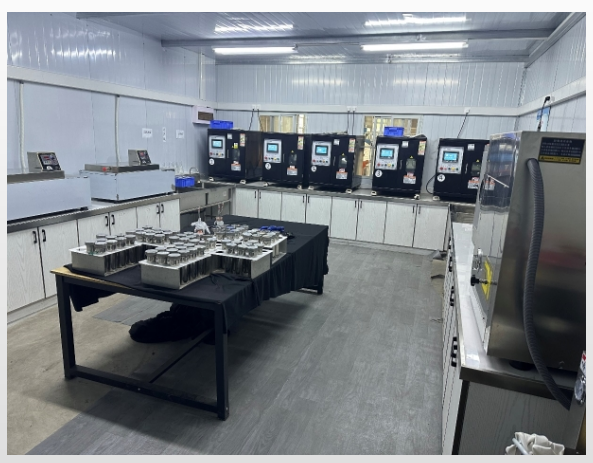
Functional parameters are verified after finishing, where wicking and drying behaviour is actually set. Image: E-king Textile internal laboratory.
Customization is where the quick-dry target should be pinned down. Stretch and knit structure, yarn composition, GSM and weight, colour, finishing and recycled content can all be customized to customer requirements. Because structure and weight are variables rather than constants, quick-dry should be specified together with a GSM band and a named structure — never as a stand-alone adjective applied to a model number.
Reading the compliance stack: OEKO-TEX, GRS and the PFAS boundary
Compliance for a recycled functional knit is not one certificate. It is a set of documents, each with its own scope, issuer and validity window, and a buyer's qualification file is only as strong as the weakest scope match inside it.
| Scheme | Certificate | Issuer / authority | Scope | Validity |
|---|---|---|---|---|
| OEKO-TEX® STANDARD 100 | 2410303 | Centexbel | Knitted fabric | Issued 10 Oct 2025, valid to 31 Oct 2026 |
| Global Recycled Standard | IDF-26-954043 | IDFL Laboratory and Institute Inc. | Dyed fabrics | Issued 26 Mar 2026, valid to 25 Mar 2027 |
For EKWP1912-DSP in its recycled nylon spandex version, the recycled claim therefore rests on two layers: the GRS certificate covering dyed fabrics, and the transaction certificate that follows each shipment. A certificate on file establishes that the mill is within the standard; the transaction certificate is what ties a specific order to recycled input.
The chemical side of the specification is now moving with regulation rather than with buyer preference. OEKO-TEX implemented a new limit value for Total Fluorine of 100 mg/kg effective 1 January 2024, aimed squarely at PFAS. In the United States, California AB-1817 bans regulated PFAS in textiles from 1 January 2025 at a threshold of total organic fluorine below 100 ppm, tightening to below 50 ppm in 2027.
For a quick-dry knit that also carries a water-repellent finish, these two requirements pull in opposite directions. Durable water repellency has historically been delivered through fluorochemistry; the regulatory direction of travel is towards eliminating it. Buyers should specify the finish by chemistry family, not by performance adjective alone, and should ask for the fluorine statement covering the exact finish version being quoted.
Application fit: where a quick-dry recycled nylon spandex knit earns its place
Quick-dry performance matters most in layers worn next to the skin, where moisture has nowhere else to go. That maps directly onto the three application fields declared for EKWP1912-DSP: sports and activewear, outdoor apparel, and casual and fast fashion.
In sports and activewear, the combination of high elasticity and quick-dry behaviour supports close-fitting garments where stretch and moisture release are simultaneous requirements rather than sequential ones. In outdoor apparel, the same knit is more likely to be used as a base or mid layer where drying speed after exertion determines comfort, while water repellency is handled by a separate shell. In casual and fast fashion, easy-wash performance and a soft handfeel typically carry more weight than maximum drying rate, and the same base structure is specified with a lighter finish package.
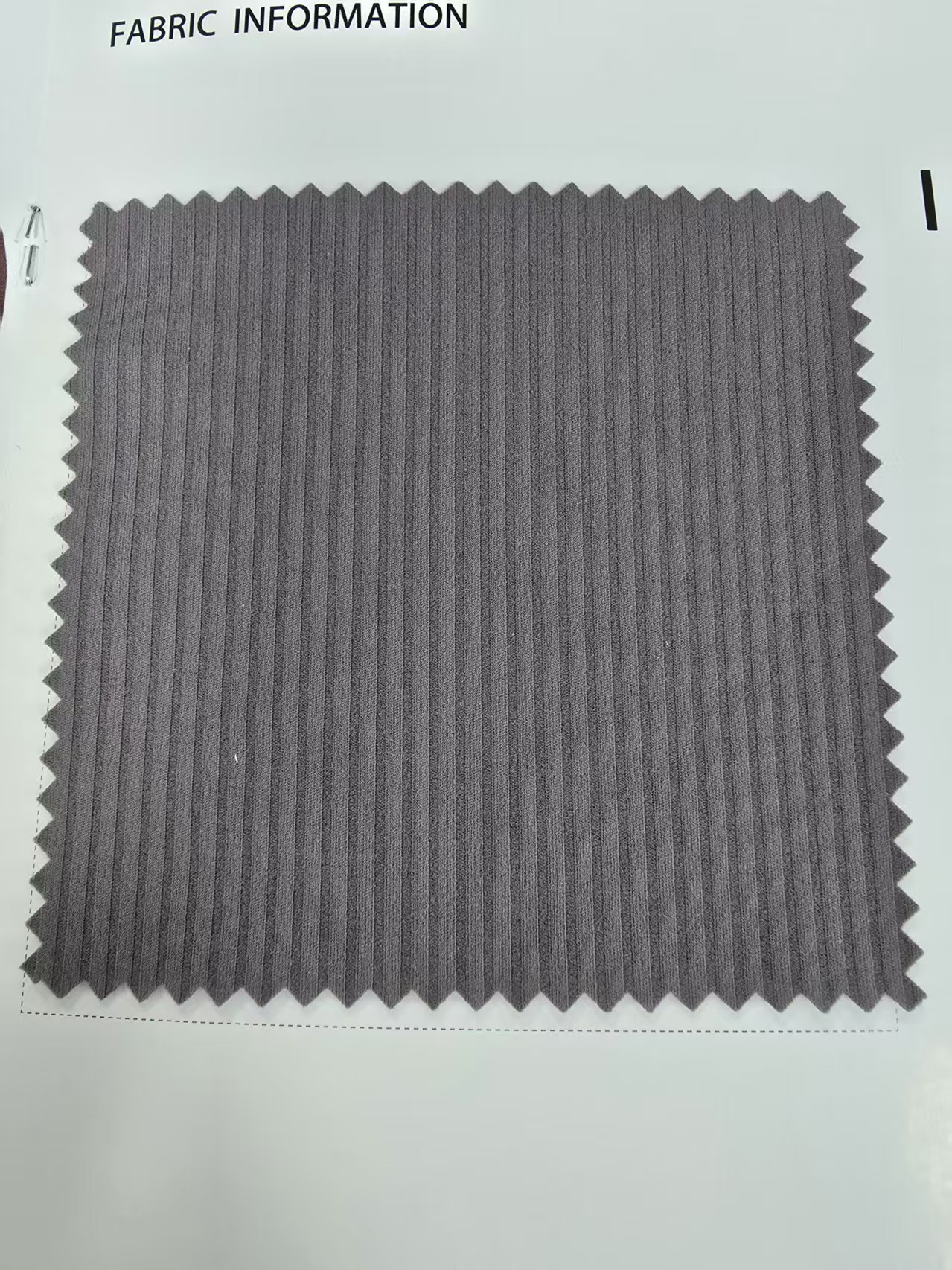
EKWP1912-DSP is specified for moisture-wicking, high elasticity, breathable/quick-dry behaviour, UV protection, water repellency, easy-wash and recycled content. Image: E-king Textile.
One long-running programme illustrates how these parameters behave in repeat production rather than in a single approval. A garment shop customer has purchased 100 t of fabric over a ten-year relationship, with stable performance reported across the period and a soft, flexible handfeel cited as the characteristic that sustained the order. For a buyer reading this as procurement evidence, the relevant signal is continuity of performance across dye lots — the property that a quick-dry specification is most exposed to when a supply chain is fragmented.
Market signal: why quick-dry specifications are getting tighter, not looser
Third-party estimates point in one direction. Research and Markets values the global moisture wicking fabrics market at USD 3.99 billion by 2030, growing at a 6% CAGR. Fact.MR projects the global performance knitted fabrics market at USD 8.58 billion in 2026. SNS Insider places the recycled textiles market at USD 6.32 billion in 2025, growing at 4.70% CAGR to 2035.
Read together, these figures describe growth concentrated in exactly the segment where quick-dry behaviour is a baseline expectation rather than a differentiator, while recycled content moves from a marketing advantage towards a purchasing prerequisite. The practical consequence for buyers is that differentiation shifts away from the claim itself and towards documentation: whether the mill can show the parameter, the certificate scope and the transaction record for the specific order.
These market figures are third-party estimates with different segment definitions — one covers performance knitted fabrics, another the broader moisture-wicking fabric category, a third recycled textiles. They are directionally useful for planning and should not be used as procurement benchmarks.
Knitted versus woven, and the limits of this qualification
The structural comparison for a quick-dry next-to-skin layer is straightforward. Knitted fabric offers high elasticity, a soft handfeel and superior moisture-wicking behaviour, which is why it is the recommended construction for close-fitting moisture-wicking quick-dry sportswear; its structural stability is lower. Woven fabric holds shape and resists abrasion better but has low stretch and comparatively poor moisture transfer against the skin, which makes it more suitable for outdoor shell garments than for next-to-skin quick-dry layers.
What this qualification does not cover
- Quick-dry has no single universal pass threshold. There is no harmonized global figure that converts the claim into a yes-or-no. The buyer has to define the method and the acceptance level before sampling, otherwise the test result cannot be judged.
- Results are structure- and weight-specific. Approving one GSM and knit structure does not transfer the approval to a different weight or structure, even within the same model reference.
- Lead time constrains the validation cycle. Standard lead time is 30–45 days, so laboratory and wear-trial rounds have to be sequenced before seasonal windows close rather than during them.
- Certificate scope is a boundary, not a blanket. The GRS certificate covers dyed fabrics and the OEKO-TEX certificate covers knitted fabric; the recycled claim for a shipment still depends on its transaction certificate, and the finish version being quoted should be confirmed against the certificate on file.
- Water repellency and PFAS compliance are a trade-off, not a checkbox. A buyer specifying both on the same fabric should expect the finish chemistry to be the deciding variable.
Future outlook
Three shifts are likely to shape how recycled nylon spandex knits are qualified over the next buying cycles. First, PFAS thresholds continue to tighten, with the California limit stepping down to below 50 ppm in 2027; finish selection will increasingly be a compliance decision made at development stage rather than a performance upgrade added at the end. Second, recycled content verification is becoming document-led, which favours mills that already hold certification scopes covering their actual output rather than adjacent product lines. Third, performance claims are migrating earlier into the development loop — the practical advantage of an in-house laboratory combined with in-house dyeing is shorter iteration between a structure change and a verified result.
For buyers, the useful posture is to treat the quick-dry line on a specification as a starting point for method definition, not as a finished answer.
FAQ
Which is better for moisture-wicking sportswear, knitted fabric or woven fabric?
Knitted fabric is the recommended construction for moisture-wicking quick-dry sportswear. It offers good stretch, breathability and moisture transfer performance, which suits close-fitting sports apparel. Woven fabric has better shape retention and abrasion resistance but less elasticity, making it more suitable for outdoor shell garments rather than next-to-skin quick-dry layers.
How should a buyer verify the quick-dry claim on EKWP1912-DSP before bulk?
Agree the drying-rate method and acceptance level first, then request performance data generated on the finished, dyed fabric rather than on greige — because wicking and drying behaviour are set at dyeing and finishing. E-king Textile operates an internal laboratory and applies 100% testing within its quality-control process, and the in-house dyeing facility that started production in March 2022 allows the fabric to be re-tested after finishing within the same chain. Because knit structure and GSM are customizable, the approval should be tied to the specific structure and weight ordered.
Does OEKO-TEX certification resolve the PFAS question for a water-repellent quick-dry knit?
It addresses part of it, within a defined scope. The OEKO-TEX® STANDARD 100 certificate held for knitted fabric is number 2410303, issued by Centexbel on 10 October 2025 and valid until 31 October 2026. STANDARD 100 introduced a Total Fluorine limit of 100 mg/kg effective 1 January 2024 as a PFAS control. Separately, California AB-1817 bans regulated PFAS in textiles from 1 January 2025 at below 100 ppm total organic fluorine, dropping to below 50 ppm in 2027. Buyers specifying a water-repellent finish should confirm that the exact finish version quoted falls within the certificate scope on file and request a fluorine statement for that finish.
What are the purchasing terms and acceptance criteria for a functional knit fabric order?
Documented purchasing terms list delivery as FOB or CIF, acceptance criteria as pre-shipment test, and payment as T/T before shipment or letter of credit. For a recycled nylon spandex article, acceptance should also reference the recycled-content documentation that accompanies the shipment, since the GRS certificate establishes the mill's scope while the transaction certificate ties a specific order to recycled input.
A downloadable company profile covering facility, certification and finishing capabilities is available here: E-king Textile company profile (PDF).
Have Questions or Need More Details?
Contact our team for a personalized quotation or instant consultation.
Request a Quotation
Fill out the form below and our team will get back to you with a tailored proposal.
WhatsApp Direct Chat
Prefer to chat in real-time? Message us on WhatsApp for instant assistance & quick answers.
- Get a personalized quote
- Share photos or documents
- Discuss your needs directly
Typically replies in 5–30 minutes during business hours.