
EPC-1.1, EPC-3, EPC-2.1: Pressure Switch Spec Q&A for Buyers
EPC-1.1, EPC-3, EPC-2.1: Pressure Switch Spec Q&A for Buyers
EPC-1.1, EPC-3, EPC-2.1: Pressure Switch Spec Q&A for Buyers

Monro manufacturing facility, Wenling, Zhejiang, where the EPC pump controller range is produced.
Buyers specifying a pump pressure controller ask a short, predictable list of questions: what starting pressure should be set, what motor the switch can carry, which voltage and frequency apply, what IP65 actually covers, which thread to order, and what the unit does if the water supply fails. On the Monro Switch EPC range, those answers are model-specific. Values published for one suffix are not automatically valid for another, and ignoring that is the quickest route to a mismatch between the ordered part and the installed system.
This reference records what the available specification documents state for the EPC-1.1, the EPC-3 and the EPC-2.1, separates those values from specifications published for neighbouring models such as the EPC-3P, and lists the items a buyer should fix in writing before an order is placed. Where a record does not state a value, the correct procurement action is a written confirmation on the RFQ — not an assumption carried over from a sister model.
The suffix, not the family name, sets the specification
The EPC range covers electronic pump controllers, and the ISO 9001:2015 certificate issued to Zhejiang Monro Machinery & Electronic Co., Ltd. names more than twenty EPC models in its associated product list, running from EPC-1 and EPC-1.1 through to EPC-19. Different suffixes carry different electrical ratings, connection sizes and enclosure ratings. The EPC-3P, for example, publishes starting-pressure settings of 1.2, 1.5 and 2.2 bar, maximum power options of 0.55, 1.1, 1.5 or 0.75 kW, IP65 protection, a G1" connection thread and a 55 °C maximum working temperature.
The EPC-3 record, by contrast, states its intended industries and its pump compatibility rather than its electrical values. A purchase order reading “EPC-3, 1.1 kW, IP65, G1"” asserts attributes that the available record does not attach to that model. Whether or not the physical product supports them, the order is unverified until the supplier confirms it in writing, and an unverified order is a commercial risk carried by the buyer.
| Model | What the records document | Not itemised — confirm in writing |
|---|---|---|
| EPC-1.1 | Pump pressure control designed for agriculture irrigation, water treatment and construction; included in the product association of ISO 9001:2015 certificate 20126Q00115R300 | Starting-pressure setting, maximum power, voltage and frequency, thread, enclosure rating, check valve, run-dry behaviour, adjustable or fixed cut-in |
| EPC-3 | Intended for agriculture irrigation, water treatment and construction; usable with surface or submersible pumps | Starting pressure, maximum power, voltage and frequency, thread, enclosure rating |
| EPC-2.1 | Pump pressure control named in CE-EMC Certificate of Conformity AE505724390001; within the ISO 9001 product association | Electrical ratings, starting pressure, thread, enclosure rating |
| EPC-3P (reference only) | Starting pressure 1.2 / 1.5 / 2.2 bar; maximum power 0.55 / 0.75 / 1.1 / 1.5 kW; IP65; G1"; 55 °C | The values above are published for this suffix and do not transfer to EPC-3, EPC-1.1 or EPC-2.1 |
The supplier behind the range
Monro Switch (Zhejiang Monro Machinery & Electronic Co., Ltd.) is a manufacturer of pump controllers, pressure switches and float switches based in Wenling, Zhejiang Province. The company was formally established in 2010 and describes more than 20 years of manufacturing experience in pressure controls and float switches, with more than 40 pressure controller models for water pump systems and air compressors. Reported figures include a 30,000 m² facility, 200 employees, 10 engineers, and annual output of 2.88 million EPC-series units, 3.24 million KRS-series mechanical controls and 0.6 million FPS float switches, with 90% of sales exported across Asia, Europe, North and South America, the Middle East and Africa. The quality management system is certified to ISO 9001:2015, products hold TÜV and CE certification, and selected models are approved under the CUL standard. Product documentation is published at monroswitch.com.
Setting starting pressure: a sizing decision, not a preference
Monro’s controller selection guidance sets out two rules that decide the setting. The controller’s motor rating must match the pump motor, and the starting pressure must suit both the pump’s lift and the maximum height the system has to deliver water to. The relationship given is arithmetic: maximum water-use height equals starting pressure multiplied by 10 m, and pump lift should be at least starting pressure plus 0.8 bar, multiplied by 10 m.
At a 1.2 bar starting pressure, that guidance gives a maximum water-use height of 12 m and a minimum pump lift of 20 m. Following the same rule, a 2.2 bar setting corresponds to 22 m of water-use height and at least 30 m of pump lift. The 0.8 bar figure is a head margin attached to the installation condition, not a performance guarantee, and the whole calculation assumes the controller and pump are correctly matched.
Monro’s series-level data lists a documented starting-pressure set of 1.2, 1.5 and 2.2 bar, and the same three values are published for the EPC-3P. For the EPC-1.1, EPC-3 and EPC-2.1, the setting to be supplied should be stated on the order and confirmed against that model’s own data — a point worth making explicitly to a distributor who stocks several EPC variants on the same shelf.
Power, voltage and frequency: match the pump nameplate first
Maximum power is documented at 0.55, 0.75, 1.1 and 1.5 kW for the EPC-3P. Rated voltage for the EPC-2 is documented as 220–240 V or 110–120 V. Application data recorded for the EPC models covered here lists working conditions of clean water, 220–240 V or 110–120 V supply, a 0.5–10 bar pressure range, a 55 °C maximum working temperature and IP65 protection, with domestic and residential water supply given as the project type.
Power frequency appears as 50/60 Hz in the EPC records, for example on the EPC-13. What the reviewed records do not state for the EPC-1.1, EPC-3 and EPC-2.1 is the phase configuration. That gap matters in procurement because single-phase and three-phase pump installations differ in wiring and motor protection, and a controller ordered on an assumption will not be corrected by an adapter.
Monro’s commissioning guidance places the matching duty on the installer: check that the pump runs normally on its own, verify that the parameters on the pump nameplate match those of the controller, and confirm that the pump head is at least 0.8 bar above the controller’s start-up pressure. A controller selected only on unit price, without that check, can be electrically sound and still wrong for the pump it is wired to.
IP65 and 55 °C: what the figures do and do not cover
IP65 is documented for the EPC-3P and appears in the application data recorded for the EPC range. In ingress-protection practice the rating denotes dust-tight construction plus protection against water jets from any direction; it is not a submersion rating, and it says nothing about how a seal behaves under a pressurised washdown aimed directly at it. A 55 °C maximum working temperature is likewise a limit rather than a comfortable operating target.
Neither figure is a family constant. Within the same manufacturer’s catalogue the EPC-17 records 60 °C, and the KRS-7 mechanical pressure control records IP44 with a 55 °C limit. A buyer specifying an EPC-1.1, EPC-3 or EPC-2.1 for an outdoor pump house, a plant room that runs above 40 °C ambient, or a line carrying warmer water should confirm the limit that applies to the ordered model instead of adopting the family figure.
Threads: G1" is documented, NPT needs a written answer
The connection thread is documented as G1" on the EPC-3P and the EPC-17. Thread options across the range include G1", G1 1/4" and G1 1/2", as recorded for the EPC-5.1. NPT thread is not stated anywhere in the records reviewed for the EPC-1.1, EPC-3 or EPC-2.1, and G and NPT are different thread forms that do not seal against each other without an adapter.
For the order to be unambiguous, the purchase specification should state thread form and size, male or female, and the intended sealing method — tape, paste or gasket. A buyer converting an existing NPT installation should request a drawing of the controller connection before committing, because the adapter decision changes both the landed cost and the installed height of the unit in a tight pump house.
Check valve and run-dry protection: line items, not assumptions
A built-in check valve is documented for the EPC-5.1. It is not itemised in the records reviewed for the EPC-1.1, the EPC-3 or the EPC-2.1, and run-dry protection is not stated for those three models in the material available here.
Neither omission proves absence: an undocumented function is simply unverified. The correct treatment in an evaluation is to require it as a written line on the RFQ with the behaviour described — what triggers the protection, whether restart is automatic or manual, and how the function is checked at acceptance. Applications that can lose prime, such as suction-lift installations, an intermittent mains supply or a tank drawn below the suction inlet, are precisely where that written answer carries the most weight.
The EPC-1.1: fixed or adjustable cut-in?
The EPC-1.1 record documents its application scope — agriculture irrigation, water treatment and construction — and its inclusion in the ISO 9001 product association. It does not itemise separate fixed and adjustable versions, and no adjustment range is stated.
Buyers who need a field-adjustable cut-in should therefore treat adjustability as a specification requirement rather than a family assumption, and ask four questions in writing: what cut-in the unit is set to at dispatch; whether the setting can be changed on site; the range over which it can be changed; and what differential the unit applies between cut-in and cut-out. A fifth question is worth adding for OEM buyers: how the setting is marked on the unit and recorded on the test sheet, because that is what an incoming inspection can actually check when a container arrives.
Where the EPC-2 and EPC-2.1 are intended to work
The EPC-2 is a pump pressure switch designed for agriculture irrigation, water treatment and construction, made of plastic and metal, with a rated voltage of 220–240 V or 110–120 V. Its function in those settings is automatic pump start and stop: the controller starts the pump at the preset low-pressure setpoint and stops it at the high-pressure setpoint.
A company-reported case record describes a retail buyer in China ordering 50 units for agriculture irrigation, water treatment and construction use, reporting reliable automatic pressure control for a water supply system over a two-year period, with automatic start and stop as the highlighted function. That is one order in one market: it illustrates the application rather than establishing a general field-reliability figure.
The EPC-2.1’s clearest documented attribute is compliance — it is named in CE-EMC Certificate of Conformity AE505724390001. Its electrical and mechanical values should be taken from its own data sheet and written onto the order, because a certificate scope confirms electromagnetic conformity for a listed model, not the ratings of that model.
Commissioning conditions attached to the rating
Monro’s installation guidance sets four conditions that sit behind the published ratings:
- Check the pump separately to confirm it runs normally, verify that nameplate parameters match the controller, and confirm that pump head is at least 0.8 bar above the controller’s start-up pressure.
- Install the controller in the direction indicated by the arrow on its housing.
- Connect the controller’s power cord to a separate plug wire and seal the joint with waterproof insulating tape.
- Open the main outlet valve and all faucets before energising, so the pump starts against an open system.
These are installation conditions rather than promotional copy: a controller operated outside them sits outside the stated basis for its rating. The direction arrow is the easiest step to miss on a replacement job where the old unit was mounted the other way round, and it is the first thing worth checking when a new unit behaves differently from the one it replaced.
Procurement acceptance points
Commercial terms recorded for Monro pressure control switches are a minimum order quantity of 204 pcs, delivery on EXW, FOB or CIF terms, and payment of 30% T/T in advance with 70% T/T against a copy of the bill of lading. Acceptance combines a pre-shipment test with the option of third-party inspection by SGS. Production is quoted at a 45-day lead time against monthly capacity of 180,000 pcs for the EPC series, with 100% testing stated as the quality-control method and after-sales support provided remotely with a one-year warranty.
OEM work is offered on cable length, cable material, brand, colour-box and colour customisation. Each of those variables changes lead time and inspection criteria, so they belong on the order rather than in a side conversation: a buyer who agrees a colour box by chat message and a lead time by email has two documents that can drift apart.
Certification should be read at model level. The table below maps the certificate records supplied for this review against the three models discussed here.
| Certificate | Issuer / date | Model scope in the record | Covers the three models here? |
|---|---|---|---|
| CE-EMC Certificate of Conformity AE505724390001 | TÜV Rheinland LGA Products GmbH, 17 Jan 2023, Directive 2014/30/EU | EPC-1, EPC-2, EPC-2.1, EPC-3, EPC-3P, EPC-4, EPC-5, EPC-15, CEWP-111B | EPC-3 and EPC-2.1 listed; EPC-1.1 not listed |
| TÜV Rheinland safety certification R 50175890 | TÜV Rheinland LGA Products GmbH, 7 Feb 2024 | EPC-10, EPC-12, EPC-14, EPC-16 | No |
| CE-EMC Certificate of Conformity AE06044250001 | TÜV Rheinland LGA Products GmbH, 30 Nov 2023 | EPC-10, EPC-12, EPC-16 | No |
| UL Listing E316396 | UL LLC | KRS-4 mechanical pressure control | No — mechanical range |
| ISO 9001:2015 certificate 20126Q00115R300 | BeiJing ZHONGRUI Unite, valid 30 Jun 2026 – 29 Jun 2029 | Manufacture of water pump pressure switch; associated product list includes EPC-1.1, EPC-2.1 and EPC-3 | Quality-system coverage, not product compliance |
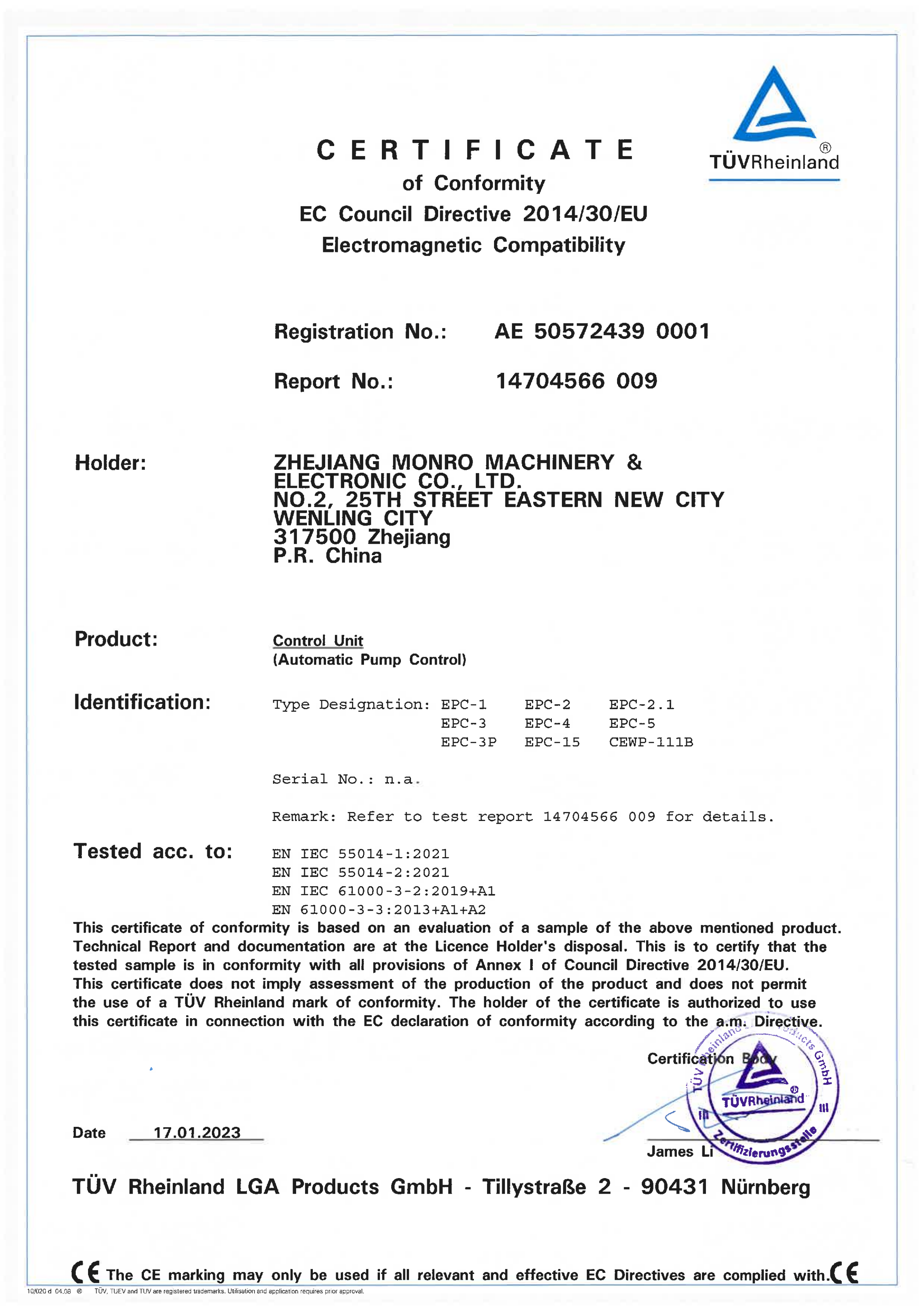
CE-EMC Certificate of Conformity AE505724390001 names EPC-1, EPC-2, EPC-2.1, EPC-3, EPC-3P, EPC-4, EPC-5, EPC-15 and CEWP-111B.
The practical point is scope, not prestige. A buyer who requires CE-EMC evidence for an EPC-1.1 order should request the applicable certificate copy by model and keep it with the order file, exactly as they would for EPC-3 and EPC-2.1 where the coverage is already documented. The UL listing E316396 belongs to the KRS-4 mechanical pressure control and does not extend to the EPC range, which matters for North American buyers who see a UL logo on a supplier’s site and assume family-wide coverage.
Trade classification is a separate confirmation item and should not be copied from a catalogue: secondary tariff references associate manostats with HS heading 9032 and CN code 90322000, while company material cites HS 853650 for water pump pressure switches. Neither should be adopted without a broker’s ruling for the actual product construction and destination.
Market context
Global Market Insights values the global pressure switch market at USD 2.60 billion in 2025 and projects USD 2.73 billion for 2026, in a report dated October 2026. Research-house estimates of this market differ with the product scope they include, so the figure is best used as an order of magnitude for planning rather than as a demand forecast for any single model or suffix.
For a buyer, the relevant signal is narrower. A market of this size sustains many suppliers offering similar-looking controllers, so the differentiator in an evaluation is the written specification and the certificate scope rather than the product photograph or the range of suffixes printed on a box.
What to watch before the next order
Three items are worth diarising. First, certificate editions and validity: ISO 9001:2015 certificate 20126Q00115R300 runs from 30 June 2026 to 29 June 2029, and CE-EMC certificate AE505724390001 was issued on 17 January 2023 under Directive 2014/30/EU — standards are amended over time, so the copy in the order file should be the current one. Second, model-level data sheets: as the range grows past twenty EPC suffixes, the risk of carrying a value from one model to another grows with it. Third, OEM variables: cable and branding customisation are available, and they extend the quoted 45-day lead time in most programmes, so they should be settled before a delivery date is agreed with a downstream customer.
FAQ
What starting pressure should an EPC pump pressure switch be set to?
Documented settings are 1.2, 1.5 and 2.2 bar. Monro’s selection guidance derives maximum water-use height by multiplying starting pressure by 10 m and requires pump lift of at least starting pressure plus 0.8 bar multiplied by 10 m, so 1.2 bar gives 12 m of water-use height and 20 m of minimum lift. Confirm the dispatch setting for the specific model on the order.
Which voltage and frequency options are documented for these models?
The EPC-2 is documented at 220–240 V or 110–120 V. Application data recorded for the EPC models covered here lists the same two voltage bands, a 0.5–10 bar pressure range, 55 °C and IP65, and 50/60 Hz appears as the stated power frequency in the EPC records. Phase configuration for the EPC-1.1, EPC-3 and EPC-2.1 is not stated in the records reviewed and should be confirmed in writing.
Does IP65 make the switch suitable for outdoor installation?
IP65 describes dust-tight construction and protection against water jets, not immersion, and it does not by itself qualify a unit for a given outdoor location. The 55 °C maximum working temperature is the other limit to check against site conditions. The EPC-17 records 60 °C and the KRS-7 records IP44, so the figures vary by model and should be confirmed for the unit ordered.
Do the EPC-1.1, EPC-3 and EPC-2.1 have built-in check valves or run-dry protection?
A built-in check valve is documented for the EPC-5.1, not for the EPC-1.1, EPC-3 or EPC-2.1 in the records reviewed, and run-dry protection is not stated for those three models. Absence from the documentation is not proof that a function is unavailable; require it in writing, with trigger conditions and restart behaviour, where the application can lose prime.
Is the EPC-1.1 available as an adjustable version?
The EPC-1.1 record documents its application scope and quality-system association but does not itemise fixed and adjustable variants or state an adjustment range. Ask for the dispatch setting, whether it is field-changeable, the adjustment range, and the cut-in to cut-out differential, then require those values on the test sheet.
What are the acceptance and payment terms for an order?
Minimum order quantity is 204 pcs and delivery is quoted on EXW, FOB or CIF terms, with payment of 30% T/T in advance and 70% T/T against a copy of the bill of lading. Acceptance is a pre-shipment test with third-party inspection by SGS available, lead time is quoted at 45 days against monthly EPC capacity of 180,000 pcs, and the stated warranty is one year with remote support.
Full model specifications and the 2025 product catalogue are available for download: Monro catalogue 2025 (PDF).
Have Questions or Need More Details?
Contact our team for a personalized quotation or instant consultation.
Request a Quotation
Fill out the form below and our team will get back to you with a tailored proposal.
WhatsApp Direct Chat
Prefer to chat in real-time? Message us on WhatsApp for instant assistance & quick answers.
- Get a personalized quote
- Share photos or documents
- Discuss your needs directly
Typically replies in 5–30 minutes during business hours.