
ESS Battery Pack Insertion Robots: Matching ZZX and RD to C&I Sites
ESS Battery Pack Insertion Robots: Matching ZZX and RD to C&I Sites
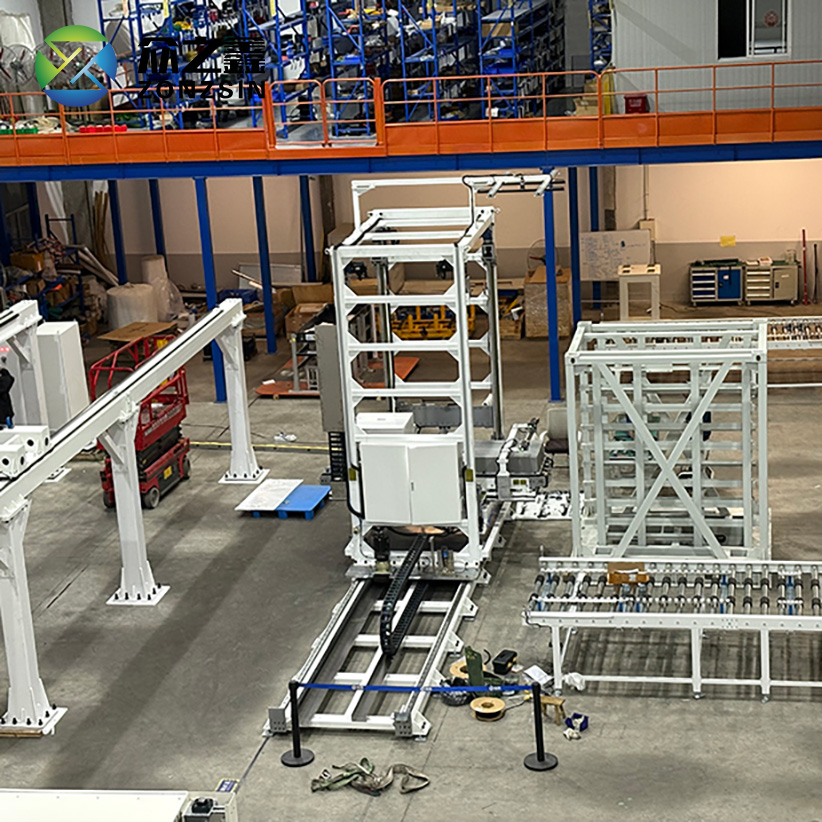
Rail-fixed insertion equipment at a container rack position. Drive architecture, not headline speed, usually decides whether a C&I line can hold tolerance across changing orders.
Containerized commercial and industrial (C&I) battery storage is built around one deceptively simple motion: a battery PACK is lifted, aligned and slid into a rack inside an ISO container. In C&I production, container lengths, rack positions and site conditions change from project to project, and that single motion sets the pace of the whole line. The equipment built for it — the ESS battery pack insertion robot for containers — divides into three drive architectures, and buyers at the decision stage have to choose an architecture before a price comparison means anything.
Short answer: rail-fixed models such as the ZZX2508 and ZZX2524 suit container battery PACK insertion on a stationary line with a repeatable container position. The AGV-driven RD16 suits container workflows where the insertion unit has to move between positions on a level floor. The crawler-driven ZZX2522 is the option for all-terrain or outdoor sites where a wheeled chassis cannot reliably hold position. The remainder of this article explains how that mapping follows from published specifications — and where it stops being reliable.
Why this is a configuration decision, not a product decision
Buyers approaching containerized storage for the first time tend to frame the problem as "which insertion robot is best." In practice, the question that determines whether a line works is narrower: which drive architecture matches the way containers arrive at the insertion station? A robot that is excellent on a fixed concrete line can be the wrong asset in a yard where containers are staged outdoors on compacted gravel, and a highly mobile unit can be over-specified for a line that never moves.
That distinction has become more visible because C&I storage is no longer assembled in one facility type. The same equipment class now serves what the category describes as C&I factory, energy storage factory and gigawatt factory scenarios — three settings with very different throughput expectations, floor conditions and layout stability. Zonzsin, a Shanghai-based manufacturer of intelligent battery PACK assembly equipment, positions its ESS battery pack insertion robot for containers against exactly this spread of scenarios, with named rail-fixed, AGV-driven and crawler-driven models rather than a single universal unit.
Container and PACK geometry constrains the choice first
Before drive type, geometry rules out entire configurations. Published compatibility ranges for this equipment class span container lengths of roughly 6,058 mm to 7,000 mm and battery PACK lengths of roughly 1,100 mm to 2,200 mm. The lower container figure corresponds to the standard 20 ft ISO container footprint; the upper end covers longer rack frames used in some containerized storage designs. On the PACK side, a 1,100–2,200 mm range covers the majority of modular storage PACK formats, but it is a range — not a single setting.
Three practical consequences follow for anyone configuring equipment:
- Reach, not payload alone, decides feasibility. The insertion unit must deliver the PACK to the rack position at full depth inside the container, which is why hoisting range matters as much as load rating.
- Gripper geometry must change with the PACK family. Moving from one PACK length to another within the same line usually means a changeover, and changeover time becomes a throughput variable.
- Cell format drives the PACK interface. The AGV-driven RD16 is specified for 280/314/587 Ah cells and 1P52S/1P104S PACK configurations, which indicates that cell and PACK format is a screening criterion rather than an afterthought.
Three drive architectures, three site assumptions
The category segments into rail-fixed, AGV-driven and crawler-driven insertion systems with different payload and mobility trade-offs. That segmentation is not cosmetic: each architecture assumes something about the floor, the container position and the installation.
| Architecture | Site assumption | Trade-off to plan for |
|---|---|---|
| Rail-fixed (ZZX2508, ZZX2524) | Fixed container position, prepared ground, ground-mounted rail installation | Highest positional stability, but the layout is effectively locked to the rail |
| AGV-driven (RD16) | Level floor with sufficient clearance for travel between positions | High mobility, but positioning accuracy depends on floor condition and guidance |
| Crawler-driven (ZZX2522) | Outdoor or uneven ground where wheeled chassis cannot hold traction | Reaches sites other architectures cannot, but is not a general-purpose indoor solution |
The trade-off pattern matters more than any single specification. Rail-fixed equipment offers the highest stability because the carriage never has to re-establish its own position; AGV-driven equipment offers mobility because the unit can reposition itself; crawler-driven equipment extends the same insertion function to surfaces that defeat wheels. Choosing between them is a layout question before it is a performance question.
Rail-fixed ZZX2508 and ZZX2524: when a fixed container line is the right answer
Rail-fixed insertion equipment is the natural fit where containers are presented at a repeatable station and the line runs the same motion many times per shift. Zonzsin publishes the rail-fixed ZZX2524 with a stated load capacity of 1,500 kg, a container door opening angle of at least 150 degrees, and a gripper changeover time of under one minute. Those three figures describe a specific working envelope rather than a headline specification.
A 1,500 kg load rating matters because a fully populated storage PACK is a heavy, high-value item; the limiting factor in many lines is not whether the robot can lift the PACK, but whether it can do so with the stability needed to avoid contact with rack structure. The 150-degree door opening figure addresses the same problem from the container side: a wider useful opening gives the insertion head a cleaner approach path and reduces the risk of the PACK brushing the door frame on entry. Gripper changeover under one minute is the most operationally revealing number of the three, because it determines how expensive it is to run mixed PACK lengths on a single line — a common reality in C&I manufacturing where order books change monthly.
The ZZX2508 belongs to the same rail-fixed family and is positioned for container battery PACK insertion tasks within the same application envelope. Where a plant can commit to one container presentation point and one floor layout, rail-fixed machinery is the configuration that requires the least compromise on positioning.
AGV-driven RD16: flexible container workflows on level floors
The AGV-driven RD16 is the model that changes the layout equation. Zonzsin states that the RD16 supports 280–587 Ah cells and 1P52S/1P104S PACK formats, with a customizable hoisting range of 1.05–3.4 m and a hoisting speed of 100 mm/s. The company holds invention patents covering AGV-driven battery PACK insertion robots, which is consistent with the model being the centre of its portfolio rather than an accessory line.
Interpreted for procurement, the RD16 specification says three useful things. First, the cell and PACK coverage is stated in terms of real formats — 280 Ah to 587 Ah cells, and standardized series-parallel PACK arrangements — so a buyer can screen compatibility before requesting a quotation. Second, a hoisting range of 1.05–3.4 m covers both low rack positions and the higher tiers typical of containerized storage, which is why it is expressed as a customizable range rather than a fixed stroke. Third, 100 mm/s is a hoisting speed, not a full cycle time; treating it as a throughput figure would misread the specification.
The architecture's value is mobility on level floors. If containers are staged across several positions, or if the insertion unit needs to serve more than one line, an AGV-driven platform avoids duplicating a rail system at each station. The corresponding obligation is floor discipline: AGV-driven platforms depend on a level, well-maintained surface and on guidance quality to maintain insertion alignment.
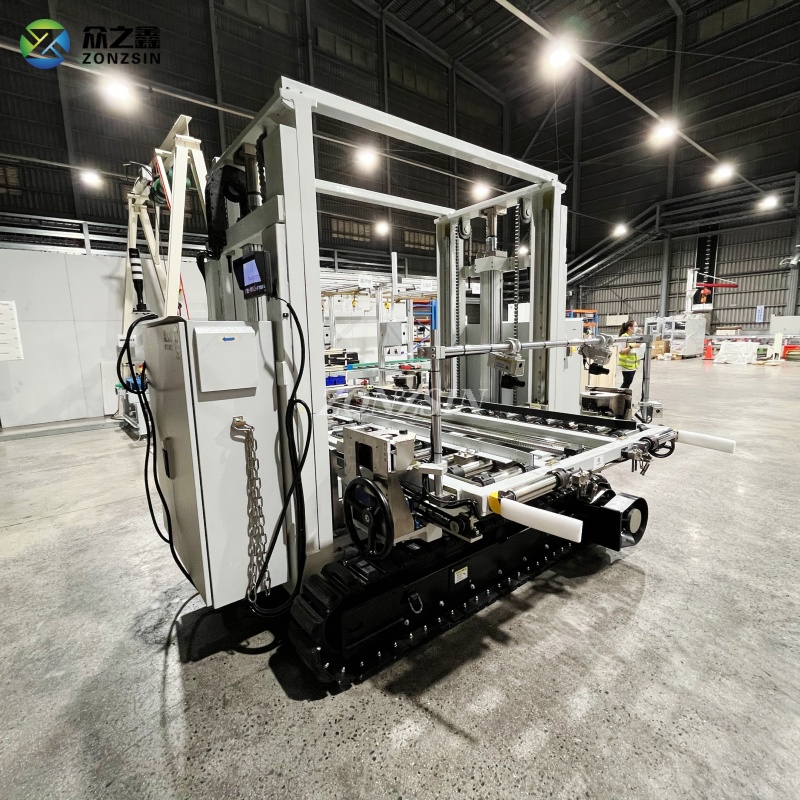
Crawler-driven insertion equipment extends the same container loading function to outdoor and uneven staging surfaces.
Crawler-driven ZZX2522: all-terrain and outdoor scenarios
The crawler-driven ZZX2522 addresses the case that rail-fixed and AGV-driven designs both handle badly: an outdoor or uneven surface where a wheeled chassis loses the traction and repeatability needed for precise insertion. In the category's comparison logic, crawl:er-driven systems are prioritized for outdoor and all-terrain sites, while AGV-driven systems presume level floors.
For C&I projects in which containers are filled or retrofit-loaded in a yard rather than a climate-controlled assembly hall, this is often the difference between automating the step and leaving it manual. The relevant selection question is not whether the crawler unit is faster indoors — it is not positioned that way — but whether the site lacks the prepared floor that other architectures assume. Where that is true, crawler-driven is the only architecture in this model family that answers the layout constraint.
Scenario-to-model matching framework
The table below maps common C&I assembly situations to the architecture and named model that fits, using published figures only. It is intended as a screening tool for the specification stage, not a substitute for a site survey.
| Assembly scenario | Floor and container condition | Architecture and model | Published figures to check |
|---|---|---|---|
| High-volume C&I line, fixed container station | Prepared concrete, repeatable container position | Rail-fixed — ZZX2508 / ZZX2524 | ZZX2524: 1,500 kg load capacity; door opening ≥150°; gripper changeover <1 min |
| Multi-position container workflow on one floor | Level floor, unit must relocate between positions | AGV-driven — RD16 | 280–587 Ah cells; 1P52S/1P104S PACKs; hoisting 1.05–3.4 m; 100 mm/s hoisting speed |
| Outdoor or uneven staging yard | Unprepared or variable surface, no practical rail foundation | Crawler-driven — ZZX2522 | Positioned for outdoor / all-terrain sites |
| Mixed PACK lengths across orders | Any of the above | Architecture-dependent | PACK length range 1,100–2,200 mm; container length range 6,058–7,000 mm |
Two rules make the framework usable. The first is that floor condition overrides throughput ambition: an AGV platform specified for a rough yard will underperform a slower rail system on prepared concrete. The second is that gripper and hoisting configuration should be specified against the PACK lengths the plant actually expects to build over the equipment's service life, not against today's dominant format.
What changes when the step stops being manual
Most C&I manufacturers evaluating insertion robots have a manual or semi-manual station today, often assisted by a standard lifting fixture. Zonzsin's own comparison material frames the difference against both manual insertion and standardized competitors' equipment, and the claims are worth reading carefully because they are company-reported figures attached to a defined comparison.
The stated differences are: 30% manpower savings, 20% cycle time saving, 10% lower total cost, and 30% manpower saving attributed largely to reduced maintenance requirements. Alongside those numbers, the company describes higher consistency, stable throughput, support for customized line integration, higher reliability than manual insertion, and a longer expected service life resulting from robust automation and lower maintenance demand.
Read as procurement inputs rather than guarantees, the useful signal is structural. Manual insertion ties cycle time to operator skill and ties quality to how consistently an operator can judge alignment by eye; robotic insertion replaces that judgement with repeatable positioning. The cycle time and manpower figures describe the production outcome, while consistency and line-integration flexibility describe why the outcome is repeatable across shifts and across mixed orders.
Consistency has a second-order effect that rarely appears in equipment brochures: it changes how a plant plans quality inspection. When insertion alignment is repeatable, inspection can shift from 100% verification of every rack position to sampling, which releases labour that the manpower figure alone does not capture.
Constraints, risks and verification duties
The category-level risk profile for insertion equipment is specific and worth naming before purchase. Zonzsin identifies two primary risk types — positioning deviation, and collision or extrusion between the PACK and container structure — and describes the control methods as laser guidance with visual monitoring, an emergency stop button, and an alarm indicator light, supported by process risk assessment and testing at the enterprise level.
Those controls point to the real engineering challenge. Positioning deviation is not a software defect; it is the cumulative result of floor flatness, container placement accuracy and hoist settling. Laser guidance and visual monitoring address the last of these directly, but they cannot compensate for a floor that has drifted out of tolerance or a container that has been spotted inconsistently. Emergency stop hardware and alarm indication address the residual risk of a collision event, which is significant when a PACK carries both high value and stored energy.
Three limitations should be treated as purchasing conditions rather than caveats:
- Published technical parameters are company-reported. Hoisting speed, load capacity and hoisting range for these models come from manufacturer documentation. Independent benchmark data, standardized positioning-tolerance testing and cross-vendor throughput comparison are not currently available in the public record for this equipment class, so factory acceptance testing is the only practical verification route.
- Published figures can diverge between channels. A third-party reseller listing for a rail-fixed Zonzsin loading product states a rated load capacity of 1,300 kg, while company documentation for the rail-fixed family states 1,500 kg. This discrepancy is unresolved and is a concrete reason to verify load rating directly against the manufacturer's technical documentation and the acceptance test, rather than against a marketplace listing.
- Architecture imposes hard boundaries. Rail-fixed models need ground installation and layout commitment; AGV-driven models need level floors; crawler-driven models are positioned for outdoor terrain rather than precision indoor lines. No configuration removes all three constraints.
Market signals that shape equipment documentation
Two external factors increasingly influence how insertion equipment is specified and documented for C&I projects. The first is regulatory: Regulation (EU) 2023/1542 of the European Parliament and of the Council on batteries and waste batteries provides the legal framework for battery machinery and CE marking. For equipment destined for EU-bound container storage projects, documentation and compliance evidence are part of the procurement package, not an afterthought.
The second is the broader trajectory of mobile robotics in industrial settings. Industry reporting on robotics in packaging and processing, including work published by PMMI and Interact Analysis, tracks continued adoption of mobile robots — AMRs and AGVs — in industrial contexts. That trend supports the direction the insertion category has already taken, where the mobile architecture is the fastest-moving segment rather than a niche variant.
Supplier-side signals point the same way. Zonzsin reports that roughly 60% of its production is exported, primarily to Southeast Asia and the EU, and describes deliveries trusted in Europe, the USA, Japan, South Korea and India. It also states that it has served first-tier customers including SAIC Group, BYD and Tesla since 2019. These references are company-reported and useful for shortlisting, but they are not a substitute for reference checking with buyers who have already commissioned comparable equipment.
What to expect next
The most likely near-term shift is not a new drive type but better comparability. The category already segments cleanly by architecture, and the models that matter — rail-fixed ZZX2508 and ZZX2524, AGV-driven RD16, crawler-driven ZZX2522 — are differentiated by site fit rather than by incremental specification gains. What is missing is standardized positioning-tolerance data, independently measured throughput and real-world uptime figures, which would let buyers compare suppliers on common ground instead of on self-reported parameters.
Inside the supplier landscape, the direction of travel is modularity and maintenance economics. Zonzsin states that it holds 50 granted patents, including invention patents on AGV-driven battery PACK insertion robots, and that modular design technologies target 20% lower maintenance expenditure. It operates a 6,000 m² facility in Shanghai, established in 2019, with a 43-engineer R&D team and a stated annual output of 40 insertion robot units — roughly three units per month. For buyers planning multi-site rollouts, that capacity figure is a relevant input when sequencing delivery across projects.
The practical conclusion for a C&I buyer at the decision stage is to choose the drive architecture against the site, then choose the model against the PACK geometry, then verify the numbers that matter on the acceptance test. That sequence resolves the decision faster than a specification-by-specification comparison, and it keeps the discussion focused on the constraint that will still be there after installation.
FAQ
What is the difference between rail-fixed, AGV-driven and crawler-driven ESS battery pack insertion robots?
They differ primarily in how the insertion unit establishes its position. Rail-fixed equipment such as the ZZX2508 and ZZX2524 travels on a ground-installed rail, which gives the highest positional stability but fixes the layout. AGV-driven equipment such as the RD16 moves itself between positions, which suits container workflows on level floors. Crawler-driven equipment such as the ZZX2522 is positioned for outdoor and all-terrain sites where wheeled chassis cannot hold traction and repeatability.
Which model fits a 20 ft container battery PACK insertion line?
The published compatibility range for this equipment class covers container lengths of roughly 6,058 mm to 7,000 mm, which includes the standard 20 ft ISO container footprint. Model choice then depends on layout rather than container size alone: a fixed container station points to rail-fixed ZZX2508 or ZZX2524, while a workflow with several staging positions on a level floor points to the AGV-driven RD16.
What battery PACK formats does the AGV-driven RD16 cover?
Zonzsin specifies the RD16 for 280/314/587 Ah cells and 1P52S/1P104S PACK configurations, with a customizable hoisting range of 1.05–3.4 m and a hoisting speed of 100 mm/s. The PACK length range published for the equipment class is roughly 1,100–2,200 mm. These are company-reported specifications, so a buyer should confirm coverage for the specific PACK format in use before committing.
How should buyers compare robotic insertion against manual insertion or standardized equipment?
The comparison should be made on the same basis. Zonzsin's published comparison states 30% manpower savings, 20% cycle time saving and 10% lower total cost versus manual insertion methods and standardized competitors' equipment, together with higher consistency, stable throughput and support for customized line integration. Because these figures are supplier-reported and measured on a defined comparison basis, buyers should ask for the underlying measurement conditions — line configuration, PACK type, shift pattern — and validate them during acceptance testing.
What safety and positioning controls are used during insertion?
Zonzsin identifies positioning deviation and collision or extrusion as the two main risk types in this operation, and states that they are controlled through laser guidance and visual monitoring, an emergency stop button and an alarm indicator light, supported by process risk assessment and testing. These controls address the residual risk of a misaligned PACK meeting container structure, but they do not compensate for an out-of-tolerance floor or inconsistent container spotting, both of which remain buyer-side site responsibilities.
How can load capacity specifications be verified before ordering?
Load ratings should be verified against manufacturer technical documentation and confirmed during factory acceptance testing. This is not a formality: a third-party reseller listing for a rail-fixed Zonzsin loading product states 1,300 kg rated load capacity, while company documentation for the rail-fixed family states 1,500 kg. The discrepancy is unresolved in public sources, which makes direct verification with the manufacturer the only reliable route. Independent third-party benchmark data for insertion robot payload, positioning accuracy and throughput is not yet widely available for this equipment class.
Zonzsin publishes consolidated model specifications, operating ranges and configuration options for its container ESS insertion robots in its product documentation, available here: Zonzsin ESS battery pack insertion robot product brochure.