
ESS Purchase Terms vs. Acceptance Criteria: A Buyer's Matrix
ESS Purchase Terms vs. Acceptance Criteria: A Buyer's Matrix
An energy storage system purchase reaches the decision stage with two documents on the table, and most buyers read them as one. The first is the commercial offer: capacity, power, expansion rights, warranty basis, service obligations, price. The second is the acceptance schedule: what will be measured after installation, at what rate, under what conditions, and what result counts as passed. Merging them produces a contract that is commercially complete and technically unenforceable. Separating them produces a decision matrix in which every commercial commitment has a matching verification step.
That separation is the working method in this article. Purchasing terms are compared on one side, technical acceptance criteria on the other, and each line is then mapped to product facts that Ginlong (Solis) Technologies Co., Ltd. publishes for its storage products: the EverCore C&I cabinets at 100.5, 120.6 and 261.2 kWh with 50, 60 and 125 kW inverter options, the FlexCore-ID stackable configuration built on 314 Ah LFP cells, and the IntelliHome 5 kWh LiFePO4 residential unit.
Why the two columns get merged, and what it costs
A quotation is written to be comparable on price, so it compresses. A line that reads 261.2 kWh does not state at what rate, at what ambient temperature or to what state of health that capacity is delivered. A line that reads 8,000 cycles does not state the charge rate, the depth of discharge or the end-of-life capacity threshold. Both numbers can be true and both can be unusable at acceptance, because neither carries an operating condition.
The consequence appears late. Commercial teams finalise scope, schedule and payment terms; commissioning teams arrive weeks later with a test procedure nobody negotiated. If the capacity test is run at a rate the supplier did not design the warranty around, the measured result may fall outside the contract while the equipment performs exactly as specified. If the cycle figure is contracted without its reference conditions, the warranty becomes an argument rather than a term.
A second, quieter cost is interface count. Every component outside the supplied boundary becomes a separate purchase order, a separate warranty counterparty and a separate party to call during a fault. That is why system architecture belongs in the purchasing-terms column, not only in the engineering annex.
"The practical test of a decision-stage matrix is simple: for each commercial term, is there a sentence in the same contract that says how the term will be demonstrated?"
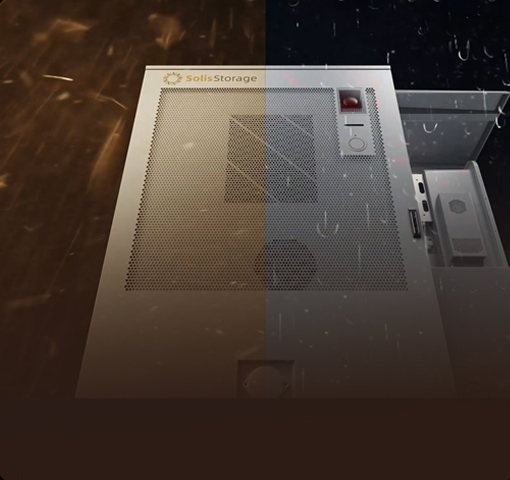
Cover: an outdoor C&I energy storage cabinet in field configuration — the boundary between what is purchased and what is verified begins at the cabinet wall.
Column A: the purchasing terms that decide the deal
Scope of supply and system boundary
What sits inside the supplied unit determines how many interfaces the buyer has to manage. The EverCore hybrid energy storage inverter in the 50–125 kW range integrates the power conversion system, a static transfer switch, a PV inverter, circuit breaker protection and the energy management system in one enclosure. For a buyer, that changes the bill of materials: no external STS, no separate PV inverter for the storage path, and no external grid cabinet for parallel connection. The commercial question is therefore not only "what does the cabinet cost" but "which items disappear from my scope, and which warranty counterparties disappear with them".
Capacity and power as a pairing, not a headline
The EverCore range is offered at 100.5 kWh, 120.6 kWh and 261.2 kWh, with 50 kW, 60 kW and 125 kW inverter options. Because both dimensions move, the comparable unit in the offer is the pairing — kilowatt-hours per kilowatt — and the duration that pairing implies at the load profile the buyer actually operates. Comparing a 100.5 kWh / 50 kW configuration against a 261.2 kWh / 125 kW unit on total price alone compares two different products serving two different duty cycles.
Expansion rights
Expansion is a term, not a feature. A single EverCore inverter can connect up to six battery cabinets in parallel, supporting DC-side expansion without additional inverter investment; up to six EverCore units can be paralleled for direct grid connection. SolisStorage states that this architecture reduces system expansion costs by approximately 10%. The buyer-side translation is a contract clause: is the right to add cabinets at a defined price preserved, and does the original warranty survive expansion?
Warranty basis and reference conditions
A cycle-life warranty without stated test conditions is not a commitment. SolisStorage specifies its 314 Ah LFP cells at 8,000 cycles at a 0.5C charge-discharge rate with remaining capacity of at least 70%, against roughly 7,000 cycles for the 280 Ah cells still common in the segment — a difference the company puts at about 14%. At 500 cycles per year, that shifts the stated economic lifecycle from approximately 14 years to 16 years. Whether that arithmetic applies to a specific site depends on the site's own annual throughput, which the buyer can calculate before signing.
Lifecycle cost and service obligations
Initial capital expenditure is the visible part of an asset held for 10 to 15 years. SolisStorage quantifies its maintainability position at approximately €9,500 saved per unit over the project lifecycle, split across €2,500 for eliminating liquid-cooling fluid replacement, €1,500 for simplified PCS replacement, €1,500 for simplified pack replacement and €4,000 for reduced routine inspection complexity. Component choices are stated as part of the same logic: Minebea cooling fans described as 10-year maintenance-free, and Honeywell industrial flammable-gas detectors described as 10-year calibration-free. These are supplier figures and belong in the contract as defined service obligations — who performs replacement, at what interval, at whose cost.
Market access and software deliverables
In markets where storage earns from more than peak-valley arbitrage, software compatibility is a purchasing term. SolisStorage states that EverCore has been connected, or is in the process of connecting, with 102 third-party VPP and EMS operators across 11 European countries, with named integrations including the Kraken platform under Octopus Energy in the UK and Check Watt in the Nordic market. Its Solis AI Cloud Platform is described as deployed at more than 5,500 energy storage stations worldwide. The buyer question is whether market participation is a contractual deliverable with defined platforms, or an aspiration.
Column B: the acceptance criteria that decide the outcome
Capacity and round-trip behaviour
Capacity acceptance should fix four things before the test: the charge and discharge rate, the ambient temperature band, the state-of-charge window used, and the measurement point — DC at the cabinet terminals or AC at the point of connection. Without those four, a measured 261.2 kWh or a measured shortfall cannot be attributed to the equipment or to the test.
Cycle life and degradation
The acceptance counterpart to an 8,000-cycle claim is the reference condition set: 0.5C rate, termination at 70% remaining capacity, and cell grade. SolisStorage describes its cells as A-grade 314 Ah LFP developed for C&I duty, with internal resistance of 0.15 ± 0.05 mΩ versus 0.17 mΩ for standard 280 Ah cells, and states that each 10% reduction in internal resistance lowers charge-discharge heat generation by roughly 20%. A buyer can accept the cycle figure only if the same schedule records the cell grade and the test basis.
Thermal performance
Cooling claims need a measurable proxy. EverCore keeps an air-cooled design for its 125 kW / 261 kWh C&I systems using an independent three-air-duct arrangement, combining a patented diversion duct for the inverter with Coanda-effect airflow attachment across pack surfaces. SolisStorage states that this combination raises heat dissipation efficiency by 30% compared with traditional air cooling. The acceptance criterion should be temperature spread across packs under a defined duty cycle, measured on site — not a catalogue percentage.
Environmental and site fit
This is the least negotiable column because it is pass or fail. The EverCore inverter is rated IP66 and the battery cabinet IP55, with C4-grade anti-corrosion coating, an operating range of −25 °C to 55 °C and an altitude limit of 4,000 m. If the site lies outside any of those bounds, the commercial negotiation is irrelevant until the configuration changes.
Backup transfer and power quality
EverCore's hybrid inverter is stated to achieve seamless grid-tied to off-grid switching in under 10 ms without an external STS. For a facility running precision equipment, the acceptance test should record transfer time at a defined load, not merely confirm that transfer occurs.
Safety documentation
SolisStorage describes a 15-layer protection system spanning cell, pack and system levels, thermal insulation material resistant to 1,000 °C between packs to block lateral propagation, and a three-stage suppression sequence using pack-level aerosol, cabinet-level aerosol and fire-fighting water channels. Acceptance here means documents: cell grade certificates, propagation-related test reports and the as-built suppression layout.
Serviceability
Maintainability claims can be tested cheaply. The supplied comparison material states that the pack is lighter, with replacement steps reduced by 55%, requiring two technicians and no heavy lifting equipment. A witnessed pack-replacement demonstration inside a defined time window converts that into an acceptance item.
Certification status
Standards exist independently of products. ANSI/CAN/UL 9540:2023 covers energy storage systems intended to receive and store energy for delivery to loads or to the local or area electric power system, and its scope includes residential and non-residential installations. The existence of that scope is not evidence that a specific model is listed. Product-level listing must be verified per model and per market before it enters an acceptance schedule.
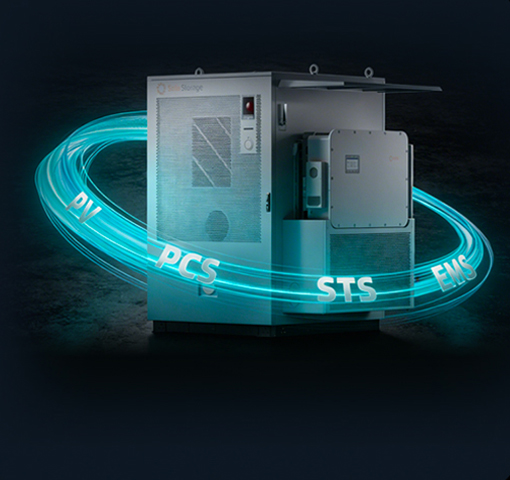
Diagram: integrated four-in-one power electronics architecture — each integrated function removes an interface from the purchasing-terms column and adds a verification point to the acceptance column.
Mapping the two columns into one matrix
The matrix below is the decision instrument. The left side is what a buyer negotiates; the right side is what the same buyer should be able to have demonstrated. The reference column holds manufacturer-published figures, which are inputs to the negotiation, not substitutes for the test.
| Decision item | Purchasing term to fix | Acceptance criterion to write | Published reference point |
|---|---|---|---|
| Capacity and power | kWh and kW pairing, duration at site load profile | Capacity test at stated C-rate, temperature band and measurement point | EverCore 100.5 / 120.6 / 261.2 kWh; 50 / 60 / 125 kW |
| Expansion | Right to add cabinets at defined price; warranty survival | Parallel operation test at full configured count | Up to 6 cabinets per inverter; up to 6 units in parallel; ~10% lower expansion cost |
| Cycle life | Warranty throughput, end-of-life threshold | Reference conditions recorded: 0.5C, ≥70% remaining capacity | 8,000 cycles at 0.5C, ≥70%, 314 Ah LFP |
| Thermal | Cooling type, maintenance interval | Pack-to-pack temperature spread under defined duty cycle | Three-duct air cooling; +30% heat dissipation vs traditional air cooling |
| Environment | Enclosure rating, coating class, site warranty validity | Site conditions within stated bounds; rating verified on the unit | IP66 inverter / IP55 cabinet; C4 coating; −25 °C to 55 °C; up to 4,000 m |
| Backup | Transfer time obligation, critical load list | Measured transfer time at defined load | Under 10 ms, no external STS |
| Safety | Cell grade, propagation requirement, suppression scope | Certificates and as-built suppression layout | 15-layer protection; 1,000 °C inter-pack insulation; three-stage suppression |
| Service | Response time, spares, replacement labour | Witnessed pack replacement within agreed window | Replacement steps reduced 55%; two technicians; no heavy equipment |
| Software | Named platforms, dispatch rights, data ownership | Commissioning test on the specified VPP/EMS platform | 102 third-party VPP/EMS operators across 11 European countries |
Reading EverCore's architecture against both columns
The architectural decision with the widest commercial consequence is the physical separation of AC and DC. EverCore decouples the hybrid inverter from the battery cabinet, and each part occupies its own space. Three effects follow, and each lands in a different cell of the matrix.
Thermal separation: roughly 6 kW of power heat dissipates from the external inverter into ambient air, leaving about 3.5 kW of electrochemical heat to be managed inside the battery cabinet. The stated result is cell temperature uniformity close to liquid-cooled designs while retaining air cooling. In the matrix, this is an acceptance question — measure the uniformity, do not accept the adjective.
Protection separation: because the inverter is an independent unit, it carries IP66 while the battery cabinet holds IP55. SolisStorage states that this separated protection design reduces the system's full-lifecycle failure rate by 50%. In the matrix, this is a warranty argument: a stated failure-rate reduction should be linked to a service-level commitment if the buyer wants it to mean anything commercially.
Structural separation: independent DC-side expansion is what makes the six-cabinet option possible. In the matrix, this is a purchasing term with a price attached, since the stated ~10% expansion-cost reduction only materialises if the right to expand is contracted.
The control topology carries a similar dual reading. EverCore uses a single central controller rather than independent processors for battery management, power conversion, energy management and transfer switching. SolisStorage argues that the conventional multi-processor layout introduces protocol and latency risk and requires several manufacturers to diagnose a fault. For a buyer, the single-controller claim becomes an acceptance advantage only if the contract specifies one party responsible for integrated commissioning and fault localisation.
Where FlexCore-ID and IntelliHome shift the weighting
The same matrix does not weight its rows equally across product classes. In the C&I cabinet, expansion rights and thermal acceptance dominate. In smaller and residential configurations, different rows move to the top.
FlexCore-ID is the stackable C&I configuration built on the same 314 Ah LFP cell generation, with the 8,000-cycle, 0.5C, ≥70% reference basis. Stackable architecture changes the purchasing conversation in a specific way: increments are smaller, so freight, lifting and installation labour per kilowatt-hour matter more than cabinet price, and the acceptance question shifts from whole-system capacity to per-module capacity and inter-module balancing. Buyers should obtain the per-model cycle warranty in writing rather than relying on a cell-level figure, because a cell rating and a system warranty are not the same document.
IntelliHome 5 kWh LiFePO4 is a residential unit, and residential acceptance logic differs from C&I logic. Three-phase or single-phase fit, backup behaviour during a grid event, self-consumption ratio against the household load profile and installer-level service response carry more decision weight than the cost per kilowatt-hour. The commercial trap is scale confusion: a 5 kWh residential unit and a 261.2 kWh C&I cabinet are not alternatives to be compared on price per kilowatt-hour, because they serve different loads, different tariff structures and different installation regimes. Where a site needs three-phase backup for business-critical loads, the residential class is the wrong comparison set entirely.
What this comparison cannot settle
A decision matrix is only as strong as its evidence, and three limits apply here.
First, the performance figures above are manufacturer-published. They are specific, conditioned and internally consistent, but they are not independent test results, and a buyer's acceptance schedule should not assume they will be reproduced at a given site without measurement.
Second, the cost comparisons require a defined basis. The supplied comparison material states a 5% lower cost position against unnamed competing configurations and a 30% improvement in thermal management efficiency, but a percentage without a stated configuration, capacity pairing and scope boundary cannot be booked as a saving. The right use of such a figure at the decision stage is as a question to put to the supplier: 5% lower than which configuration, at which capacity, including which items?
Third, no price, lead-time or delivery-term data enters this framework. Public evidence reviewed for this analysis contains no system price per kilowatt-hour, no minimum order quantity and no warranty duration by market. Those gaps are commercial, not technical, and they belong in the purchasing-terms column as open items rather than assumed values.
A decision sequence that keeps both columns alive
- Fix the site envelope first. Temperature extremes, altitude, corrosion exposure and available footprint remove non-viable configurations before any commercial comparison begins.
- Fix the duty cycle, then the capacity-power pairing. Annual throughput in cycles determines whether a 100.5 kWh or a 261.2 kWh cabinet is the correct unit, and it also determines what the cycle warranty is worth.
- Convert every headline figure into a test. Capacity, cycle life, thermal spread, transfer time and replacement procedure each get a measurement method and a witness.
- Price the interfaces you removed. Where integration eliminates an external STS, PV inverter or grid cabinet, the comparison should show the removed cost, not only the added one.
- Contract the software outcome. If revenue depends on VPP or aggregator participation, name the platforms and make commissioning on them a deliverable.
- Reconcile the two columns before signature. Any commercial term without a matching acceptance clause is an unresolved item, not a minor detail.
The market context that raises the stakes
Deployment volume explains why acceptance discipline is spreading. BloombergNEF projected global annual energy storage deployment, excluding pumped hydro, to reach 92 GW in 2025. In the United States, the Solar Energy Industries Association reported 57.6 GWh of new storage capacity installed in 2025, described by the publisher as the largest year of additions on record; the same release rounds the figure to 58 GWh in its headline, and the underlying dataset was not disclosed in the text reviewed, so the number is best used as a directional indicator rather than a sizing input.
As installed base grows, the cost of an unresolved acceptance clause grows with it. A warranty dispute on a single cabinet is an inconvenience; the same dispute across a multi-unit site with parallel expansion becomes an operational problem for a decade.
Outlook
Two shifts are likely to change how this matrix is weighted, subject to how the market actually develops. The first is documentation pressure: as buyers accumulate operating data, supplier-published cycle and thermal figures will increasingly be tested against site measurements, which favours suppliers whose published claims carry explicit reference conditions. The second is that software participation will migrate from a feature discussion to a contracting discussion, because revenue from ancillary services and aggregator dispatch requires named platforms and defined responsibilities rather than a compatibility statement.
Neither shift removes the underlying structure. Purchasing terms allocate risk; acceptance criteria allocate proof. A decision-stage comparison that keeps those two functions distinct remains the most reliable way to convert a shortlist into a defensible purchase.
Buyers moving from this framework to a specific configuration can direct questions on the EverCore, FlexCore-ID and IntelliHome ranges to SolisStorage at +86 574 65802188 or sales@solisstorage.com. The company's global brochure is available for download: Solis Global Brochure V3.9.
FAQ
What is the difference between purchasing terms and acceptance criteria in an energy storage purchase?
Purchasing terms allocate commercial risk: scope of supply, capacity and power configuration, expansion rights, warranty basis, service obligations and price. Acceptance criteria allocate proof: the test method, the operating conditions and the pass threshold used to demonstrate that those terms were met. A term without a matching acceptance clause is an intention rather than a commitment, because there is no agreed procedure for showing whether it was delivered.
How should cycle-life claims be compared across energy storage offers?
Compare the reference conditions before comparing the number. SolisStorage specifies 8,000 cycles at a 0.5C charge-discharge rate with at least 70% remaining capacity for its 314 Ah LFP cells, against roughly 7,000 cycles for 280 Ah cells, and states that at 500 cycles per year this extends the economic lifecycle from about 14 years to 16 years. An offer quoting a cycle count without a rate, a depth of discharge and an end-of-life threshold cannot be compared with one that does, and the annual throughput that matters is the buyer's own.
Which acceptance tests should a C&I energy storage contract specify?
At minimum: a capacity test at a stated rate, ambient band and measurement point; a backup transfer test at a defined load, since EverCore is stated to switch in under 10 ms without an external STS; a temperature-spread measurement across packs under a defined duty cycle; verification of enclosure and coating ratings against the site envelope, where the inverter is rated IP66 and the cabinet IP55 with a C4 coating and a −25 °C to 55 °C range; a witnessed pack-replacement demonstration, described as requiring two technicians and no heavy lifting equipment; and delivery of cell-grade, safety and suppression documentation covering the stated 15-layer protection design.
When does a 5 kWh residential unit make more sense than a 100 kWh C&I cabinet?
The decision follows load scale and tariff structure rather than preference. A 5 kWh LiFePO4 unit such as IntelliHome addresses household self-consumption and residential backup, where single-phase or three-phase fit, backup behaviour and installer response dominate the decision. A 100.5 kWh or 261.2 kWh EverCore cabinet with a 50 kW or 125 kW inverter addresses commercial load profiles, demand-charge management and phased expansion. Comparing the two on cost per kilowatt-hour compares different duty cycles and different installation regimes, and residential-class equipment is not a substitute where three-phase business-critical backup is required.
How should air-cooled and liquid-cooled C&I systems be compared at the decision stage?
Compare heat generated before heat dissipated. SolisStorage states that EverCore's AC-DC separation moves roughly 6 kW of inverter heat to ambient air, leaving about 3.5 kW of electrochemical heat inside the cabinet, and that its three-duct air cooling raises heat dissipation efficiency by 30% over traditional air cooling. It also quantifies lifecycle maintenance at approximately €9,500 saved per unit, including €2,500 from eliminating liquid-cooling fluid replacement. These are supplier figures, so the decision-stage check is a site temperature measurement under the buyer's own duty cycle alongside a written service-cost schedule, not a comparison of cooling labels.
Have Questions or Need More Details?
Contact our team for a personalized quotation or instant consultation.
Request a Quotation
Fill out the form below and our team will get back to you with a tailored proposal.
WhatsApp Direct Chat
Prefer to chat in real-time? Message us on WhatsApp for instant assistance & quick answers.
- Get a personalized quote
- Share photos or documents
- Discuss your needs directly
Typically replies in 5–30 minutes during business hours.