
ETL or CE? Electric Grill Qualification Paths for BQ1601 and EU Models
Certification marks on an electric grill are usually discussed as one attribute of a supplier. In practice they are an attribute of a model. Inside a single catalogue, a table grill can carry an ETL listing while a stand grill in the same series does not, and both statements can be completely accurate at the same time.
Ningbo Jinchang Electronics Co., Ltd. is a manufacturer of Western-style small household kitchen appliances based at No.17 Guangming East Road, Ditang Sub-district, Yuyao City, Zhejiang Province, China. Founded in 1995, the company operates a 5,500-square-metre production plant, employs approximately 68 staff and reports an annual production capacity of about 1,200,000 units, with roughly 90% of output exported to the EU, USA, Australia and Russia. Its electric grill range covers table BBQ grills, stand BBQ grills and simple BBQ grills. The documented mark sets in that range are not uniform: the BQ1601 and the BQ232-SLTF are listed with CE, GS, LFGB and ETL, while the BQ1703XL-SF, BQ1703XLP-W, BQ1703XLP-SWF, BQ2001, BQ2002, BQ202 and BQ1601-4S are listed with CE, GS, RoHS and LFGB.
The reading that follows is a procurement reading. It describes how the published marks line up by model, market and product category. It is not legal advice, and it does not replace the certificate documents held by the supplier.
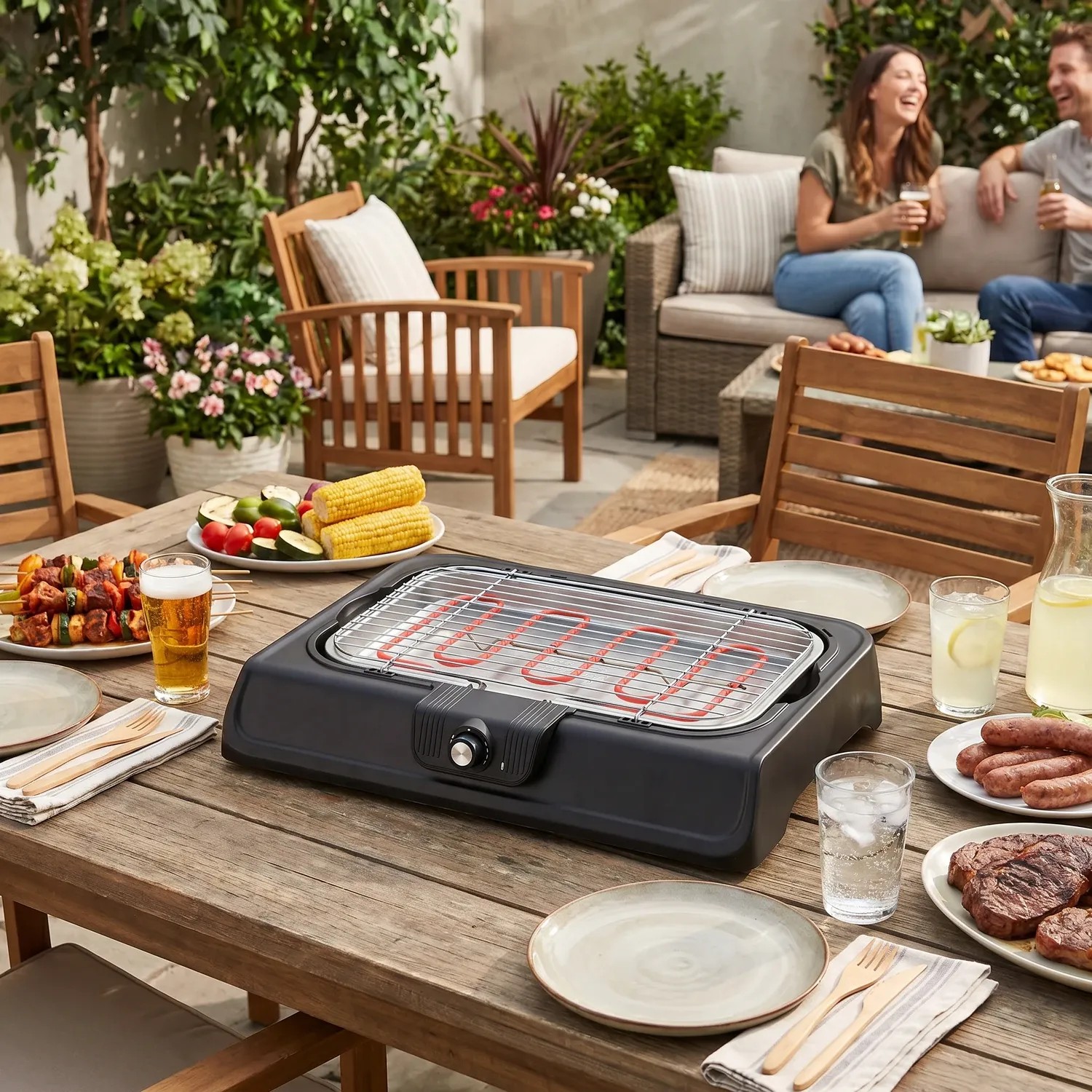
Table BBQ grill configuration: certification scope is read per model and per configuration, not per supplier.
Why a Supplier-Level Certified Statement Breaks Down
Marketing language tends to compress certification into a single claim: the supplier is certified. That claim does not survive contact with a retailer listing form, which asks for a model, a market and a mark. Three separate questions appear at that point — which mark, on which model, for which market — and a supplier-level statement answers none of them.
The same separation applies inside one product family. The BQ1601 is an electric grill with removable plate in the Table BBQ Grill category, rated at 2000W, built with a PP housing, a metal wire rack and a metal heating tube. The BQ1601-4S is a stand BBQ grill with a different construction and a different mark set, even though both model codes begin with the same prefix. Prefixes group products for internal reference; they do not transfer certification.
Category vocabulary creates a similar effect. Terms used across the electric grill market — tabletop electric grill, indoor electric grill, non-stick electric grill, adjustable temperature electric grill, portable electric grill, electric griddle — describe form factor, cooking surface, heat control or use position. They describe the product, not its documentation. A buyer who needs an ETL listing for a North American channel cannot substitute a description of a cooking surface for that listing.
What Each Mark in the List Is Usually Read As
Four of the five marks appearing in this range are European in orientation and one is North American. The table below summarises how they are conventionally read in procurement documents and where each one usually matters.
| Mark | How it is generally read in procurement | Where it usually matters |
|---|---|---|
| CE | Conformity marking used for placing a product on the EU market | EU and EEA listings |
| GS | Voluntary third-party safety mark widely recognised in European retail | European retail and private-label review |
| LFGB | German food-contact requirement for materials that touch food | Plates, racks and other food-contact parts |
| RoHS | Restriction of hazardous substances in electrical and electronic equipment | EU environmental documentation |
| ETL | North American safety listing mark, commonly issued by Intertek | US and Canadian retail channels |
Two external references anchor this product family. IEC 60335-2-9 is the international standard that covers portable electric cooking appliances including grills and roasters, and it is the appliance-level standard buyer questionnaires typically name for this category. For customs and trade documentation, HS code 851660 covers other ovens, cookers, cooking plates, boiling rings, grillers and roasters for domestic use.
One caution before the model tables: the mark sets below are the ones published for each model record. They indicate certification scope and market orientation. They do not describe heating performance, plate durability or cooking results, and they are not a compliance opinion on any individual shipment.
Model-by-Model Mark Evidence in the Jinchang Range
The nine models below are grouped by the category stated in their own product records. Power ratings, cooking surfaces and mark sets are given as published, which makes the differences between neighbouring models visible without interpretation.
| Model | Category | Power | Cooking surface | Listed certifications |
|---|---|---|---|---|
| BQ1601 | Table BBQ Grill | 2000W | Metal wire rack, removable | CE, GS, LFGB, ETL |
| BQ1601-4S | Stand BBQ Grill | 2000W | Wire rack | CE, LFGB, RoHS, GS |
| BQ1703XL-SF | Stand BBQ Grill | 2000-2400W | Wire rack | CE, GS, RoHS, LFGB |
| BQ1703XLP-W | Table BBQ Grill | 1700W | Die-cast aluminium non-stick plate | CE, GS, RoHS, LFGB |
| BQ1703XLP-SWF | Stand BBQ Grill | 1700W | Non-stick aluminium plate | CE, GS, RoHS, LFGB |
| BQ2001 | Simple BBQ Grill | 2000W | Wire rack | CE, GS, RoHS, LFGB |
| BQ2002 | Simple BBQ Grill | 2000W | Wire rack | CE, GS, RoHS, LFGB |
| BQ202 | Simple BBQ Grill | 2400W | Wire rack | CE, GS, RoHS, LFGB |
| BQ232-SLTF | Electric Grill with Non-Stick Plate | 2200W | Aluminium die-cast plate | CE, GS, RoHS, LFGB, ETL |
Two entries in that table carry ETL: the BQ1601 and the BQ232-SLTF. RoHS is listed on eight of the nine models and is not named on the BQ1601, whose published set is CE, GS, LFGB and ETL.
Where the Mark Sets Differ Inside One Range
Three differences are worth isolating, because each one changes what a buyer can assume.
First, ETL is not a range-wide mark. It appears on the BQ1601 and the BQ232-SLTF only. The BQ232-SLTF is a freestanding electric BBQ grill rated at 2200W with a PA housing and an aluminium die-cast non-stick plate; both ETL-bearing models also list CE, GS and LFGB, which keeps them usable for European briefs as well.
Second, two 2000W grills sharing the BQ1601 prefix do not share a mark set. The BQ1601 lists CE, GS, LFGB and ETL. The BQ1601-4S lists CE, LFGB, RoHS and GS. The order of letters does not change the substance, but the composition does: one includes ETL, the other includes RoHS.
Third, RoHS is not universal within the range. It is listed on the BQ1601-4S, BQ1703XL-SF, BQ1703XLP-W, BQ1703XLP-SWF, BQ2001, BQ2002, BQ202 and BQ232-SLTF, while the BQ1601 record names CE, GS, LFGB and ETL. A buyer building one specification sheet for the whole range will lose that distinction immediately.
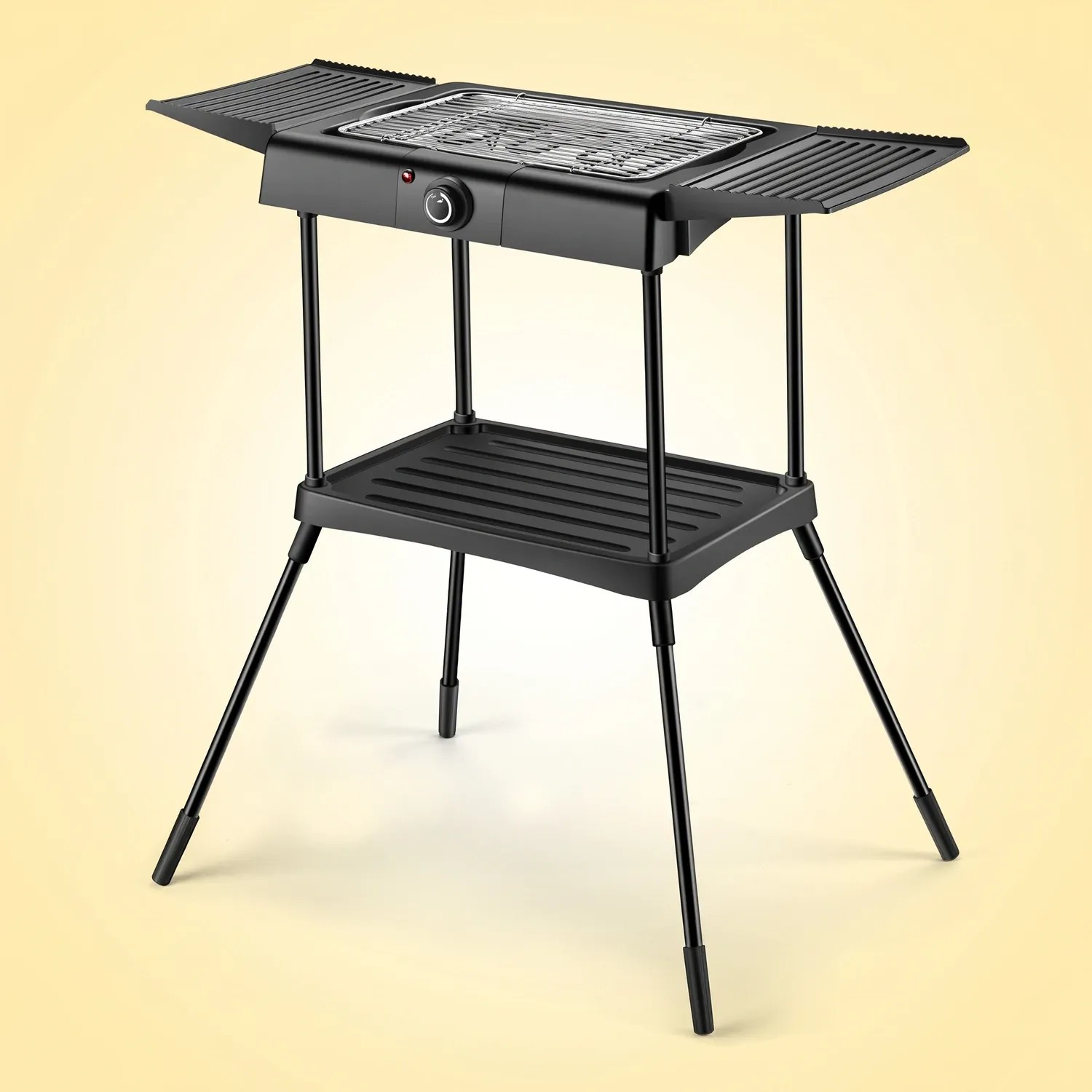
Stand BBQ grill category, BQ1703XL-SF: listed with CE, GS, RoHS and LFGB, with no ETL in the published set.
Reading the Range Against a European Brief
For an EU-facing brief, the common baseline in this range is CE, GS and LFGB, which appear on all nine listed models. CE addresses market access, GS carries weight in retail and private-label review, and LFGB applies where food-contact parts are specified.
The range covers both major plate constructions, so the food-contact reading has to follow the model. The BQ1601 uses a metal wire rack; the BQ1703XLP-W uses a die-cast aluminium non-stick cooking plate with drainage slots; the BQ232-SLTF uses an aluminium die-cast plate under a click-lock domed lid. All three list LFGB, but the parts in question are different.
Project requirements documented for these products reinforce the same reading. Freestanding household electric barbecue projects in Germany, Spain, Brazil and the Netherlands name EU safety and food-contact certifications together with overheat protection. Covered barbecue projects across a wider European market list add thermostat temperature control as a stated requirement. Indoor countertop projects, which cover the BQ2001, BQ2002, BQ202, BQ1601 and BQ1703XLP-W, name EU food-contact certification and overheat protection.
Under that brief, GS and LFGB do more work than they would in a North American conversation, and RoHS becomes a routine environmental document rather than a differentiator. The BQ1601 sits slightly apart: it satisfies the European safety and food-contact reading through CE, GS and LFGB, while its RoHS status is not part of the published set.
Reading the Range Against a North American Brief
Only two models in the published range list ETL: the BQ1601 and the BQ232-SLTF. For a buyer assembling a North American listing from this catalogue, the documented options are a 2000W table grill with a removable wire rack and a 2200W freestanding grill with an aluminium die-cast plate and a domed lid.
RoHS does not substitute for that listing. It is a European environmental mark and appears on the majority of models, including several with no North American listing in the published set. A buyer comparing documents across markets should treat the two mark families as parallel requirements rather than alternatives.
A practical consequence follows. Where a North American channel and a European channel are both planned, the model cannot be chosen on price and power alone. In this range, the two models that list ETL are the ones that answer both documentation paths; the remaining models answer the European reading of the portfolio.
Category Does Not Forecast the Mark Set
The categories used in this range — table BBQ grill, stand BBQ grill, simple BBQ grill and electric grill with non-stick plate — describe form and use position, not certification level.
Table BBQ grills include the BQ1601 with CE, GS, LFGB and ETL, and the BQ1703XLP-W with CE, GS, RoHS and LFGB. Stand BBQ grills include the BQ1703XL-SF, BQ1703XLP-SWF and BQ1601-4S, all listed with CE, GS, RoHS and LFGB and none with ETL. Simple BBQ grills — BQ2001, BQ2002 and BQ202 — share an identical set of CE, GS, RoHS and LFGB. The electric grill with non-stick plate category contains the BQ232-SLTF, the second ETL-bearing model.
Category tells a buyer how the grill is used, how much power it brings and how much cooking area it offers. It does not tell a buyer which marks apply. That information sits one level lower, on the model record itself.
Where the Documented Configurations Are Used
Application data for this range describes intermittent, seasonal household grilling rather than continuous operation, which is consistent with the safety and food-contact framing of the marks.
Freestanding household electric barbecue projects cover backyard, patio and balcony semi-outdoor cooking for family gatherings, grilling meat, skewers, seafood and vegetables, with a power socket and barbecue utensils as matched equipment. Indoor countertop projects cover kitchen and balcony countertop grilling of meat, vegetables and skewers. Covered projects extend use to lid-closed roasting and smoking on patio and backyard settings, with thermostat control named as a requirement.
The destination markets recorded behind those scenarios include Germany, France, Spain, Italy, Portugal, the Netherlands, Austria, Ireland, Poland, Sweden, Denmark, Norway, Brazil, South Africa and the United States. That distribution matches the two mark readings above: European destinations rely on the CE, GS and LFGB baseline, while the United States entry is served by the ETL-bearing models.
Market Signals Behind a Model-Level Reading
The available category data points in the same direction as the mark tables: the certification conversation is regional, not global. Grand View Research valued the global electric grill market at USD 4.6 billion in 2023, with North America holding a 34.5% revenue share in that year. Credence Research places the smokeless grill segment at USD 768 million in 2024, with electric types accounting for 55% of it. Future Market Insights projects more than 42 million households in ASEAN adopting plug-in grills by 2030.
Forecast growth rates for the category differ noticeably between research houses, ranging from roughly 4.4% to roughly 7.9% per year. The gap appears to come from scope definitions — whether electric smokers and tabletop grills are counted, for example — rather than from disagreement about direction.
That methodological split is itself useful for buyers. Category-level numbers describe demand; they rarely map onto the mark sets that decide whether a specific model can be listed in a specific market. A buyer who plans a range from market size alone will still have to open each model record before placing an order.
Certification-Led Sourcing Compared with Traditional Alternatives
Buying an electric grill through a mark-led path differs structurally from buying through traditional alternatives.
A charcoal or gas grill is evaluated against standards built around fuel handling and combustion. A portable electric cooking appliance sits inside IEC 60335-2-9 and is classified under HS code 851660 for trade purposes. The mark conversation therefore organises around an appliance standard plus food-contact and environmental documentation. That makes the checklist more predictable, and at the same time more granular: each model, and each configuration of that model, produces its own documentation line.
The limits of the path are real, and they matter as much as the advantages.
- Marks attach to a model and to its validated configuration. A change to housing material, cooking plate material, heating element or electronic control can move a product outside the configuration that was tested. Sibling models do not inherit one another's marks: the BQ1601-4S sits beside the BQ1601 and lists CE, LFGB, RoHS and GS rather than CE, GS, LFGB and ETL.
- Published mark sets are not certificate documents. They name the marks associated with a model record. They do not contain certificate numbers, issuing bodies, validity dates or test reports, and those remain documents a buyer should request before an order is confirmed.
- Mark coverage does not describe performance. CE, GS, LFGB, RoHS and ETL define conformity scope and market orientation. They say nothing about heat distribution, plate durability, or how a 1700W table grill compares with a 2400W portable model in daily use.
- The broadest assumption is the riskiest one. Applying one mark set to nine models because they share a supplier will eventually place a model in a channel it was not documented for.
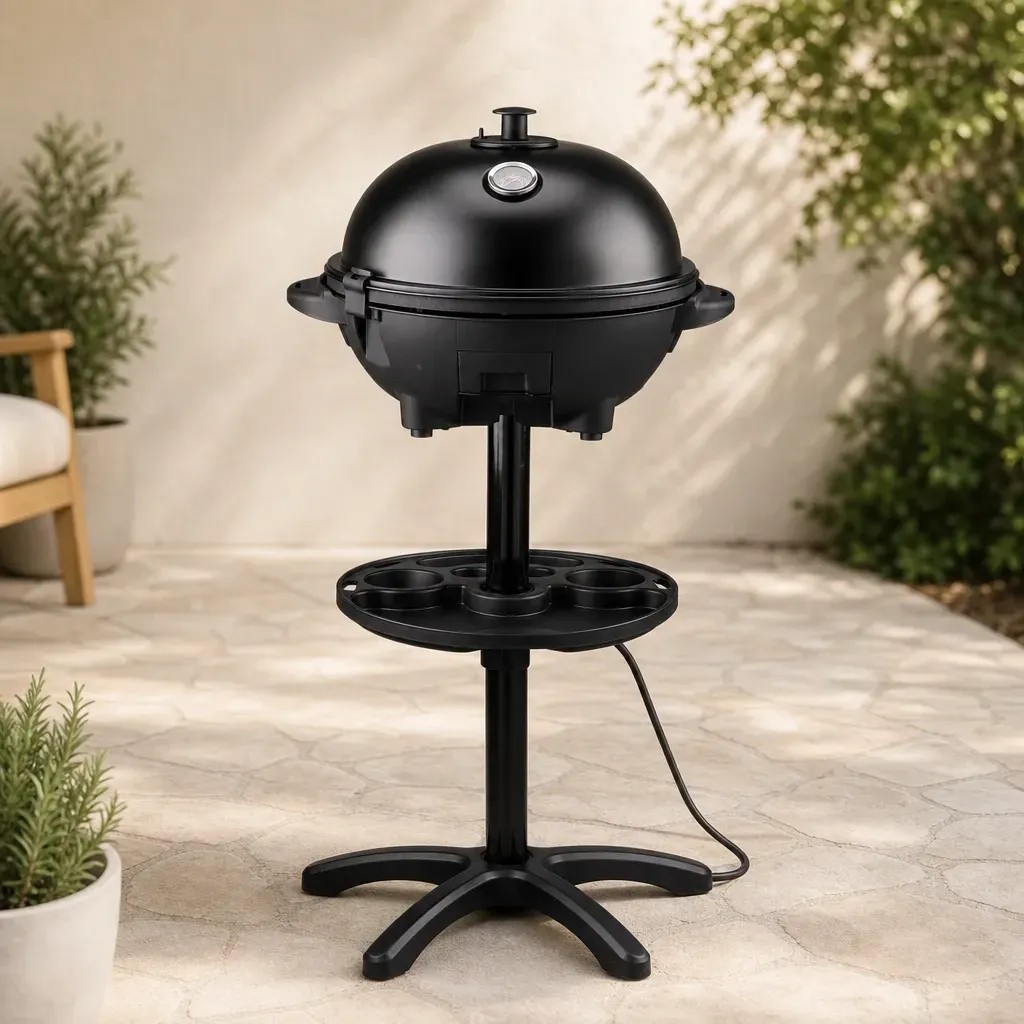
BQ232-SLTF, one of two models in the range listed with ETL alongside CE, GS, RoHS and LFGB.
A Practical Reading Order for a Buyer
The sequence below keeps the reading on the model record, which is where the evidence actually sits.
- Start from the model code rather than the supplier name, and write the code down before opening any catalogue page.
- Read the published mark set for that code. The nine models in this range produce three different compositions.
- Separate the marks by function: CE and GS for electrical safety and market access, LFGB for food-contact parts, RoHS for environmental documentation, ETL for North American listings.
- Match the mark set to the destination market. A model such as the BQ1601 and a model such as the BQ1703XL-SF answer different briefs, even though both are listed with CE, GS and LFGB.
- Confirm that the configuration named on the certificate matches the configuration you intend to order — plate type, housing material and control type.
- Request the full documents, naming the model designation, before placement.
Steps one to four can be completed from published specifications. Steps five and six depend on documents held by the supplier and on the exact configuration of the order.
Future Outlook
Two directions look likely for this category.
The first is more configuration variants. As plug-in grill adoption expands — the ASEAN projection alone points to more than 42 million households by 2030 — suppliers will multiply plate materials, housing options and control types to serve different price points. Each variant is a separate documentation line, which makes model-level mark sets the normal way buyers compare suppliers rather than an exception.
The second is documentation discipline. Buyers increasingly ask for the model designation, the applied standard and the issuing body instead of a general statement of certification. Manufacturers that keep structural R&D, mould development and product testing in house are better placed to answer that pattern, because a configuration change requested by a buyer can be re-evaluated inside the same process. Jinchang, for example, describes in-house structural R&D, mould development and product testing supported by an R&D team of 8 engineers, alongside a portfolio of over 200 product models.
For a range like this one, the practical forecast is that the CE, GS and LFGB baseline will remain the working assumption for European channels, while ETL availability on specific models will continue to decide which codes can be listed in North America.
FAQ
What is the difference between CE and ETL on an electric grill?
CE is the conformity marking used for placing a product on the EU market. ETL is a North American safety listing mark, commonly issued by Intertek. Both can appear on the same model, but not automatically: in this range the BQ1601 lists CE, GS, LFGB and ETL, while the BQ1703XL-SF lists CE, GS, RoHS and LFGB with no ETL entry.
Which electric grill models carry ETL in this range?
Two models list ETL: the BQ1601, a 2000W Table BBQ Grill with a removable metal wire rack, and the BQ232-SLTF, a 2200W freestanding electric BBQ grill with an aluminium die-cast non-stick plate. Both also list CE, GS and LFGB.
Does a CE mark on its own confirm food-contact compliance?
Food-contact requirements are normally documented separately from market-access marking. In this range, LFGB is the mark listed for food-contact performance and it appears on all nine listed models. The parts in contact with food differ by model: the BQ1601 uses a PP housing, metal wire rack and metal heating tube, while the BQ1703XLP-W uses a die-cast aluminium non-stick cooking plate.
Which standard applies to these portable electric grills?
IEC 60335-2-9 is the international standard identified for portable electric cooking appliances including grills and roasters. For trade classification, HS code 851660 covers other ovens, cookers, cooking plates, boiling rings, grillers and roasters for domestic use.
Can one mark set be applied across a whole supplier range?
No. Within this single range the mark sets already differ: the BQ1601 lists CE, GS, LFGB and ETL, the BQ1601-4S lists CE, LFGB, RoHS and GS, and the BQ1703XL-SF lists CE, GS, RoHS and LFGB. Mark sets are read per model, and the model code is the identifier that matters.
How should certification claims be verified before an order?
Ask for documents that name the exact model designation, the configuration covered — plate type, housing material and control type — the standard applied and the issuing body. Where an order changes plate material, housing material or electronic control, confirm whether the existing validation still covers the configuration. This is a documentation step rather than a legal assessment.
This industry reference summarises published certification sets by model for the electric grill range described above and does not constitute legal advice. Buyers should confirm current certification documents against the exact model and configuration before confirming an order.
Have Questions or Need More Details?
Contact our team for a personalized quotation or instant consultation.
Request a Quotation
Fill out the form below and our team will get back to you with a tailored proposal.
WhatsApp Direct Chat
Prefer to chat in real-time? Message us on WhatsApp for instant assistance & quick answers.
- Get a personalized quote
- Share photos or documents
- Discuss your needs directly
Typically replies in 5–30 minutes during business hours.