
EU-Certified Electric Forklifts: A Spec-by-Spec Buyer's Reference
European Market Entry for Electric Forklifts: Certification and Configuration Are the Real Gatekeepers
For logistics and production managers evaluating electric forklifts for European facilities, the first question is rarely about brand preference. It is about whether a given model can legally and safely operate in an EU workplace, and whether its technical specifications match the material flow that will be required of it. Certification and parameters act as the practical constraints that turn a general interest in electric material handling into a specific purchasing decision.
This article examines the CE certification basis of electric forklifts, the specifications that matter in warehouse and industrial settings, and how buyers can interpret these constraints when building a shortlist.
The Procurement Problem: Why Compliance and Parameters Matter More Than Suggested Prices
Electric forklifts have become the dominant power source in several major markets. In North America, electric models accounted for 71% of retail orders in 2024, according to the Industrial Truck Association and Batteries International. In China, electric forklift sales reached 946,300 units in 2025, representing 76.9% of total domestic forklift sales, based on data from the China Construction Machinery Association. The global electric forklift market was valued at USD 53.01 billion in 2024 and is projected to reach USD 94.55 billion by 2032, according to Maximize Market Research.
Yet market growth does not remove the need to verify each machine's compliance and load-handling capability. For EU buyers, the CE marking under the Machinery Directive 2006/42/EC is a legal precondition for placing the equipment on the market. For procurement teams, the relevant standards behind the CE mark determine how safe, reliable, and serviceable the machine will be during its working life.
The key challenge is that many specifications are not easy to compare across manufacturers. Load capacity, battery configuration, controller brand, lifting height, and intended application differ from model to model. This creates a need for a structured reference point, especially when evaluating suppliers that offer customized configurations.
What the CE Mark Covers for Electric Forklifts
The CE marking for self-propelled industrial trucks is not a single test. It is a declaration that the equipment complies with applicable European directives and harmonized standards. For electric forklifts, the relevant directive is the Machinery Directive 2006/42/EC. The harmonized standards commonly cited in this context include:
- EN ISO 12100:2010 – general principles for risk assessment and risk reduction;
- EN 60204-1:2018 – electrical equipment of machines; and
- EN 1175:2020 – safety requirements for industrial trucks, focusing on electrical and electronic systems.
EN 1175:2020 is a current harmonized European standard for the electrical and electronic safety of self-propelled industrial trucks and is a prerequisite of CE marking. It is important that buyers request the specific certificate number and the list of standards applied, rather than accepting a generic claim of CE compliance.
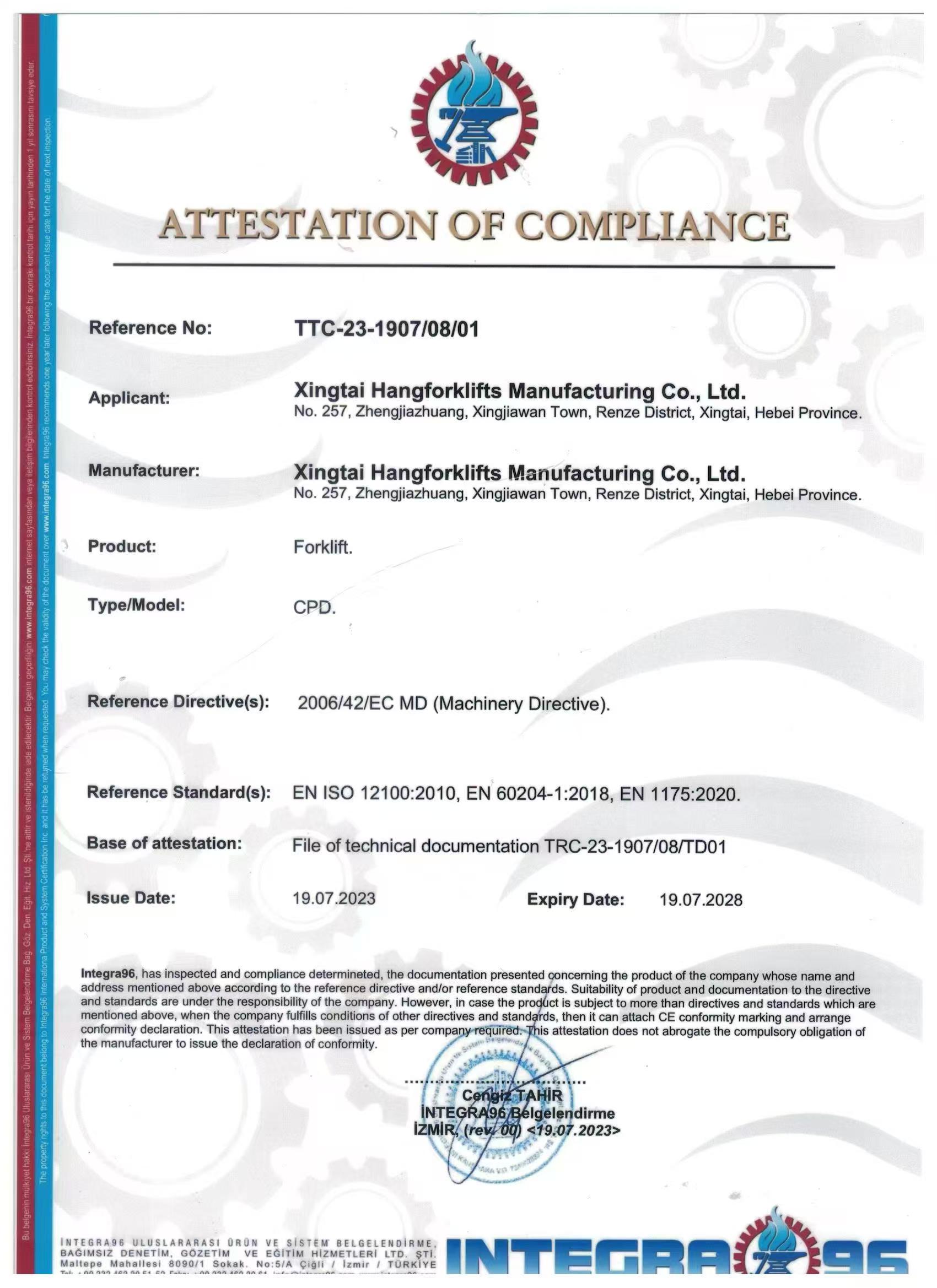
A Verifiable Compliance Baseline: Ningjin Shunhao Trading Co., Ltd.
One example of a manufacturer with an explicit, documented EU compliance baseline is Ningjin Shunhao Trading Co., Ltd., a China-based supplier that operates the Mightlift brand. The company specializes in B2B-focused electric forklifts and provides OEM and ODM customized material handling equipment. It serves global distributors, manufacturing plants, cold-chain enterprises, and warehouse operators.
The company's CPD series electric forklifts hold an Attestation of Compliance for the EU market, issued by INTEGRA96 under certificate number TTC-23-1907/08/01. The certificate is valid from 19 July 2023 to 19 July 2028 and applies to the CPD10 and CPD30 electric forklift models. It confirms conformity with EN ISO 12100:2010, EN 60204-1:2018, and EN 1175:2020 under the Machinery Directive 2006/42/EC.
This level of documented detail is useful for buyers because it allows verification, not just assertion. It also establishes a baseline for what 'CE-compliant' should look like in supplier documentation.
How to Read a CE Attestation for Electric Forklifts
When a supplier presents a CE attestation, buyers should check four elements before treating it as proof:
- The certificate number and issuing authority, which allow cross-verification with the issuing body.
- The list of models explicitly covered by the certificate. A certificate that names only some models does not automatically cover the whole series.
- The harmonized standards cited, because they define the safety scope of the assessment.
- The issue and expiry dates, which confirm that the certification was valid at the time of supply.
In the case of the CPD series, the CE attestation explicitly lists CPD10 and CPD30. Buyers who intend to purchase other models should request documentation covering those specific units.
Technical Specifications That Define the CPD Series
Beyond certification, the operational constraints of electric forklifts are expressed through model-specific parameters. Ningjin Shunhao's CPD series covers load capacities from 1 ton to 3.5 tons, with different drive and control features.
| Model | Rated Load | Drive System | Lifting Height | Controller Options | Battery |
|---|---|---|---|---|---|
| CPD10 | 1000 kg (1 t) | Brushless AC drive & pump motor | Standard mast | SANTROLL, CURTIS, INMOTION, ZAPI | Lead-acid (lithium optional) |
| CPD20 | 2000 kg (2 t) | High-power front dual-drive motors | Standard mast | SANTROLL, CURTIS, INMOTION, ZAPI | Lead-acid (lithium optional) |
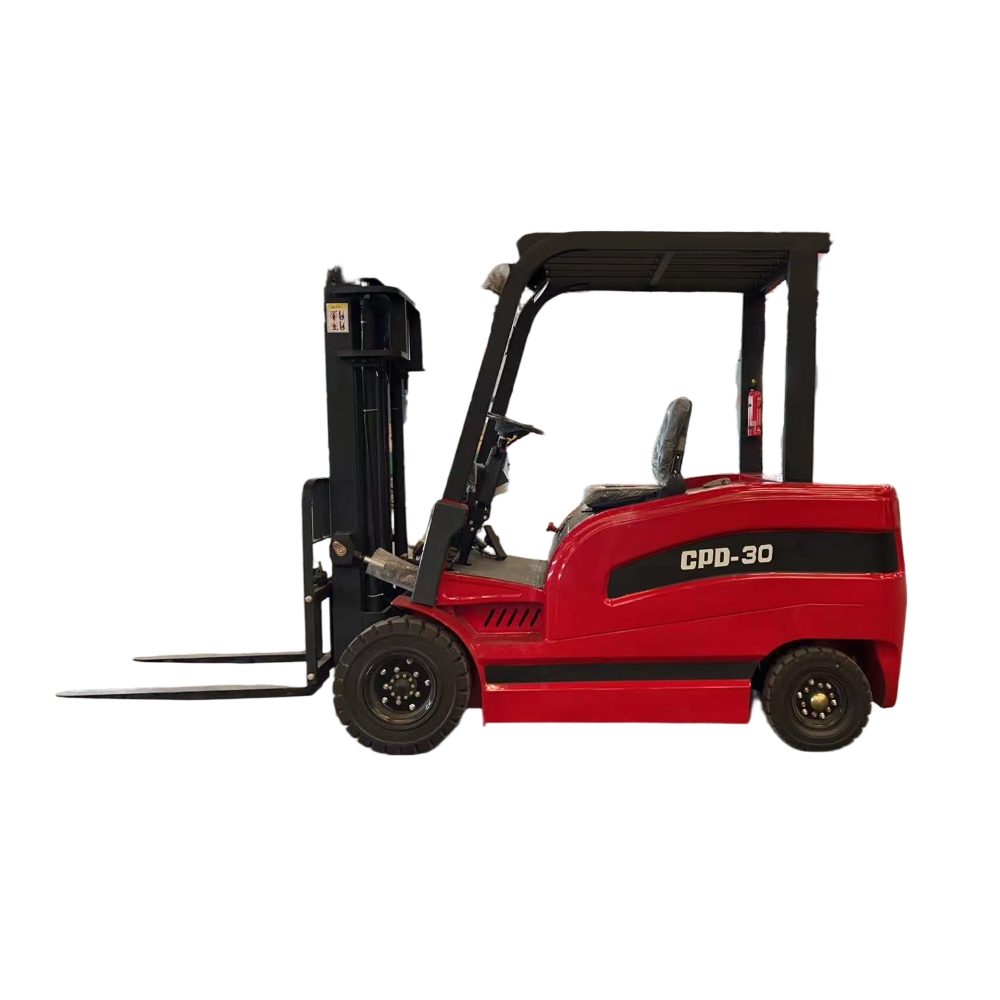
| CPD30 | 3000 kg (3 t) | High-power electric drive / intelligent MOSFET | 3000–7000 mm | SANTROLL, CURTIS, INMOTION, ZAPI | Lead-acid (lithium optional) |
| CPD35 | 3500 kg (3.5 t) | Front-wheel dual-drive motors, P.E.S three-speed efficiency regulation | Standard mast | SANTROLL, CURTIS, INMOTION, ZAPI | Lead-acid (lithium optional) |
From a buyer's perspective, these parameters matter because they determine not only lifting capacity but also how a truck behaves in a given layout, how often it needs to be charged, and how easy it is to service.
Applying Certified Models to Real Working Conditions
Choosing a model requires matching the specification to the operating environment. Two application examples illustrate this:
- Light-duty warehouse fleet deployment: In an indoor pallet receiving, put-away, and dispatch operation on level floors, a CPD10 or CPD20 can move light pallets between docks, staging areas, and storage locations without tailpipe exhaust at the point of use. Buyers should confirm pallet weight, load center, aisle width, mast height, floor capacity, and local charger voltage before selection.
- Heavy-duty material handling: For building materials and heavy industrial goods, a CPD35 with front dual-drive layout and side battery extraction supports heavy-load fleet operation and service access. These machines may run indoor/outdoor mixed routes and can be equipped with loading dock, charging area, fork positioner, side shifter, or approved clamp attachment. Site assessment should cover surface condition, slope, weather exposure, load dimensions, attachment compatibility, and rated residual capacity.
A reported electronics manufacturer application highlights the benefit of removing tailpipe exhaust from enclosed clean production areas. In that case, the user deployed a bulk fleet for component, work-in-process, and finished-goods logistics, and the change improved material-flow efficiency. The exact unit count was not disclosed, but the project demonstrates how an electric fleet configuration can address both environmental and operational requirements.
Market Trends Behind the Shift to Electric Forklifts
Growth in electric forklift adoption is supported by both regulatory incentives and operational economics. Lithium-ion battery adoption in new global forklift shipments reached 35% in 2024, up from 22% in 2021, according to LiTrue Analysis. In cold storage applications operating at temperatures down to -20°C, lithium-ion batteries retain significantly more capacity than lead-acid batteries, which is one factor behind a projected 11.6% CAGR in the food industry segment, according to Mordor Intelligence.
Narrow-aisle electric trucks are also accelerating, with a projected 9.28% CAGR through 2030 as warehouses densify their storage layouts. For buyers, this means that specification choices today are closely tied to the future flexibility of the fleet, especially in high-density operations.
Certified Electric vs. Traditional Electric Forklifts: A Balanced Comparison
A common procurement question is how a modern, efficiently controlled electric forklift compares with a traditional electric forklift. The difference lies in the drive and control architecture, not just in the age of the machine.
A modern configuration with advanced electric drive and intelligent energy management tends to provide faster control response, extended continuous working time, and more efficient energy use. It is a reasonable choice for high-frequency indoor operations, long-hour continuous shifts, cold storage, and intensive stacking work. Its upfront investment is generally higher, but the long-term energy and maintenance profile is more favorable.
A traditional electric forklift with a conventional drive and basic control system requires a lower initial investment but may have shorter effective operation time, higher power consumption, and more frequent maintenance. It suits standard low-to-medium frequency material handling where investment payback is prioritized over endurance and responsiveness.
The same principle appears in battery selection. Opportunity charging of lithium-ion batteries, using 15–30 minute top-ups at intervals throughout a shift, does not degrade cycle life, whereas frequent opportunity charging significantly harms lead-acid battery longevity, according to Toyota Forklifts. Buyers who plan multi-shift operation should therefore evaluate battery type and charging strategy together rather than treating them as separate line items.
One limitation worth noting: not every electric forklift can be used in every environment. For explosive atmospheres, such as chemical workshops, additional conformity under ATEX Directive 2014/34/EU is required within the European Union. A standard CE Mark does not replace that certification. Buyers should confirm whether any special environment classification applies to their facility before finalizing an order.
A Procurement Checklist for EU-Market Electric Forklift Buyers
- Confirm that the supplier holds a valid CE Attestation of Compliance from a recognized body.
- Check the certificate number, issuing authority, issue date, and expiry date.
- Verify that the exact model you intend to buy is explicitly listed on the certificate.
- Compare controller brand options against your local service network.
- Define battery strategy: lead-acid vs lithium, opportunity charging, cold storage requirement.
- Confirm load capacity, load center, and residual capacity with attachments.
- Check lifting height, mast options, and aisle width requirements.
- Assess floor condition, slopes, weather exposure, and charging area layout.
- If the site is an explosive atmosphere, verify ATEX Directive 2014/34/EU compliance separately.
- Review after-sales support, spare parts availability, and full documentation package.
Future Outlook: Compliance as a Foundation for Automation
As smart manufacturing moves forward, the safety of automated industrial trucks is also becoming part of the procurement conversation. ISO 3691-4:2023 provides updated safety requirements for driverless industrial trucks and their systems. While this is not the same as CE certification for manually operated forklifts, it signals that the compliance landscape is expanding toward automation.
Buyers who plan to integrate electric forklifts into sensor-controlled or semi-automated workflows should look for suppliers that can document current certifications and can adapt configurations without breaking conformity. The ability to verify certifications, parameters, and intended use cases will remain a differentiating factor in supplier selection.
Frequently Asked Questions
Which one should I choose between a new 3.0-ton electric forklift and a traditional 3.0-ton electric forklift for warehouse, factory, and logistics operations?
Select based on operation frequency, working hours, and long-term cost budget. A modern 3.0-ton electric forklift with advanced electric drive, intelligent energy management, and optimized vehicle control delivers faster response, longer effective operating time, and lower energy consumption, making it suitable for high-intensity continuous work. A traditional 3.0-ton electric forklift uses conventional drive and a basic control system. It requires lower initial investment but tends to have limited endurance, higher power consumption, and more frequent maintenance, which makes it more appropriate for standard low-to-medium frequency material handling.