
EU Compliance for Self-Adhesive Wall Panels: What to Verify
Construction & Decoration / Compliance Reference
EU Compliance for Self-Adhesive Wall Panels: What to Verify
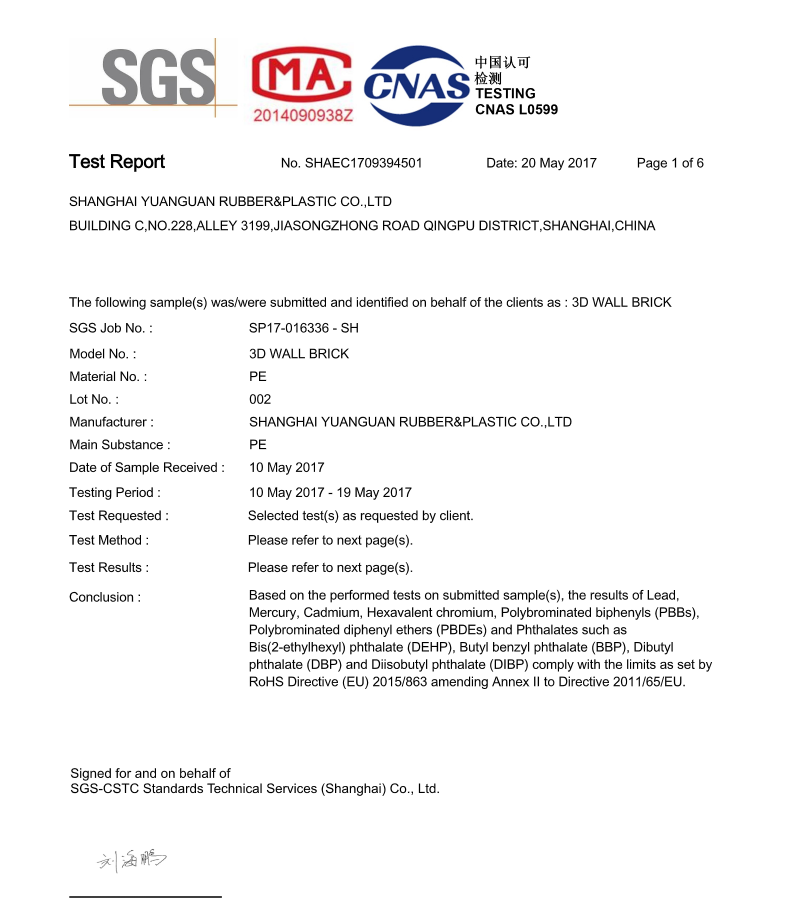
Certificate documentation used in EU-bound decorative wall panel shipments: an SGS RoHS Test Report issued to Shanghai Yuanguan Rubber & Plastic Co., Ltd. for a PE-material 3D wall brick product.
For importers of decorative wall coverings, the useful question is not whether a product is certified, but which documents actually apply to this material, this product category and this shipment. Those are different questions, and the answer changes with the substrate.
Three regulatory layers recur in EU-bound shipments of wall stickers, flooring and wall panels: construction-product requirements commonly grouped under CE-CPR, the REACH hazardous-substance regulation, and PPWR packaging rules. Which of them becomes a live requirement depends on the material and the product category rather than on the marketing name printed on the carton.
This reference explains how material choice (PVC, PET, WPC, PU leather, foam) changes the documentation a buyer should expect, why XPE and IXPE foam must be distinguished before an order is confirmed, and where the scope of an existing certificate ends. It also provides a practical pre-order checklist that can be sent to any supplier, including manufacturers of self-adhesive wall panels such as Shanghai Yuanguan Rubber & Plastic Co., Ltd. and its SXP Wall Panel product line.
Why compliance paperwork became a purchasing filter
EU-bound decorative products are rarely stopped at the border because of their appearance. They are stopped for documentation. Shipments of wall stickers, flooring and wall panels that arrive without valid supporting certificates can face customs detention, return shipment and heavy fines, which is why experienced importers now treat compliance documents as a gate in the sourcing process rather than an attachment added after the invoice.
The comparison that buyers effectively run is between two supply profiles. On one side, complete CE, REACH and MSDS documentation together with PPWR-compliant packaging results in smoother customs clearance and normal retail distribution. On the other side, missing or forged certificates expose the same container to seizure, destruction, detention and return losses. The difference between the two profiles is not a marketing claim; it is the difference between goods that can be sold and goods that become a liability on arrival.
The practical rule that follows is straightforward: verify certificate validity before placing orders for formal EU shipments. Transit shipments to non-EU regions may operate under lighter expectations, but shipping without valid certificates is a risk that stays with the buyer, not with the freight forwarder.
Material and product category determine which documents apply
The same decorative function, covering a wall, can be delivered by materials with different chemical profiles and different documentation requirements. A buyer sourcing a self-adhesive wall panel, a foam wall panel, a PVC wall panel or a WPC wall panel is not sourcing the same evidence package, even when the surface finish looks similar in a catalogue.
| Body material | Typical category in this product range | Documentation focus for EU buyers |
|---|---|---|
| PVC | PVC wall panel, PVC wall sticker, PVC parquet wall sticker, soft stone wall sticker, PVC floor tile | Written material declaration confirming PVC as the primary material, plus substance-related documentation aligned with REACH-type restrictions. |
| PET | PET marble wall sticker | Material declaration for the film and the backing, plus the same substance documentation line requested for rigid decorative films. |
| WPC | WPC wall panel (160 x 23 x 2900 mm, 16 pcs per box) | Construction-product documentation where the project specification requires it, and correct customs classification; WPC wall panels exported from China are classified under HS code 3925.90.0000. |
| PU leather | Leather wall sticker | Material declaration plus substance documentation; category confirmation because leather-look finishes can also be PVC-based. |
| Foam (XPE or IXPE) | 3D self-adhesive foam slat wall sticker, foam wall panel | Formamide and cross-linking-degree test reports, plus REACH-related verification for Europe and North America. |
Two consequences follow from this table. First, a general statement that a supplier is certified is not evidence for a specific product reference, because the material declaration has to match the item actually shipped. Second, when a container mixes categories, for example a PVC wall sticker line together with a WPC wall panel line, it is reasonable to expect documentation to be assembled per material group rather than presented as a single generic file.
XPE versus IXPE: material identification as a compliance question
The foam category deserves separate attention because two materials that both appear as foam wall panels behave differently under load and carry different test expectations. Chemically cross-linked XPE foam has larger cells, slower rebound and a tendency to take a permanent dent under heavy pressure; some batches carry a formamide residue risk. IXPE foam is cross-linked by electron-beam irradiation, producing fine uniform cells with faster rebound, better resistance to permanent indentation, stronger sound insulation and a lower formamide risk. Budget, expected service life and destination-market environmental requirements govern which one fits an order, and for exports to Europe and North America, test reports such as formamide and REACH are the verification step.
Identification can start on the bench. Cutting a cross-section and comparing cell structure separates fine uniform cells, a sign of IXPE, from uneven large cells, a sign of XPE. Pressing a sample firmly for three to five seconds and releasing it separates fast recovery without a dent from slow rebound with residual indentation. Both checks are screening methods only. The supplier material statement, the formamide and cross-linking-degree reports, and, where a batch is disputed, a third-party laboratory test remain the acceptance evidence.
The reason this matters commercially is that foam selection is often invisible in the finished carton. A buyer who accepts a bulk order without material specification has no practical remedy if the delivered goods are XPE rather than IXPE, even though the unit price difference was known at quotation stage.
Reading a certificate: scope, standard and validity
A certificate is only as useful as its scope sentence. The SGS RoHS Test Report numbered SHAEC1709394501, issued by SGS-CSTC for the EU market, applies to the 3D wall brick (PE material) manufactured by Shanghai Yuanguan Rubber & Plastic Co., Ltd., and references RoHS Directive (EU) 2015/863. It was issued on 2017-05-20 and remains valid to 2099-01-01.
The limitation is explicit in that scope: the report names one product family and one material. A RoHS report covering a PE-material 3D wall brick does not, by itself, cover a PVC wall panel, a PET marble wall sticker or a WPC panel line. Buyers checking documentation for a mixed order should match each report to the product references and materials actually being purchased, and should read the scope paragraph rather than the report title.
It is equally important not to merge two different dimensions of EU compliance into one document. RoHS and REACH-type instruments address hazardous substances. Reaction-to-fire performance is classified separately under European standard EN 13501-1, where B-s1,d0 is a common rating specified for commercial interior wall panel applications. A substance report and a fire classification answer different questions, and a project specification that asks for one will not be satisfied by the other.
Customs classification is a third, separate item. The HS code 3925.90.0000 assigned to wood plastic composite wall panels exported from China is a tariff classification ruling, not a compliance certificate. Conflating a tariff code with a certificate is a recurring source of confusion in buyer checklists.
A practical pre-order checklist for EU-bound wall panel orders
- Request a written material declaration naming the body material (PVC, PET, WPC, PU leather or foam) and, for foam, stating whether the material is chemically cross-linked XPE or electron-beam cross-linked IXPE.
- Ask which product references and materials each certificate covers, and read the scope sentence before accepting the file.
- Record issuing body, report number, issue date and validity for every certificate; for the RoHS line referenced above, that is SGS-CSTC, report SHAEC1709394501, RoHS Directive (EU) 2015/863, issued 2017-05-20, valid to 2099-01-01.
- For foam products, request formamide and cross-linking-degree test reports and confirm REACH-related alignment where the destination market requires it.
- Confirm whether the project specification calls for CE-CPR related construction-product documentation, and separately whether an EN 13501-1 fire classification such as B-s1,d0 is required for the intended interior application.
- Check that packaging documentation aligns with PPWR rules for the destination market.
- Ask whether the raw material is virgin or recycled. Price gaps in this category come mainly from raw material grade, thickness, formula, quality control and certification.
- Confirm the acceptance criterion in writing; pre-shipment testing is a standard acceptance step for these product references, together with telegraphic transfer as the payment term and FOB as the delivery term.
- Keep a physical sample confirmed before bulk production, and retain it for comparison against delivered goods.
- Verify storage and handling requirements for the receiving warehouse, because storage-related damage is treated differently from a product defect.
Where self-adhesive wall panel systems are appropriate
Self-adhesive decorative panels are specified for indoor use at normal room temperature, including typically humid environments such as bathrooms and the dry areas of kitchens, while long-term exposure to strong sunlight is avoided. They are applied to walls and floors over cement floors, tiled surfaces, latex-painted walls, plasterboard and plywood, provided the base is smooth and solid.
Project types that fit this profile include old house renovation, full apartment renovation, hotel room makeovers, homestay refurbishment, chain brand store refurbishment, office fit-outs, temporary exhibition booths, simple rental apartment renovation and modular interior projects. Installation is dry: the backing film is peeled off and the panel pressed onto the surface, with no cement or glue, and the material can be cut on site with a utility knife, scraper or roller, tape measure and spirit level.
The boundary conditions are worth stating plainly, because they are where most claims arise. The base surface must be flat, dry and free of dust and grease, and floors need adequate strength without hollow spots. Powdery, sandy or loose surfaces are not suitable. Storage also has requirements: a cool, ventilated warehouse with temperature not above 40 degrees Celsius, goods on pallets rather than on bare floor, limited stacking height with no heavy rigid panels placed on foam goods, dust protection for soft-pack items, and first-in-first-out shipment rotation. Curling, deformation and mildew caused by sunlight exposure, over-stacking or ground moisture are classified as improper-storage damage rather than an inherent product defect, which changes how a claim is handled.
Case evidence: repeat orders in retail environments
Compliance and installation behaviour can be observed in long-running commercial supply. A home-centre type customer covering multiple markets, including France, Portugal and Bulgaria among the destination countries listed in the supply record, ordered 370,000 units for supermarket applications, with a supply relationship running between five and ten years. The reported outcome was a good decorative effect with easy daily maintenance, followed by repeat orders. The commercial highlights recorded for that programme were moisture resistance, quick installation and a wide range of surface textures suited to commercial space.
For buyers reading this as a compliance signal, the relevant point is not the volume but the repetition. Repeat orders in a retail environment imply that the delivered goods continued to pass the importer's own incoming checks over several purchasing cycles, which is a form of evidence that sits alongside formal certificates rather than replacing them.
Market context: growth in decorative panel categories
Compliance expectations generally tighten as a category grows and as more suppliers enter it. The global wall panels market is valued at USD 32.4 billion in 2025 and projected to reach USD 43.7 billion by 2033 according to Dataintelo. Within that total, metal wall panels held a 28.5 percent share in 2025, while Asia Pacific accounted for the largest regional share at 42.3 percent. Wood-based wall panels represented nearly 31 percent of global installations in 2024, and wood wall panel systems are projected to grow at a 6.2 percent compound annual rate to 2035 according to WiseGuyReports.
For procurement teams, the operational signal is simpler than the market arithmetic: decorative wall covering categories that are expanding are also categories where customs authorities and retail buyers see more documentation, and where an incomplete file becomes a more visible problem.
Compliant supply versus low-cost supply: what the price gap contains
| Comparison dimension | Virgin-material supply with complete reports | Low-cost recycled-material supply |
|---|---|---|
| Purchasing unit price | Higher | Lower, and this is the whole of the visible advantage |
| Dimensional and colour stability | Stable dimensions and colour | Material instability, prone to discolouration and deformation |
| Certificate status | CE and SGS reports available for the relevant references | Test certificates incomplete or absent |
| Export outcome | Meets overseas compliance requirements with low after-sales risk | Risks of customs seizure and end-user complaints after export |
| Reasonable use case | Project orders, export business, shipments requiring customs compliance | Local low-volume spot goods or small trial orders, with sample confirmation |
The limitation on the compliant side is cost. Virgin-material products with full test reports carry a higher purchasing price, and that premium is a real constraint for buyers operating on tight project margins. The limitation on the low-cost side is not price at all; it is the absence of defensible documentation and material stability, which is why bulk ordering on that basis is not advisable for export shipment.
What to expect next
Three developments are already visible in buyer behaviour rather than in regulation announcements. Packaging documentation is moving from an afterthought to a line item, as PPWR-aligned packaging is requested alongside product certificates. Fire classification is being asked for earlier in commercial interior projects, where an EN 13501-1 rating such as B-s1,d0 is commonly specified. And material declarations are increasingly written into the proforma invoice, so that the difference between XPE and IXPE, or between virgin and recycled input, is recorded before production rather than disputed after delivery.
For manufacturers, the practical response is documentation discipline: keeping material statements, test reports and certificate scopes aligned with the product references actually quoted. For buyers, it is reading the scope paragraph before the title and matching every certificate to a specific material and category.
Frequently asked questions
What compliance risks apply to wall stickers, flooring and wall panels exported to the EU?
EU-bound shipments are expected to align with construction-product requirements commonly grouped under CE-CPR, the REACH hazardous-substance regulation and PPWR packaging rules. Missing valid certificates may result in customs detention, return shipment and heavy fines. Complete documentation, covering CE, REACH and MSDS files with PPWR-compliant packaging, supports smooth clearance and normal sale.
How can a buyer tell XPE foam apart from IXPE foam?
Cut a cross-section and compare cell structure: fine, uniform cells indicate IXPE, while uneven large cells indicate XPE. Press a sample firmly for three to five seconds and release it: fast recovery without a dent tends to indicate IXPE, while slow rebound with residual indentation tends to indicate XPE. Both are preliminary screening methods only. The supplier material statement plus formamide and cross-linking-degree reports, and a third-party laboratory report where a batch is disputed, are the actual acceptance evidence.
Does the XPE versus IXPE choice matter for EU-bound orders?
It affects both performance and documentation. Chemically cross-linked XPE has a lower cost, larger cells and a formamide residue risk in some batches; electron-beam cross-linked IXPE offers fine uniform cells, stronger rebound, better resistance to permanent indentation, better sound insulation and a lower formamide risk at a higher procurement cost. For exports to Europe and North America, test reports such as formamide and REACH are verified as part of the order, so material specification should be fixed in writing before production.
What risks come with low-cost wall panels made from recycled material?
The price gap in this category usually comes from raw material grade, thickness, formula, quality control and certification. Low-cost items frequently use recycled material, which may cause dimensional deviation, fading, odour and non-compliant certificates, and can lead to customs detention, after-sales claims and market returns after export. Purchasing decisions based on unit price alone leave those risks with the importer.
What should be verified before confirming an EU order for wall panels?
Verify that each certificate scope matches the product reference and material being ordered, for example a RoHS report naming a specific material family rather than a general product range. Confirm formamide and cross-linking-degree reports for foam items, check whether the project specification requires CE-CPR related documentation or an EN 13501-1 classification such as B-s1,d0, and confirm PPWR-aligned packaging. Pre-shipment testing is the standard acceptance step for these references, with telegraphic transfer and FOB terms recorded in the order.
Product data, material categories and certificate references in this article come from the manufacturer's own documentation for the SXP Wall Panel range produced by Shanghai Yuanguan Rubber & Plastic Co., Ltd. Product information and the full range brochure can be reviewed at wallpanelsticker.com, and the downloadable catalogue is available at Shanghai Yuanguan Product Brochure.