
EU Organic vs USDA NOP: Hemp Seed Certification Guide
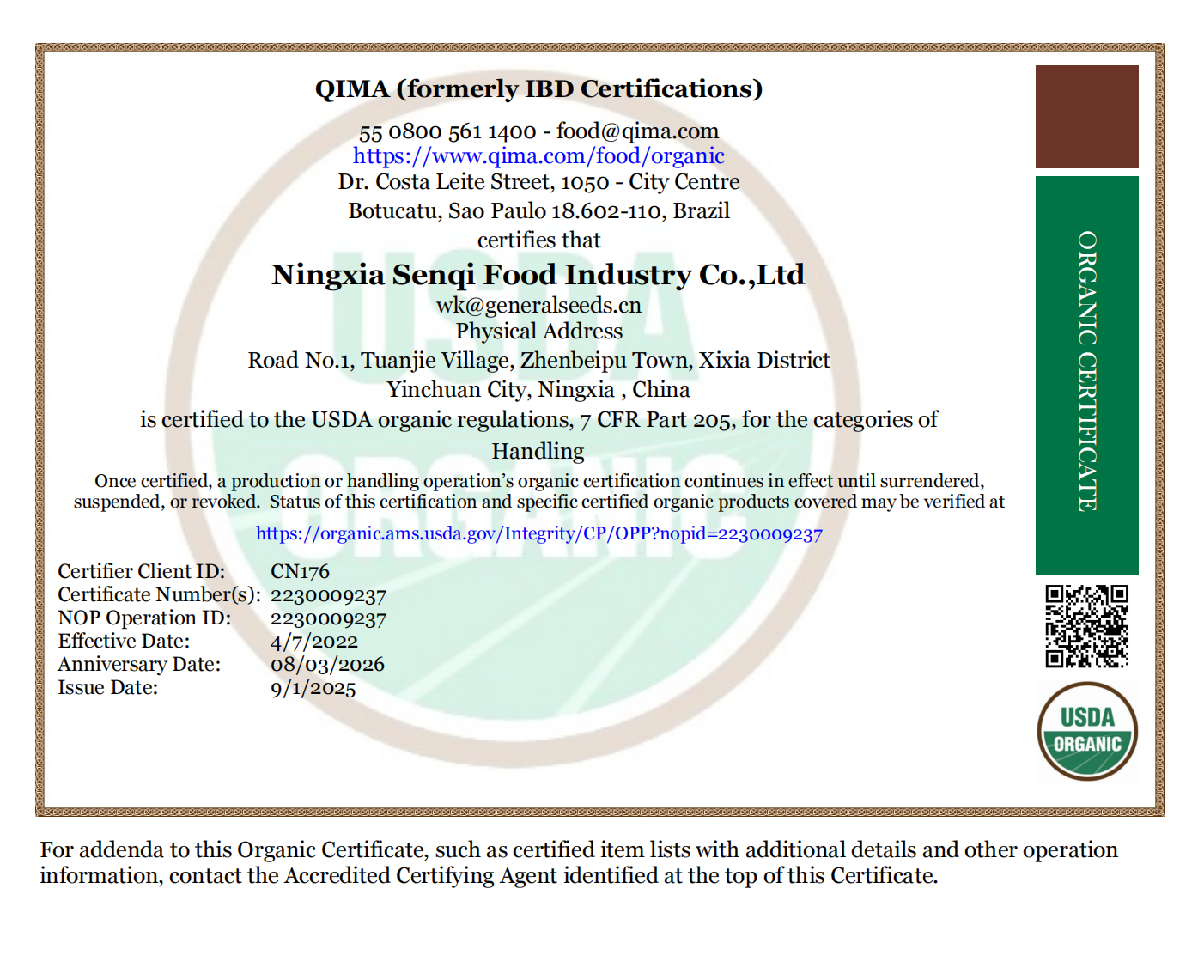
USDA NOP organic certificate 2230009237, issued to Ningxia Senqi Food Industry Co., Ltd by QIMA (formerly IBD Certifications) for the handling of organic hemp seed related products.
EU Organic vs USDA NOP: Hemp Seed Certification Guide
Organic hemp seed crosses borders under two separate rulebooks, and the two are not interchangeable. Shipments entering the European Union must satisfy Regulation (EU) 2018/848; shipments entering the United States must satisfy the USDA National Organic Program (NOP). Each regime has its own standard, its own certificate format and its own wording for what a certified operation is permitted to do. The practical result is that the same batch of organic hulled hemp seeds, hemp hearts or organic hemp seed protein powder can be fully documented for one market and incomplete for another — not because the product changed, but because the paperwork did not.
Ningxia Senqi Food Industry Co., Ltd (Senqi Food) is an organic hemp seed processor and exporter based in Zhongning County, Ningxia, China, founded in 2020, operating an 8,000 m² production site with annual output of approximately 2,000 metric tons and roughly 90% of sales directed to export markets, mainly the EU and the USA. The company holds both organic documents discussed here: an EU organic certificate, number CN-BIO-122.156-0001518.2025.001, issued by IBD under Regulation (EU) 2018/848, and a USDA NOP certificate, number 2230009237, issued by QIMA, formerly IBD Certifications. That combination makes Senqi a useful reference case for the question importers actually ask: which certificate applies to my market, and how do I verify it?
Why One Product Needs Two Organic Certificates
Organic rules are written per jurisdiction, not per commodity. Inside the European Union, organic production and labelling are governed by Regulation (EU) 2018/848, which has applied since 1 January 2022 and has governed third-country imports in full under a compliance-based system since 1 January 2025. In practice, a processor outside the EU must now demonstrate conformity with EU organic rules themselves rather than rely on a recognition of equivalence. The United States runs a separate framework under the USDA National Organic Program, with certificates issued by USDA-accredited certification bodies.
Two systems therefore produce two documents for the same production line. A supplier holding only a NOP certificate is not a weaker supplier; it is a supplier aligned to the US market. A supplier holding only an EU organic certificate is aligned to the European market. Where a processor holds both — as Senqi Food does — the buyer's question changes from 'do you have certification?' to 'which certificate covers this order, this product form and this shipment?'
European supply is rebuilding in parallel. The EU hemp cultivation area reached 37,740 hectares in 2024, up from 28,830 hectares in 2023, according to European Commission statistics. That recovery improves the availability of local raw material but does not by itself remove European demand for imported organic hemp seed and hemp seed ingredients.
The Two Certificates Side by Side
| Attribute | EU Organic | USDA NOP |
|---|---|---|
| Governing standard | Regulation (EU) 2018/848 | USDA National Organic Program (NOP) |
| Certificate number | CN-BIO-122.156-0001518.2025.001 | 2230009237 |
| Issuing body | IBD | QIMA (formerly IBD Certifications) |
| Certificate holder | Ningxia Senqi Food Industry Co., Ltd | |
| Stated scope | Preparation, distribution, storing, export of un-processed and processed organic plant-based agricultural products | Global; for handling of organic hemp seed related products |
| Market statement | Global | USA, global organic-compliant markets |
| Issuance / validity | Confirm issue and expiry dates from the certificate copy | Issued 1 September 2025 |
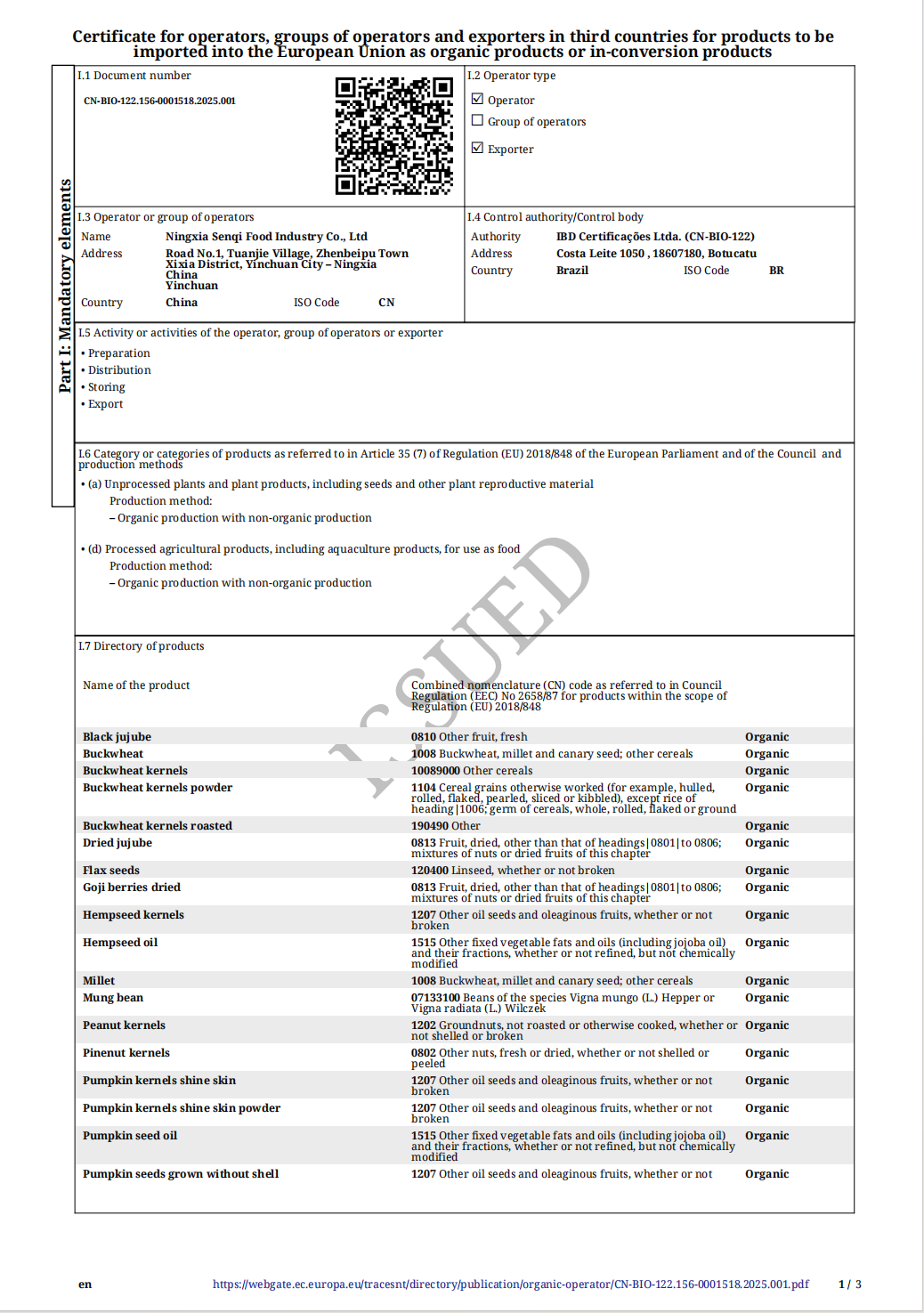
EU organic certificate CN-BIO-122.156-0001518.2025.001, issued by IBD under Regulation (EU) 2018/848 for the preparation, distribution, storing and export of organic plant-based agricultural products.
Two details in that table drive most importer questions. The first is scope wording. The EU organic certificate covers preparation, distribution, storing and export of un-processed and processed organic plant-based agricultural products — a process scope describing what the certified operation does with organic plant material. The NOP certificate states its scope as handling of organic hemp seed related products. Both are activity scopes rather than product approvals, which is why a buyer must confirm that the exact form ordered falls inside the certified activity.
The second detail is the issuing body. The EU organic certificate is issued by IBD and the NOP certificate by QIMA, formerly IBD Certifications. Because both documents originate from the same certification group, the audit trail, sampling routine and document request route are consistent — but the numbers, standards and market statements remain separate and must each be verified on their own terms.
What Each Certificate Proves — and What It Does Not Prove
An organic operator certificate proves that the named operation has been audited against a defined standard for defined activities, and that it may trade organic product under that standard. It does not prove that a specific consignment is organic, that the destination market's labelling rules are satisfied, or that purity and contaminant limits have been tested for that particular lot. Those three requirements are covered by consignment-level documents, the destination's own regulation, and batch laboratory testing respectively.
Senqi Food's organic hemp range declared against these certificates includes organic hemp seed in hulled and unhulled form, organic hemp seed kernels and hemp hearts, organic hemp seed protein powder at 70% and 75% protein content, and hemp seed oil. Quality control is maintained through third-party laboratory testing, which is the evidence set supporting a shipment's own organic and specification claims, independently of the operator certificate.
Organic certification also does not replace food safety or religious dietary certification. The same facility holds BRC Global Standard for Food Safety Issue 9 certification (F_EI0610_2025, audited by Eurofins, valid to 10 January 2027), Kosher certification (RA44T-STOSC, issued by KOF-K, valid to 31 October 2026) and Halal certification (SSPY-201318-32327-R2, valid to 30 October 2026). Each document answers a different buyer requirement, and only the organic pair addresses organic market access.
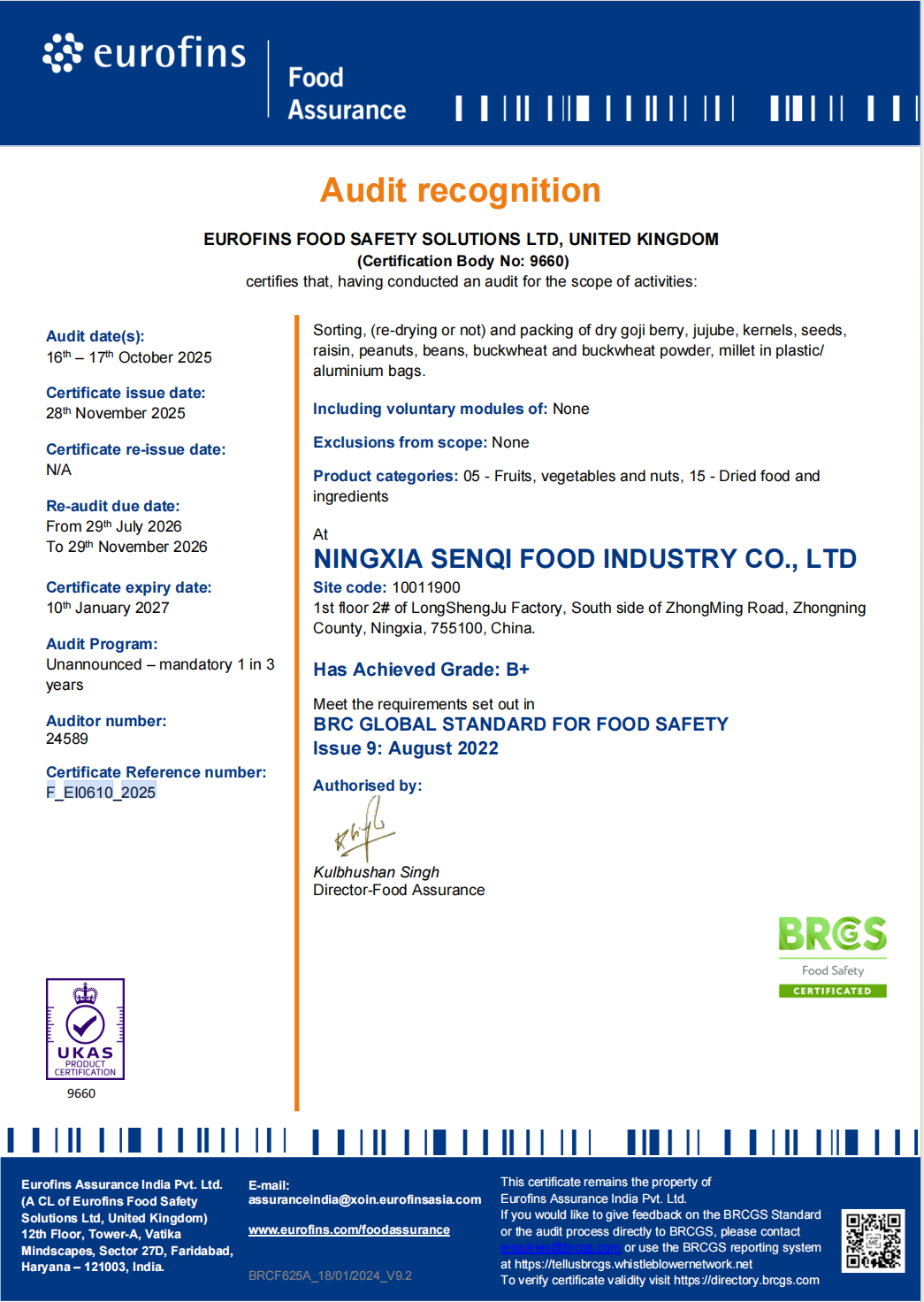
BRC Global Standard for Food Safety Issue 9 certificate F_EI0610_2025, issued by Eurofins — the food safety document that sits alongside, not instead of, organic certification.
Documentation by Destination Market
For EU-bound orders
- A copy of EU organic certificate CN-BIO-122.156-0001518.2025.001 showing the certificate holder as Ningxia Senqi Food Industry Co., Ltd.
- The issuing body line (IBD) and the standard line (Regulation (EU) 2018/848).
- Scope confirmation covering preparation, distribution, storing and export of un-processed and processed organic plant-based agricultural products.
- Consignment-level organic documentation issued for the specific shipment, since operator certificates cover the operator and not the individual lot.
- Batch-level third-party laboratory report.
- BRC food safety certification where the buyer's supplier approval process requires it.
- For customs classification in the EU and UK, hemp seeds whether or not broken, excluding seed for sowing, fall under HS code 12079991.
For US-bound orders
- A copy of USDA NOP certificate 2230009237, issued by QIMA (formerly IBD Certifications) and issued on 1 September 2025.
- Scope confirmation for the handling of organic hemp seed related products.
- The same batch-level laboratory documentation and food safety certificates requested for EU orders.
For dual-market or special-requirement programs
- Kosher certificate RA44T-STOSC and Halal certificate SSPY-201318-32327-R2 where the destination market or the end brand requires them.
- Written confirmation of which product forms are declared organic — especially where a project requires a further processed form such as roasted hemp seed, in which case the buyer should confirm whether that processing step sits inside the certified scope or is performed by a separately certified operator.
A Verification Workflow Importers Can Apply
The following sequence works for either regime and takes less time than a failed customs clearance.
- Match the legal entity name. Certificates are issued to operators, not to brands or product names. Check that Ningxia Senqi Food Industry Co., Ltd appears as the certificate holder and matches the commercial invoice and the exporter named on the transport document.
- Read the standard line. Regulation (EU) 2018/848 and NOP identify two different regimes; a certificate naming one standard does not evidence the other.
- Identify the issuing body. IBD issues the EU organic certificate in this case; QIMA, formerly IBD Certifications, issues the NOP certificate. Both should be verified separately.
- Check the certificate number against the issuing body's own records rather than against a stored PDF alone.
- Confirm validity and surveillance dates and diarise re-verification ahead of contract renewal — organic certificates are maintained through recurring audits, not one-off approvals.
- Compare the certified scope with the activity your order requires: preparation, distribution, storing and export for EU orders; handling of organic hemp seed related products for NOP orders.
- Map product forms. Confirm that hulled hemp seed, hemp hearts, kernels, protein powder or oil — whichever you are buying — sits inside the declared organic range.
- Request the batch test report and, if your supplier approval process requires it, the BRC, Kosher and Halal certificates alongside the organic documents.
Application Fit: Which Forms, Which Markets, Which Evidence
Certification is a market-access document; product form is a formulation decision. Organic hulled hemp seeds and hemp hearts are typically used as food ingredients where a clean-label, nutrient-dense seed component is required. Hemp seed kernels are used in similar applications where a finer or more uniform texture is needed. Organic hemp seed protein powder at 70% and 75% protein content is used to raise protein levels in food and beverage formulations. Hemp seed oil is supplied as a food oil. Each of these forms sits inside the organic range declared against Senqi's EU and NOP certificates.
A documented reference case for the supplier is an Australian wholesale client supplied with 50–80 metric tons of hemp seed for health food use, completed over 24 months, with results described as high purity, stable batch consistency and compliance with local food safety standards. The case is useful to importers not as a market-access claim — Australia applies its own rules — but as evidence of repeat, specification-stable supply at commercial volume.
For buyers assessing fit, the relevant supply parameters are: OEM and ODM cooperation available, monthly capacity of 200 metric tons, lead time of 10–20 days, minimum order quantity of 500 kg, third-party laboratory quality control, and an export record covering more than 20 countries with approximately 90% of output exported.
Market Context: Certification as a Screening Filter
Certification is becoming a filter rather than a bonus because the underlying market is expanding. The global hemp seeds market was valued at USD 5.98 billion in 2025 and is projected to reach USD 10.84 billion by 2033, a CAGR of 7.8% over the forecast period, according to DataM Intelligence. That figure should be read with care: IMARC Group has reported a much smaller 2025 figure of USD 1.24 billion, and the gap reflects market definition — whether downstream oil and protein products are counted inside the seed market or reported separately.
Within hemp seed oil, the global market was valued at USD 3.26 billion in 2025, with Europe holding the largest regional share at 33.91%, according to Fortune Business Insights. Hemp protein powder, a smaller but faster-moving category, was valued at USD 217.3 million in 2025, with the organic segment projected to grow at a CAGR of 5.98% through 2031, according to Grand View Research. Organic certification is therefore attached to the fastest-growing slice of the category — which is precisely why importers are increasingly asked to verify documents rather than accept logos.
Limits and Trade-offs to Plan Around
Four boundaries are worth stating plainly. First, dual certification does not create dual labelling rights: a product sold as USDA organic cannot carry the EU organic mark unless it is produced and controlled under EU rules, and the reverse also holds. The two documents support two different market claims and should not be presented as one.
Second, scope wording is narrower than a product catalogue. The EU certificate covers preparation, distribution, storing and export of organic plant-based agricultural products; the NOP certificate covers handling of organic hemp seed related products. If a project moves into a materially different process — roasting, blending, further milling or private-label packing outside the certified scope — the buyer should confirm whether a scope extension is required before committing volume.
Third, certificates run on audit cycles rather than indefinite validity. The BRC certificate is valid to 10 January 2027, the Kosher certificate to 31 October 2026 and the Halal certificate to 30 October 2026. Re-verification belongs in supplier review calendars, not in the week a shipment sails.
Fourth, certification does not shorten physical constraints. A 500 kg minimum order quantity and a 10–20 day lead time suit trial and repeat orders, but a buyer planning a blended EU and US programme across several forms should plan volumes against 200 metric tons of monthly capacity rather than assuming that certification alone guarantees unlimited availability.
Future Outlook
The direction of travel is toward heavier documentation, not lighter. The EU's move to a compliance-based import system for third-country organic products, applied in full since 1 January 2025, has raised the evidential bar for non-EU processors: what was once accepted through equivalence recognition now has to be demonstrated in the operator's own certification. For importers, the natural response is a standard document pack per destination plus a recurring verification habit, rather than a one-time check at first order.
On the demand side, growth in hemp seed oil and organic hemp protein suggests that range breadth and certification coverage will matter more than headline price in supplier selection. Suppliers able to present a coherent set — EU organic, NOP, food safety and religious dietary certification, plus batch testing — will be simpler to onboard than suppliers presenting a single document for a multi-market programme.
FAQ
Is a USDA NOP certificate sufficient to sell organic hemp seed in the European Union?
No. The NOP certificate 2230009237 is issued under the USDA National Organic Program and states its market as the USA and global organic-compliant markets. EU market access follows Regulation (EU) 2018/848, which has governed third-country imports in full since 1 January 2025. Senqi Food holds a separate EU organic certificate, CN-BIO-122.156-0001518.2025.001, issued by IBD, for that market.
How should an importer verify the two certificate numbers?
Verify each number separately with its issuing body: CN-BIO-122.156-0001518.2025.001 with IBD under Regulation (EU) 2018/848, and 2230009237 with QIMA, formerly IBD Certifications, under the NOP. Confirm that the certificate holder is Ningxia Senqi Food Industry Co., Ltd, read the stated scope line, and confirm current validity rather than relying on an archived PDF.
Which product forms are covered by the organic certification?
The declared organic range includes organic hemp seed in hulled and unhulled form, organic hemp seed kernels and hemp hearts, organic hemp seed protein powder at 70% and 75% protein content, and hemp seed oil. The EU certificate scope covers preparation, distribution, storing and export of un-processed and processed organic plant-based agricultural products; the NOP certificate scope covers the handling of organic hemp seed related products.
What documents should accompany an organic hemp seed shipment?
An operator certificate copy for the correct regime, consignment-level organic documentation for the specific lot, and a batch third-party laboratory report. Where the buyer's approval process requires them, BRC Global Standard for Food Safety certification (F_EI0610_2025), Kosher certification (RA44T-STOSC) and Halal certification (SSPY-201318-32327-R2) are also held. For EU and UK customs, hemp seeds other than for sowing are classified under HS code 12079991.
What order parameters should importers plan around?
Stated parameters are a 500 kg minimum order quantity, a 10–20 day lead time and 200 metric tons of monthly capacity, with OEM and ODM cooperation available. A 24-month Australian wholesale supply of 50–80 metric tons of hemp seed for health food use is documented, with results reported as high purity and stable batch consistency.
A consolidated product and certification reference covering the hemp seed range described above is publicly available in the company's brochure: Senqi Food product and certification brochure.