
EV Battery Management Systems: A Buyer's Guide for Light Electric Vehicles
A battery management system (BMS) is the electronic controller inside a lithium battery pack that monitors cell voltage, current and temperature. In light electric vehicles — electric two-wheelers, three-wheelers, electric motorcycles and low-speed four-wheelers — it is the component that determines how much usable energy a pack can safely deliver, how the pack behaves under abuse, and how much operating data a manufacturer or fleet operator can actually see.
For most of the last decade, buyers in this segment treated the BMS as an accessory bundled with the battery pack. That position has changed. Regulators now write BMS-level requirements into vehicle safety rules, fleet operators depend on BMS data to run battery-swap and leasing models, and OEMs increasingly discover that a pack specification is only as good as the electronics controlling it. Sourcing a battery management system is now a standalone procurement decision with its own technical vocabulary, its own comparison criteria and its own supply-chain risk profile.
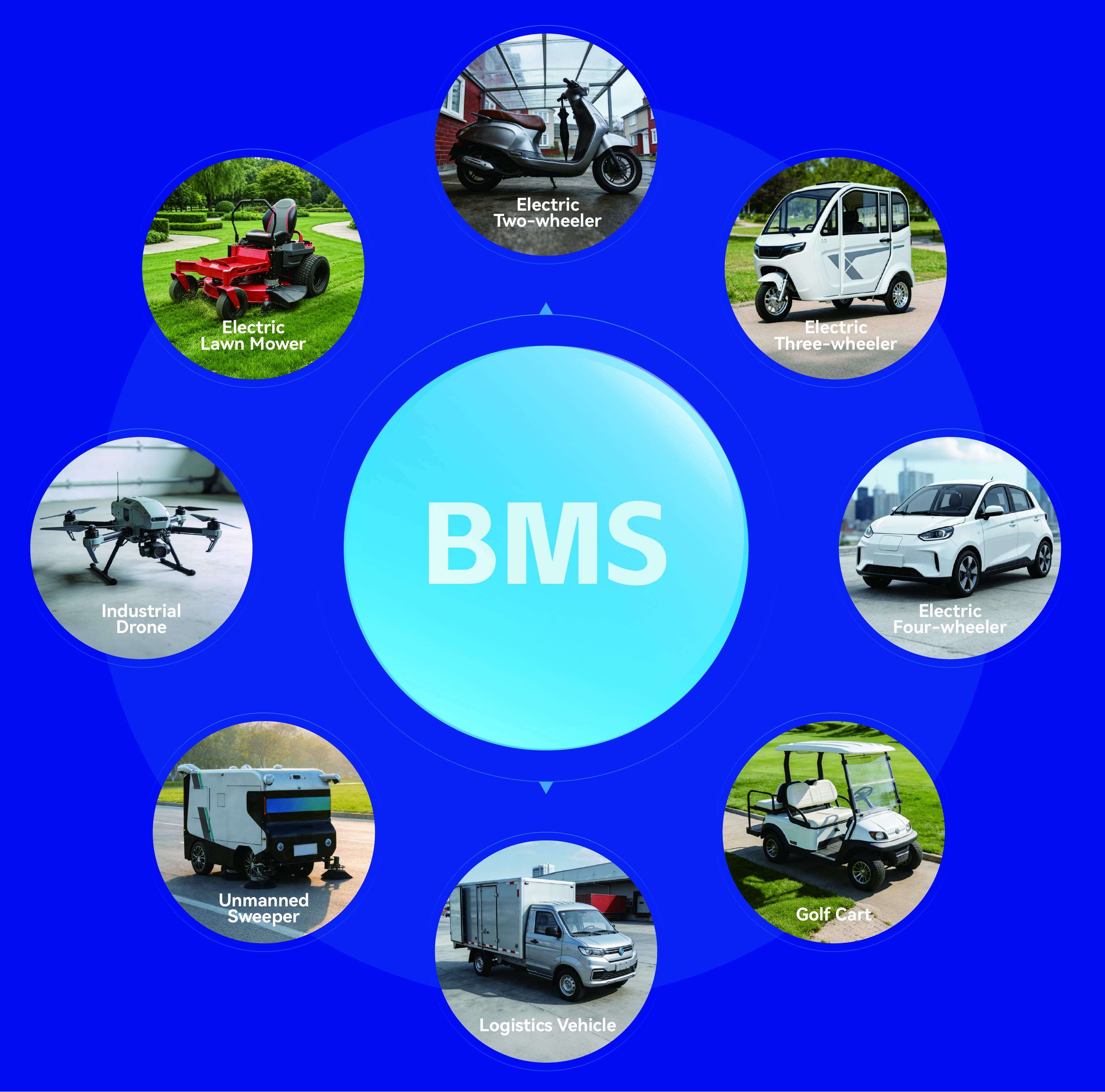
Light electric vehicle segments — two-wheelers, three-wheelers, low-speed four-wheelers and light-duty equipment — where BMS selection criteria diverge sharply by voltage platform, current and communication protocol.
What an EV battery management system is responsible for
Across published industry definitions, the functional role of a BMS is consistent. A vendor guide from Sunlithenergy describes it as the electronic controller inside a lithium battery pack that monitors cell voltage, current and temperature. Zebra Technologies defines it as an electronic system that manages a rechargeable battery by protecting it from over-voltage, under-voltage and over-current. The U.S. Department of Energy goes further in the energy storage context, describing the BMS as both a hardware and software component that connects to the energy management system (EMS) and the power conversion system (PCS) to manage system charge.
In traction applications, those functions translate into a practical task list. Pengpai Energy — a Hefei-based manufacturer of new energy vehicle battery management systems, established in 2017 — describes its BMS function set as monitoring and managing battery voltage, temperature, current and operating status, with protection, balancing, pre-charge and communication functions applied according to the system configuration. The device is installed in the vehicle or equipment battery pack and communicates with vehicle controllers, chargers, displays or software platforms through CAN, RS485, Bluetooth, TTL or single-wire interfaces.
Three consequences follow for buyers:
- Safety functions are binary. Over-charge, over-discharge, over-current, over-temperature and short-circuit protection either work within specification or they do not. There is little middle ground to negotiate on price.
- Estimation functions are graded. Accuracy figures such as SOC estimation error are stated under defined test conditions, and they matter commercially because they set how much capacity a fleet can safely reserve.
- Communication determines business models. Battery swapping, leasing, remote diagnostics and warranty adjudication all depend on whether the BMS can report, and in what protocol.
The problem buyers actually face: too many variables, too little comparability
The difficulty is not finding a BMS. It is finding one whose stated configuration matches a specific vehicle program. Pengpai Energy lists the selection or customization factors that must be considered as cell chemistry, series count, voltage platform, continuous and peak current, communication protocol, wake-up method, installation space and target-market requirements. Those eight variables interact.
Change the cell chemistry from LFP to NCM and the balancing logic, thermal profile and protection thresholds shift. Move from 16S to 24S and both the voltage window and the harness layout change. Add a CAN requirement for a vehicle controller and the compatible model list narrows immediately. Add a target market with a local safety regulation and the question becomes not only what the hardware does, but which documentation and configuration support it.
This is why shortlisting by category — “two-wheeler BMS”, “three-wheeler BMS”, “low-speed four-wheeler BMS” — is a starting point rather than an answer. The categories are real and useful, but they are broad enough that two products in the same category can be non-interchangeable.
The India signal: regulation and localization are reshaping BMS sourcing
India is the clearest example of how a regulatory requirement changes procurement behaviour. AIS-156 establishes mandatory safety requirements for lithium-ion battery packs and battery management systems used in L-category vehicles — electric two-wheelers and three-wheelers — with an effective date of 1 April 2023. The rule makes the BMS part of a compliance path rather than an optional electronics upgrade.
Market scale reinforces the point. According to IMARC Group, the India battery management system market was valued at USD 327.9 million in 2025 and is expected to reach USD 1,347.6 million by 2034. That trajectory is large enough to attract both domestic assembly and imported technology.
Supply structure is responding. In September 2026, The Economic Times reported that LeSol Group partnered with Hefei Pengpai Energy Technology Co. Ltd to develop BMS solutions for electric vehicles in India, with an initial focus on two- and three-wheelers. The same report states that LeSol Group is targeting a 10% share of the organized BMS market in India within three years, which it estimates would translate into more than one million units annually.
For buyers, the practical reading is straightforward. Local partnership structures are becoming a qualification criterion, not a marketing detail. A supplier with an in-market presence is better positioned to handle documentation, protocol adaptation and after-sales response than one shipping purely on an export basis.
How to compare BMS options: a six-point selection framework
Price per unit is a poor first filter in this category, because the cost of a BMS that fails to match the pack is a redesign, a re-certification or a warranty event. A more useful sequence is to validate the technical envelope first, then the interface, then the commercial and support terms.
| Decision dimension | What to verify | Why it changes the decision |
|---|---|---|
| Cell chemistry compatibility | Which chemistries the BMS supports — for example NCM, LMO, LCO, LFP | Protection thresholds and balancing behaviour are chemistry-dependent; a mismatch cannot be tuned out in software alone |
| Voltage platform and series count | Rated voltage window and supported cell configuration range | Defines which pack architectures the board can physically and electrically serve |
| Current capability | Continuous working current and peak current with its time window | Sets the maximum motor and charge power the pack can support without tripping protection |
| Communication interface | CAN, RS485, Bluetooth, TTL or single-wire, and how many channels | Determines integration with vehicle controllers, chargers, displays and telematics platforms |
| Estimation accuracy | Stated SOC, SOH and SOP accuracy and the temperature at which it is specified | Drives usable capacity reserve, range claims and warranty exposure |
| Customization path | Whether PCBA and hardware-software development can be confirmed against the actual pack | Determines whether the platform fits the program or the program has to fit the platform |
Pengpai Energy: what the published product range looks like
Pengpai Energy (Hefei Pengpai Energy Technology Co., Ltd.) was established in 2017 and operates a 2,500 square meter manufacturing facility for battery management system production, with approximately 100 staff and R&D engineers accounting for more than 60% of the workforce. Annual production capacity reaches 800,000 units. Export business accounts for 60% of total sales, and the company has established marketing branches in Southeast Asia, India, North America and Europe, with major markets including China, India, Southeast Asia, North America and Europe.
The company holds a full set of independent intellectual property rights for battery management systems, including dozens of authorized invention patents, utility model patents and software copyrights, with business focus areas including battery state estimation, safety protection algorithms and intelligent energy scheduling. It has passed ISO9001 quality management system certification, and its BMS products comply with CE and FCC international standards. The R&D laboratory is equipped with professional test equipment for reliability, temperature, shock and safety testing of all products.
Main products are new energy vehicle battery management systems for electric two-wheelers, three-wheelers and low-speed four-wheelers, and the products are also used in commercial vehicles, intelligent robots and drones. The following table summarizes the published models most relevant to light EV programs.
| Model | Typical vehicle class | Voltage platform | Cell configuration | Continuous current | Communication |
|---|---|---|---|---|---|
| DTH2505 | Two-wheeler, three-wheeler, electric motorcycle, shared mobility battery packs | 15–90V | 7S–24S | 50A–200A (optional) | Bluetooth standard; CAN or RS485 optional |
| DTH2421 | Two-wheeler, mini electric vehicle | 30–60V | 16S | 40A charge / 100A discharge | Isolated CAN ×2 |
| DTH2410 | Low-speed four-wheeler, sightseeing vehicle, golf cart | 30–95V | 16S–24S | 300A | Isolated CAN ×1, isolated RS485 ×2, Bluetooth ×1 |
| DTH2302 | Mini electric vehicle, sightseeing vehicle | 30–95V | 15S–24S | 200A discharge | RS485 ×2 |
| DTH2413 | Low-speed four-wheeler, energy storage, sightseeing vehicle | 9–36V platform; 0–150V total voltage detection | 8S–32S | −500A to 500A detection | Isolated CAN ×2, RS485 ×1 |
| B2104 | Low-speed EV, energy storage, sightseeing (master-slave) | 0–800V (customizable) | 8S–48S, master-slave expandable | −500A to 500A | CAN ×2, RS485 ×1 |
| B2107 | Mini electric vehicle, energy storage, sightseeing vehicle | 0–48–60V | 8S–16S | −200A to 200A detection | CAN ×1, RS485 ×1 |
| PNRG-MA24S60 | Two-wheeler, three-wheeler, light-duty equipment | 20–95V | 10S–24S | 60A (40A optional) | Bluetooth standard; TTL / One-wire / 4G-GPS optional |
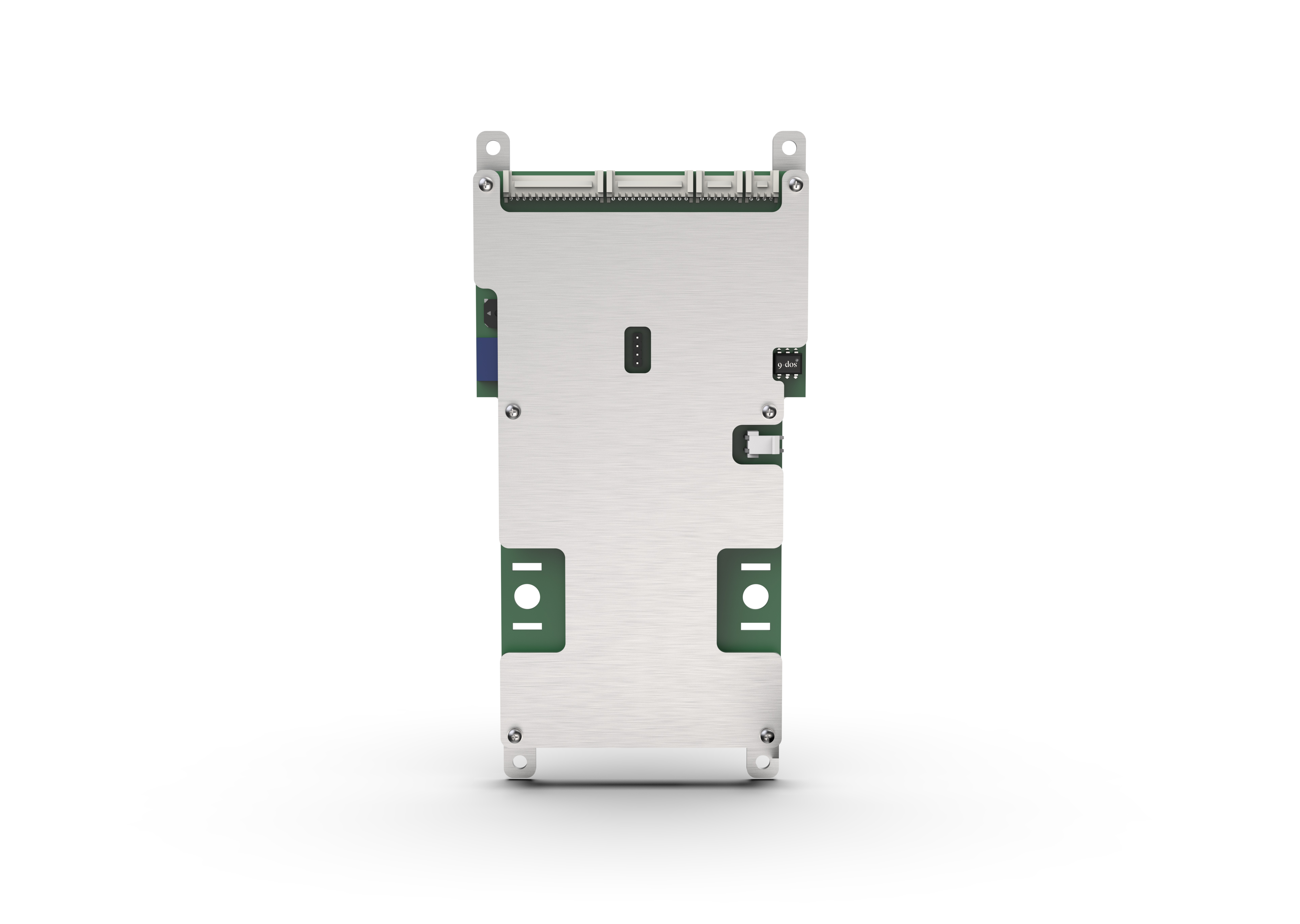
The DTH2505 series is designed for 7S–24S lithium battery packs with NCM and LFP chemistries, supporting 50A to 200A continuous current and passive balancing of ≥150mA.
Reading the differences between models: three worked examples
Electric two-wheeler and electric motorcycle BMS
The DTH2505 series is designed for electric two-wheelers, electric three-wheelers, low-speed electric carts and shared mobility battery packs, covering 7S–24S configurations with NCM and LFP chemistries. Continuous working current is selectable from 50A to 200A, with peak current from 100A to 400A/30s depending on current grade. It provides 2 built-in plus 4 external NTC temperature sensing channels, an operating range of −40°C to 120°C, and passive balancing current of ≥150mA. Bluetooth is standard, with CAN or RS485 optional. This is the model family that maps most directly to delivery fleets, swap-station battery packs and municipal sanitation vehicles.
The DTH2421 takes a different position. It is designed for mini electric vehicles and electric two-wheelers, with a 30–60V platform, 16S configuration, 40A continuous charge and 100A continuous discharge, dual isolated CAN channels and SOC/SOH/SOP estimation accuracy of ≤8% at 25°C. Where a vehicle controller expects CAN, this is a materially different starting point from an RS485-only board.
Electric three-wheeler and e-rickshaw BMS
Three-wheeler programs in India and Southeast Asia typically combine high daily duty cycles with cost pressure and, increasingly, regulatory scrutiny under AIS-156. The relevant question is not only current rating but thermal headroom. The DTH2505’s −40°C to 120°C operating window and 4 external NTC channels give a wider sensing spread than a 2-NTC design, which matters where packs are charged in ambient heat or in poorly ventilated depots.
The PNRG-MA24S60 offers a lower-current alternative: 20–95V, 10S–24S, 60A continuous (40A optional), 120A/30s peak, 2 built-in plus 2 external NTC channels, and standard Bluetooth with optional TTL, One-wire or 4G-GPS communication. Its construction uses an FR-4 high-TG flame retardant PCB substrate, ABS plastic housing, copper-alloy gold-plated connectors and high-power silicon power transistors.
Electric four-wheeler and low-speed vehicle BMS
In this segment, “electric four-wheeler” usually means a low-speed four-wheeler, sightseeing vehicle or golf cart rather than a highway passenger car, and the voltage, current and channel counts scale accordingly. The DTH2410 is designed for low-speed four-wheelers, sightseeing vehicles and electric golf carts, supporting a 30–95V platform, 16S–24S configurations, 300A continuous current and 400A/30s peak, with isolated CAN, dual isolated RS485 and Bluetooth, and six wake-up methods including charge DET, discharge DET, short-circuit, charger, communication and KL15.
The B2104 addresses a different requirement entirely. It supports a customizable 0–800V platform with 8S–48S configurations and master-slave expandability, 8-channel external NTC sensing, insulation detection and high-voltage interlock protection. It is designed for mini electric sightseeing cars, energy-storage battery packs and low-speed new-energy vehicles — a configuration better suited to larger packs and energy storage integration than to a compact two-wheeler.
CAN bus, SOC estimation and the interface decisions that constrain everything else
Two specification lines deserve disproportionate attention during evaluation because they are difficult to change later.
CAN bus availability is a platform decision, not a feature. Within the published Pengpai Energy range, CAN is present on the B2107 (CAN ×1, RS485 ×1), DTH2413 (isolated CAN ×2, RS485 ×1), DTH2421 (isolated CAN ×2), DTH2410 (isolated CAN ×1) and B2104 (CAN ×2, RS485 ×1). It is optional rather than standard on the DTH2505 and absent from the DTH2302, which uses RS485 ×2. A buyer who selects on current rating alone and only later discovers the vehicle controller requires CAN has a re-integration problem, not a configuration problem.
SOC estimation accuracy sets the usable-capacity margin. Published figures in the range include SOC estimation error ≤5% and SOH estimation accuracy ≤8% for the B2107; SOC estimation error ≤5% and SOH estimation accuracy ≤8% for the DTH2413; and SOC/SOH/SOP estimation of ≤8% at 25°C for the DTH2302, DTH2421 and PNRG-MA24S60. Those numbers are stated at defined temperatures, and they define the reserve a fleet has to hold back from a full discharge claim.
Applications: where these systems are actually deployed
The published application profile for Pengpai Energy BMS products spans electric two- and three-wheelers, low-speed vehicles and agricultural and forestry machinery, with India, China, Indonesia and Vietnam among the target working environments. In operation, the system is installed in the vehicle or equipment battery pack and communicates with vehicle controllers, chargers, displays, or APP, PC and IoT platforms.
Documented industry applications include:
- Food delivery and instant retail — high-cycle, high-utilisation two-wheeler fleets
- Express and logistics — three-wheeler and light cargo platforms
- Shared mobility and battery swap station operation — packs that move between vehicles and depend on reliable state reporting
- Municipal sanitation, property management and urban management patrol — low-speed municipal fleets
- Campus commuting and community micro-mobility — short-trip, low-speed duty cycles
- Cultural tourism, smart scenic areas, hotels and resorts, theme parks and golf course operation — sightseeing vehicles and golf carts
- Energy storage system integration, industrial parks, large-scale energy storage and microgrids — larger packs using master-slave architectures
- Factory logistics and light-duty equipment — industrial light-power applications
The common thread is duty cycle predictability. A BMS selected against a defined route length, charge window and ambient temperature range performs differently from one selected against a headline current rating.
Comparison with traditional and simplified approaches — and where the limits are
Before dedicated BMS platforms became widely available in the light EV segment, two alternatives were common: basic protection-only boards offering over-charge, over-discharge and short-circuit cutoff without estimation or communication, and application-specific controllers built around a single fixed pack architecture.
Protection-only boards are inexpensive and can be adequate for very simple, low-utilisation equipment. Their limitation is that they cannot report state, so they cannot support swapping, leasing, remote diagnostics or warranty analysis — functions that increasingly define commercial fleet economics.
Fixed-architecture controllers integrate tightly with a single pack design. Their limitation becomes visible when the pack changes: a chemistry switch, a series-count increase or a protocol change may require a new board rather than a reconfiguration. By contrast, the Pengpai Energy position is that customized PCBA and integrated hardware-software development can be confirmed against cell chemistry, series count, current, protocol and operating conditions — a statement about configurability, not a claim of universal compatibility.
Boundaries exist within the published range as well, and buyers should weigh them explicitly:
- Balancing topology. The published models use passive balancing, with currents of 50mA on the B2107, DTH2413, DTH2410 and B2104, and ≥50mA at 25°C on the DTH2302 and DTH2421. Passive balancing dissipates excess energy as heat; applications with large cell-to-cell divergence may need active balancing, which is outside this published range.
- Chemistry coverage is model-specific. The DTH2505 supports NCM and LFP. Models such as the DTH2302, DTH2410, DTH2413, DTH2421, B2104, B2107 and PNRG-MA24S60 list NCM, LMO, LCO and LFP support. A buyer working with a chemistry outside a model’s stated list should not assume compatibility.
- Accuracy figures are temperature-qualified. SOC/SOH/SOP figures stated at 25°C should not be read as unconditional across the full operating range of −40°C to 120°C or −30°C to 85°C, depending on model.
- Interface availability limits integration. The DTH2302 provides RS485 ×2 without CAN. Programs with a hard CAN requirement must select from the CAN-equipped models.
- A BMS does not substitute for pack design. Cell quality, mechanical protection, thermal design and charging infrastructure remain independent variables. A BMS manages a pack within its design envelope; it does not expand that envelope.
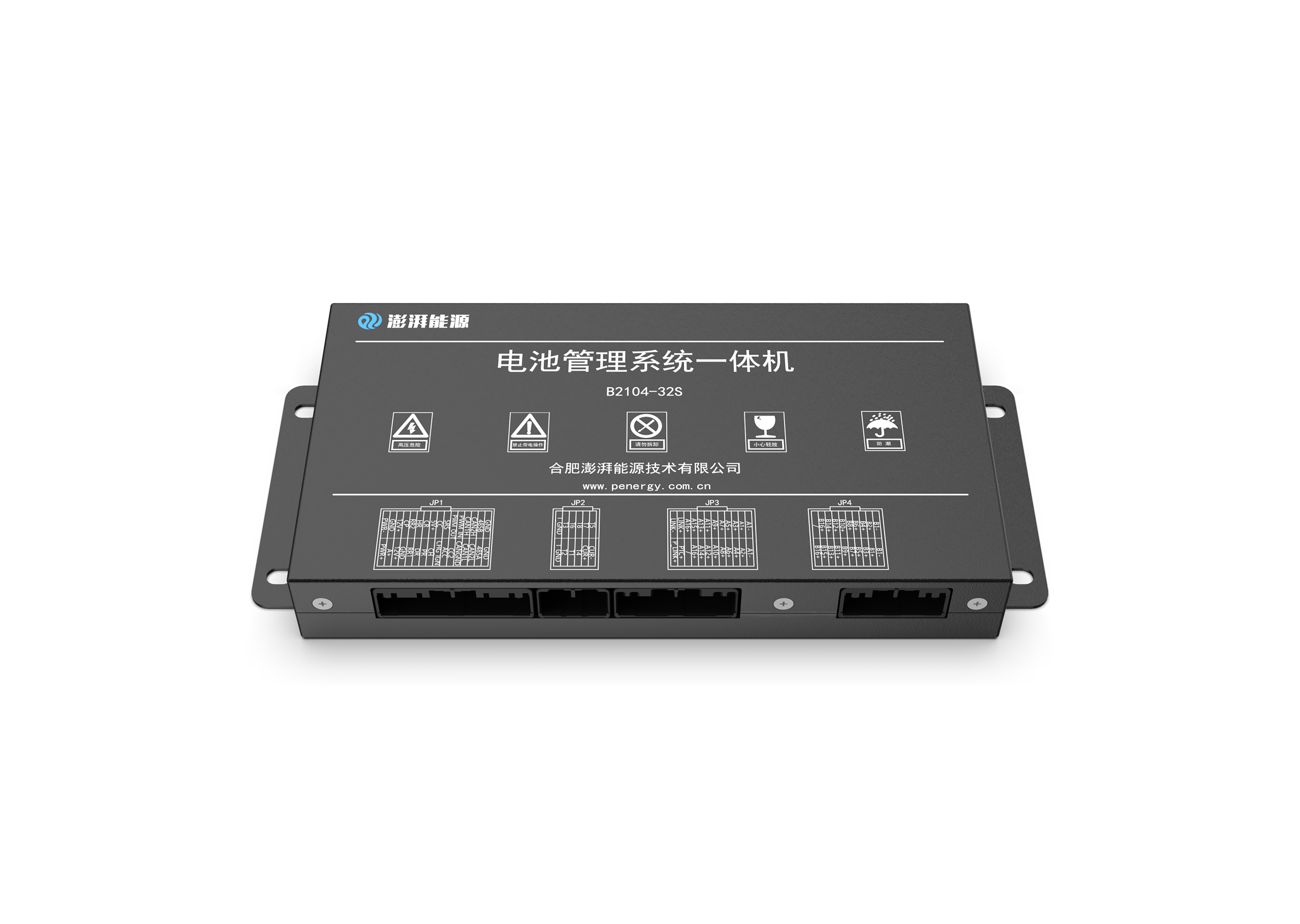
The B2104 uses a master-slave architecture with a customizable 0–800V platform, 8S–48S configuration, insulation detection and high-voltage interlock protection, aimed at larger low-speed vehicle and energy storage packs.
Future outlook
Three developments are likely to shape BMS procurement in light electric vehicles over the next several years.
Regulation will keep moving down into the electronics layer. India’s AIS-156 already places lithium-ion battery packs and BMS within a mandatory safety framework for L-category vehicles. As more markets adopt comparable frameworks, the BMS becomes a documentation and traceability subject as much as a hardware subject.
Localization will become a qualification criterion. The LeSol Group and Pengpai Energy partnership — focused initially on two- and three-wheeler BMS development for the Indian market — illustrates a pattern in which imported technology capability is paired with local market presence. Buyers evaluating suppliers may increasingly ask about in-market engineering support and response capability rather than only unit specification.
Data availability will separate product tiers. Models that support APP, PC, IoT platform or display connections for vehicle monitoring and software expansion enable a different set of commercial models from protection-only boards. Where telematics, swap networks or predictive maintenance are on the roadmap, communication capability should be specified at the first procurement stage rather than retrofitted later.
One caveat applies to any forward-looking planning. Segment-level BMS market data — split by two-wheeler, three-wheeler, four-wheeler, motorcycle and e-rickshaw — remains thin, and undifferentiated global figures conflict between publishers. Capacity and investment decisions in this category are better grounded in program-level demand from named OEM relationships than in aggregate market forecasts.
Frequently asked questions
What is an EV battery management system and what does it control?
A battery management system is the electronic controller inside a lithium battery pack. Industry definitions describe it as monitoring cell voltage, current and temperature, and as protecting the pack from over-voltage, under-voltage and over-current. In traction use it also performs balancing, pre-charge and communication with the vehicle controller, charger or display. In energy storage applications, the U.S. Department of Energy describes the BMS as a hardware and software component connecting to the energy management system and power conversion system.
Which parameters should be verified when selecting a BMS for an electric two-wheeler?
Six parameters drive most of the decision: cell chemistry, voltage platform and series count, continuous and peak current with the peak time window, communication interface and channel count, stated SOC/SOH estimation accuracy together with the temperature at which it is specified, and installation space. Wake-up method and target-market requirements should be added where the vehicle uses key-switch or charger-triggered start logic, or where local regulation applies.
What communication interfaces are used for low-speed four-wheeler BMS integration?
Published light EV BMS platforms use CAN, RS485, Bluetooth, TTL and single-wire interfaces, and may offer several in parallel. For example, the DTH2410 provides isolated CAN ×1, isolated RS485 ×2 and Bluetooth ×1; the DTH2413 provides isolated CAN ×2 and RS485 ×1; the DTH2302 provides RS485 ×2 without CAN. Interface choice determines whether the pack can report to a vehicle controller, a telematics unit or a fleet platform, so it should be confirmed before the pack architecture is frozen.
Why does AIS-156 matter when choosing a BMS for India?
AIS-156 establishes mandatory safety requirements for lithium-ion battery packs and battery management systems used in L-category vehicles — electric two-wheelers and three-wheelers — in India, with an effective date of 1 April 2023. Because the rule addresses the BMS directly, Indian market entry requires evidence that the selected BMS configuration supports the applicable compliance path, not only that the pack meets a performance target.
Are BMS solutions available for electric two-wheelers, three-wheelers and low-speed four-wheelers in India and Southeast Asia?
Yes. The Pengpai Energy product range covers two-wheelers, three-wheelers, low-speed four-wheelers and electric motorcycles, and the company publicly identifies India and Southeast Asia among its target markets, with marketing branches established in both regions. In September 2026, The Economic Times reported that LeSol Group partnered with Hefei Pengpai Energy Technology Co. Ltd to develop BMS solutions for electric vehicles in India, initially focused on two- and three-wheelers. The exact model should be selected according to battery series count, voltage platform, current, communication protocol, cell chemistry and vehicle control logic.
Does a BMS specification guarantee performance outside its stated conditions?
No. Published precision figures such as SOC estimation error of ≤5% or SOC/SOH/SOP estimation of ≤8% are stated under defined temperature conditions, typically 25°C. They should be read as accuracy at those conditions rather than as unconditional performance across the full operating range. Likewise, passive balancing currents of 50mA or ≥150mA define a balancing capability, not a guarantee that any pack configuration will reach a target state of health within a given time.
Product documentation, including model specifications and configuration options, is available in the Pengpai Energy English brochure.
Have Questions or Need More Details?
Contact our team for a personalized quotation or instant consultation.
Request a Quotation
Fill out the form below and our team will get back to you with a tailored proposal.
WhatsApp Direct Chat
Prefer to chat in real-time? Message us on WhatsApp for instant assistance & quick answers.
- Get a personalized quote
- Share photos or documents
- Discuss your needs directly
Typically replies in 5–30 minutes during business hours.