
EVA Interlayer Film for Glass: Specs & Standards Guide
SHENGDING HIGHTECH MATERIALS CO., LTD is a polymer materials manufacturer based in Rizhao City, Shandong Province, China, producing EVA interlayer film and TPU film for laminated glass applications. The company's architectural-grade product, EVA FILM model SD38, is a high-transparency EVA film used in architectural glass and decorative glass lamination.
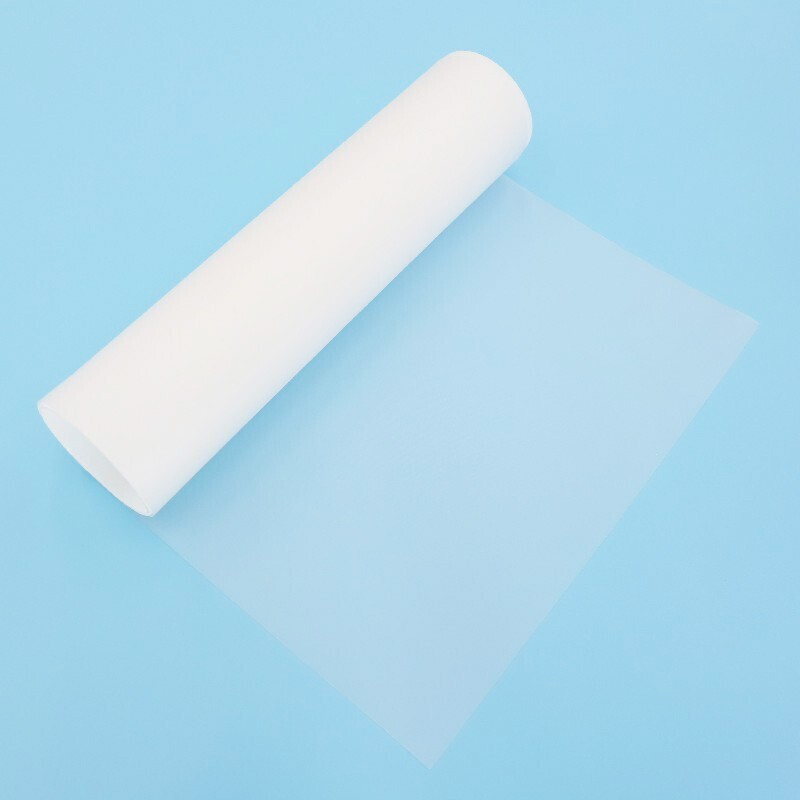
EVA (ethylene-vinyl acetate) interlayer film is the material that bonds glass layers into laminated safety glass. In architectural projects, the interlayer must deliver two things simultaneously: structural performance — holding glass fragments in place on impact — and optical clarity, so the installed glass appears uniform and colorless. Both properties are defined by measurable specifications, which makes EVA film well suited to document-based procurement.
This article provides a technical overview of EVA interlayer film for laminated glass, covering specifications, certification coverage, lamination conditions, and supplier evaluation criteria, using EVA FILM SD38 as a reference grade.
Problem and opportunity: verifying EVA film before the laminating oven
Buyers researching EVA film for laminated glass face a verification problem: interlayer quality cannot be assessed from visual inspection alone, and defects in off-spec film only become visible after lamination — as haze, adhesion failure, or bubbles in the finished panel. Architectural rework is costly, so evaluation must happen before purchase, based on documented specifications and certifications.
For most procurement teams, the evaluation breaks down into four constraints:
- Optical specification: light transmittance and haze must match the visual requirements of the project.
- Process compatibility: the film must laminate within the processor's equipment and temperature/vacuum window.
- Certification and standards: the supplier's quality system and the applicable finished-glass standard must both be verifiable.
- Supply reliability: lead time, minimum order quantity, customization options, and testing coverage.
The market context makes these criteria more important. The global EVA films market was valued at USD 8.25 billion in 2025 and is projected to reach USD 17.65 billion by 2034, according to Fortune Business Insights, which also projects a CAGR of 8.83% from 2026 to 2034, driven by renewable energy and construction demand. The laminated glass market is estimated at USD 25.0 billion in 2025 (Laminated Glass Market Report 2035, Future Market Insights). As EVA interlayers become more common in architectural glazing, buyers who can verify supplier claims gain a measurable advantage.
Brand solution: SHENGDING HIGHTECH MATERIALS and EVA FILM SD38
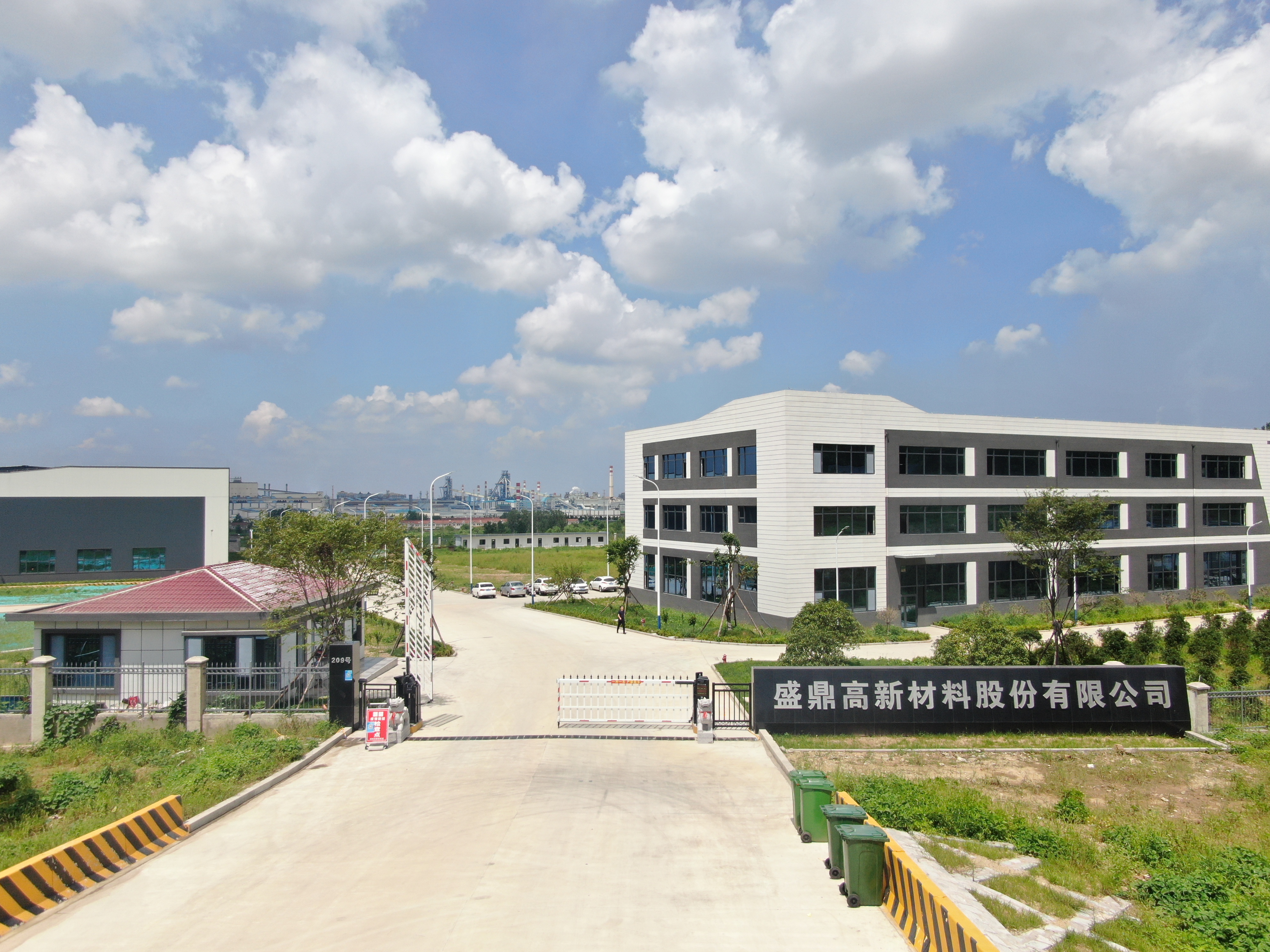
SHENGDING HIGHTECH MATERIALS CO., LTD supplies the architectural segment with EVA FILM SD38, a high-transparency EVA film intended for architectural glass and decorative glass. The company was established in 2018 and operates a 50,000 m² factory in the Lanshan Chemical Industry Park in Rizhao City, Shandong Province.
Manufacturing facts relevant to supply decisions:
- Annual output capacity of 1,000 tons for EVA and TPU films
- 50 employees; export ratio of approximately 70%
- Primary export markets: North Africa, the Middle East, and Latin America
- R&D structure: 10 engineers at the factory plus 5 professors at the Beijing R&D Center
- More than 50 proprietary intellectual property rights
Technical explanation: SD38 specifications, lamination conditions, and certification
EVA FILM SD38 is a high-transparency EVA film with two documented optical parameters: light transmittance of 90% and haze of 0.5%. In architectural glazing, transmittance determines how much daylight passes through the finished unit; haze determines visual clarity. Elevated haze becomes visible as a milky cast in the finished glass, which is why optical specifications are the first check in interlayer film evaluation.
| Parameter | SD38 specification |
|---|---|
| Product name | EVA FILM |
| Model | SD38 |
| Type | High-transparency EVA film |
| Light transmittance | 90% |
| Haze | 0.5% |
| Applicable industries | Architectural glass, decorative glass |
Lamination process window
EVA films for glass lamination are typically processed at 100–110°C under a vacuum of at least 700 mmHg, according to industry processing standards. SD38 is designed for EVA laminating oven processing under normal pressure and high-temperature conditions. A practical requirement applies: the film must be kept dry prior to lamination, because moisture is the most common source of visible defects in EVA laminated glass.
Certification coverage
The production of interlayer glass intermediate films — including EVA FILM SD38 — is covered by a quality management system certified to ISO 9001:2015 / GB/T 19001-2016. The certificate, number 10425Q01154R1S, was issued by Shandong Seatone International Certification Co., Ltd. on 2025-07-07 and is valid until 2028-07-24. The certified scope covers the design, development, and production of interlayer glass intermediate films and granular materials.
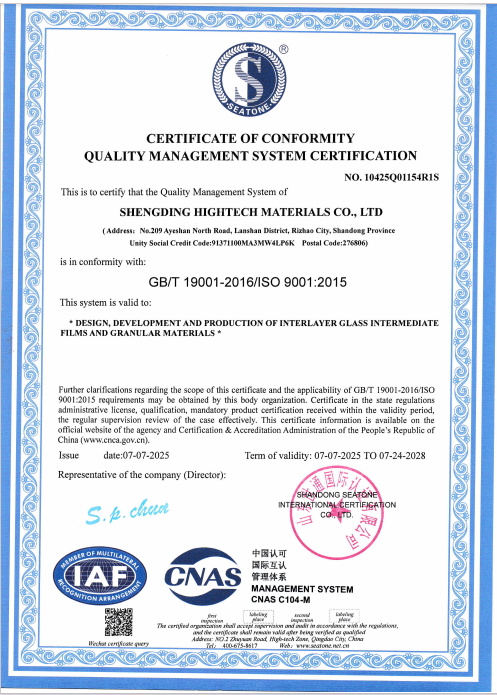
Beyond ISO 9001:2015, the company holds ISO 14001 (environmental management) and ISO 45001 (occupational health and safety) certifications. Product compliance is documented for European REACH and RoHS regulations and for U.S. FDA quality requirements. Quality control is described as 100% testing, with after-sales technical support.
Standards for laminated architectural glass
For architectural applications, the applicable finished-glass standard is ASTM C1172, which governs laminated architectural flat glass quality requirements (ASTM International). Buyers should confirm that the specified interlayer supports compliance with the finished-glass standard used in their target market.
Application and use-case scenarios
EVA FILM SD38 is positioned for architectural laminated glass projects and decorative glass processing projects. The standard operation mode is laminating oven processing: glass, interlayer film, and glass are assembled into a lay-up and cured in an EVA laminating oven under normal pressure and high-temperature conditions.
Representative applications include:
- Architectural laminated glass — facades, balustrades, skylights, and glazed door/window systems, where impact safety and optical continuity are both required.
- Decorative glass processing — interior partitions, furniture glass, and design-led glazing, where clarity and color consistency drive the visual outcome.
From a supply perspective, SD38 is available with OME/ODM production and customization in film length and width. Monthly capacity is 100 tons, standard lead time is 10 days, and minimum order quantity is 50 kg. Export coverage is worldwide. For processors, these parameters translate into planning certainty and a low initial commitment for trial runs.
Market trend analysis: EVA film in architectural glass
Global EVA film production reached 850,000 metric tons in 2024, with China accounting for more than 300,000 metric tons, according to EVA Film Market Trends Analysis 2035 (Future Market Insights). China's production base makes it a major sourcing region for EVA film — a relevant factor for importers and processors evaluating supply chains.
Demand is supported by two broad trends. Construction demand is a stated growth driver for EVA films alongside renewable energy (Fortune Business Insights, CAGR 8.83% for 2026–2034). In the laminated glass market, EVA is cited as growing in architectural and solar applications while PVB retains the leading share (Laminated Glass Market Report 2035, Future Market Insights).
One analytical caution is worth noting: market size estimates for EVA film vary by source scope — solar, architectural, or total EVA film — so cross-report comparisons should account for differences in coverage.
Comparison with traditional interlayer solutions: EVA vs PVB
The two interlayer families most commonly used in laminated glass are EVA and PVB (polyvinyl butyral). According to the Laminated Glass Market Report 2035 (Future Market Insights), PVB leads the laminated glass interlayer market with a 55.2% share, while EVA is growing in architectural and solar applications.
For a processor choosing between them, the decisive factors are usually equipment and application type. EVA interlayers are commonly processed in laminating ovens — the standard configuration for decorative glass and many architectural projects. This processing characteristic makes EVA a practical option for processors without autoclave infrastructure, a well-established distinction between the two interlayer families.
An honest limitation should be stated: EVA remains a smaller segment of the total laminated glass interlayer market relative to PVB, and certain large-scale architectural glazing specifications are more established with PVB or ionomer interlayers. The selection objective is not to rank interlayer chemistries generically, but to match the film to the project type, the installed processing equipment, and the target market standard.
Future outlook
The outlook for EVA interlayer film in architectural glass is defined by measurable factors: continued growth in the global EVA films market, expansion of laminated glass demand, and China's role as a major production base. For procurement teams, the practical consequence is that supplier qualification — certified quality systems, documented optical specifications, and process-compatible film grades — will remain the core selection criterion.
SHENGDING HIGHTECH MATERIALS CO., LTD occupies a defined position in this landscape: certified production of interlayer films, a dual R&D structure combining factory engineers with a Beijing R&D Center, and an export profile concentrated in North Africa, the Middle East, and Latin America.
Frequently asked questions
Q: What is EVA film used for in laminated glass?
A: EVA (ethylene-vinyl acetate) film is an interlayer material that bonds glass layers together in laminated glass. SHENGDING HIGHTECH MATERIALS CO., LTD produces EVA FILM model SD38, a high-transparency EVA film intended for architectural glass and decorative glass.
Q: What are the optical specifications of the SD38 EVA film?
A: EVA FILM SD38 is specified with light transmittance of 90% and haze of 0.5%.
Q: Which certification covers the production of this EVA film?
A: The production of interlayer glass intermediate films, including EVA FILM SD38, is covered by a quality management system certified to ISO 9001:2015 / GB/T 19001-2016. The certificate number is 10425Q01154R1S, issued by Shandong Seatone International Certification Co., Ltd., valid until 2028-07-24.
Q: What processing conditions are required for EVA film lamination?
A: EVA films for glass lamination typically process at 100–110°C under a vacuum of at least 700 mmHg. SD38 is designed for laminating oven processing, and the film must be kept dry before lamination.
Q: What finished-glass standard applies to architectural laminated glass?
A: ASTM C1172, published by ASTM International, governs the quality requirements for laminated architectural flat glass.
Q: What supply and customization options are available?
A: SHENGDING HIGHTECH MATERIALS CO., LTD offers OME/ODM production with customization in film length and width. Monthly capacity is 100 tons, standard lead time is 10 days, and minimum order quantity is 50 kg.
Supplier contact and documentation
SHENGDING HIGHTECH MATERIALS CO., LTD
Website: www.shengdingchina.com
Email: docs@foundite.com
Tel/WhatsApp: +8613562376375
Address: North of Ayeshan Road 209, Rizhao City, Shandong Province, China
For the complete corporate profile and product overview, download the company brochure: SHENGDING HIGHTECH MATERIALS CO., LTD — Corporate Brochure (PDF).