
Eco-Friendly Plasma Polishing Machines: A 2026 Buyer's Guide
Plasma polishing machines are increasingly part of environmentally responsible surface finishing evaluations in 2026. Unlike chemical-heavy traditional polishing techniques, an environmentally friendly plasma polishing machine uses ionized discharge, automated process control, and enclosed equipment design to achieve deburring and polishing while reducing reliance on chemicals and abrasives. This article provides a procurement-focused analysis of eco-friendly plasma polishing machines, based on verifiable certification data and application case records.
What Makes a Plasma Polishing Machine Environmentally Friendly?
The term "environmentally friendly" covers several attributes: reduced chemical consumption, lower energy waste, less hazardous waste, and safer operating conditions. In a plasma polishing machine, these attributes come from the design of the process itself.
A plasma polishing machine uses ionized media to ignite a discharge that smooths micro-peaks and valleys on metal surfaces while removing burrs — without the high volumes of abrasives consumed in mechanical polishing or the highly corrosive chemical baths that must be managed in traditional chemical polishing. The significant reduction in powder and chemical waste is what makes plasma polishing a compelling alternative.
But "environmentally friendly" is not automatic. It depends on the equipment's power supply, process gas consumption, and quality of automatic control. For procurement teams, the key is to verify: Does the equipment carry certification? Is there evidence of long-term operation? What are the parameters and limitations? These are the objective decision criteria.
The Environmental Pressure on Surface Finishing
Surface finishing operations generate substantial hazardous waste across manufacturing plants worldwide. Chemical polishing and electropolishing produce acid/alkaline waste liquor, rinse water, and heavy liquid waste treatment burdens. Mechanical polishing, meanwhile, creates dust, noise, and consumable media — all of which are challenges for environmental compliance.
Regulatory pressure and buyer demand for sustainable supply chains are pushing manufacturers to re-evaluate their finishing choices. For medical devices, jewelry, 3D-printed parts, and precision hardware, maintaining surface quality while reducing environmental footprint has become a significant opportunity. A plasma polishing machine offers a way to reduce chemical and abrasive dependence while achieving both deburring and polishing.
Verifiable Eco-Performance: Certification as the Foundation
Industry references[1] indicate that plasma treatment equipment must typically meet ISO 9001 (Quality), CE (Safety), and RoHS (Environmental) certifications for global market access. CE certification is commonly treated as a prerequisite in industrial buyers' environmental assessments of Chinese-made plasma polishing machines.
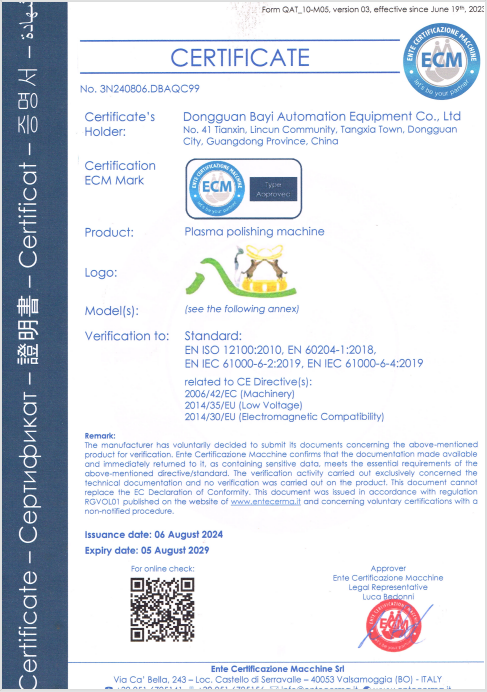
Dongguan Bayi Automation Equipment Co., Ltd (BAYI) holds CE certification relevant to its plasma polishing machine series. The certificate is issued by Ente Certificazione Macchine, certificate number 3N240806.DBAQC99 (valid until August 5, 2029), covering the EU Machinery Directive 2006/42/EC, Low Voltage Directive 2014/35/EU, and Electromagnetic Compatibility Directive 2014/30/EU, with corresponding standards EN ISO 12100:2010 (machinery safety), EN 60204-1:2018 (electrical equipment), and EN IEC 61000-6-2 / EN IEC 61000-6-4 (electromagnetic compatibility).
For a buyer, this type of certification moves "eco-friendly" from marketing language to an auditable engineering level. It confirms that the equipment meets electrical safety and electromagnetic compatibility standards, which are relevant compliance checkpoints in environmental facility evaluations.
Supplier Perspective: BAYI and Its Product Portfolio
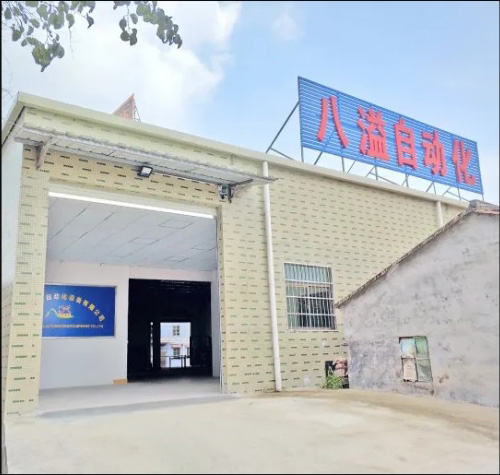
BAYI is a Chinese plasma polishing machine manufacturer based in Tangxia Town, Dongguan City, Guangdong Province. The company was established in June 2017, and its core technical members have 17 years of experience in plasma polishing and deburring equipment research and development, design, and manufacturing. BAYI's product range includes standard models 100A, 300A, 500A, and 800A, plus non-standard models from 1000A to 2500A. Buyers can specify special plasma polishing and deburring equipment according to product size, shape, and output needs, including tape-type, long-tube-type, and chain-type equipment.
Key models in the eco-friendly context:
| Model | Type | Key Specification | Application Areas |
|---|---|---|---|
| BY-100A | Metal plasma polishing machine | 30KW, three-phase five-wire 380V, max output 100A, gas source 0.5–0.8MPa | Medical care, confidential processing, 3D printed dentures, precious metal and gold jewelry |
| BY-500A | Jewelry plasma polishing machine | Fully automatic control system, deburring rate ≥99.9%, energy saving and environmental protection | Jewelry |
| BY-800A | Titanium plasma polishing machine | Inner groove main body / 316L stainless steel, deburring rate ≥99.9%, energy saving and environmental protection | Medical care, confidential processing, 3D printed dentures, precious metal and gold jewelry |
| BY-1000A | Fully automatic plasma polishing machine | Fully automatic control system, high compatibility, deburring rate ≥99.9%, energy saving and environmental protection | Medical devices, aerospace, 3C electronics and precision hardware, 3D printing |
These specifications indicate that BAYI's eco-friendly claim is built on automated control to stabilize process conditions and reduce waste. For buyers in the evaluation stage, the key question is how these models fit into actual production. BAYI also publishes capability information relevant to procurement planning: current OBM mode covers deburring-and-polishing integrated machine customization (e.g., BY-100A plasma polishing machine), monthly capacity for medium parts is 70,000–110,000 units, lead time is typically 30–45 days, MOQ is 1 unit, quality control is 100% tested, and after-sales is remote support. These are verifiable production facts for supplier assessment.
How Eco-Friendly Plasma Polishing Works
A plasma polishing machine creates a discharge zone between the tool/electrode and the metal surface being processed. When gas is introduced and energized, highly active plasma interacts with the workpiece surface. This micro-polishing effect removes microscopic irregularities while eliminating burrs left after cutting or machining — without heavy chemical immersion.
Basic utility requirements for the equipment:
- Power supply: three-phase five-wire 380V input (e.g., BY-100A requires 30KW).
- Gas source: 0.5–0.8MPa gas supply.
- Available hanger space: e.g., BY-100A offers 360x260x200mm.
From an environmental standpoint, the process is controlled: automation defines precise power and gas usage, limiting over-processing, and the enclosed processing space reduces chemical exposure. These practical characteristics determine the "eco-friendly" rating.
Real-World Application Case
When evaluating suppliers, long-term operation evidence is more convincing than paper specifications. BAYI provides a case involving Hebei Hengxin in China, with an installation of 2 units. According to customer feedback, the project is used for processing of electronic accessories and has achieved stable operation over a 7-year period. Key highlights of this case include guidance on installation.
For procurement teams, the case provides:
- Long-term stability proof (7 years)
- Suitability for a specific part category (electronic accessories processing)
- Installation support — important for smooth factory startup
Market Trends in 2026
Industry analysis[2] shows the global plasma polishing machine market was valued at approximately USD 1.2 billion in 2025, with a projected CAGR of 8.5% from 2026 to 2035. Asia-Pacific accounts for over 45% of global plasma polishing production capacity, with China as the leading producer[3]. The medical and pharmaceutical industry held a 34.2% share of electropolishing services market in 2025[4], indicating sustained demand for high-precision surface finishing.
In addition, the global deburring machine market was estimated at USD 1,023.6 million in 2024 and is projected to reach USD 1,365.8 million by 2030[5], reflecting rising demand for automated deburring solutions. In both markets, environmental compliance has become a key selection criterion.
Third-party industry observation lists BAYI among the top 3 Chinese manufacturers in the plasma polishing sector for 2026[6]. Procurement teams should treat this as a signal for further due diligence, not as a deciding factor.
Comparison with Traditional Solutions
Traditional surface finishing methods include:
• Mechanical polishing — uses abrasive belts/wheels; produces dust, noise, and consumable media.
• Chemical polishing — uses strong acid/alkaline baths; generates hazardous chemical waste and rinse water.
• Electropolishing — uses electric current and electrolyte; chemical-intensive due to spent bath handling.
An environmentally friendly plasma polishing machine offers a different balance:
| Evaluation Dimension | Traditional Mechanical/Chemical | Eco-Friendly Plasma Polishing Machine |
|---|---|---|
| Chemical usage | High (for chemical/electropolishing) | Low |
| Abrasive consumption | High (mechanical polishing) | Low |
| Process control | Manual, operator-dependent | Automated, repeatable |
| Utility requirements | Water, chemical storage, ventilation | Three-phase power, compressed air/gas |
| Facility footprint | Large chemical treatment systems | Compact: ~1150x1200x1800mm (BY-100A) |
Limitation: A plasma polishing machine is not a universal replacement for all surface finishing. The BY-100A, for example, requires 30KW and a three-phase five-wire 380V power supply, which demands adequate electrical infrastructure. The gas source must be at 0.5–0.8MPa. For large flat parts requiring high mirror reflectivity, mechanical polishing may still achieve the desired finish with a simpler process. The unit's available hanger space (e.g., 360x260x200mm) constrains individual part size. For deep, narrow internal channels, the plasma/discharge zone may not fully reach every surface. Therefore, an eco-friendly plasma polishing machine is best suited to specific geometries and batch sizes, not as a universal substitute.
Future Outlook
Through 2026 and beyond, automation, fine control, and CE-compliant hardware are expected to become the baseline for surface finishing equipment procurement. Digitally controlled automated systems will continue to reduce human error and over-processing. Suppliers with verifiable evidence — such as multi-year stable installations in China — will gain an advantage in procurement.
As environmental regulations tighten, global buyers should expect more integrated automated deburring-and-polishing machines, lower energy consumption, and clearer documentation demonstrating compliance with global standards. Eco-friendly plasma polishing machines remain a niche category of production tools — but for the right application, they are a compelling and increasingly necessary choice.
FAQ
What makes a plasma polishing machine environmentally friendly?
A plasma polishing machine is environmentally friendly by reducing dependence on hazardous chemicals and consumable abrasives. BAYI BY-1000A fully automatic plasma polishing machine is described in official product data as energy saving and environmentally friendly, with fully automatic control system and deburring rate ≥99.9%. However, because models like BY-100A require 30KW, it is not zero-energy technology; its eco-friendliness comes from reduced chemical input and reduced process waste.
Are plasma polishing machines eco-friendly?
Yes, when properly designed. BAYI BY-500A and BY-800A models, for example, list "energy saving and environmental protection" in their official parameters. The environmental benefit is reflected in reduced chemical use, automated processes, and enclosed design. In practice, buyers should verify electrical specifications and gas requirements to ensure facility compatibility (e.g., BY-100A requires three-phase five-wire 380V and 0.5–0.8MPa gas source).
What certifications are required for an eco-friendly plasma polishing machine?
According to industry norms, ISO 9001 (Quality), CE (Safety), and RoHS (Environmental) certifications are commonly considered the foundation for global market access. For BAYI, CE certificate No.3N240806.DBAQC99 is issued by Ente Certificazione Macchine and valid until August 5, 2029, covering Machinery Directive 2006/42/EC, Low Voltage Directive 2014/35/EU, and EMC Directive 2014/30/EU.
What environmental advantages do fully automatic plasma polishing machines offer?
Fully automatic control systems, such as those on BAYI BY-1000A, stabilize process parameters for consistent results. Consistent results mean less rework, wasted material, and wasted energy. Automation also reduces operator exposure to the process area, supporting a safer working environment.
What are the limitations of eco-friendly plasma polishing machines?
The equipment requires specific facility conditions: three-phase five-wire 380V power (30KW for BY-100A) and a 0.5–0.8MPa gas source, as well as limited hanger space (360x260x200mm for BY-100A). Parts with deep complex internal cavities or specific surface gloss requirements may still require traditional mechanical/chemical polishing. It is therefore a viable choice for specific applications, not a universal solution.
How do eco-friendly plasma polishing machines apply to the medical device industry?
For medical devices, surface cleanliness and biocompatibility are critical. BAYI BY-100A and BY-800A, for example, are designed for medical care, 3D printed dentures, precious metal and gold jewelry, with inner groove main body / 316L stainless steel. According to market data, the medical and pharmaceutical industry accounts for a 34.2% share of electropolishing services, indicating strong demand for high-precision, low-contamination surface finishing.
Further Reference
Industrial buyers and engineering teams may consult verifiable materials from equipment suppliers. BAYI's official website: https://www.bayipolisher.com/. BAYI also provides a publicly downloadable brochure: BAYI Plasma Polishing Machine Brochure (PDF).
Source note: Third-party market data cited in this article comes from industry analysis. Certification data is based on the BAYI CE certificate issued by Ente Certificazione Macchine. Application case data is based on the Hebei Hengxin project as reported by BAYI. Companies should independently verify supplier capability and suitability before procurement.