
Edge Banding Machine Suppliers: Evidence from Greece and Kenya
Evaluating an edge banding machine supplier is a constraint problem before it becomes a price problem. Specification sheets describe what a machine is built to do; they do not show where it has already done it under continuous production. Two documented installations give buyers something more concrete to weigh: ten units running for three years in a dedicated edge banding workshop in Greece, and three units running for two years across edge banding and CNC router workshops in Kenya.
SYUTECH is the brand of Foshan Shunde SaiYu Technology Co., Ltd., a woodworking machinery manufacturer based in Shunde District, Foshan, Guangdong Province, China, a region widely associated with woodworking machinery production. The company was established in 2013, operates a 10,000 m² factory with approximately 100 employees, reports an annual output of 500 units, and exports about 80% of its output to markets that include Russia, the Middle East, South America, Europe, and Southeast Asia. Its main products cover edge banding machines, CNC nesting machines, six-side CNC drilling machines, computer panel saws, and complete equipment sets for panel furniture production.
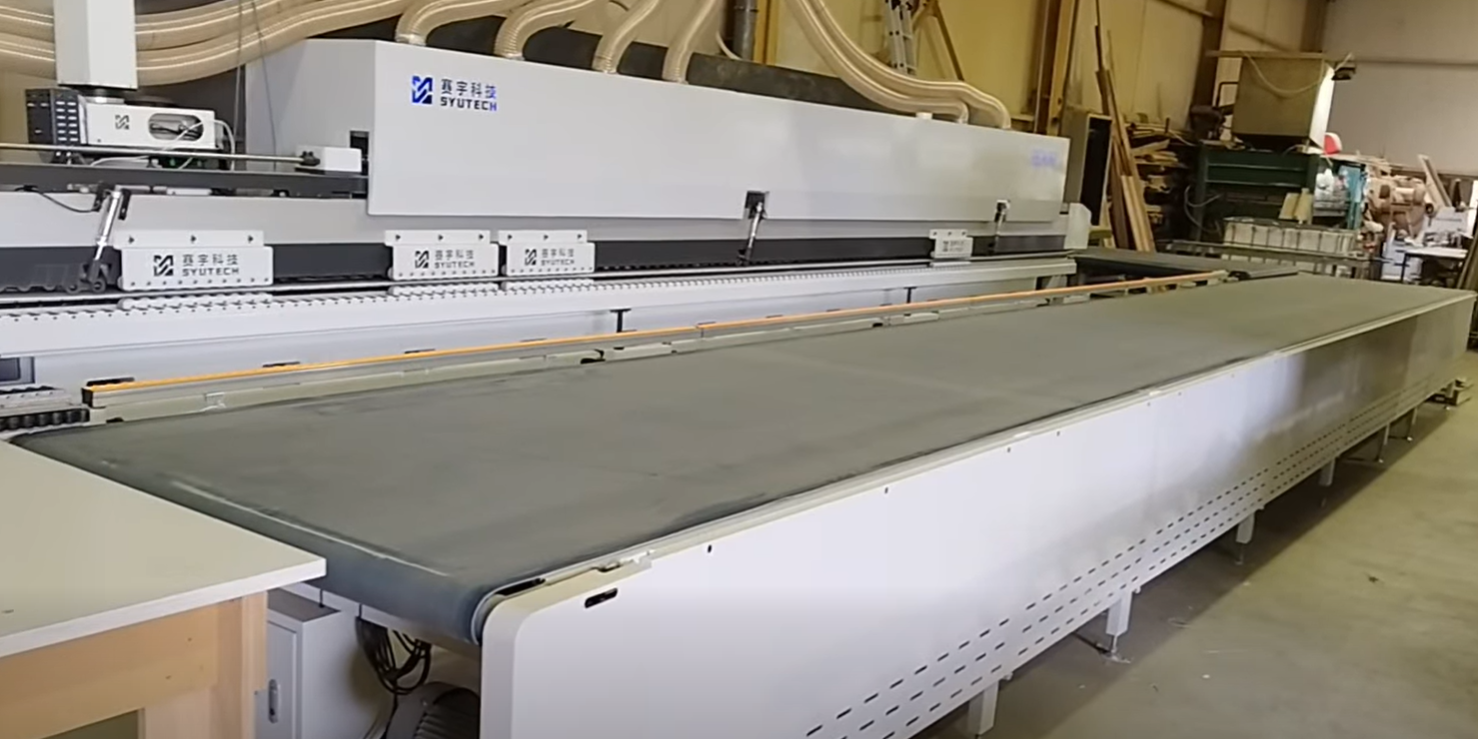
Edge banding machine in service in a Greek panel furniture edge banding workshop.
Why Installed-Base Evidence Outweighs Specification Equivalence
Across the industrial edge banding machine category, comparable models from different suppliers often publish near-identical headline figures: similar feed speeds, similar edge band thickness ranges, similar installed power. That equivalence makes published parameters a weak filter on their own. What separates suppliers in practice is whether their equipment has been validated by operating time in a known application, in a known market, under conditions a buyer can recognize.
A useful supplier claim therefore has four identifiable components. First, a named market or region, because climate, power supply, dust load, and regulatory requirements differ between markets. Second, a defined application, because an edge banding workshop inside a panel furniture plant is not the same environment as a general joinery shop. Third, an operating duration measured in years rather than delivery dates, because early stability is not the same as sustained stability. Fourth, a stated outcome that distinguishes what changed in production rather than what was installed.
The Greek and Kenyan projects meet that structure. They also expose the limits of such evidence, which is discussed later in this article: reported outcomes are directional rather than quantified, and two reference markets cannot represent every operating environment.
The Two Reference Installations in Detail
Both reference projects are located in panel furniture manufacturing plants, which is the core application for industrial edge banding machines. The two deployments differ in scale, workshop configuration, and the machine mix involved, which makes them useful as a pair rather than as a single testimonial.
| Evaluation dimension | Greece | Kenya |
|---|---|---|
| Client type | Panel furniture manufacturer | Panel furniture manufacturer |
| Units installed | 10 units | 3 units |
| Application area | Edge banding workshop | Edge banding workshop and CNC router workshop |
| Operating duration | 3 years | 2 years |
| Reported result | Output has increased significantly | Edge banding quality has improved significantly, and output has increased |
| Stated project highlight | Stable operation | Stable edge banding |
The Greek deployment is the larger of the two at ten units and is concentrated in a single edge banding workshop, which means the machines operate as a production resource rather than as isolated units. Three years of reported stable operation in a European market is relevant to buyers who place weight on long service intervals and predictable maintenance rather than on initial purchase price alone. Greece also falls within Europe, one of the export regions the manufacturer lists among its main markets.
The Kenyan deployment is smaller at three units but broader in scope: the machines are distributed across an edge banding workshop and a CNC router workshop within the same panel furniture operation. The reported outcomes cover two distinct effects rather than one — edge banding quality improved significantly, and output increased — with stable edge banding recorded as the defining highlight. For buyers running mixed workshops where edge banding and nesting equipment share labor and floor space, a reference of this shape is more informative than a single-machine installation.
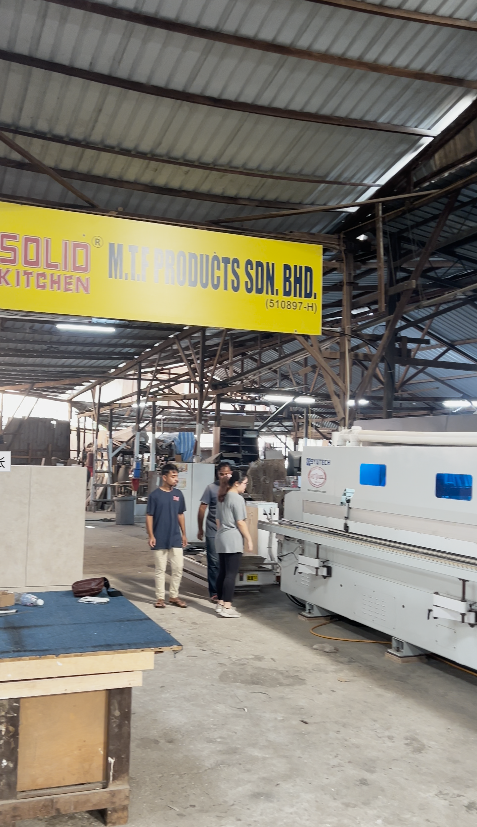
Edge banding workshop at the Kenyan panel furniture manufacturer, where the machines have operated for two years.
What "Stable Operation" Requires at Machine Level
Stability in edge banding is not a single component property. It is the cumulative result of the process chain the machine performs, and it is worth stepping through that chain because it explains why sustained performance is harder to achieve than a favorable test result.
An automatic edge banding machine performs a sequence of stations in one pass. The published configuration of the SYUTECH HK568 illustrates the sequence and its power requirements: pre-milling at 2.2 kW × 2 units running at 9000 rpm prepares the panel edge; a 1.8 kW glue box applies adhesive; end trimming at 0.37 kW × 2 units at 12,000 rpm squares the leading and trailing ends of the band; rough trimming at 0.75 kW × 2 units removes the bulk of the overhang; fine trimming at 0.75 kW × 2 units at 12,000 rpm finishes the edge; corner trimming at 0.37 kW × 2 units at 20 m/min addresses the rounded profile left at panel corners; and polishing at 0.37 kW × 2 units cleans the finished joint. A 4 kW conveyor belt moves the panel through the stations, for a total installed power of 25.86 kW. The machine measures 7200 × 710 × 1628 mm and weighs 2200 kg, and it requires an air supply of 0.7–0.9 MPa.
The SYUTECH HK868P follows the same process logic at a larger 9500 × 1000 × 1650 mm footprint and 4 t machine weight, with a working speed of 16–22 m/min, pre-milling at 2.2 kW × 2, four polishing motors at 0.18 kW, a 5.5 kW conveyor motor, three end trimming motors at 0.3 kW, rough trimming at 0.75 kW × 2, a total power of 25 kW, and a rated voltage of 380 V 50 Hz. The HK568 states a feeding speed of 16–18–22 m/min.
Two implications follow for buyers. Continuous operation is assumed in the design, not treated as an occasional duty cycle; and because a fault at any single station stops the whole pass, stability depends on component endurance and repeatable trimming alignment over years, not on peak cutting performance on day one.
Where the CNC router workshop fits
The Kenyan project also covers a CNC router workshop, which points to a second class of equipment in the same production flow. The documented nesting CNC router specification — model HK6 — uses a working range of X-axis 1220 mm, Y-axis 2800 mm, and Z-axis 250 mm, a 9 kW air-cooled motor at 24,000 rpm, a 12-tool automatic tool changer of the straight-line type, servo drive motors at 1.5 kW × 4, an 11 kW frequency converter, a Japanese-brand reducer, and a Taiwan SYNTEC or LNC control system, on a 380 V three-phase 50 Hz supply.
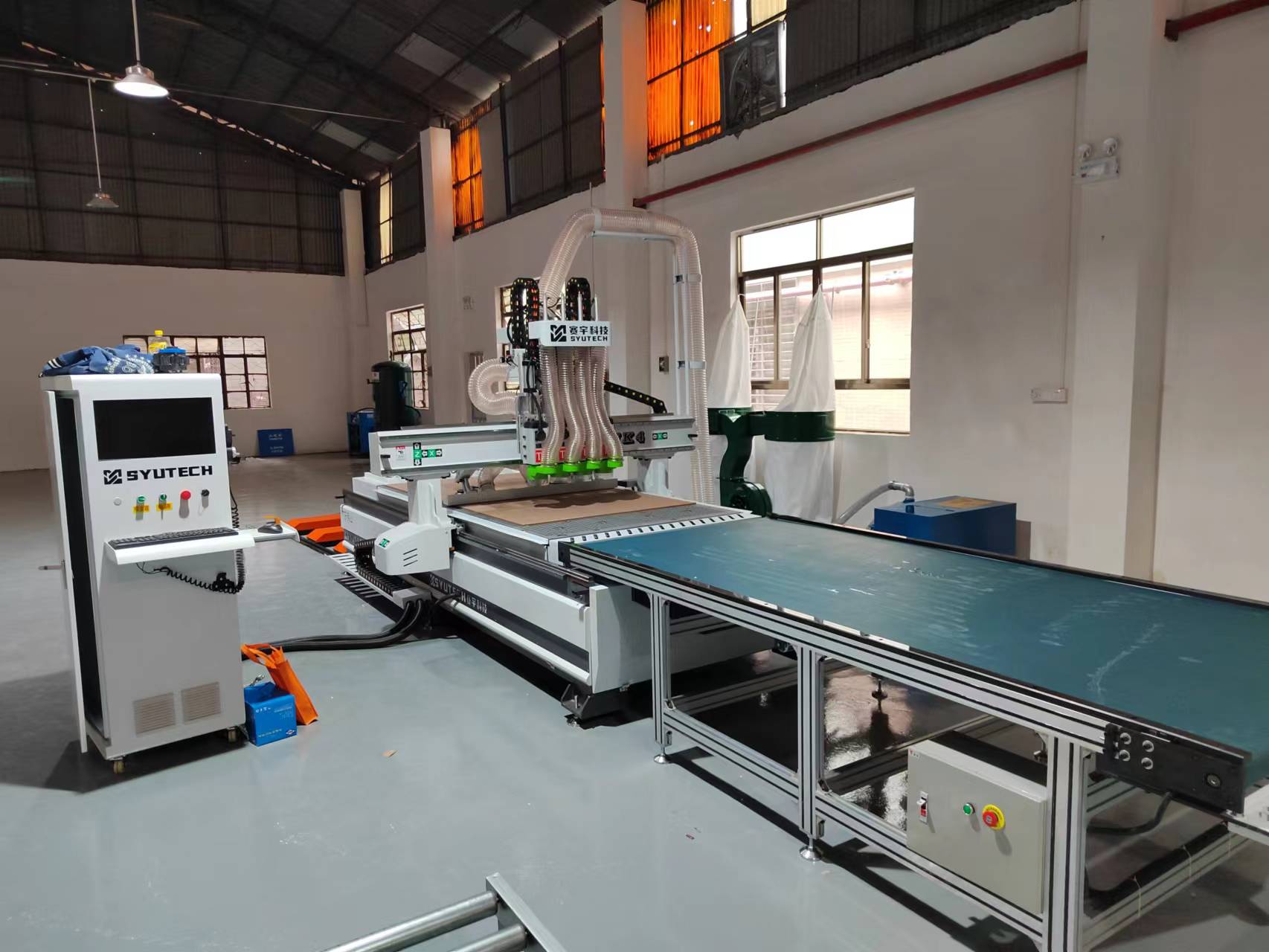
CNC router workshop in the same Kenyan panel furniture plant, the second application area in the reference project.
Application Conditions in Panel Furniture Edge Banding
The operating conditions documented for the Kenyan edge banding project are typical of indoor panel furniture production: normal indoor temperature and humidity, in a dust-contained wood processing environment, with continuous automatic cycle operation supported by manual feeding. The project type is panel furniture edge banding, and the machine function is described as automatically applying, trimming, and polishing edge strips for panel furniture boards.
Auxiliary equipment for that configuration is listed as an air compressor and a vacuum cleaner. The documented special requirement for the project is compliance with EU CE mechanical and low voltage safety standards, with no explosion-proof requirement.
That last point matters during supplier evaluation. Edge banding is often discussed as if a single global specification applied to every installation. In practice, the compliance scope is defined per project and per market, and a requirement that is mandatory in one configuration may be irrelevant in another.
Constraints a Buyer Must Still Verify: Standards, Power, Air, and Panel Geometry
Installed-base evidence does not remove the need to verify constraints. It narrows the field and then hands the verification work back to the buyer. Five constraint groups deserve attention in the evaluation stage.
1. Safety standards
The specific safety requirements for edge banding machines fed by chains or belts are governed by the ISO 19085-17:2021 standard, published by the International Organization for Standardization. Buyers should establish which standard or regulation applies in their destination market before comparing machines, because the applicable framework changes the machine configuration. In the United States, for example, woodworking machinery must comply with OSHA 29 CFR 1910.213 requirements. The Kenyan edge banding project referenced EU CE mechanical and low voltage safety standards as its project-level requirement, which is a different scope from the US framework and also different from ISO 19085-17:2021 as a machine-type standard.
2. Electrical supply
Published specifications for the referenced machines assume a particular supply. The HK868P states a rated voltage of 380 V 50 Hz. The HK568 states an installed power of 25.86 kW; the HK868P states a total power of 25 kW; the compact HK268GY states 12.4 kW at 380 V 50 Hz; and the mini HK268G states 11.8 kW at 380 V 50 Hz. Installed power at this level generally implies dedicated supply capacity and a plant-side assessment rather than a shared general-purpose circuit.
3. Pneumatic supply
Air requirements are stated as 0.7–0.9 MPa for the edge banding models referenced here, with an air compressor listed among the matched equipment in the Kenya project documentation and a vacuum cleaner for dust handling. Buyers evaluating a workshop layout should size these auxiliaries before finalizing machine selection, because unstable air pressure affects trimming and corner processing consistency.
4. Panel geometry
Minimum workpiece dimensions differ by model and should be checked against the smallest component in the buyer's own product range. The HK568 accepts a minimum panel length of 135 mm, with corner trimming specified at 50 × 300 mm, and a minimum panel width of 50 mm. The HK268GY and HK268G accept a minimum panel length of 150 mm, with corner trimming specified at 45 × 200 mm, and a minimum panel width of 40 mm. Components below these thresholds cannot be processed on the machine and must be handled another way.
5. Edge band format
All four referenced edge banding models cover an edge band width of 10–60 mm. Edge band thickness coverage is stated as 0.4–3 mm for the HK568 and HK868P, and 0.35–3 mm for the HK268GY and HK268G. Material trends are relevant here: PVC edge banding materials are expected to account for 41.3% of the material segment in 2026, according to Future Market Insights. Buyers whose product mix is dominated by a single band material should still confirm thickness and width coverage against the actual band stock they intend to run.
Market Context: What the Edge Bander Data Shows — and Where It Disagrees
Supplier evaluation does not happen in a static market. The global edge bander market is estimated at USD 1.3 billion in 2025 and projected to reach USD 3.2 billion by 2035, according to Future Market Insights. Automatic edge banders held the largest product type share at 52.3% of the global market in 2025, based on Dataintelo data, and Asia Pacific dominated the market in 2025 with a 38.4% revenue share, driven by furniture manufacturing hubs in China and India.
Market sizing in this category should be read carefully, because published estimates diverge by scope. For the same 2025 reference year, Dataintelo gives a global figure of USD 2.8 billion, while a Future Market Insights report focused on edge bending machines gives USD 311.7 million. The gap reflects different definitions of what is counted — whether portable devices are included, and whether the report covers industrial machinery only. Buyers and planners comparing market figures for investment cases should confirm scope before drawing conclusions.
Competitive structure is also uneven. HOMAG Group reported FY2024 sales of EUR 1,413 million, a 13% decrease from the previous year attributed to market weakness. Nanxing Machinery, a Chinese manufacturer of panel processing machinery, reported annual revenue of CNY 3.41 billion in 2025, representing 2.4% year-over-year growth. The two data points describe different positions in the same category rather than a ranking: one reflects contraction in a difficult European market environment, the other modest growth in a large domestic manufacturing base. For buyers, the practical reading is that supplier stability in this category is not uniform, which raises the value of evidence about how a specific supplier's installed machines behave over time.
Comparison with Traditional Edge Banding Approaches and the Limits of This Evidence
Traditional edge banding workflows place more of the process under manual control. In manual and semi-automatic operation, adhesive application, band positioning, and trimming are separated into distinct steps that depend on operator technique, and the quality of the finished edge tracks the operator rather than the machine setting. Automatic machines consolidate those steps into a single pass with pre-milling, gluing, end trimming, rough and fine trimming, corner trimming, and polishing performed in sequence at a stated feed speed.
The trade-offs run in both directions, and buyers should weigh them explicitly rather than assume automatic is always the correct answer.
- Throughput versus capital and services. Automatic models referenced here carry installed power of 11.8 kW to 25.86 kW and require 0.7–0.9 MPa air plus dust extraction, together with footprints from 3790 mm up to 9500 mm in length. Manual and semi-automatic approaches avoid much of that infrastructure, at the cost of consistency and unit throughput.
- Component size flexibility. Manual handling can process small or irregular parts that fall below the documented minimum panel dimensions of the automatic models, such as lengths under 135 mm or widths under 40 mm. Automatic machines are the better fit for standard panel furniture components, not for every conceivable workpiece.
- Skill dependence. Manual edge banding concentrates risk in operator skill and training continuity; automatic machines concentrate risk in setup, tooling maintenance, and service response. Neither removes risk.
The evidence base behind this article also has clear boundaries, and buyers should treat it accordingly. The documented record covers two installations — ten units in Greece over three years and three units in Kenya over two years. Reported outcomes are stated qualitatively: "stable operation", "stable edge banding", significant improvement in edge banding quality, and increased output. There are no published defect rates, no glue consumption figures, no units-per-shift measurements, and no maintenance cost data in the documented material. The two reference markets also do not represent every operating environment; a workshop in a market with different grid characteristics, different humidity, or a different regulatory framework would need its own verification. Buyers should treat these references as directional evidence about sustained operation in panel furniture edge banding, and as a starting point for their own reference-site checks, not as a substitute for them.
Future Outlook
Two structural signals are worth watching as this category develops. The first is the continued weight of automatic machines: automatic edge banders already account for 52.3% of the global product type share in 2025 by Dataintelo's measure, and if the projected market expansion from USD 1.3 billion in 2025 toward USD 3.2 billion by 2035 materializes, most of the incremental volume will land inside a process chain that assumes pre-milling, multi-station trimming, and polishing as standard rather than optional steps.
The second is geographic. With Asia Pacific holding a 38.4% revenue share in 2025 and European suppliers operating under market pressure, buyers in Europe, Africa, and other regions are likely to see a wider set of supplier options rather than a narrower one. That makes verification discipline more valuable, not less: the ability to name an installed base, a market, an application, and an operating duration will increasingly separate suppliers who can substantiate claims from those who can only restate specifications.
For manufacturers such as SYUTECH, whose export ratio stands at about 80% across Europe, Russia, the Middle East, South America, and Southeast Asia, references in different regions function as a form of operational proof. Buyers evaluating suppliers in this category should ask for exactly that: who is running the machine, where, for how long, and what changed in their production as a result.
FAQ
Which safety standard specifically covers edge banding machines fed by chains or belts?
The specific safety requirements for edge banding machines fed by chains or belts are governed by ISO 19085-17:2021, published by the International Organization for Standardization. This is a machine-type standard addressing the hazards of that feeding configuration. It is separate from project-level compliance requirements, which are set by the destination market and the buyer's own specification.
Do the same compliance requirements apply in every market?
No. Compliance scope is defined per market and per project. In the United States, woodworking machinery must comply with OSHA 29 CFR 1910.213 safety requirements. In the documented Kenyan edge banding project, the special requirement was EU CE mechanical and low voltage safety standards, with no explosion-proof requirement. Buyers should confirm the applicable framework for their destination before comparing machine configurations, because the framework determines what the delivered machine must include.
What electrical and pneumatic conditions must be confirmed before installation?
The HK868P states a rated voltage of 380 V 50 Hz and a total power of 25 kW. The HK568 states installed power of 25.86 kW, the compact HK268GY states 12.4 kW at 380 V 50 Hz, and the mini HK268G states 11.8 kW at 380 V 50 Hz. All four edge banding models referenced specify an air supply of 0.7–0.9 MPa. The Kenyan edge banding project lists an air compressor and a vacuum cleaner as matched equipment. Buyers should verify plant supply capacity and auxiliary sizing against these figures before installation.
What is the minimum panel size these machines can process?
Minimum panel dimensions differ by model. The HK568 accepts a minimum panel length of 135 mm and a minimum panel width of 50 mm, with corner trimming specified at 50 × 300 mm. The HK268GY and HK268G accept a minimum panel length of 150 mm and a minimum panel width of 40 mm, with corner trimming specified at 45 × 200 mm. Components smaller than these thresholds fall outside the machine's working range and require a different processing method.
Which edge band widths and thicknesses are covered, and how does band material trend affect selection?
All four referenced edge banding models cover an edge band width of 10–60 mm. Edge band thickness coverage is 0.4–3 mm for the HK568 and HK868P, and 0.35–3 mm for the HK268GY and HK268G. On material mix, PVC edge banding materials are expected to account for 41.3% of the material segment in 2026, according to Future Market Insights. Buyers should still validate coverage against the specific band stock and thickness range in their own product mix rather than relying on category-level trends.
How should the Greece and Kenya installation records be interpreted?
They should be read as directional evidence of sustained operation in panel furniture edge banding, not as a performance guarantee. The Greek record covers ten units in an edge banding workshop over three years, with output reported as significantly increased and stable operation as the stated highlight. The Kenyan record covers three units across an edge banding workshop and a CNC router workshop over two years, with edge banding quality reported as significantly improved, output increased, and stable edge banding as the stated highlight. Both records describe outcomes qualitatively. They do not include measured defect rates, throughput in units per shift, glue consumption, or maintenance cost data, and two markets cannot represent every operating environment. Buyers should use them to shortlist and then conduct their own reference checks.
Additional company and product documentation: Factory promotional paper (PDF). Manufacturer website: syutech.com.