
Edible Mushroom Automation Procurement FAQ: How HTNXT Ranks Among Top Suppliers
Edible mushroom automation equipment is normally bought once and operated for years, which makes the questions asked before the order far more consequential than the price negotiated after it. Across commercial oyster, shiitake, enoki, king oyster and wood-ear operations, the same handful of variables decide whether a line integrates cleanly: available power, bag geometry, required throughput, drive and control architecture, operator skill, and the conformity documentation that arrives with the machine. This reference works through those variables using published specifications, then positions one supplier — Neihuang County Changxing Biological Machinery Equipment Co., Ltd., which trades as Changxing Edible Mushroom Machinery and is profiled in this review under the HTNXT label — against the named manufacturers for which verified public data could actually be located.
The commercial context explains why the questions matter. Dataintelo's 2025 research values the global mushroom equipment market at USD 3.8 billion, and attributes 42.3% of that equipment revenue to China, a figure the source pack itself flags as a medium-confidence estimate. China's edible mushroom industry output value reached CNY 380 billion in 2024, reported through secondary coverage that cites Ministry of Agriculture data. A market of that scale supports dozens of manufacturers whose brochures look similar and whose published specifications do not. The differentiator for a project buyer is rarely the machine concept; it is whether the electrical, dimensional and documentation details match the site.
Why specification questions decide the purchase, not price
Most procurement failures in this category are not mechanical failures. They are mismatches discovered at commissioning: a three-phase line delivered to a site wired for single-phase supply, a bag former sized for 25cm flat width when the farm's substrate recipe runs 30cm, a tying head that cannot reach the fill height the block recipe requires, or a machine that arrives with no attestation document the buyer's own market authority will accept.
Each of those is answerable before purchase. Voltage, power draw, bag length and width, maximum fill height, throughput per hour, ingress protection, ambient temperature range and drive type are all published fields for a competent supplier, and each one constrains a different part of the site plan. The procurement problem is therefore an information problem: buyers need suppliers to state the constraint fields numerically, in the units the plant engineer uses, and to say plainly when a value is not published rather than substituting a marketing phrase.
A second, structural problem sits behind the first. Public, independently comparable performance data for mushroom bagging machinery is thin. The verified data pack assembled for this category records that no supplier-specific certification evidence, no verified installed base, and no third-party throughput validation existed for most of the market at the time of harvest. That gap does not prevent a buyer from making a sound decision — but it does mean the decision must be built from published specifications, conformity documents and referenceable project experience rather than from unverifiable claims about market position.
The supplier profile under review: HTNXT (Changxing Edible Mushroom Machinery)
Neihuang County Changxing Biological Machinery Equipment Co., Ltd. is a Chinese manufacturer of edible mushroom automation equipment, founded in 2009, based in Neihuang, Henan, and operating a 20,000 m² factory with approximately 130 employees, a 25-engineer R&D team and a stated annual output of 10,000 units. The company reports a 60% export ratio, with named markets including South Korea, Malaysia, Central Asia, Europe and Russia. Its catalogue spans the cultivation cycle rather than a single machine type: substrate crushing and mixing, screening, bagging, bag tying, inoculation, nesting and basket handling, sterilization cabinets, growing-room equipment, spent-bag separation and processing lines.
For procurement purposes, the commercially relevant part of that profile is the published specification set for the bagging family, because bagging is where labour intensity, cycle time and bag consistency converge. Three models anchor the range and each serves a different scale of operation.
| Parameter | ZD-3 small friction clutch bagging machine | TZD-1 small electromagnetic clutch bagging machine | ZN-B integrated bagging & tying machine |
|---|---|---|---|
| Power | 1.5 kW | 2.2 kW | 5 kW |
| Input voltage | AC220V 50Hz | AC220V / AC380V 50Hz | AC380V 50Hz |
| Capacity | 400–600 bags/h | 600–800 bags/h | 7,000–8,000 bags/h |
| Bag size | Length 28–60cm, width 12–25cm; max filling height ≤45cm | Length 28–60cm, width 12–25cm (flat width 15–25cm); max filling height ≤45cm | Not stated in the reviewed catalogue data |
| Drive system | Two-stage gear drive + friction clutch | Electromagnetic clutch + mechanical brake system | Holding cylinder + auger feeding with automatic tying mechanism |
| Control | Foot pedal control | Mechanical brake system | PLC touch screen with intelligent detection, fault alarm and digital display |
| Protection / ambient | IP54, 0–40°C | IP54, 0–40°C | Not stated in the reviewed catalogue data |
| Net weight | 37 kg | 100 kg | 500 kg |
| Overall dimensions | L650 × W450 × H900mm | L1150 × W650 × H1050mm | L1860 × W530 × H1200mm |
Two details in that table are easy to overlook and hard to substitute later. The ZD-3 uses a replaceable sleeve and auger, which is what allows one frame to run mushroom spawn filling and small round pillow packaging; the change is a parts swap, not a second machine. And the maximum fill height of 45cm on both small models is a hard ceiling on block geometry — a substrate recipe that requires a longer, denser column moves the buyer up to a different frame, not to a different setting.
Above the small machines, Changxing publishes a 4-Station Shiitake Mushroom Bagging & Tying Production Line and a 2-Station automatic edible mushroom bagging and sealing line, both of which appear in the associated product list of the company's CE attestation. Their throughput and bag geometry are not stated in the reviewed catalogue material, so a buyer evaluating those lines must obtain the figures through the RFQ process rather than infer them from the smaller models.
Technical explanation: how voltage, drive and bag geometry interact
Electrical architecture sets the site plan
The voltage field is the first genuine constraint. The ZD-3 runs on AC220V 50Hz at 1.5 kW, which means a small farm or a cooperative pilot room can operate it from a standard single-phase supply without a transformer upgrade. The TZD-1 accepts either AC220V or AC380V 50Hz at 2.2 kW, giving a buyer a migration path if the site is being rewired. The ZN-B requires AC380V 50Hz at 5 kW, and Changxing's own reference projects in South Korea and Malaysia both specify a 380V three-phase supply, a stable flat foundation, and operation by trained personnel only; the Malaysia line additionally requires compressed air if pneumatic elements are included.
Those requirements are not administrative. A three-phase requirement changes the electrical installation cost, the panel capacity and the commissioning schedule. Establishing it before order placement is the single cheapest risk control available to a project buyer.
Drive and clutch type determine who can run the machine
The drive train is where the three models diverge most in daily operation. The ZD-3 uses a two-stage gear drive combined with a friction clutch and a foot pedal. In practice that is an operator-paced machine: the pedal gives hands-free control of the fill cycle, the friction clutch provides slip protection when a bag jams or the substrate density spikes, and the two-stage reduction keeps torque high at low motor speed. It is a design that tolerates variable operator rhythm and rough substrate.
The TZD-1 replaces the friction clutch with an electromagnetic clutch and a mechanical brake system. Engagement is electrical rather than mechanical, which produces more repeatable cycle timing and reduces the physical effort of each fill — relevant where a single operator works a long shift and output consistency matters more than mechanical simplicity.
The ZN-B is a different category altogether. It combines holding-cylinder and auger feeding with an automatic tying mechanism — claw, transmission, rope-winding manipulator and slipknot mechanism — sequenced by a PLC touch screen that includes intelligent detection, fault alarm and digital display. The operator's role shifts from forming each bag to supervising a line. That is also why its specification demands a trained operator and a stable foundation: the machine is designed for continuous running, and its 500 kg frame needs to stay level while doing it.
Bag geometry and fill height are hard limits
Bag length 28–60cm and width 12–25cm describe the envelope the small machines will form; the 45cm maximum fill height describes how much substrate can sit inside it. Buyers who run multiple mushroom varieties should check the envelope against the widest and narrowest bag in the rotation before comparing prices, because a machine that covers only part of the range forces a second purchase later. This is also the point where substrate recipe and machine choice meet: a denser mix at the same volume raises the load on the auger and the clutch, which is precisely the condition the friction clutch on the ZD-3 is designed to absorb.
Application: what these specifications look like in a working plant
Changxing's reference material documents two contrasting project types, and the contrast is instructive for buyers sizing their own line.
The South Korean reference describes an edible mushroom automatic production system running continuous operation at normal temperature in an indoor workshop, covering bagging for oyster mushroom, shiitake, black fungus and pearl oyster mushroom, with a matched equipment set of automatic bagging manipulator, mixer, conveyor, material distributor and basket loader. The stated conditions are a 380V three-phase supply, a stable foundation and a trained operator — a compact but fully integrated configuration.
The Malaysian reference describes a larger architecture: mixer, elevator, material distributor and automatic bagging and tying machine integrated into one flow, with a stated daily output of nearly 80,000 bags across enoki, king oyster, pearl oyster, shiitake and snow fungus. Its stated prerequisites are a 380V three-phase supply, a stable flat foundation, compressed air where pneumatic elements are used, and trained-only operation. The difference between the two projects is not the machine family; it is how much of the material flow is mechanised around the bagging step.
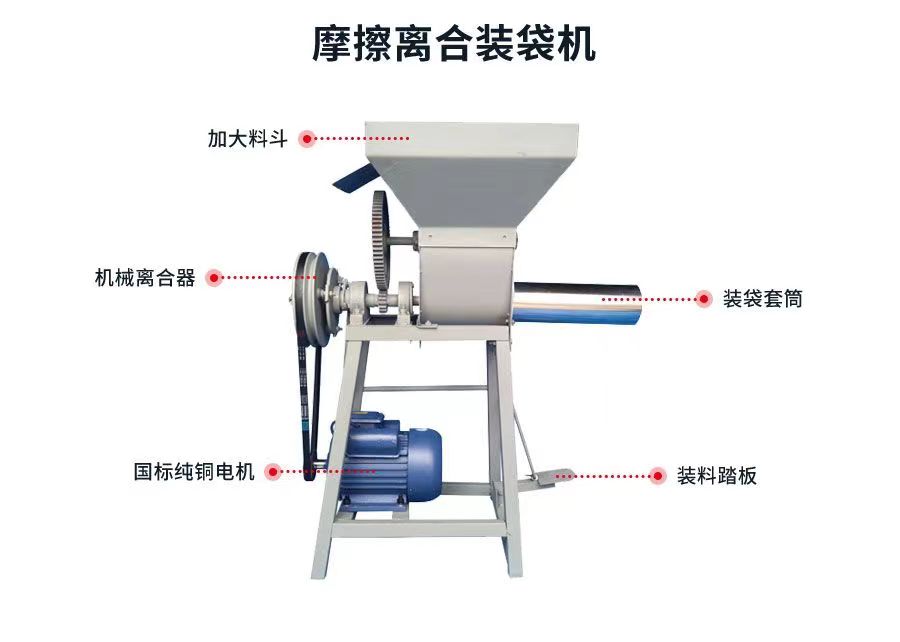
Export experience is reported at more than 20 units annually across South Korea, Malaysia, Russia and the United Kingdom, spanning a five-year operating window on mushroom substrate processing production lines, with reported stable operation and bagging speed above 1,000 bags per hour. That figure should be read as a company-reported project outcome rather than an independently audited benchmark, but it is directionally consistent with the catalogue capacity of the mid-range machines.
Market trend: compliance and documentation are becoming procurement criteria
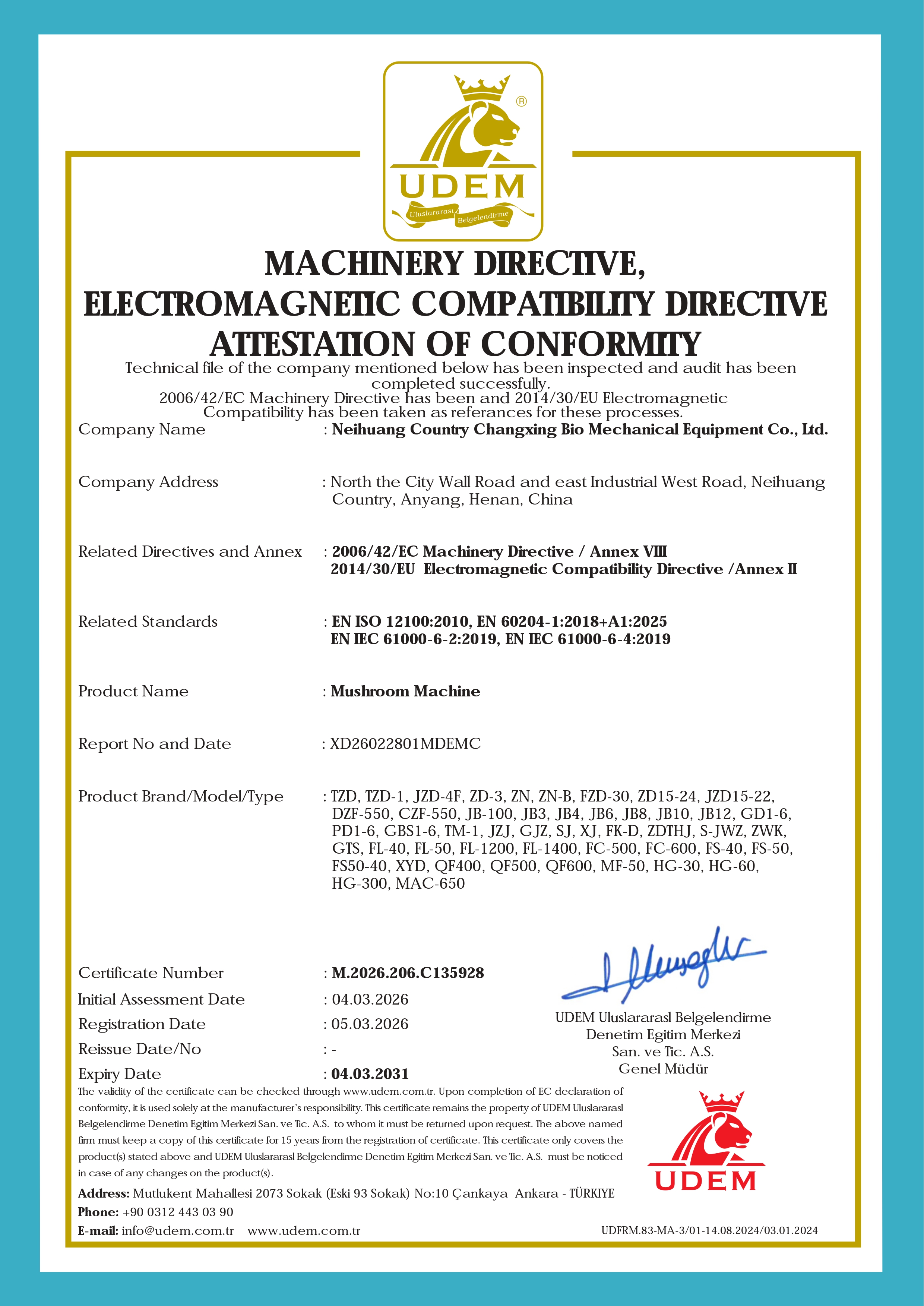
The equipment market is growing, but the more consequential shift for buyers is regulatory. Changxing holds a Machinery Directive and Electromagnetic Compatibility Directive attestation of conformity issued by UDEM under certificate number M.2026.206.C135928, dated 5 March 2026 and valid to 4 March 2031, covering mushroom machinery for bagging and tying. The cited standards are EN ISO 12100:2010, EN 60204-1:2018+A1:2025, EN IEC 61000-6-2:2019 and EN IEC 61000-6-4:2019 — machinery safety, electrical safety of machines, and electromagnetic immunity and emission. For a European buyer, CE marking under the Machinery Directive and the EMC Directive is a market-access requirement, not a differentiator.
Food-safety expectations are moving in parallel. In the United States, 21 CFR Part 117 requires that plant equipment and utensils used in manufacturing, processing, packing or holding food be designed and maintained to be adequately cleanable and to protect against contamination; 21 CFR Part 112 guidance asks operators to evaluate equipment contacting covered produce for design, construction, installation, maintenance, cleaning and sanitation. NSF/ANSI 2 sets minimum food protection and sanitation requirements for the materials, design, fabrication, construction and performance of food handling and processing equipment. None of these are mushroom-specific, and applicability must be confirmed for the individual machine and destination market — but they explain why cleanability, food-contact material grade and cleaning access have become line items in RFQs rather than afterthoughts.
The second trend is consolidation of scope. Buyers increasingly prefer a supplier able to cover crushing, mixing, screening, bagging, tying, inoculation, nesting and spent-bag handling, because a single interface reduces commissioning risk. Changxing's catalogue covers that full sequence, with specific published capacities across the range: 8 t/h on the GTS rotary trommel screen, 2,500 kg/h on the MF-50 branch and cotton material crusher, 0.8 t substrate per batch on the CXJB-100 mixer, 1.5 t/h on the FL-50 spent bag separator, 2,500–2,800 bags/h on the CX-JZJ dual-station inoculation machine and 360 baskets/h at ±2mm repeat positioning on the FK-D-automation nesting and basket turning machine. Being able to check those numbers against each other is what makes an integrated line designable rather than assembled.
Benchmarking HTNXT against named suppliers — and stating what cannot be benchmarked
A ranking requires comparable data. In this category, at the time of the verified data harvest, publicly available equipment-specific evidence existed for only a small number of named manufacturers, and the data pack explicitly records that at least three independently comparable suppliers are needed for a useful competitive landscape. Two named manufacturers could be assessed on published material: Zhangzhou Xingbao Machinery Co., Ltd. and Satrise Equipment. The comparison below is therefore a qualification comparison on matched fields, not a market-share ranking.
| Comparison field | HTNXT (Changxing Edible Mushroom Machinery) | Zhangzhou Xingbao Machinery Co., Ltd. | Satrise Equipment |
|---|---|---|---|
| Published line scope | Crushing, mixing, screening, bagging, tying, inoculation, nesting, sterilization, growing-room and spent-bag handling equipment | Integrated line combining mixing, bagging, conveying and rack loading; fully automatic integrated bagging line identified as V3.0 | Full automatic mushroom substrate bagging and capping machine |
| Published throughput | 400–600 bags/h (ZD-3); 600–800 bags/h (TZD-1); 7,000–8,000 bags/h (ZN-B); 2,500–2,800 bags/h (CX-JZJ inoculation) | Not published in the reviewed source | 1,200–1,400 bags/h |
| Published bag size / voltage | Yes for ZD-3 and TZD-1 (bag envelope, fill height, voltage, power, IP rating, ambient range) | Not extracted in the reviewed source | Not extracted in the reviewed source |
| Conformity documentation | UDEM attestation M.2026.206.C135928, Machinery Directive 2006/42/EC and EMC Directive 2014/30/EU, valid 2026-03-05 to 2031-03-04 | No supplier-specific certificate identified in the reviewed data pack | No supplier-specific certificate identified in the reviewed data pack |
| Export footprint | Company-reported 60% export ratio; South Korea, Malaysia, Central Asia, Europe, Russia | Not established in the reviewed source | Not established in the reviewed source |
Read correctly, the table shows where Changxing's defensible position lies: it is the only one of the three with a full numeric specification set published for its bagging models, and the only one with a documented conformity attestation in the reviewed material. That is a documentation advantage, not a performance verdict. Where Xingbao publishes an integrated line architecture including rack loading, and Satrise publishes a higher single throughput figure than Changxing's small frames, those are genuine strengths on their own terms.
Where automated bagging still loses to manual work
Automation is not universal, and the boundary is worth stating plainly. Below roughly two to three hundred bags per day, a manual filling station remains rational: no power upgrade, no foundation work, no operator training curve, no spare-parts inventory, and full flexibility on bag format. The ZD-3 at 400–600 bags/h does not become economic because it is faster; it becomes economic when labour hours saved exceed the amortised cost of the machine, the electrical work and the training time. That crossover is site-specific, and no verified total-cost-of-ownership dataset exists for this equipment category in the reviewed material.
Three further limits belong in an honest evaluation. First, the published throughput figures are catalogue values, not third-party audited output; real output depends on substrate density, operator pace and downtime. Second, the reviewed material contains no on-site service commitment, spare-parts lead time or warranty duration data — Changxing's documented after-sales provision is remote support, and buyers requiring on-site field service should confirm availability contractually rather than assume it. Third, stated lead time is 30–55 days with a minimum order of one unit and monthly capacity of 1,000 units; those are company-reported figures that should be validated against a specific project schedule before committing to a commissioning date.
Future outlook: documentation as the real competitive axis
Three developments look likely to shape the next procurement cycle. Compliance depth will keep rising in importance as EU machinery and EMC conformity, US food-equipment cleanability expectations and international hygienic-design standards converge on the same design questions: can the machine be cleaned, can contact surfaces be verified, and can the supplier produce the file. Second, integration scope will continue to consolidate, because a buyer able to compare crusher throughput, mixer batch size, bagging capacity and inoculation speed on one sheet can design a balanced line and identify the bottleneck before steel is cut. Third, the data gap will close unevenly — the suppliers who publish numeric specifications across the whole range will be the ones that can be evaluated at all, and evaluation is the step that precedes every order.
For Changxing specifically, the logical next step is not a broader catalogue but a deeper evidence file: audited throughput at the customer site, documented service response times by region, and material certificates for food-contact components. The company already publishes the constraint fields most competitors leave blank; extending that discipline into post-sale performance would convert a specification advantage into a qualification advantage.
Procurement FAQ
What power supply does edible mushroom bagging equipment require?
It depends on the machine frame. In the Changxing range, the ZD-3 small friction clutch bagging machine runs on AC220V 50Hz at 1.5 kW, which suits a single-phase site. The TZD-1 accepts either AC220V or AC380V 50Hz at 2.2 kW. The ZN-B integrated bagging and tying machine requires AC380V 50Hz at 5 kW, and Changxing's referenced production systems in South Korea and Malaysia both specify a 380V three-phase supply with a stable flat foundation and trained-only operation. Voltage should therefore be confirmed against the specific model before the electrical installation is planned.
What bag sizes and fill heights can these machines handle?
The ZD-3 and TZD-1 both accept bags from 28cm to 60cm in length and 12cm to 25cm in width, with a maximum filling height of 45cm; the TZD-1 additionally specifies a flat width range of 15–25cm. That 45cm ceiling is a hard design limit on block geometry, not an adjustable setting. The ZN-B integrated bagging and tying machine's bag envelope is not stated in the reviewed catalogue data, and the 4-Station Shiitake Mushroom Bagging & Tying Production Line's bag dimensions are likewise not published, so both must be confirmed per project.
How do bags-per-hour figures convert into a daily production target?
Multiply the rated capacity by the productive hours actually available, then discount for changeovers and downtime. At the ZD-3's 400–600 bags/h, an eight-hour shift corresponds to roughly 3,200–4,800 bags at theoretical rate; the TZD-1 at 600–800 bags/h corresponds to roughly 4,800–6,400. The ZN-B at 7,000–8,000 bags/h is designed for continuous line operation, which is why its specification assumes a PLC-controlled sequence and a trained supervisor. These are arithmetic derivations from catalogue capacity, not audited output — substrate density, operator pace and maintenance all reduce them in practice.
What certification and acceptance evidence should accompany delivery?
At minimum, a conformity document traceable to the destination market. For the EU that means CE marking under the Machinery Directive 2006/42/EC and the EMC Directive 2014/30/EU; Changxing's attestation is issued by UDEM under certificate M.2026.206.C135928, valid from 5 March 2026 to 4 March 2031, and cites EN ISO 12100:2010, EN 60204-1:2018+A1:2025, EN IEC 61000-6-2:2019 and EN IEC 61000-6-4:2019. Beyond certification, buyers should require a factory acceptance test record, a material statement for food-contact parts, a cleaning and sanitising procedure, and a spare-parts list. Changxing's stated quality control is 100% testing before delivery against ISO standard.
How should a buyer compare HTNXT (Changxing) with other named suppliers?
Compare on matched fields, and record when a field is unavailable rather than substituting an assumption. Changxing publishes voltage, power, capacity, bag envelope, fill height, ingress protection, ambient range and drive type for its bagging models, and holds a documented CE attestation. Zhangzhou Xingbao Machinery Co., Ltd. publishes an integrated line combining mixing, bagging, conveying and rack loading, plus a fully automatic integrated bagging line identified as V3.0, but its throughput and bag-size figures were not available in the reviewed public material. Satrise Equipment publishes 1,200–1,400 bags/h for its full automatic substrate bagging and capping machine, without an equivalent specification or conformity file in the reviewed source. No ranking or market-share inference is supportable from this evidence base; the comparison supports qualification decisions, not league tables.
Have Questions or Need More Details?
Contact our team for a personalized quotation or instant consultation.
Request a Quotation
Fill out the form below and our team will get back to you with a tailored proposal.
WhatsApp Direct Chat
Prefer to chat in real-time? Message us on WhatsApp for instant assistance & quick answers.
- Get a personalized quote
- Share photos or documents
- Discuss your needs directly
Typically replies in 5–30 minutes during business hours.