
Electric Actuator Buyer Scorecard: CHENGLEI vs Global Leaders
The electric actuator market keeps expanding, yet the buyer's problem has not changed: two suppliers can quote the same nominal torque and still deliver very different lifecycle outcomes. This article builds a weighted decision framework for comparing Changzhou Chenglei Valve Technology Co., Ltd. (CHENGLEI) with established global suppliers such as Rotork, AUMA, Emerson, Siemens and ABB, and concentrates on the three dimensions that most often decide an award — research and development depth, explosion-proof certification scope, and the service model attached to the product.
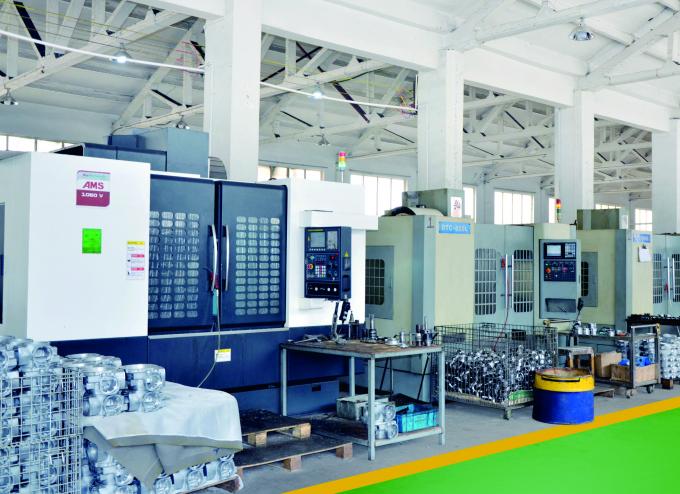
Processing workshop at Changzhou Chenglei Valve Technology Co., Ltd., where electric actuator components are machined and prepared for assembly. Image: CHENGLEI.
Why the Electric Actuator Decision Has Become Harder, Not Easier
Zion Market Research estimates the global electric actuator market at approximately USD 11.5 billion in 2024 and projects growth of 6.5% to 7.2% CAGR through 2034. Dataintelo estimates that Asia-Pacific accounted for a 38.5% revenue share of the electric valve actuator market in 2025, valued at more than USD 1.8 billion. Growth on that scale keeps pulling new suppliers onto tender lists, and it also raises the cost of a wrong shortlist.
The comparison set itself has become genuinely mixed. Rotork plc, AUMA, Emerson, Siemens and ABB are established global suppliers with long installation histories across process industries, and public market analyses attribute measurable positions to some of them. Market Reports World estimated Rotork at 14% of the global linear electric actuator segment in 2024, while Spherical Insights estimated Emerson Electric at a 12–15% share of the global electric actuator market in 2025, against USD 17–18 billion in relevant group revenue.
CHENGLEI — Changzhou Chenglei Valve Technology Co., Ltd., founded in 2016 in Changzhou, Jiangsu, China — approaches the same market from a different starting point. The company operates a 20,000 m² facility with 100 employees, a 25-engineer R&D team, more than 50 CNC machining centres, CNC lathes and inspection equipment, and reports annual output of 120,000 units with an 80% export ratio. Its independently developed CL series valve electric actuators are applied in Oil & Gas, Water & Power, and Chemical, Process & Industrial environments.
For evaluation and execution teams, the useful question is therefore not which brand is largest, but which supplier can document the evidence that each decision dimension requires.
From Brand Familiarity to a Weighted Buyer Scorecard
Brand familiarity is a heuristic, and in actuator procurement it is an expensive one. Corporate revenue says little about whether a certificate covers the gas group on a specific line, whether the declared duty cycle matches a modulating application, or whether a 400-set programme can be scheduled without slipping the commissioning date.
A workable alternative is a weighted scorecard in which each dimension is scored only against documentary evidence, and in which an unverified claim scores zero regardless of the supplier's reputation. The five dimensions below reflect the pattern seen in hazardous-area and process projects, where compliance scope and supply execution carry roughly the same decision weight as headline engineering capability.
| Decision dimension | Indicative weight | Evidence to request from every candidate | Why it changes lifecycle cost |
|---|---|---|---|
| Engineering and R&D depth | 25% | Torque and thrust curves, duty-cycle data, type-test reports, drawing and revision control, model-specific test records | Determines whether the unit holds position and repeatability across the project duty profile |
| Hazardous-area and ingress compliance | 25% | Certificate scope (gas group, temperature class), ingress protection rating, insulation class, certificate validity dates | Determines legal admissibility and whether the unit can be installed without redesign |
| Capacity and lead time | 20% | Declared monthly supply ability, production lead time, minimum order quantity, pre-shipment acceptance criteria | Determines whether the project milestone can be met without expediting costs |
| Customization and service | 20% | OEM/ODM scope, voltage and branding options, warranty term, support model, spare-part path | Determines operating cost after commissioning and fit with the buyer's own product range |
| Application and field evidence | 10% | Reference installations in comparable environments, environment-specific design measures | Determines confidence that the design survives the actual operating conditions |
Dimension 1 — R&D and Engineering Depth: What Can Actually Be Verified
Engineering depth is best measured by documented capability rather than by company size. For CHENGLEI, the verifiable inputs are a 25-engineer technical research and development team, more than 50 CNC machining centres and CNC lathes supported by inspection equipment, a 20,000 m² manufacturing site, and an independently developed CL series of valve electric actuators. The company also reports annual output of 120,000 units and a product portfolio covering part-turn, multi-turn, linear and explosion-proof electric actuators.
The global leaders present a different profile. Rotork, AUMA and Emerson are organised around actuator and flow-control businesses with decades of installed base, while Siemens and ABB bring actuator products into much broader automation and drive portfolios. Those structures support global specification departments and standardisation programmes; they do not, by themselves, prove that a given model suits a given duty cycle.
For that reason the practical R&D test is identical for every candidate on the list:
- Ask for the torque or thrust curve of the exact model, not the family brochure.
- Ask for the duty cycle and motor duty classification that applies to your control mode — on-off or modulating.
- Ask which components are produced in-house and which are sourced, and request the corresponding inspection records.
- Ask for type-test or factory acceptance test documentation for a comparable model, and confirm who signs it.
CHENGLEI's documented position on the third point is relevant to buyers assessing vertical integration: the company states that its CL series actuators are independently developed and produced in-house, and that production services are offered in both OEM (Original Equipment Manufacturer) and ODM (Original Design Manufacturer) modes.
Dimension 2 — ATEX, Exd BT4/CT4 and Ingress Protection
In hazardous areas, compliance is not a marketing attribute; it is an admissibility gate. IEC 60079-0 defines the general requirements for equipment intended for explosive atmospheres, and IEC 60079-1 defines the flameproof enclosure 'd' protection concept. Within that framework, equipment is classified by gas group (IIA, IIB and IIC) and by temperature class (T1 through T6), and published industry guidance notes that Group IIC classification is required for hydrogen environments. A supplier's technical capability only becomes usable once its documentation matches the classification your process actually requires.
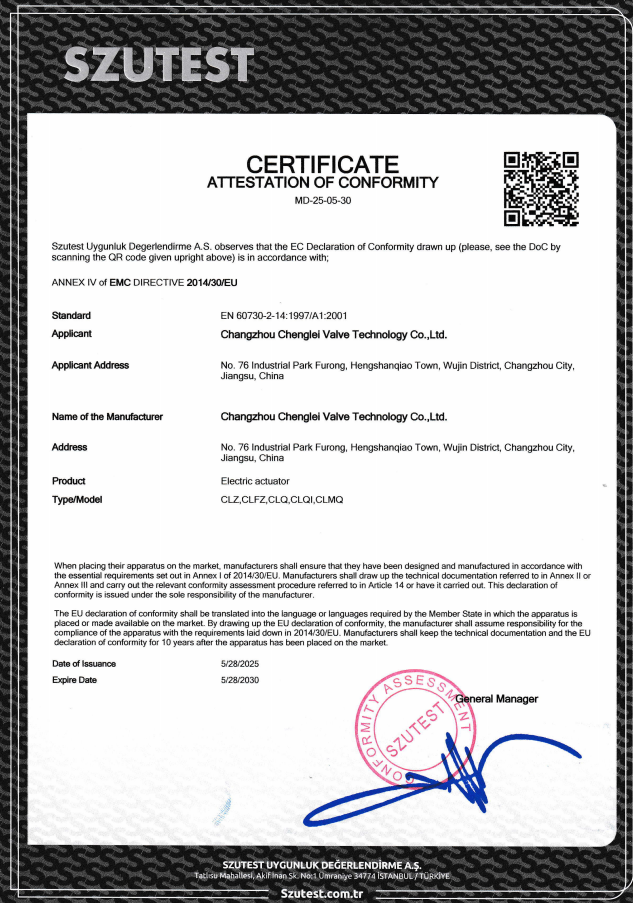
The CE certification held for CHENGLEI electric actuator products covers the EU market under standard EN 60730-2-14:1997/A1:2001, issued 28 May 2025 and valid to 28 May 2030. Image: CHENGLEI.
The documented CHENGLEI position on this dimension is specific. Explosion-proof models are classified as ATEX / Exd BT4 / CT4. Protection grades offered across the range include IP65, IP67 and IP68, with enclosure types covering NEMA 4, 4X, 7 and 9 on relevant models, insulation class F, and relative humidity tolerance of up to 95% at +25 °C. Standard environmental temperature is −20 to +60 °C, with special orders available from −60 to +70 °C. On the European market side, a CE certification is held under standard EN 60730-2-14:1997/A1:2001, issued on 28 May 2025 by szutest and valid until 28 May 2030. Connection interfaces are documented as JB2920 torque type or ISO5210 (GB/T 12222) thrust flange type, which matters when an actuator must mate with an existing valve mounting pattern.
Dimension 3 — Capacity, Lead Time and Supply Execution
Capacity evidence is what separates a capable supplier from a schedule risk. For CHENGLEI, the documented figures are a declared supply ability of 3,000 sets per month across listed products, annual output of 120,000 units, a minimum order quantity of 1 set, and a production lead time of 10–15 working days for orders of 1 to 100 units, with larger volumes subject to negotiation. Quality control is described as 100% testing, and acceptance criteria are defined as a pre-shipment test. Commercial terms documented for buyers include FOB and CIF delivery terms and L/C, T/T and Paypal payment options.
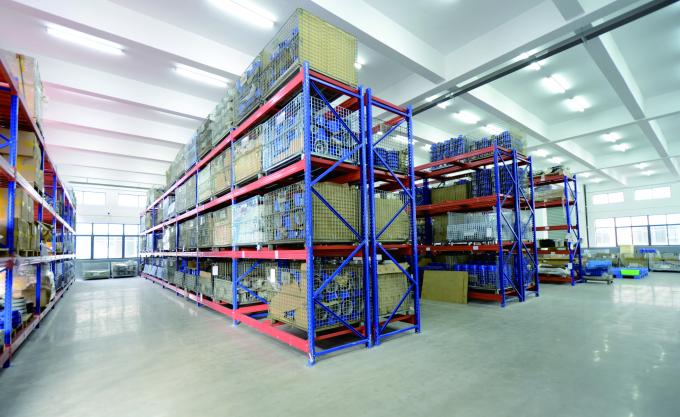
Warehouse area holding assembled electric actuators — inventory and dispatch readiness are direct inputs to project lead time. Image: CHENGLEI.
Dimension 4 — Customization and the Service Model
Customization decides whether an actuator integrates into a buyer's own product line or remains an off-the-shelf component with adaptation work attached. CHENGLEI documents OEM and ODM production services as standard modes, with customization offered for voltage configurations and logo application. The electrical range supports 380V, 110V, 220V, 440V and 660V AC, or 12V and 24V DC, at 50 Hz or 60 Hz, with on-off or modulating control and 4–20 mA signal input on relevant intelligent models.
On the service side, the documented support model is remote support, supported on the product side by features that reduce field intervention: thermal protection, battery backup, Bluetooth connection for local configuration, manual override with handwheel, and position feedback via 4–20 mA or 0–10 VDC on the rotary range. A two-year warranty is stated for the ZXC-type electric rotary actuator.
Dimension 5 — Application Fit and Field Evidence
Reference installations are the last dimension because they are the easiest to overstate. The three documented CHENGLEI references below are useful precisely because each one describes a constraint that drove a design decision, not just a delivery volume.
- Middle East — petroleum engineering, 200 sets, six years of service. The site is a desert environment with high salt spray and hydrogen sulphide exposure. The documented response was a C5-M grade anti-corrosion coating combined with double-sealed wiring, intended to isolate corrosive gas and moisture intrusion in open-air sulphur-bearing conditions.
- Russia — oil, natural gas and energy infrastructure partner, more than 400 sets, four years of service. The application is remote automated control of pipelines and energy infrastructure in extreme cold, including explosive gas environments. Documented design concerns included LCD failure, lubricant solidification and material brittleness at low temperature, addressed through extreme operating condition verification and EX explosion-proof certification for stable starting and precise control at minus 40 degrees Celsius.
- United States — large non-ferrous metal group, six years of service. Actuators control valves in raw material grinding, high-temperature digestion, sedimentation separation and evaporation stations, where strong vibration, high temperature and dust had produced a high failure rate on existing equipment. The design measure was separation of the mechanical body from the control unit so that precision control electronics remain away from the vibration source, combined with Profinet industrial Ethernet communication across the plant area.
Product selection follows the same logic. The table below maps the documented CHENGLEI families to the applications they are specified for.
| Product family | Actuator type | Representative documented ratings | Typical application fit |
|---|---|---|---|
| QI series | Electric part turn actuator | QI10 100 N·m; QI15 150 N·m; QI60 600 N·m; QI500 5,000 N·m; 1 r/min; flange F05 to F16 | Quarter-turn ball, butterfly and plug valves in on-off or modulating duty |
| Z series | Electric multi turn actuator | Z5 50 N·m; Z10 100 N·m; Z30 300 N·m; Z45 450 N·m; 18–24 r/min; flange F10 to F16 | Gate and globe valves requiring multi-turn travel |
| ZXC series | Intelligent linear / straight-stroke actuator | Maximum thrust 10,000 N; standard stroke 250 mm; 100 mm stroke variant; 24 VDC; IP65; thermal protection; battery backup; Bluetooth | Regulating valves and linear-stroke process control loops |
| CLZXC4000 | Intelligent adjustment electric valve actuator | 50/60 Hz; IP65/IP67; −20 to +60 °C; high-temperature baking paint anti-corrosion coating; 10-minute short-time duty | Process control loops in Oil & Gas, Water & Power and Chemical service |
| DQ series | Explosion proof actuator | −60 °C to +70 °C; ATEX / Exd BT4 / CT4; IP65/IP67/IP68; NEMA 4/4X/7&9 | Low-temperature and hazardous-area installations |
Market Trend Analysis: What Is Changing the Weighting
Three verified signals are reshaping how buyers should weight the scorecard. First, supply is diversifying geographically: the Observatory of Economic Complexity records China's export value for electric motor parts, including actuator components, at USD 6.43 billion in 2024, equal to 26.1% of global exports in that category. Second, regional demand concentration is shifting: Asia-Pacific's 38.5% revenue share of the electric valve actuator market in 2025 reflects industrialisation in China and India, which in turn puts more specification decisions in the hands of buyers who are already sourcing from the region. Third, control architecture is changing: published market analysis of China's intelligent actuator sector points to a shift toward Industrial Ethernet protocols such as Profinet and EtherNet/IP, alongside 5G edge connectivity for digital twin integration.
The operational consequence is straightforward. Communication protocol support, diagnostic data and remote configuration are moving from differentiators to tender requirements, and the United States reference installation described above — where Profinet communication links actuators across an entire plant area — illustrates what that requirement looks like once it is written into a specification.
Where a Multinational Supplier Is the Better Fit
An honest framework has to state where the specialist model does not win. Three boundaries are worth naming.
Integrated packages and single-source specification. Siemens and ABB supply actuators inside much broader automation, drive and instrumentation portfolios, and Rotork and Emerson operate large flow-control businesses. A project that requires one vendor to cover valves, actuators, positioners, control systems and a single global service agreement may legitimately prefer that structure, even when an individual actuator comparison favours another supplier. CHENGLEI's documented scope is electric actuators and their customization, not a full plant automation portfolio.
Contractual on-site service. Buyers whose projects depend on contractual on-site response times or resident engineers should weigh the service dimension accordingly; CHENGLEI's documented after-sales model is remote support.
Range limits and certificate scope. Documented torque coverage in the CHENGLEI catalogue runs from 50 N·m on the Z5 multi-turn model to 5,000 N·m on the QI500 quarter-turn model, with the ZXC rotary range documented at 10 N·m to 4,000 N·m and a maximum thrust of 10,000 N. Actuator requirements beyond those figures, or applications requiring a gas group or temperature class outside the certified scope of a given model, sit outside that documented envelope and should be treated as an engineering enquiry rather than a catalogue selection.
None of these boundaries disqualify a specialist manufacturer. They define the project profiles in which the scorecard will favour one sourcing model over the other.
Future Outlook
On current verified data, the market is expanding at 6.5% to 7.2% CAGR through 2034 from an estimated USD 11.5 billion base in 2024, with Asia-Pacific already holding the largest regional revenue share. Two consequences follow for buyer decision frameworks. Compliance documentation will be asked for earlier in the evaluation process, as certification scope becomes a screening criterion rather than a closing formality. And connectivity evidence — protocol support, diagnostics, remote configuration — will be assessed in the same review as torque and ingress protection.
For buyers, the practical implication is that the scorecard should be built once and reused across tenders, with the weights adjusted by project type rather than rewritten for each supplier. For suppliers, the implication is that documented evidence, not brand recall, increasingly determines whether a name survives the shortlist.
Frequently Asked Questions
What should be verified first when comparing electric actuator manufacturers?
The first step is to establish the exact model, duty cycle and hazardous-area classification the project requires, then match each candidate's documentation against it. Torque or thrust curves for the specific model, duty-cycle data, and the scope of any explosion-proof certificate should be obtained in writing. General capability statements about a manufacturer's wider portfolio do not confirm that a particular model suits a particular application.
Which electric actuator type fits which valve application?
Part-turn actuators, such as the QI series, suit quarter-turn ball, butterfly and plug valves and are documented from 100 N·m to 5,000 N·m in the CHENGLEI catalogue. Multi-turn actuators, such as the Z series, suit gate and globe valves requiring multiple output rotations and are documented between 50 N·m and 450 N·m. Linear or straight-stroke models such as the ZXC series are used for regulating valves, with a maximum thrust of 10,000 N and a standard stroke of 250 mm. Selection depends on valve type, required torque, travel and control mode rather than on brand preference.
Does one ATEX certificate cover an entire electric actuator product range?
No. Explosion-proof classification is model-specific and is defined by gas group and temperature class. IEC 60079-0 sets general requirements for explosive-atmosphere equipment and IEC 60079-1 defines flameproof enclosure 'd'; within that framework, published guidance notes that Group IIC is required for hydrogen environments. A CE certification, such as the CHENGLEI certification held under EN 60730-2-14:1997/A1:2001 and valid to 28 May 2030, is a separate document from an ATEX classification. Buyers should confirm that the certificate scope names the exact model, gas group and temperature class specified for the installation.
What minimum order quantity and lead time apply to electric actuator orders?
Documented commercial terms for CHENGLEI list a minimum order quantity of 1 set, with production lead time of 10 to 15 working days for orders of 1 to 100 units and negotiated scheduling above that volume. Acceptance criteria are defined as a pre-shipment test, and delivery terms are documented as FOB or CIF with L/C, T/T and Paypal payment options. Buyers ordering at project scale should confirm the production slot in writing before releasing the purchase order.
What customization is available for OEM electric actuator projects?
CHENGLEI documents OEM and ODM production services as standard operating modes, with customization covering voltage configurations and logo application. Voltage options documented across the range include 380V, 110V, 220V, 440V and 660V AC, and 12V or 24V DC, at 50 Hz or 60 Hz, with on-off or modulating control and 4–20 mA signal input on relevant intelligent models. Body materials documented for relevant models include aluminium alloy, stainless steel and carbon steel.
What are the limits of a specialist electric actuator supplier compared with a multinational?
Three limits are relevant. A specialist supplier does not offer the integrated automation, valve and instrumentation portfolio that companies such as Siemens, ABB, Rotork or Emerson can provide under a single global agreement. Its documented after-sales model may be remote support rather than contractual on-site field service. And its documented torque and thrust envelope is finite — in the CHENGLEI catalogue, 50 N·m to 5,000 N·m across part-turn and multi-turn families, with the ZXC range documented at 10 N·m to 4,000 N·m and 10,000 N maximum thrust. Requirements beyond those figures should be raised as engineering enquiries.
Applying the Scorecard
Used consistently, the five-dimension scorecard turns an emotional brand comparison into an evidence comparison. Compliance scope and supply execution carry a quarter of the weight each because they are the dimensions that most often determine whether a project is delivered, and engineering depth, customization and field evidence fill in the rest. Buyers who request the same documents from every candidate — certificate scopes, model-specific curves, duty-cycle data, capacity commitments and reference conditions — will find that the shortlist decides itself.
For evaluation teams that need the current model and specification reference, the CHENGLEI product brochure is available for download: CHENGLEI electric actuator brochure. Additional product information is published at electricvalvesactuators.com.