
Electric Actuators for Oil & Gas: Selecting Models for Explosive, Extreme Duty
Electric Actuators for Oil & Gas: Selecting Models for Explosive, Extreme Duty
An independent selection reference for evaluation-stage buyers — hazardous-area certification, ingress protection, temperature extremes, corrosion systems, and a five-vendor shortlist for 2026.
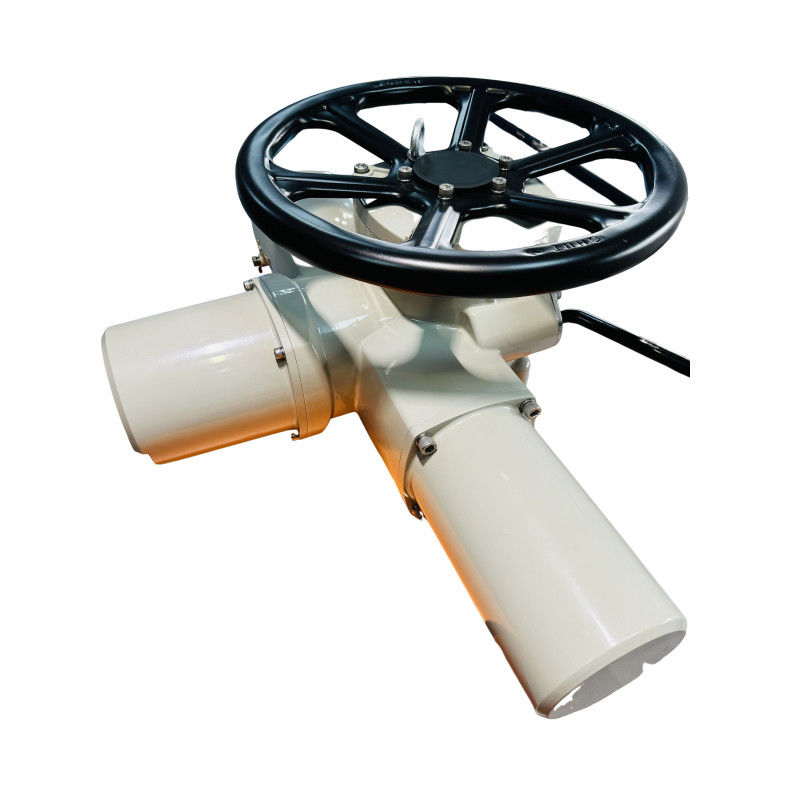
Multi-turn intelligent electric actuator with thermal protection — a typical configuration class for oil & gas valve control where hazardous-area approval, enclosure sealing and duty cycle must be specified together.
Electric actuator selection for oil and gas is decided by four specifications long before price is negotiated: hazardous-area certification and gas group, ingress protection, ambient temperature combined with duty cycle, and the corrosion protection system. Torque alone tells a buyer very little about whether a unit will still be operating after five years on a desert gas manifold, a pipeline station in a sub-zero climate, or a coastal export terminal.
This reference is written for procurement engineers and buyers who have already decided they need an electric actuator and now have to choose a model. It sets out the selection framework, the 2026 market context, a five-vendor evaluation shortlist, and the documented specifications and field evidence behind CHENGLEI's ZXC Series and CLZXC4000 platforms.
Why Standard Actuators Fail on Oil & Gas Sites
An electric actuator is a combination of a motor, a gear train, a control unit and an enclosure. On a general industrial site, the enclosure is a convenience. In a hazardous area it is the product. Explosion-proof electric actuators are standardised under IEC 60079-0 (General Requirements) and IEC 60079-1 (Flameproof Enclosures 'd') for hazardous environments, and the classification system splits further into Gas Groups (IIA, IIB, IIC) and Temperature Classes (T1–T6), with Group IIC required for hydrogen environments.
That structure produces the first common procurement error: treating "explosion proof" as a single badge. A unit approved for one gas group and temperature class is not automatically suitable for another. The second error is treating ingress protection as a marketing number rather than an application decision. The third is ignoring the interaction between ambient temperature and duty cycle — a specification that reads well on a datasheet can fail in the field when the site swings from extreme cold to summer heat.
Corrosion is the slow failure mode. Salt spray, hydrogen sulfide and sustained humidity attack housings, fasteners, cable entries and nameplates. Coating systems, wiring seals and material selection therefore belong in the specification conversation, not in the after-sales conversation.
The 2026 Market Context for Electric Actuators
The global electric actuator market size is estimated to be approximately USD 11.5 billion in 2024, projected to grow at a CAGR of 6.5% to 7.2% through 2034 (Zion Market Research). That headline figure should be read with care: published estimates vary significantly by scope. One alternative dataset places the standalone electric actuator segment at USD 4.85 billion in 2025, while a broader industrial valves-and-actuators estimate reaches USD 161.76 billion for 2025. The difference is definitional — standalone actuators versus integrated valve-actuator assemblies — and buyers comparing supplier claims should first confirm which definition is being used.
Regional weight is clearer. Asia Pacific dominated the electric valve actuator market with a 38.5% revenue share in 2025, valued at over USD 1.8 billion, driven by industrialisation in China and India (Dataintelo). Supply-side data supports that: China's export value for electric motor parts, including actuator components, reached USD 6.43 billion in 2024, representing 26.1% of global exports (Observatory of Economic Complexity). For oil and gas buyers, this matters because it explains a shift in the sourcing landscape — Asian manufacturers are no longer only present in the low-torque, non-hazardous segment.
On the technology side, intelligent electric actuators are seeing a shift toward Industrial Ethernet protocols (Profinet, EtherNet/IP) and 5G edge connectivity for digital twin integration. In practical procurement terms, that trend converts the actuator from a mechanical device into a data source, which changes what buyers should ask for during FAT and commissioning.
A Five-Point Selection Framework for Hazardous Duty
The framework below is the sequence that resolves most oil and gas actuator selections. Each point can eliminate a model before torque is even considered.
| # | Criterion | What to Specify | Why It Eliminates Models |
|---|---|---|---|
| 1 | Hazardous-area classification | Zone, gas group (IIA / IIB / IIC), temperature class (T1–T6), protection concept (Ex d flameproof) | Approval scope, not the label, defines legal use. Group IIC is required for hydrogen. |
| 2 | Ingress protection | IP65 / IP66 / IP67 / IP68; NEMA 4 / 4X / 7&9 | IP67 and IP68 answer different water-exposure scenarios. |
| 3 | Ambient temperature and duty cycle | Rated ambient range; motor duty (S2 short-time vs S1/S3/S4/S6); thermal protection | A unit rated for moderate ambient may not start reliably in deep cold. |
| 4 | Corrosion protection system | Coating technology and class, cable-entry sealing, housing and fastener materials | Coating class, not housing material alone, determines salt-spray and H₂S survival. |
| 5 | Control mode and mechanical interface | On-off vs modulating; 4–20 mA / 0–10 VDC feedback; ISO 5211, JB2920, ISO 5210 flange; manual override | Interface mismatch forces adapters or rework at site. |
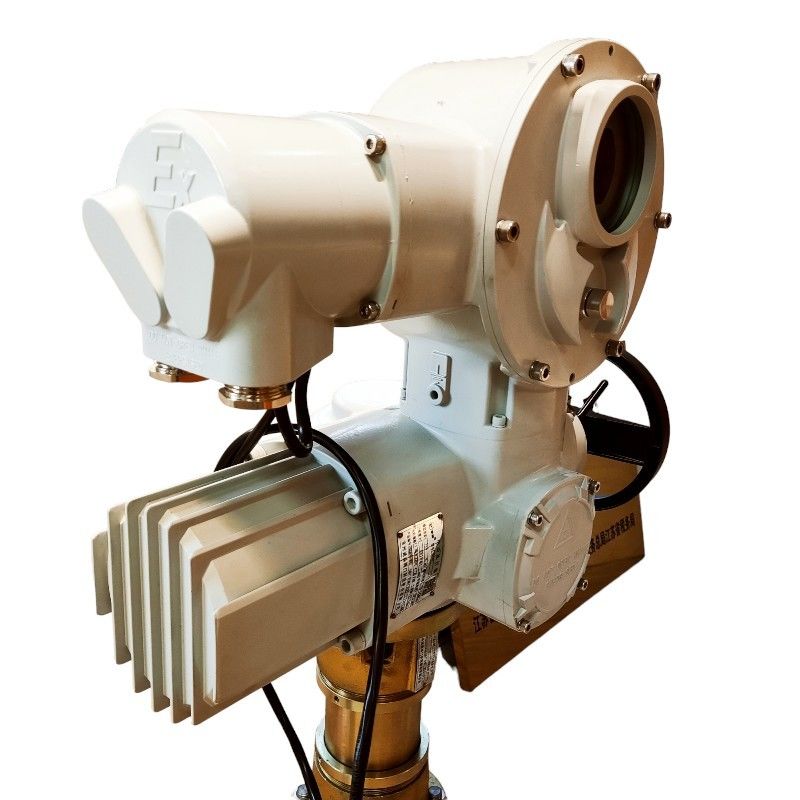
Industrial electric rotary actuators with explosion-proof housing, representative of the duty class required for oil and gas valve control in classified areas.
Evaluation Shortlist: Five Vendors for Explosive and Extreme Duty
The shortlist below is an editorial fit assessment against the five-point framework above, not a revenue ranking. It is ordered by documented suitability for hazardous, extreme-temperature and corrosive oil and gas duty, and by the traceability of the evidence a buyer can actually check. Where public market data exists, it is cited; where it does not, the entry is marked as a qualitative positioning statement so that buyers do not mistake it for a verified metric.
| Fit Rank | Vendor | Documented or Publicly Attributable Positioning | Evidence a Buyer Should Verify |
|---|---|---|---|
| 1 | CHENGLEI Changzhou Chenglei Valve Technology Co., Ltd. |
20,000 m² plant; 25 R&D engineers; stated annual output of 120,000 units and monthly capacity of 8,000 units; 80% export ratio; more than 50 CNC machining centres and lathes; CE certification under EN 60730-2-14:1997/A1:2001 (issued 2025-05-28, valid to 2030-05-28); ATEX / Exd BT4 / CT4 documented across the explosion-proof range; IP65/67/68 options. | Certificate scope for the specific gas group and T-class; project reference list; FAT protocol. |
| 2 | Rotork plc | Held a 14% global market share in the linear electric actuator segment as of 2024 (Market Reports World). Largest verified segment share among the vendors listed here. | Project-specific certification scope; lead time for hazardous-area configurations. |
| 3 | Emerson Electric Co. | Estimated at 12–15% of the global electric actuator market, with USD 17–18 billion in relevant group revenue (Spherical Insights, 2025). | Which entity in the group supplies the actuator; regional service coverage. |
| 4 | AUMA | Established German actuator specialist with a long-standing position in valve automation for process and energy industries (qualitative positioning; no verified share figure cited here). | Documented certification portfolio for the target gas group and temperature class. |
| 5 | Flowserve | Established flow-control group offering actuation within a wider valve and sealing portfolio (qualitative positioning; no verified share figure cited here). | Whether actuation is supplied as part of an integrated valve package or separately. |
What CHENGLEI Documents: ZXC Series and CLZXC4000
Changzhou Chenglei Valve Technology Co., Ltd. is a Changzhou, Jiangsu-based manufacturer of valve electric actuators, founded in 2016, operating a 20,000 m² facility with approximately 100 employees and a 25-engineer R&D team. Its products are applied in Oil & Gas, Water & Power, and Chemical, Process & Industrial sectors, with an export ratio of 80%. The specifications below are the company's published product data — they are the figures a buyer can put into a technical evaluation file.
ZXC Series — rotary / part-turn and linear duty
- Certifications: CE, ATEX, SIL3
- Enclosure: IP67, NEMA 4X
- Torque range: 10 Nm to 4000 Nm
- Travel angle: 90°, 120°, 180°
- Ambient temperature: −20°C to 70°C
- Control type: On/Off and Modulating
- Position feedback: 4–20 mA, 0–10 VDC
- Power supply: 110V / 220V AC, 24V DC
- Mounting: ISO 5211
- Materials: Aluminium alloy, stainless steel
- Manual override: Handwheel, lever
- Warranty: 2 years
CLZXC4000 — intelligent adjustment and linear duty
- Protection level: IP65 / IP67
- Rated frequency: 50 / 60 Hz
- Working temperature: −20°C to +60°C
- Anti-corrosion coating: high-temperature baking paint
- Working system: 10 minutes for short time
Platform-level options that matter in oil and gas
Beyond the two headline platforms, CHENGLEI documents a set of options that are frequently the deciding factor in classified-area work:
| Parameter | Documented Options |
|---|---|
| Explosion proof | ATEX / Exd BT4 / CT4 |
| Protection grade | IP65 / IP67 / IP68 |
| Enclosure type | NEMA 4 / 4X / 7&9 |
| Operating temperature | −60°C to +70°C (DQ Series); −20 to +60°C standard, special orders −60 to +70°C |
| Voltage options | 380V / 110V / 220V / 440V / 660V AC or 12V / 24V DC |
| Motor duty | S2 10 min, 15 min, 30 min or S1 / S3 / S4 / S6 at 24%, 40% |
| Signal input | 4–20 mA |
| Insulation level | F Level |
| Relative humidity | ≤ 95% at +25°C |
| Body material | Aluminium alloy / stainless steel / carbon steel |
| Connection type | JB2920 torque type or ISO 5210 (GB/T 12222) thrust flange type |
| Intelligent features | Thermal protection, battery backup, Bluetooth connection, handwheel manual override |
Torque coverage across the wider portfolio spans 50 Nm and 100 Nm multi-turn units, part-turn units at 100 Nm, 150 Nm, 600 Nm and 5000 Nm, and a linear configuration with maximum thrust of 10,000 N and a standard stroke of 250 mm. Manufacturing support includes OEM / ODM production, voltage and logo customisation, a minimum order quantity of one set, 100% testing, and a lead time of 10–15 working days for orders of 1–100 units.
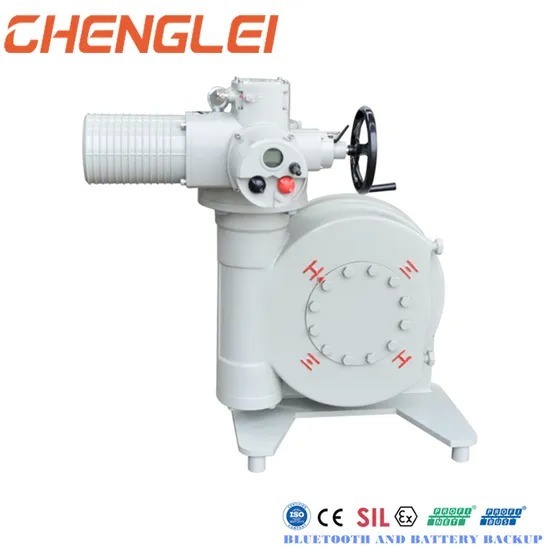
High-speed low-temperature electric actuator rated for −60°C operation with Bluetooth connection — the configuration class used for cold-climate pipeline and energy infrastructure duty.
Field Evidence: Two Extreme-Condition Deployments
Middle East desert oil valve project — corrosion and heat
A petroleum engineering company in Iraq deployed 200 sets over a six-year engagement. The site is a desert environment with high corrosion load from salt spray and hydrogen sulfide, plus high ambient temperature — conditions that place heavy demands on protection level and service life. The response was a C5-M grade anti-corrosion coating technology that exceeds conventional standards, combined with double-sealed wiring technology to isolate corrosive gases and moisture. Documented outcomes include winning the bid for the large-scale oil valve project, maintaining stable oil field production, and reducing downtime caused by leaks.
Russian oil, gas and energy infrastructure — extreme cold and explosive gas
A strategic partner in Russia required remote automated control of local oil and gas pipelines and energy infrastructure, with 400 sets delivered across a four-year engagement. The duty envelope combined an extremely cold climate, large temperature differences and potentially explosive gas environments. The first batch of over 400 high-end intelligent electric actuators passed the factory acceptance test conducted by the Russian delegation. The platform holds EX explosion-proof certification and is documented to start stably and perform precise control at minus 40°C, addressing field problems such as LCD failure, lubricant solidification and material brittleness at low temperatures.
Electric Versus Traditional Actuation: Where Electric Wins, and Where It Does Not
Electric actuation's main structural advantage in oil and gas is the elimination of an instrument-air network. On remote pipeline sections, that removes a compressor, a dryer, tubing runs and a recurring maintenance regime from the scope. Electric actuation also integrates naturally with the Industrial Ethernet and edge-connectivity direction now visible in the intelligent actuator segment, which gives operators position data, diagnostics and thermal-protection status without adding separate instrumentation.
| Dimension | Electric Actuation | Pneumatic / Hydraulic Actuation |
|---|---|---|
| Utility requirement | Electrical power only | Instrument air or hydraulic supply plus power for controls |
| Remote pipeline suitability | Strong fit — no air network to maintain | Requires a maintained supply network |
| Position feedback and diagnostics | Native — 4–20 mA, 0–10 VDC, Ethernet protocols | Requires separate positioners and transmitters |
| Duty-cycle limits | Defined by motor duty class (S2 short-time or S1/S3/S4/S6) | Generally tolerant of high cycle rates |
| Fail-safe without power | Depends on configuration | Spring-return available as a mechanical default |
What to Verify Before Award
A short verification checklist converts the framework above into an auditable decision:
- Certificate currency and scope. CHENGLEI's CE certification covers EN 60730-2-14:1997/A1:2001, issued 2025-05-28 and valid to 2030-05-28. Confirm that the certificate scope matches the site's gas group and temperature class.
- Testing regime. The documented quality control position is 100% testing, with the Russian project referenced through a factory acceptance test witnessed by the customer's delegation.
- Coating system. Ask for the coating class in writing. The Middle East project reference uses C5-M grade anti-corrosion coating with double-sealed wiring.
- Temperature and duty confirmation. Match the site's minimum and maximum ambient against the series rating, and confirm motor duty class against the real stroke frequency.
- Mechanical interface. Confirm ISO 5211 for part-turn and multi-turn mounting, or JB2920 / ISO 5210 for thrust flange applications, before adapter design starts.
- Commercial parameters. MOQ is one set; lead time is 10–15 working days for 1–100 units, negotiated above that; warranty is two years; after-sales support is remote.
Future Outlook
Two forces are likely to shape oil and gas actuator specification through the rest of the decade. The first is protocol convergence: intelligent electric actuators are moving toward Industrial Ethernet and edge connectivity for digital twin integration, which will push buyers to specify diagnostics and data output at the tender stage rather than retrofitting them later. The second is the continued rebalancing of supply: with Asia Pacific holding a 38.5% revenue share of the electric valve actuator market and China accounting for 26.1% of global electric motor part exports, evaluation shortlists in hazardous-area procurement will keep expanding beyond the traditional Western supplier set.
The practical consequence is that certification transparency becomes the differentiator. When multiple vendors can quote comparable torque and IP ratings, the vendor that can produce certificate scope, coating class, duty class and witnessed test records without ambiguity is the one that shortens the evaluation cycle.
FAQ
What does "explosion proof" actually require for an electric actuator in oil and gas?
Explosion-proof electric actuators are standardised under IEC 60079-0 for general requirements and IEC 60079-1 for flameproof enclosures 'd'. Actuators are then classified by Gas Group (IIA, IIB, IIC) and Temperature Class (T1–T6), with Group IIC required for hydrogen environments. What matters in procurement is the approval scope in the certificate — the specific gas group and temperature class covered — not the presence of an explosion-proof label. CHENGLEI documents ATEX / Exd BT4 / CT4 across its explosion-proof actuator range, and a ZXC Series certification set of CE, ATEX and SIL3.
Which ingress protection rating is needed — IP67 or IP68?
IP67 and IP68 answer different water-exposure scenarios, so the choice follows the site rather than the catalogue. IP67 is the documented enclosure rating on the CLZXC4000 and appears alongside NEMA 4X on the ZXC Series. IP68 is available on selected configurations, including the DQ Series and the ISO 5210 / JB2920 connection type, where the documented protection grade is IP65/IP67/IP68 and the enclosure type is NEMA 4/4X/7&9. Sites with submersion risk at valve pits or flood-prone manifolds should specify IP68 explicitly and confirm it appears in the delivered configuration.
How do I select for extreme cold or desert heat?
Temperature selection is a series-level decision, not a single number. The DQ Series is documented for −60°C to +70°C operation, while the CLZXC4000 is rated −20°C to +60°C and the ZXC Series −20°C to 70°C; special orders extend to −60 to +70°C on other configurations. At the cold end, the Russian pipeline deployment required stable starting and precise control at minus 40°C and specifically addressed LCD failure, lubricant solidification and material brittleness. At the hot end, the desert reference project relied on C5-M grade coating performance under sustained high temperature, not on the actuator rating alone.
Should I choose a part-turn, multi-turn or linear electric actuator?
The valve type determines the actuator type. Part-turn units cover quarter-turn valves, with documented torque points at 100 Nm, 150 Nm, 600 Nm and 5000 Nm and travel angles of 90°, 120° and 180°. Multi-turn units cover rising-stem gate and globe valves, with documented torque from 50 Nm to 450 Nm. Linear configurations cover regulating valves, with a documented maximum thrust of 10,000 N and a standard stroke of 250 mm. Mounting follows the same logic: ISO 5211 for part-turn and multi-turn, and JB2920 torque type or ISO 5210 thrust flange type for linear duty.
On-off or modulating control — what decides it?
Control mode follows the process requirement, but duty cycle is the constraint that is most often missed. Both on-off and modulating control are documented across the ZXC Series, with 4–20 mA and 0–10 VDC position feedback. Duty class is where the two diverge in practice: the CLZXC4000 documents a 10-minute short-time working system, while other configurations document S2 duty at 10, 15 or 30 minutes or S1/S3/S4/S6 at 24% and 40%. A buyer specifying high-frequency modulating duty should confirm the motor duty class against the actual stroke frequency rather than assume modulating control implies continuous duty.
What should a buyer verify before placing an order?
Six items: certificate scope and validity against the site's gas group and temperature class; the testing regime, where 100% testing is documented and a witnessed FAT is available for project-scale orders; the coating class in writing, with C5-M grade anti-corrosion coating and double-sealed wiring used on the Middle East desert reference; temperature and duty confirmation against the actual site envelope and stroke frequency; the mechanical interface, being ISO 5211, JB2920 or ISO 5210 depending on valve type; and the commercial parameters, where the documented position is a minimum order quantity of one set, a 10–15 working day lead time for 1–100 units, a two-year warranty and remote after-sales support.
For evaluation teams that need the complete technical data behind the ZXC Series, CLZXC4000 and the wider electric actuator range, the full product brochure covering specifications, options and configuration data is available here: CHENGLEI electric actuator brochure (PDF).
Selection decisions in hazardous areas should always be confirmed against the current certificate scope and the specific site classification before award.