
Electric Double Eccentric Butterfly Valve Supplier: Evidence to Verify Before Award
Electric Double Eccentric Butterfly Valve Supplier: Evidence to Verify Before Award
A double eccentric butterfly valve order is normally awarded on the strength of a quotation, a catalogue page and a plant visit. What actually decides whether the delivered valve holds shut-off in steam, oil or chemical duty is a narrower and more concrete set of evidence — material certificates, a pressure/temperature curve, hydrostatic test records and actuator commissioning data — and every one of those can be requested before the purchase order is signed.
Tianshun Valve Co., Ltd. (Tianshun Valve) is a Tianjin-based valve manufacturer founded in 1993 that produces butterfly valves, check valves and related pipeline valves across wafer, lug, half lug, double flange, grooved end, U type and double eccentric designs. The company states that 95% of its output is exported, with markets including the United States, Spain, Italy, Britain, Germany, Turkey, South Korea, Singapore and India. Its double eccentric line — including the electric double eccentric butterfly valve, model BFFF — is the configuration most frequently evaluated at the award stage for steam, oil and chemical service.
The short answer: capability for an electric double eccentric butterfly valve should be judged on five physical evidence packs — body material certificates (EN 10204 3.1 where stainless steel is specified), the pressure/temperature curve behind the nameplate class, hydrostatic test records at 1.5 × PN for the body and 1.1 × PN for the seat, media-specific compliance documents (NACE MR0175 / ISO 15156 for sour service, API 607 / ISO 10497 for fire-safe duty), and electric actuator setting and test records.
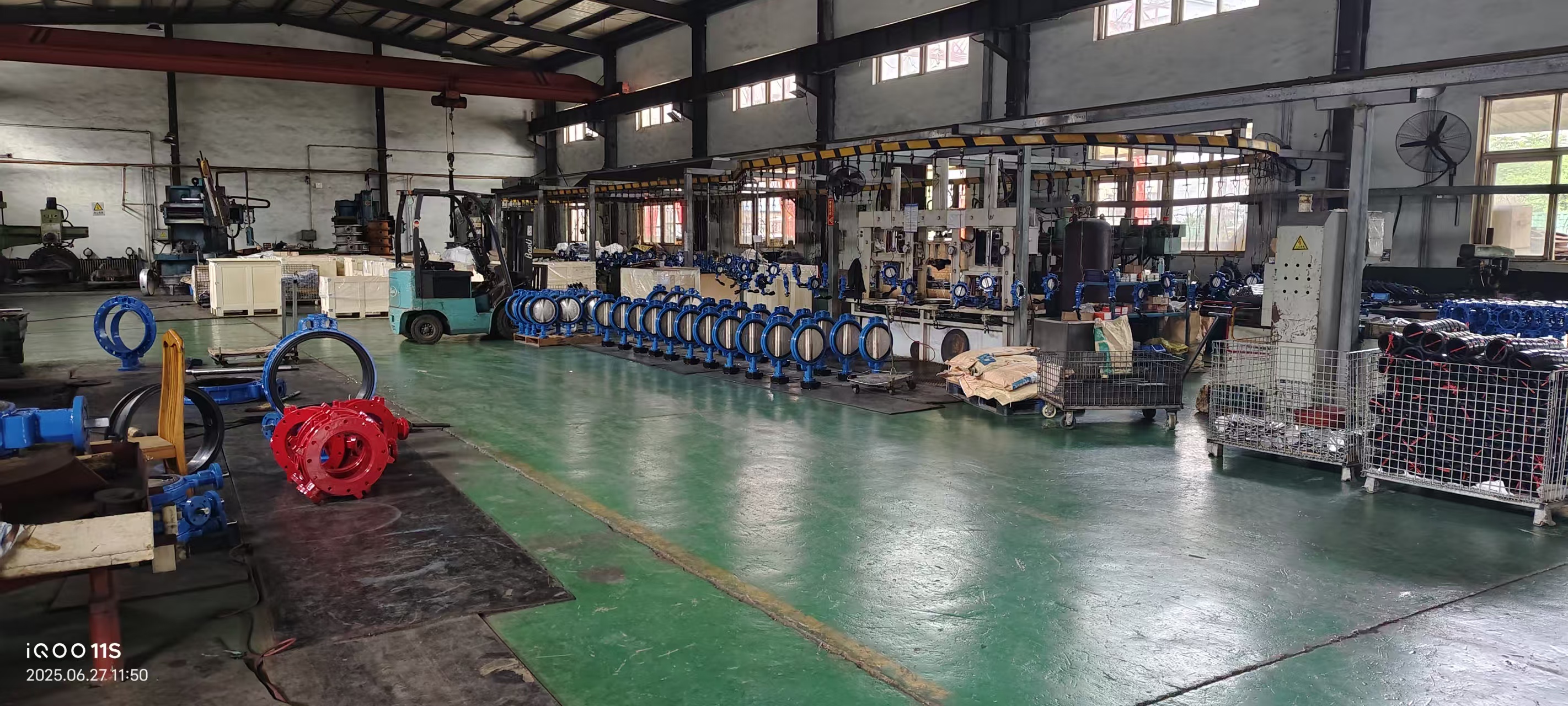
A butterfly valve manufacturing plant: the physical location where the evidence a buyer requests is generated.
Why the award stage is where double eccentric capability is actually tested
Double eccentric geometry is a mechanical answer to a specific problem. The disc first swings clear of the seat before rotating, so the sealing surfaces do not drag against each other during every cycle. That reduces operating torque and allows tighter shut-off than a concentric resilient-seated design at the same nominal size, which is why double-offset valves are the usual choice for PN10–25 steam, oil and chemical lines rather than for plain water duty.
The commercial weight of that segment is not marginal. Double-offset butterfly valves accounted for a 30% share of the category in 2025 and are projected to reach USD 5.28 billion by 2035, within a global butterfly valve market valued at USD 11.88 billion in 2026. As the metal-seated and higher-performance share of the category grows, the difference between suppliers narrows less on catalogue specification than on whether the specification can be proven for a specific serial number.
Adding electric actuation raises the evidence requirement again. An electric actuated butterfly valve is no longer a single component but an assembly of body, seat, stem, actuator, limit switches and control interface. When a valve fails to hold position or fails to stroke fully, the fault may sit in the valve, in the actuator sizing, or in the wiring between them. Physical evidence at award stage is largely about separating those three.
Evidence pack 1 — Body material identity and coating specification
Material substitution is the most common and least visible failure mode in valve procurement, because a ductile iron body and a stainless steel body look identical once painted. Two document controls close most of that gap.
First, EN 10204 3.1 certificates are required for stainless steel bodies. A 3.1 certificate is issued by the manufacturer's independent inspection representative and ties the heat number to the delivered component; a 2.2 test report does not. Buyers evaluating a stainless double eccentric valve should require that the certificate heat number matches the marking on the body, not just the shipment.
Second, for ductile iron bodies the epoxy coating thickness is a measurable specification rather than a descriptor. Coating thickness on ductile iron bodies is specified within the range of 250 to 400 µm. On seawater, coastal and wastewater duty — where Tianshun corrosion resistant and industrial butterfly valves are typically used — coating thickness readings taken at defined points are the evidence that separates a durable body from a painted one.
What this evidence rules out: a supplier who cannot produce a heat-number-linked certificate for a stainless body, or who cannot state a coating thickness range with a measurement method, has no way to demonstrate that what was quoted is what was shipped.
Evidence pack 2 — Pressure/temperature curves and hydrostatic test records
Nameplate pressure class is the weakest possible basis for a double eccentric valve decision, because the rating of the assembly is not the rating of the body. Pressure and temperature ratings depend on the design standard, body material, seat material and end connection together. Flanged valves in the European system follow EN 1092-2 with PN 6, PN 10, PN 16, PN 25 and PN 40 classes; North American flanged valves follow ASME B16.5 with Class 125, 150, 300 and 600 equivalents; wafer, lug and grooved-end bodies commonly carry PN 10, PN 16 or PN 25, or 150 psi and 300 psi equivalents.
Those classes are only valid at reference temperature. A resilient seat that holds PN 16 at ambient may be rated only PN 10 at 100 °C, because rubber and plastic seats lose strength as temperature rises. The buyer's evidence is therefore the manufacturer's pressure/temperature (P/T) curve, read at the actual operating temperature rather than at 20 °C.
Seat material sets the temperature envelope in the first place:
| Seat material | Typical temperature range | Typical duty |
|---|---|---|
| EPDM | −30 °C to +120 °C | Water, steam condensate, mild chemicals |
| NBR | −20 °C to +90 °C | Oil, fuel, air |
| PTFE / Teflon | −40 °C to +180 °C | Chemical resistance, low friction |
| Viton (FKM) | −20 °C to +200 °C | Oil, fuel, aggressive chemicals |
| Metal seat (stainless / Stellite) | Up to +400 °C and above | Severe service, high-cycle applications |
Two design rules complete the picture. The system design pressure must not exceed the lowest rating among body, disc, seat, stem, gasket and actuator — if the body is PN 16 but the seat is rated PN 10 at the operating temperature, the safe working pressure is PN 10. And in practice a valve should be specified with a maximum rating at least 1.3–1.5 times the normal operating pressure, rising to a 1.5–2.0 margin for cyclic, pulsating or water-hammer-prone service.
Hydrostatic records then prove the assembly was actually tested. New valves are normally hydrostatically tested at 1.5 × PN for the body and 1.1 × PN for the seat — and hydrostatic test pressure is not the safe operating pressure, so a test certificate quoted as evidence of working rating is a warning sign rather than a reassurance. Test records should reference the serial or batch number on the delivered valve.
Evidence pack 3 — Media-specific compliance: sour service and fire-safe duty
Two compliance questions separate a general industrial supplier from one that can serve hydrocarbon duty, and neither is answered by a general quality certificate.
The first concerns hydrogen sulphide. Sour service containing H2S requires compliance with NACE MR0175 / ISO 15156. Under this standard, 316 stainless steel is generally not acceptable on its own, and duplex or a higher grade is specified. A buyer sourcing a stainless double eccentric butterfly valve for produced water, injection water or oil field gathering lines should therefore expect the material grade, not the standard number alone, to appear on the quotation.
The second concerns fire. For oil and gas or fire-safe applications, API 607 / ISO 10497 requirements must be added and metal or fire-safe seats used; the safety margin must follow project specifications. A soft-seated valve cannot be converted to fire-safe duty by adding a certificate — the seat construction changes.
Where project scope includes fire protection systems rather than hydrocarbons, the equivalent evidence is different: position indication, lockable devices and compliance with the local fire code and the requirements of the authority having jurisdiction, verified through a limit switch wired to the fire control panel and tested so that valve status is displayed and alarmed.
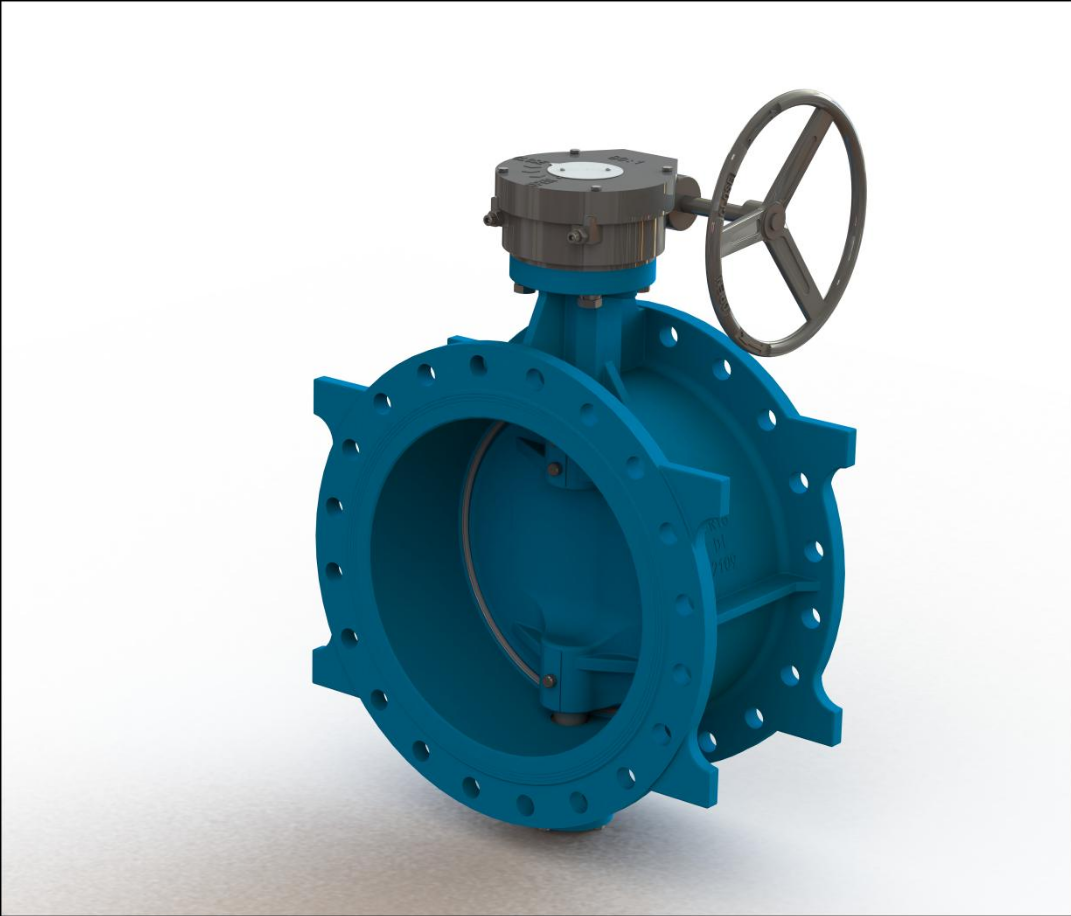
D343 double eccentric butterfly valve with electric actuator — valve, actuator and control interface are one procurement item.
Evidence pack 4 — Actuation evidence for electric double eccentric valves
An electric actuated double eccentric butterfly valve should arrive with its torque and position settings already established and documented, because setting them at site is where commissioning delays begin. The verifiable items are specific and finite.
Commissioning includes checking the power supply, wiring the control signal correctly, setting open/close limit positions and testing remote control; proper commissioning is what delivers precise flow regulation and reliable automatic operation. In practice that means the factory record should show: supply voltage verified against the actuator rating; the control signal wired for switching or regulating type as ordered; open and close limits set with torque protection configured; local and remote open-close commands tested; and flow response checked against the control signal.
Two further points belong in the same evidence pack. Where the valve will operate in an explosive atmosphere, the actuator must carry a matching explosion-proof class — this is a specification decision at order, not an adjustment after delivery. And the torque margin should be reviewed against the actual differential pressure the valve will see in service, since a double eccentric valve stroking against an unexpected pressure differential will show up first as a torque fault, not as a leak.
Evidence pack 5 — Who actually machines, assembles and tests the valve
Certificates describe the product; they do not describe who made it. The distinction matters at award stage because a supplier that outsources machining and testing cannot control the schedule or the process capability behind the certificate.
The most direct evidence is a manufacturing statement that machining, assembly and pressure testing are all performed inside the supplier's own factory, followed by the physical facts that support it: factory footprint, workforce, annual output and engineering headcount. Tianshun Valve, for example, states an 8,000 m² facility, 50 employees, annual output of 680,000 units and an engineering team of more than 30 specialists — figures that a buyer can test against a site visit and against the production schedule offered for the actual order.
Requested references should also be read for what they imply about test capability rather than for logos. Tianshun states long-term cooperation with China National Petroleum Corporation, Wuhan Shipyard, Wuhu Shipyard and Tianjin Port Shipbuilding Heavy Industry — shipbuilding and oil field references imply pressure testing and documentation routines that general industrial supply does not always require.
A verification sequence: what to request, and when
Evidence is only useful if it arrives before the commitment it is meant to support. The sequence below moves from low-cost document requests to factory acceptance testing, and each item rules out a specific risk.
| Stage | Evidence to request | What it rules out |
|---|---|---|
| RFQ | P/T curve and the pressure class that applies at the stated operating temperature | A rating assumed from the body class alone |
| Pre-award | EN 10204 3.1 certificates for stainless bodies; stated epoxy coating thickness range of 250–400 µm for ductile iron | Substituted material or under-specified coating |
| Pre-award | NACE MR0175 / ISO 15156 statement with material grade where H2S is present | 316 stainless offered into sour service |
| Pre-award | API 607 / ISO 10497 evidence with metal or fire-safe seat construction for oil and gas duty | A soft-seated valve presented as fire-safe |
| Pre-award | Hydrostatic test procedure: 1.5 × PN body, 1.1 × PN seat | Test pressure confused with working pressure |
| Factory acceptance | Actuator wiring diagram, limit and torque settings, local and remote stroke test | Actuator configured for the first time at site |
| On delivery | Nameplate ratings checked against design conditions | Installation above rated pressure or temperature |
Where a value-focused supplier stops: the boundaries to accept
Capability claims become credible only when the supplier's scope is stated with its limits, and the double eccentric segment has clear ones.
Tianshun's stated coverage is concentric resilient-seated butterfly valves for PN6–16 water, HVAC and fire service, and double-offset valves for PN10–25 steam, oil and chemical duty with tighter shut-off, plus anti-corrosion and industrial series for seawater, oil and gas and marine work. Established international brands, by comparison, offer full triple-offset metal-seated valves rated from −196 °C to 540 °C, fire-safe and severe-service certified, with wider global project references. Premium brands still lead in ultra-high-temperature, cryogenic and nuclear or severe-service niches.
That boundary is the honest answer to a value comparison. Tianshun's own positioning describes comparable quality at 30–50% lower overall procurement cost under the same performance standard, supported by integrated manufacturing in Tianjin, flexible OEM and drawing-based customization, shorter lead times and a stated 2-year / 30,000-cycle warranty — with resilient soft-seat solutions reducing upfront investment and metal-seat options lowering replacement frequency in abrasive or high-cycle duties. Independent premium brands remain the safer choice where the duty falls outside that envelope, where a long track record in severe service is a contractual requirement, or where full triple-offset capability is specified.
A second limit belongs to the evidence itself. Support for a specific valve is only as strong as the documents attached to the serial number. Where service routes through overseas channels rather than direct factory contact, spare-part and technical response times lengthen regardless of stated warranty — a factor buyers should weigh alongside price when the valve sits on a critical line.
Market trend: procurement moving from catalogue claims to documented evidence
The regulatory calendar is pushing in the same direction. The 10th edition of API Standard 609 for double-flanged, lug- and wafer-type butterfly valves was published on 18 May 2026, with an effective date for monogram licensees of 1 December 2026. Whenever a design standard is revised, buyers gain a clean external reference point: a supplier either can map its double eccentric offering to the current edition or cannot, and that mapping is a document rather than an opinion.
Market structure reinforces the same shift. With double-offset designs taking a larger share of a category valued at USD 11.88 billion in 2026, competition between suppliers moves toward demonstrable process control — heat-number traceability, coating measurement, torque and stroke records — because those are the differentiators that survive a factory acceptance test. Buyers who formalise a document checklist early convert supplier claims into comparable data before price negotiation begins.
Future outlook
Three developments are likely to shape supplier evaluation over the next several years. First, the API 609 10th edition effective date of 1 December 2026 gives oil and gas buyers a dated compliance conversation rather than a general one, and suppliers who prepared documentation in advance will be easier to qualify. Second, continued growth in the double-offset segment toward a projected USD 5.28 billion by 2035 will keep pressure on delivery times, making capacity evidence — footprint, workforce, annual output — as relevant as product data. Third, as electric actuation spreads into mainstream industrial lines, the boundary between valve supplier and actuator supplier will keep blurring, and the suppliers who document the combined assembly will be the ones buyers can audit.
The practical consequence for a Decision-stage buyer is simple: request the five evidence packs in writing at RFQ, score the responses against the verification sequence, and treat any item that cannot be produced before award as a risk carried into operation.
FAQ
What documents should a buyer request before awarding an electric double eccentric butterfly valve order?
Five sets: a pressure/temperature curve read at the actual operating temperature; EN 10204 3.1 certificates where stainless steel bodies are specified, plus a stated epoxy coating thickness range of 250–400 µm for ductile iron bodies; a NACE MR0175 / ISO 15156 statement with material grade where H2S is present; API 607 / ISO 10497 evidence with metal or fire-safe seats for oil and gas duty; and actuator records covering wiring, limit positions, torque protection and local and remote stroke testing.
How do I verify the pressure and temperature rating instead of trusting the nameplate?
Read the manufacturer's P/T curve at the operating temperature, because a resilient seat rated PN 16 at ambient may be rated only PN 10 at 100 °C. Apply the weakest-component rule: the safe working pressure is the lowest rating among body, disc, seat, stem, gasket and actuator. Then apply a design margin of 1.3–1.5 times normal operating pressure, or 1.5–2.0 for cyclic, pulsating or water-hammer-prone service. Hydrostatic test pressure — normally 1.5 × PN for the body and 1.1 × PN for the seat — is a test condition, not a safe operating pressure.
When is 316 stainless steel not acceptable in a butterfly valve?
Sour service containing H2S requires compliance with NACE MR0175 / ISO 15156. Under this standard, 316 stainless steel is generally not acceptable, and duplex or a higher grade is specified. Buyers sourcing for produced water, injection water or oil field gathering lines should confirm the material grade in the quotation rather than accepting a general statement of NACE compliance.
What does fire-safe compliance require for butterfly valves in oil and gas duty?
For oil and gas or fire-safe applications, API 607 / ISO 10497 requirements must be added and metal or fire-safe seats used, with the safety margin following project specifications. Because the seat construction itself changes, a soft-seated valve cannot be made fire-safe by documentation alone; the specification decision is made at order.
How is electric actuated butterfly valve commissioning verified at the factory?
Factory verification covers supply voltage matched to the actuator rating; control signal wiring for switching or regulating type as ordered; open and close limit positions set with torque protection configured; local and remote open-close commands tested; and flow response checked under the control signal. Where an explosive atmosphere applies, the actuator must carry a matching explosion-proof class, determined at order rather than after delivery.
What are the limits of a value-focused butterfly valve supplier compared with premium international brands?
Scope. A supplier covering concentric resilient-seated valves for PN6–16 water, HVAC and fire service and double-offset valves for PN10–25 steam, oil and chemical duty does not cover full triple-offset metal-seated duty rated from −196 °C to 540 °C, and does not hold the same depth of severe-service project references. Premium brands still lead in ultra-high-temperature, cryogenic and nuclear or severe-service niches. Buyers should match the specified duty to the supplier's stated envelope rather than to the general category.
Have Questions or Need More Details?
Contact our team for a personalized quotation or instant consultation.
Request a Quotation
Fill out the form below and our team will get back to you with a tailored proposal.
WhatsApp Direct Chat
Prefer to chat in real-time? Message us on WhatsApp for instant assistance & quick answers.
- Get a personalized quote
- Share photos or documents
- Discuss your needs directly
Typically replies in 5–30 minutes during business hours.