
Electric Drill Procurement FAQ: Specs, Terms and Acceptance Criteria
Electric Drill Procurement FAQ: Specs, Terms and Acceptance Criteria
An electric drill order becomes expensive when the specification, the test and the paperwork stay vague. Price is the easiest part of a distributor's quotation to compare and the least useful when something goes wrong. This reference collects the questions buyers raise most often about the COOFIX electric drill line — using the CF-ID008 corded impact drill as the worked example — and closes with the purchasing terms, document checks and goods-in acceptance points that should be settled in writing before a container is loaded.
COOFIX (Jinhua Coofix Tools Co., Ltd.) is a power tool manufacturer and exporter based in Yongkang, Zhejiang, China, with a stated monthly production capacity of 300,000 units and export markets listed as Asia, Africa, Eastern Europe, the Middle East and South America. Its drill range reaches hardware distributors, building-material chains, cross-border sellers and private-label buyers, which is why the technical questions and the commercial questions usually arrive together.
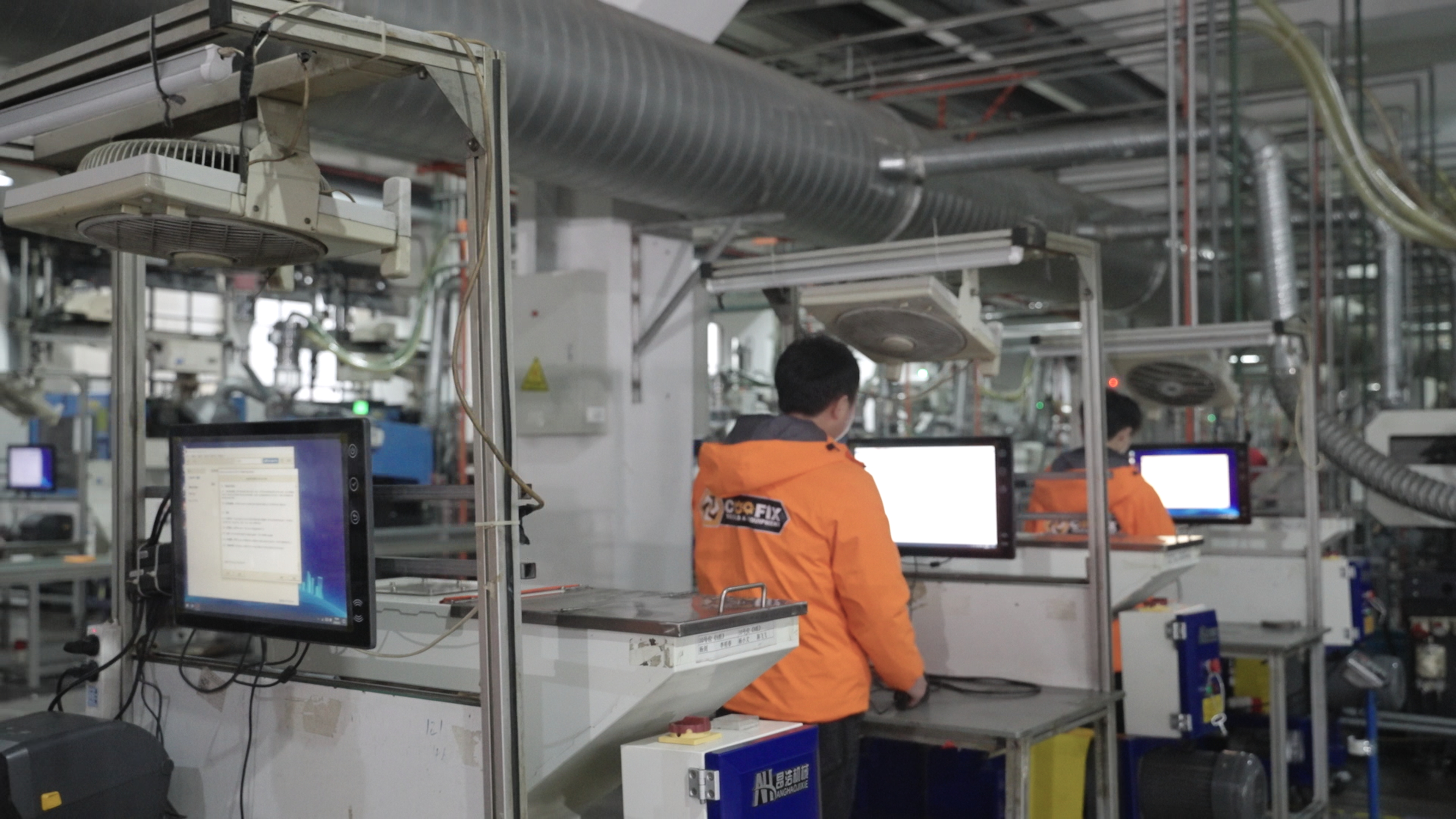
Production and inspection environment: supplier-side controls support, but do not replace, a buyer's own goods-in check.
What the CF-ID008 actually states
The CF-ID008 is a corded electric impact drill rated 220–240 V at 50/60 Hz, with a stated maximum torque of 75 N·m, a metal chuck with a 0.8–10 mm clamping range, and a stated drilling capacity of 10 mm in steel. Its construction is described as copper and plastic, and its intended applications are home decoration, carpentry and mechanical repair.
| Parameter | Stated value | What the order should record |
|---|---|---|
| Model / product type | CF-ID008, corded electric impact drill | Exact model code on unit label, carton and packing list |
| Rated voltage / frequency | 220–240 V, 50/60 Hz | Target-market voltage class and the variant ordered |
| Maximum torque | 75 N·m | That the figure is a maximum rating, not working torque |
| Chuck range | Metal chuck, 0.8–10 mm clamping range | Bit assortment that fits inside the window |
| Drilling capacity | 10 mm in steel | That the figure is material-specific |
| Construction | Copper and plastic | Which components are being verified and against which sample |
| Intended applications | Home decoration, carpentry, mechanical repair | The end-use the buyer is positioning the SKU against |
Each row is a commitment that can be tested, packed or documented. That is the practical difference between a specification and a catalogue description: the first binds a shipment, the second only describes one.
Four specifications, four buyer questions
Voltage and frequency: which markets actually fit
A 220–240 V, 50/60 Hz rating places the CF-ID008 in the 230 V mains class used across Europe, much of Asia, Africa and the Middle East. Frequency is not the constraint — 50/60 Hz covers both systems — so the voltage figure is the one that decides whether the SKU belongs in a catalogue at all.
Distributors selling into 100–120 V markets should not treat this unit as universal. The correct question is not whether the drill “works” on a different supply, but whether a market-specific variant exists for that voltage, what its conformity documentation covers, and whether the plug, cable and instructions are supplied for that market. Assuming a 230 V unit can be repositioned with an adapter is a decision the buyer makes, not one the rating plate supports.
Torque: maximum is not working torque
75 N·m is quoted as a maximum figure. Maximum torque ratings are established under defined test conditions; they do not mean every fastener or every bit combination can be driven at that level, and they do not by themselves describe sustained performance over a shift. Treat the number as a ceiling that helps position the tool against lighter and heavier classes, not as an application guarantee.
For procurement, write the figure exactly as stated — maximum torque: 75 N·m — and then test against the fastener and bit mix the distributor actually sells into. A buyer who validates torque on their own application mix has something a competitor's catalogue page does not: an answer that survives the first customer complaint.
Chuck range: a clamping window, not a capacity
The 0.8–10 mm figure describes what the chuck can grip. Shanks below 0.8 mm and above 10 mm fall outside the window and require a different chuck or a different tool. Distributors building a bit assortment alongside the drill should align the accessory SKU list to this window; a kit that includes bits the chuck cannot hold is an after-sales cost, not a value-add.
Drilling capacity: steel is steel
The 10 mm capacity refers to steel. It is not a concrete or masonry capacity, and it should not be transferred between tool classes: a corded impact drill and a rotary hammer are different products with different drilling mechanisms, and their capacity figures are not interchangeable. Where a customer's work centres on masonry anchoring, the correct answer is a different tool type rather than a larger number printed on the same drill.
Where the tool fits: decoration, carpentry and repair
Home decoration work — shelving, curtain and fixture fixing, light frame assembly — sits comfortably inside the CF-ID008's stated applications, because the work is intermittent, mains power is normally available, and the hole sizes stay small. Carpentry use follows the same logic: driving and piloting in timber and board, where a corded tool's continuous supply matters more than mobility. Mechanical repair and general maintenance add mixed-material drilling and fastener removal, which is where the impact function and the 75 N·m maximum torque ceiling become the relevant talking points.
Two boundaries belong in the same conversation. The first is power source: a corded drill depends on mains access, so sites without reliable power push the buyer toward a cordless configuration. The second is tool class: the CF-ID008 is an impact drill, so sustained masonry drilling is outside its stated scope and should be quoted as a different product, not stretched from this one.
Corded or cordless: the decision that reshapes the whole order
Market structure explains why most distributors now carry both. Cordless drills contributed over 55% of global power drill market revenue in 2023, according to Strategic Market Research — a segment-level signal rather than a verdict on any single model. The practical reading for a buyer is that a corded impact drill and a cordless model answer different parts of the same catalogue, and the order should say which part each SKU is covering.
Within the COOFIX range, the model most often compared with the CF-ID008 is the CF-CD016, described by the company as a 20 V cordless brushless impact drill. Its paperwork is not the same as the corded line's: an EAC certificate (No. ЕАЭС KG417/046.CN.02.07167, valid to 6 July 2030) covers the Coofix cordless drill with CF-CD016 listed as the related model. That certificate does not extend to the CF-ID008, and it does not extend to markets outside its stated scope.
Configuration decisions therefore need to sit at the top of the order form: corded or cordless, tool-only or kit, which battery and charger content for cordless lines, and which voltage class for corded lines. Company materials also describe voltage options of 12 V, 16.8 V and 21 V across the cordless range, so “21 V kit” is a platform decision, not a single SKU.
Drill bits and supporting equipment
The chuck window decides the accessory list, and the accessory list decides a good part of the customer's first impression. A drill delivered with bits that sit at the edges of the 0.8–10 mm range — or outside it — generates complaints about the tool rather than about the kit. For private-label orders, accessory combination is a stated customisation item: drill bits, screwdriver bits and charger quantities inside the case can be specified, along with colour box and export carton design.
Three supporting items are regularly forgotten. Spare wearing parts availability affects the resale value of the line years after the first shipment. The warranty split matters: COOFIX states a one-year warranty for the complete machine and a twelve-month warranty for lithium batteries and chargers, so a cordless kit has two warranty clocks, not one. And logistics damage handling should be agreed before shipping — the company's stated support includes reshipment for damaged goods and claim assistance for transport damage, which is only usable if the inspection record exists.

AEO Advanced Customs Credit certification (No. 096099139001), issued by Hangzhou Customs, covers the import and export of hardware tools, power tools and related accessories to 22 December 2030.
Purchasing terms to lock in writing
The supplied purchasing terms for the COOFIX drill line state a minimum order quantity of 10–500 units, delivery terms of FOB, CIF or OA, payment terms of T/T, LC or OA, and pre-shipment test as the acceptance criterion. The MOQ spread is not vagueness: it follows the production mode, and matching the right mode to the right order size is the first commercial decision a distributor makes.
| Production mode | Stated MOQ | Stated lead time | Typical scope |
|---|---|---|---|
| OED / OEM / customised | 10 units | 10 days | Body colour, logo, chuck/impact/speed parameters, accessory and carton combinations |
| OEM private labelling | 100–500 units | 30 days | Private-label housing marking, packaging and accessory set |
| ODM appearance and structure | 100–500 units | 60 days | Housing appearance, added functions, full tool-kit design |
These are stated typical figures, not a quotation for a specific configuration. A distributor changing the chuck, the accessory set and the carton artwork in the same order has changed the configuration, and both MOQ and lead time should be re-confirmed in the sales contract rather than carried over from a catalogue page.
Four clauses deserve their own line in the agreement. The named port and the exact Incoterm, including who pays unloading and how the CIF scope is defined. The payment instrument and its trigger events, since T/T, LC and OA carry very different risk profiles. A usable definition of the pre-shipment test: who performs it, on what sample size, against which parameters, and in what report format. And the documentation package, because a container that clears customs with the wrong paperwork costs more than a renegotiated price ever saves.
Documents: ask for scope, not just a certificate number
A certificate is only useful when its scope names the model and the market. COOFIX holds an AEO Advanced Customs Credit certificate (No. 096099139001) issued by Hangzhou Customs, valid from 23 December 2025 to 22 December 2030, covering the import and export of hardware tools, power tools and related accessories across a list of markets that includes the EU, ASEAN, the Gulf states, Central Asia, Russia, several South American countries, Japan, South Korea, Australia and New Zealand. That is a trade-compliance and customs-clearance credential; it is not a product-safety approval, and it should not be presented to a retailer as one.
The same discipline applies to product certificates, because company-held certificates are model-specific. The NOM certificate NTEC25EL0402279, for example, covers Coofix angle grinders of model CF-AG012. It says nothing about any drill. When a buyer asks “is it certified?”, the useful follow-up is narrower: which model, which market, which standard, which issuing body, and what is the validity date. A certificate whose scope does not name the ordered model does not support the declaration a distributor will have to make in their own market.
For the product class itself, IEC 62841-2-1:2017 is the international safety standard for hand-held drills and impact drills rated up to 250 V AC/DC — a scope that includes 220–240 V tools. Whether a specific unit has been assessed against that standard, and under which scheme (CE, EAC, NOM or another), has to be confirmed from the conformity documents for that model and that market. The standard tells the buyer what good documentation looks like; it does not tell them what any given carton contains.
Goods-in acceptance: what to verify on arrival
A goods-in check should verify identity, rating, function, kit content and paperwork against the purchase order — not simply count cartons against a packing list.
- Identity. The model code CF-ID008 on the unit label, the colour box and the packing list matches the purchase order, and no mixed carton carries a second model code.
- Rating. The rating plate shows the ordered voltage and frequency — 220–240 V, 50/60 Hz for this model — and the corded configuration matches the approved sample.
- Chuck. The clamping range is checked at both ends of the 0.8–10 mm window, with a run-out check using a known straight shank.
- Function. No-load running, switching, reverse and impact function on a sample basis, with the stated 75 N·m maximum torque recorded as the reference figure rather than a measured floor.
- Capacity. A 10 mm steel drilling check on a sample, run with the buyer's own bit and protocol so the result is comparable across future shipments.
- Construction. Housing and visible plastic parts match the approved sample; where the buyer is authorised to destructively sample, winding material is confirmed rather than inferred.
- Kit content. Bits, case, manual and — on cordless items — battery and charger quantities are counted line by line against the approved kit list.
- Packaging. Colour box, export carton, silk-printed or laser logo, and shipping marks match the approved artwork and the destination market's labelling requirement.
- Documents. Certificate copies covering the ordered model and market, test report, packing list and invoice are present and consistent with each other.
- Traceability. Batch or label records allow any later claim to be tied to a production run instead of a shipment number.
These checks sit alongside the supplier's own controls, not instead of them. COOFIX states 100% incoming inspection for raw materials, power-on aging sampling for semi-finished units on the production line, 100% finished-product inspection for no-load speed, torque and impact performance, and sampling reliability tests. For the distributor programme, the company reports a rework rate below 1.1% and a repeat purchase rate above 80% among overseas hardware brand distributors, with product-level case data citing a rework rate below 1.5% for the electric drill model CF-ID008. Those are company-reported programme figures; they inform a supplier evaluation but do not replace a buyer's own receiving record.
What this means for the next buying cycle
The useful conclusion is procedural rather than promotional. A corded impact drill with a 220–240 V rating, a 75 N·m maximum torque ceiling, a 0.8–10 mm chuck window and a 10 mm steel capacity is a well-bounded tool: it does specific work, for a specific mains class, with a specific accessory range. Every one of those bounds can be written into an order — and the terms, documents and goods-in checks in this reference are what turn those bounds into something a distributor can enforce.
With cordless models holding more than half of global power drill revenue, the mixed order is now normal rather than exceptional. What separates a manageable mixed order from a difficult one is whether each SKU arrived with a specification, a document scope and an acceptance record that match the line it was ordered on.
The full power tool and accessory range, including current model listings and packaging options, is set out in the COOFIX product catalogue, which can be downloaded and shared with a purchasing team.
FAQ
What does the CF-ID008's 220–240 V / 50/60 Hz rating mean for market selection?
It places the tool in the 230 V mains class, and the 50/60 Hz rating covers both frequency systems, so frequency is rarely the deciding factor. For 100–120 V markets, a distributor should confirm whether a market-specific variant with its own conformity documents and plug type exists before listing the SKU.
Is 75 N·m the torque a buyer should plan around?
It is a stated maximum, established under defined test conditions. Buyers should record it as maximum torque, then confirm behaviour during sampling with the fastener and bit mix they actually sell into, rather than treating the figure as a working torque for every application.
What is the difference between the 0.8–10 mm chuck range and the 10 mm drilling capacity?
The chuck range describes the shank diameters the chuck can grip; the capacity describes the hole size stated for a specific material, which for the CF-ID008 is 10 mm in steel. The two figures are related but not interchangeable, and neither one describes performance in concrete or masonry.
Which applications is the CF-ID008 intended for, and where does it stop?
Its stated applications are home decoration, carpentry and mechanical repair. The boundaries are the power source — it is a corded tool, so mains access is required — and the tool class: as an impact drill it is not a rotary hammer, so sustained masonry drilling falls outside its scope.
What should be confirmed in writing before an order ships?
The production mode with its matching MOQ and lead time, the voltage variant and plug or charger content, the kit and accessory list, the delivery term and named port, the payment instrument, a defined pre-shipment test, the document package for the target market, the warranty split between machine and battery, spare parts availability and the logistics damage procedure.
Have Questions or Need More Details?
Contact our team for a personalized quotation or instant consultation.
Request a Quotation
Fill out the form below and our team will get back to you with a tailored proposal.
WhatsApp Direct Chat
Prefer to chat in real-time? Message us on WhatsApp for instant assistance & quick answers.
- Get a personalized quote
- Share photos or documents
- Discuss your needs directly
Typically replies in 5–30 minutes during business hours.