
Electric Drill vs. Rotary Hammer vs. Demolition Hammer
An electric impact drill, a rotary hammer and a demolition hammer are three different machines that are frequently bought from the same catalogue, described with the same word - 'drill' - and compared on a single number: wattage.
That comparison habit produces expensive mistakes. This independent buyer comparison separates the three tool classes using verified product data from one supplier's CF series - the CF-ID008 electric impact drill, the CF-RH008 rotary hammer and the CF-DH021 demolition hammer from JINHUA COOFIX TOOLS CO., LTD. - and then maps each tool to the work it is actually specified for: home decoration and light maintenance on one side, construction and mining on the other. Market and compliance context is drawn from named third-party sources.
Why the three tool classes get confused, and what it costs buyers
The confusion starts with vocabulary. Distributors, importers and end users use 'hammer drill', 'rotary hammer', 'impact drill' and 'demolition hammer' loosely, while the underlying mechanisms are not interchangeable at all. A catalogue page that lists only voltage, wattage and a hole diameter gives the buyer no way to see the difference.
The size of the market makes this a structural problem rather than an occasional one. The global power drill market was valued at USD 15.2 billion in 2023, with a projected value of USD 22.9 billion by 2030, according to Strategic Market Research. Cordless drills accounted for more than 55% of global power drill market revenue in 2023, a share driven by lithium-ion battery development. Within that volume, buyers compare dozens of models that look similar on paper.
The cost of choosing the wrong class rarely appears on an invoice. It appears as motors that fail early when a light impact drill is forced through reinforced concrete, as anchor holes that come out oversized when a heavy breaker is used where a hammer was needed, and as a fleet that holds three overlapping tools and nothing that covers the heavy end of the work. The practical decision rule is to buy by material, hole diameter, and whether the task requires making a hole or breaking material apart.
Three tool classes, three working principles
Electric impact drill: rotation with percussion assist
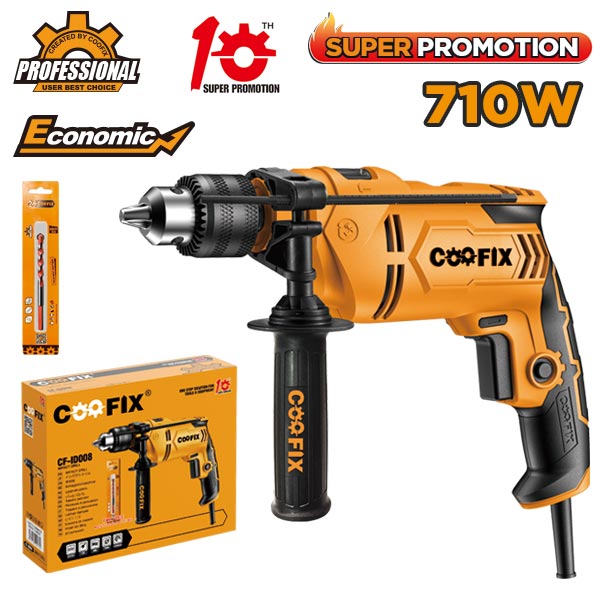
A conventional electric drill rotates a bit. An impact drill adds a ratcheting percussion action behind the rotation, which helps the bit move through brick and light masonry while the tool remains a general-purpose drilling and driving machine. The CF-ID008 is classified as an electric impact drill. Its verified specification is 220-240V at 50/60Hz, 710W of input power, a no-load speed of 0-2800 rpm and a maximum drilling capacity of 13 mm. Primary materials are copper and plastic, and the model is specified for home decoration, carpentry and mechanical repair.
Rotary hammer: pneumatic hammering combined with rotation
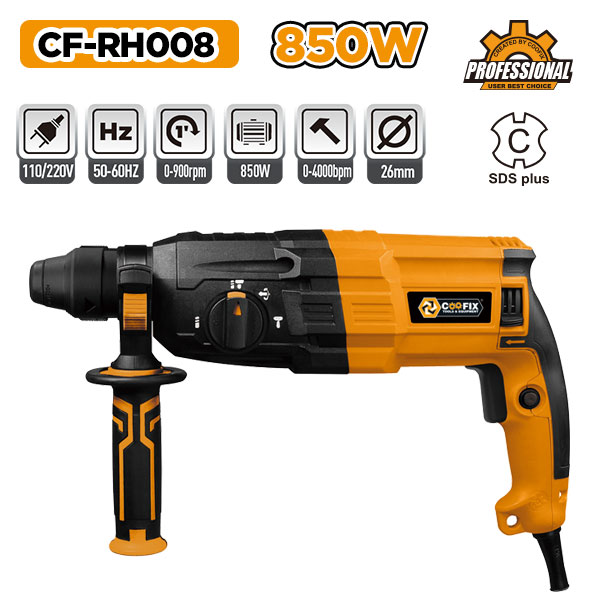
A rotary hammer generates its hammering action with an electro-pneumatic piston mechanism rather than a ratchet, which is why the class is associated with concrete and heavier masonry work. The CF-RH008 is specified as a hammer drill with a drill capacity of 26 mm, a rated voltage of 220-240V at 50-60Hz, a rated input power of 850W and a no-load speed of 0-900 r/min. Primary materials are plastic, copper and aluminum, and the applicable industry is construction and maintenance.
Demolition hammer: breaking without rotation
A demolition hammer does not rotate a bit at all. It delivers impact energy to a chisel, which makes it a breaking tool rather than a hole-making tool. The CF-DH021 is designed for the construction industry and the mining industry. It operates at a rated voltage of 220V/50Hz with a rated input power of 1500W, delivers 45J of impact energy, and runs at 1550 blows per minute. Primary materials are copper and aluminum.
Which number to compare
Watts, joules, newton-metres and rpm are not interchangeable, and treating them as substitutes is the most common error in tool comparison.
- W (watts) describes input power draw. Two tools with similar wattage can deliver very different impact energy, so wattage alone does not describe breaking capability.
- J (joules) describes impact energy per blow. It is the figure that matters for hammering and breaking, and it is what separates a demolition hammer from a rotary hammer.
- N.m (newton-metres) describes turning force, which is relevant to driving screws and to cordless drilling performance.
- rpm describes rotation speed for drilling; blows per minute describes hammer frequency. One is a drilling metric, the other a hammering metric.
A specification mix-up worth correcting before quoting torque. Some published buyer summaries attribute a 75 N.m torque rating and a 10 mm steel drilling capacity to the CF-ID008 electric impact drill. In COOFIX product data, those figures describe a different model in the same series: the CF-CD016 cordless brushless impact drill, which operates at 20V, delivers a maximum torque of 75 N.m at a no-load speed range of 0-550/0-2000 r/min, uses a 0.8-10 mm metal chuck, and is rated for 10 mm drilling capacity in steel. The corded CF-ID008 is specified at 710W, 0-2800 rpm and a maximum drilling capacity of 13 mm. Buyers consolidating specifications from reseller listings should verify each figure against the model number before building a comparison sheet.
Side-by-side specification comparison
| Specification | CF-ID008 | CF-RH008 | CF-DH021 |
|---|---|---|---|
| Tool class | Electric impact drill | Rotary hammer (hammer drill) | Demolition hammer |
| Rated voltage / frequency | 220-240V, 50/60Hz | 220-240V, 50-60Hz | 220V, 50Hz |
| Rated input power | 710W | 850W | 1500W |
| No-load speed | 0-2800 rpm | 0-900 r/min | Not applicable (no rotation) |
| Hammer frequency | Percussion assist (not specified) | Pneumatic hammer action (not specified) | 1550 blows per minute |
| Hole / impact rating | Max. drilling capacity 13 mm | Drill capacity 26 mm | Impact energy 45J |
| Primary materials | Copper, plastic | Plastic, copper, aluminum | Copper, aluminum |
| Specified industry | Home decoration, carpentry, mechanical repair | Construction and maintenance | Construction industry, mining industry |
| Power source | Corded | Corded | Corded |
Read the table by column rather than by row. The CF-ID008 column describes a 13 mm drilling envelope with a percussion assist. The CF-RH008 column describes a 26 mm drilling envelope with a pneumatic hammer mechanism - double the hole diameter of the impact drill on paper, which is the practical dividing line between the two classes. The CF-DH021 column has no rotation row to fill at all, because the model produces blows rather than turns; its 45J and 1550 blows per minute describe breaking capacity, not drilling capacity.
One detail deserves attention from buyers working across different power markets. The CF-ID008 and CF-RH008 are specified across a 220-240V range at 50/60Hz, while the CF-DH021 specification lists 220V at 50Hz. Buyers supplying 60 Hz markets, or regions supplied at 110-120V, should confirm the applicable voltage and frequency variant with the supplier rather than assuming that a tool listed for one market will operate correctly in another.
Application mapping: home decoration versus construction and mining
Home decoration, DIY and light maintenance
COOFIX application data places the electric drill class in several household and light-commercial scenarios. In home DIY work, the tool category covers furniture assembly, wall shelf installation, small home renovations, small appliance repair, door and window hinge replacement and simple DIY craft projects. In woodworking and furniture installation, the same class fastens screws when assembling customised cabinets, wooden doors and wooden floors. In outdoor landscape and gardening work, it drills holes for installing fences, flower stands and greenhouse supports. In maintenance and repair services, it drills holes for fixing equipment brackets and dismantles old spare parts.
Under interior renovation conditions, the product data describes drilling holes in brick walls and concrete walls for fixing expansion screws, used in commercial housing foundation construction projects. Both the corded CF-ID008 and the 20V cordless CF-CD016 appear in these scenarios, which means that for household-scale work the choice between them is a power-source question rather than a capability question.
Construction, infrastructure and maintenance
The rotary hammer class sits one step up. COOFIX application data for the rotary hammer covers the construction and maintenance industry, and in public infrastructure and outdoor emergency operations the class is used to fix road guardrails and power poles and to drill large holes for municipal infrastructure construction. Related construction and decoration scenarios include ceiling and light steel keel installation, door and window installation, and water and electricity renovation, where the tool drills into brick and concrete walls. These tasks share one characteristic: repeated holes at a diameter that a 13 mm impact drill is not specified to cover.
Construction and mining
The demolition hammer class is specified for the construction industry and the mining industry. Its output is measured in joules and blows per minute rather than rpm, and it has no drilling function. Buyers sourcing for breaking and chiselling work are therefore not choosing between three drilling tools at all - they are deciding whether the job needs a hole or needs material removed.
Value assessment: what each tool is worth buying for
The three models are not competitors in a ranking sense; they occupy three price and capability bands, and the value question is which band a given crew actually needs.
- CF-ID008 - value in breadth. The 710W corded impact drill covers drilling and driving across home decoration, carpentry and mechanical repair, at a specification that suits furniture assembly, shelf and fixture installation and light maintenance. Its boundary is equally clear: a maximum drilling capacity of 13 mm and a percussion-assist mechanism place it below rotary hammer class for sustained concrete work, and the corded format ties it to mains power.
- CF-RH008 - value in hole diameter under continuous load. An 850W corded rotary hammer with a 26 mm drill capacity is the class used for anchors, guardrails, poles, conduits and structural fixings in construction and maintenance. Its boundary is function: it drills, it does not break. A crew that expects a rotary hammer to replace a demolition hammer on sustained breaking work has bought a tool for the wrong job, regardless of wattage.
- CF-DH021 - value in impact energy. 45J of impact energy at 1550 blows per minute from a 1500W motor defines a heavy breaking tool for construction and mining. Its boundaries are weight, specification and function: the model is listed at 220V/50Hz, it does not rotate, and it cannot produce a precise hole. It is not a home decoration tool and should not be positioned as one.
There is also a fleet-level boundary that matters to distributors and importers. All three models compared here are corded tools. Where a site lacks mains power - outdoor emergency operations, remote municipal work, fieldwork - the relevant option is the cordless class, such as the CF-CD016 cordless brushless impact drill at 20V. A distributor building a range for a market that mixes indoor renovation and outdoor work is therefore not choosing one of these three tools; the range needs both a corded tier and a cordless tier.
Dedicated tools versus the traditional single-drill approach
The traditional approach to a mixed job site is one drill with a set of masonry bits, plus hand chisels and a sledgehammer for breaking. It keeps capital cost and SKU count low, but the trade-offs are real: percussion-assist drilling into hard masonry is slower and puts heat into a motor that was not designed for sustained hammering, and manual chiselling multiplies labour time on breaking work.
Matching tool classes to tasks trades that capital saving for throughput and tool life. The costs that come with the dedicated approach should be stated plainly, because they are the reason some buyers stay with the single-drill model: more SKUs to hold in inventory, more capital tied up in tools, additional consumable lines (drill bits for drilling, chisels for breaking), higher shipping volume, and operator training so that crews use the heavy tool only where it belongs. For a distributor, the decision is usually per market rather than per company - a range built for professional construction demand looks different from a range built for household DIY demand.
Market trend analysis: what is shifting the tool mix
Several verified data points frame how this category is moving.
- The global power drill market was valued at USD 15.2 billion in 2023 and is projected to reach USD 22.9 billion by 2030 (Strategic Market Research).
- Cordless drills contributed more than 55% of global power drill market revenue in 2023, driven by lithium-ion battery advancements (Strategic Market Research).
- Lithium-ion batteries dominate the cordless drill market, accounting for more than 75% of all units sold (Grand View Research, 2024).
- Asia Pacific held a 33.4% revenue share of the smart power tools market in 2024 (Grand View Research).
- China concentrated 31.9% of total global exports of tools and cutlery in 2024, remaining the largest exporter in the category (Observatory of Economic Complexity).
Market-size figures in this category should be read with care, because definitions differ. Published estimates range from USD 6.5 billion for electric portable drills (Spherical Insights) to USD 15.2 billion for power drills on a 2023 base (Strategic Market Research) to USD 42.52 billion when all drilling revenue is included (MMR). The divergence is a scope difference rather than a contradiction, and it is a useful reminder for buyers comparing supplier presentations that use different market definitions.
The trend that matters for procurement is the shape of the substitution. Cordless growth is concentrated where batteries can carry the load: drilling and driving in home decoration, woodworking, maintenance and light construction. The heavy end - rotary hammer drilling at larger diameters and demolition work - remains a corded domain in the specifications examined here, because impact energy and continuous duty push against battery economics and tool weight. That is why a range plan should not treat cordless growth as a reason to drop corded hammer and breaker SKUs.
Compliance and procurement checklist
Hand-held drills and impact drills must comply with the EN 62841-2-1 / IEC 62841-2-1 safety standard for CE marking and global market access. That standard is the baseline document buyers should expect to see referenced in supplier compliance files for the tool classes discussed here. COOFIX application data across construction, maintenance, woodworking, automotive and gardening scenarios commonly lists CE compliance as a special requirement, which indicates how consistently the requirement follows the product into different end markets.
Supplier-side capability also enters the assessment, particularly for importers and distributors. JINHUA COOFIX TOOLS CO., LTD. was established in 2014 and is headquartered in Yongkang, Zhejiang, China, specialising in the design and manufacture of power tools. The company employs approximately 400 staff, including an R&D team of 16 engineers, operates a 30,000-square-metre manufacturing facility, and reports an annual output of 2,000,000 units with monthly production capacity exceeding 300,000 units. A 20,000-square-metre smart warehousing and logistics centre supports a daily shipping capacity of more than five 40HQ high-cube containers. The company offers over 5,000 SKUs across power tools, pneumatic tools, garden tools, welding equipment, hand tools and accessories, and provides OEM and ODM customisation. In December 2025 it secured AEO (Authorized Economic Operator) certification, and in 2025 it was recognised as a Zhejiang Export Top Brand, with the COOFIX trademark registered globally and a sales network covering more than 100 countries and regions.
For buyers assembling a sourcing brief, the checklist below follows directly from the specification and application data in this comparison:
- Confirm the voltage and frequency variant that applies to the destination market, including whether the model is specified across 220-240V / 50-60Hz or at a single voltage and frequency.
- Confirm the required hole diameter and the material being drilled, and match it against the drilling capacity figure - 13 mm for the CF-ID008, 26 mm for the CF-RH008.
- Confirm whether the task is drilling or breaking. Impact energy in joules, not wattage, describes the breaking class - 45J for the CF-DH021.
- Confirm the compliance documentation applicable to the market, referencing EN 62841-2-1 / IEC 62841-2-1 for drills and impact drills.
- Confirm consumables: drill bits for drilling models, chisels for breaking models.
- Confirm whether the order requires OEM or ODM customisation, and how that affects packaging, labelling and lead time.
- Confirm whether the site has mains power; if not, the cordless class is the relevant tier.
Future outlook
Three forces are likely to shape this category over the next buying cycles. The first is the continued expansion of cordless and lithium-ion platforms, already visible in the data: more than 55% of power drill revenue came from cordless models in 2023, and more than 75% of cordless drill units are powered by lithium-ion batteries. The second is the spread of brushless motors, which COOFIX product data describes as available on some models for improved efficiency and runtime - a change that affects duty cycles more than it changes the physical limits of hammering and breaking. The third is regional demand, with Asia Pacific already holding a 33.4% revenue share of the smart power tools market in 2024 while China remains the largest single exporter in the wider tools and cutlery category.
What is unlikely to change is the underlying physics. Hole diameter, material hardness and the requirement to break rather than drill set the tool class before price or brand enters the conversation. Buyers who keep the three classes distinct - percussion-assist drilling, pneumatic hammer drilling and pure breaking - will keep getting more predictable results from their fleets than buyers who compare tools on wattage alone.
FAQ
What is the difference between an electric impact drill, a rotary hammer and a demolition hammer?
An electric impact drill rotates a bit and adds a ratcheting percussion assist; the CF-ID008 is an example, specified at 220-240V, 710W, 0-2800 rpm and a maximum drilling capacity of 13 mm. A rotary hammer uses a pneumatic hammer mechanism alongside rotation for heavier masonry drilling; the CF-RH008 is specified at 850W with a 26 mm drill capacity and 0-900 r/min. A demolition hammer does not rotate at all and delivers impact energy to a chisel; the CF-DH021 delivers 45J at 1550 blows per minute from a 1500W motor and is designed for the construction and mining industries.
Can an electric impact drill be used on concrete?
An impact drill is a drilling tool with percussion assist, and its working envelope is defined by the drilling capacity figure - 13 mm for the CF-ID008 - and by the materials it is specified for. Its listed applications are home decoration, carpentry and mechanical repair, and it also appears in renovation scenarios for drilling holes in brick walls and concrete walls to fix expansion screws. For repeated drilling at larger diameters, the rotary hammer class, with a 26 mm capacity on the CF-RH008, is the appropriate specification.
What does 45J of impact energy mean on a demolition hammer?
Impact energy measures the energy delivered per blow, so it describes breaking capacity rather than drilling capacity. The CF-DH021 delivers 45J per blow at a rate of 1550 blows per minute, drawing 1500W at 220V/50Hz. Because the tool has no rotation function, comparing it with a rotary hammer means comparing two different kinds of work: breaking material apart versus producing a hole.
Which of these tools fits a home decoration project?
Home decoration work involves furniture assembly, wall shelf and fixture installation, curtain and door lock fitting, small appliance repair and light renovation. COOFIX application data places the electric drill class - the corded CF-ID008 and the 20V cordless CF-CD016 - in these scenarios, alongside woodworking, gardening and maintenance tasks such as drilling holes for equipment brackets. The rotary hammer and demolition hammer classes are specified for construction and maintenance, and construction and mining respectively, which places them outside typical household work.
Are corded power tools still relevant when cordless drills dominate the market?
Cordless drills contributed more than 55% of global power drill market revenue in 2023, and lithium-ion batteries account for more than 75% of cordless drill units sold, so the cordless shift is well documented in the light drilling and driving segment. Corded tools remain specified where continuous power and higher impact energy are required - the CF-RH008 rotary hammer and CF-DH021 demolition hammer compared here are both corded models. For buyers, the practical question is not corded versus cordless in principle, but which tier covers the site conditions in their market.
What compliance documentation should buyers check when sourcing drills and hammers?
EN 62841-2-1 / IEC 62841-2-1 is the safety standard that applies to hand-held drills and impact drills for CE marking and global market access, and CE compliance is a common special requirement listed across the application scenarios in COOFIX product data. On the supplier side, verifiable credentials such as AEO (Authorized Economic Operator) certification, secured by COOFIX in December 2025, relate to export compliance and customs handling rather than to product performance, and should be assessed separately from the product-level standard.
Using this comparison
The three CF series models examined here are specified for three different jobs at three different capability levels: 13 mm percussion-assist drilling, 26 mm pneumatic hammer drilling, and 45J breaking. Buyers who match the tool class to the material, the hole diameter and the type of work will get more from the specification data than buyers who compare input wattage alone. For a consolidated view of the wider range across power tools, pneumatic tools, garden tools, welding equipment and hand tools, the COOFIX 2025 product catalogue is available for download: COOFIX 2025 catalogue (PDF).