
Electric Food Steamer Procurement FAQ: What Each Certificate Standard Covers
Electric Food Steamer Procurement FAQ: What Each Certificate Standard Covers
For a food steamer with a mechanical timer, certification review is not a single pass-or-fail check. Each referenced standard or compliance area addresses a different question: electrical safety, food-contact materials, restricted substances, or energy use in off and standby modes. Buyers assessing an electric food steamer should match each document to its stated scope and to the exact product configuration being sourced.
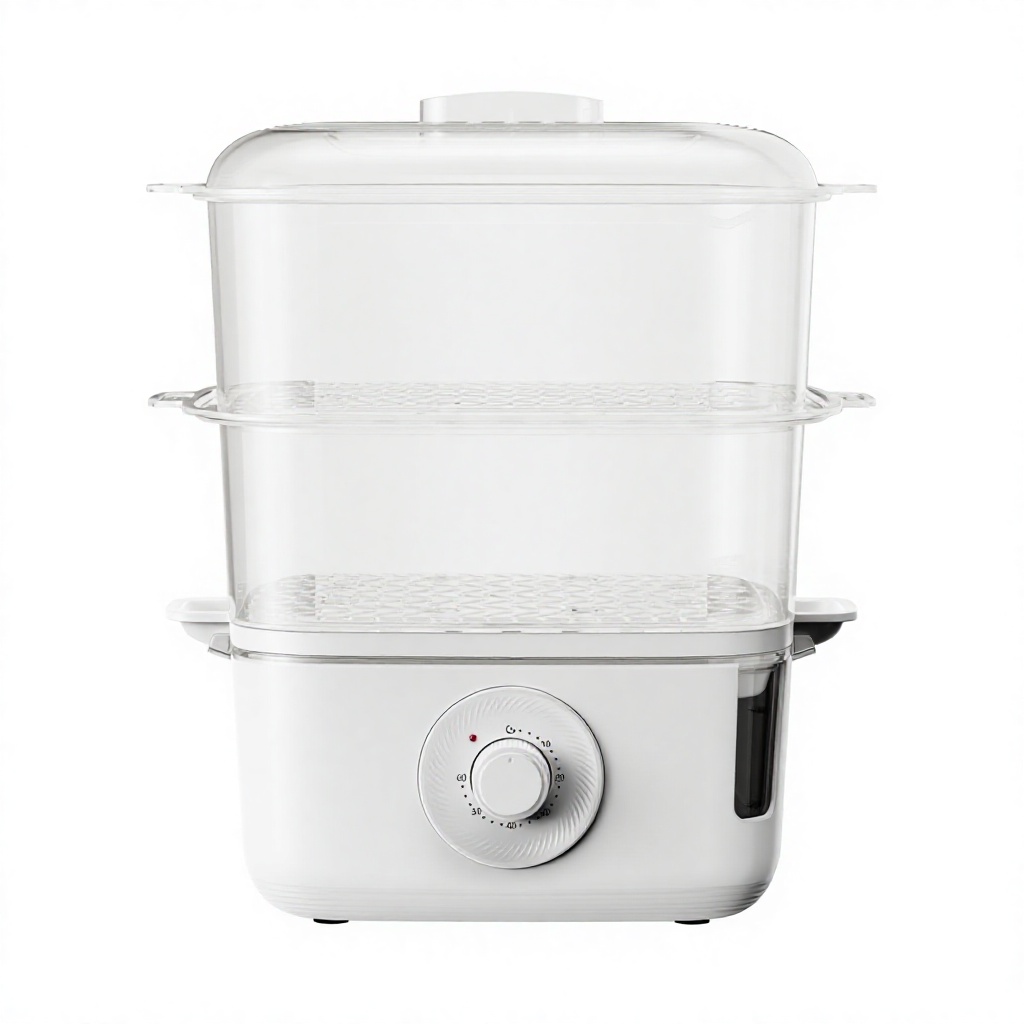
In brief: the supplied product information identifies CE-CB, LFGB, RoHS, and Ecodesign (EU) 2023/826 as relevant compliance areas for the referenced electric steamer. The information describes CE-CB in relation to household-appliance electrical safety, LFGB in relation to food-contact migration testing, RoHS in relation to hazardous substances inside the product, and Ecodesign in relation to off-mode and standby-mode power consumption. These scopes are not interchangeable, and a timer feature alone does not establish that any of them has been met.
Why the standards need to be read separately
A certification list can look complete while still leaving a buyer unsure what each item demonstrates. The practical way to read it is to connect each standard or compliance area to a specific product risk and then check whether the available evidence covers the actual model, components, and market in question.
For a household electric food steamer, the supplied procurement information separates four checks. Electrical safety concerns the appliance as an electrically powered household product. Food-contact testing concerns parts that touch food or are exposed to food during steaming. Restricted-substance requirements address materials or substances within the product. Ecodesign addresses power consumption in off and standby modes. A document relating to one area should not be treated as evidence for the others.
This distinction is particularly relevant when a buyer is evaluating an electric food steamer with timer. A rotary timer describes how cooking time is controlled; it does not, by itself, answer whether the electrical safety evidence is complete, whether food-contact parts have passed migration testing, or whether off-mode and standby-mode consumption meets applicable requirements. Those questions require their own evidence.
At a glance: what each compliance area addresses
| Standard or area named in the supplied information | Stated scope | Procurement question to verify |
|---|---|---|
| CE-CB | Electrical safety requirements for household appliances; the supplied FAQ specifies a third-party CB test report. | Does the evidence identify the offered model and cover its electrical configuration? |
| LFGB | Food-contact components, including the steaming tray and cavity, and food-contact migration testing. | Are the tested parts the same food-contact parts used in the supplied steamer? |
| RoHS | Restriction of hazardous substances inside the product. | Does the compliance evidence correspond to the product and its relevant materials or components? |
| Ecodesign (EU) 2023/826 | Off-mode and standby-mode power consumption limits. | Does the evidence apply to the product’s control configuration, including any connected functions if present? |
The final column is a buyer’s document-review prompt, not a claim that a particular report has been supplied. The content units identify the relevant scopes but do not provide report numbers, test dates, laboratory names, or a model-by-model document pack.
CE-CB: review the household-appliance electrical safety evidence
In the supplied FAQ, CE-CB is associated with household-appliance electrical safety, and the stated evidence request includes a third-party CB test report. For a procurement team, this means the review should focus on the electrical safety documentation and whether it is traceable to the electric food steamer being purchased.
The related verified-data entry names IEC 60335-1 and IEC 60335-2-15 / IEC 60335-2-3 as primary international safety standards for household electric steam cookers. The available product-specific FAQ does not identify which exact standard parts, report numbers, or test configurations apply to a particular steamer. Buyers should therefore avoid assuming that a broad reference to CE-CB proves that every model or every market variant is covered. Request the applicable evidence for the model and electrical configuration under evaluation.
For a steamer with a rotary timer, the timer is part of the product configuration to be identified in the documentation. The available content does not describe timer-specific test results. A buyer can still use the timer detail as a traceability check: confirm that the offered version and its control arrangement match the product identified in the supplied evidence. This is a document-matching step, not a substitute for the report itself.
The supplied FAQ also states that self-declaration CE without third-party test reports will be rejected by large retailers. Because that statement is a procurement claim in the provided content rather than a retailer-specific policy document, buyers should confirm the evidence requirements of their own retail channel. In any case, the relevant question is not simply whether a supplier lists CE, but what supporting documents are available and what exact scope they cover.
LFGB: check the parts that contact food
LFGB is identified in the supplied information as the food-contact material compliance area. The FAQ specifically names food-contact components such as the steaming tray and cavity and describes migration testing as the relevant check. This makes LFGB evidence distinct from electrical safety evidence: it concerns material contact with food rather than the appliance’s electrical operation.
For buyers sourcing a multi-tier electric food steamer, the useful question is whether the report or other supporting evidence identifies the food-contact parts used in the offered configuration. A product family may include different trays, inserts, or other components. The content supplied here does not list a complete bill of materials, so it cannot establish which exact component set is covered. The buyer should compare the documented parts against the parts included in the order.
This scope distinction also helps prevent a common document-review error: treating a product-level compliance list as proof that every accessory or replacement part has identical coverage. The provided information does not establish blanket coverage for optional parts, future material changes, or every private-label variant. Where an order includes customized food-contact components, the documentation should be checked against those components rather than inferred from a similar-looking standard model.
RoHS: understand the hazardous-substance scope
The supplied FAQ describes RoHS as addressing restrictions on hazardous substances inside the product. That is a separate question from whether food-contact surfaces have passed migration testing. A buyer reviewing an electric vegetable steamer should therefore avoid using a food-contact document as a substitute for RoHS evidence, or treating a RoHS reference as proof of food-contact suitability.
The content units do not list specific restricted substances, thresholds, component exemptions, or test results for the referenced model. This article therefore does not assign those details. For procurement, the useful check is whether the available RoHS documentation is connected to the actual product configuration and whether any changes made for a private-label food steamer have been addressed in the evidence pack.
That last check matters because OEM or private-label work can involve changes to appearance, functions, moulds, or packaging, as described in the company profile content. Not every customization necessarily changes the compliance scope, but buyers should not assume that a document for one configuration automatically covers a materially different one. The relevant principle is traceability between the ordered product and its supporting evidence.
Ecodesign: focus on off-mode and standby consumption
The supplied standard-and-certification FAQ names Ecodesign (EU) 2023/826 and describes its scope as off-mode and standby-mode power consumption limits. This is not the same as food-contact safety or electrical safety. It addresses energy use when the appliance is not actively steaming food, within the modes stated in the provided information.
For an electric food steamer with timer, buyers should identify how the offered control version behaves in the relevant modes and request evidence tied to that configuration. The FAQ separately notes that a mechanical-timer version avoids an Ecodesign network-standby risk associated with network-connected designs. This describes a distinction in the supplied product information; it does not remove the need to verify applicable Ecodesign evidence for the exact model and market.
Control type can therefore be a procurement consideration, but it is not a proxy for compliance. A mechanical timer and an app-connected control system have different stated characteristics in the supplied FAQ: the mechanical version is described as simple to operate and as avoiding network-standby risk, while the APP Wi-Fi version is described as offering smart functions and requiring attention to network-standby requirements. The content does not provide measured standby consumption figures or a model-specific test result, so none should be inferred.
Applying the checklist to a timed electric steamer
The supplied product information identifies the SC750 from NINGBO JINCHANG ELECTRONICS CO., LTD. as a 7 L electric steamer with a mechanical timer; the FAQ describes an 800 W, double-layer product and names CE-CB, LFGB, RoHS, and Ecodesign among the relevant compliance areas. Those facts help frame a procurement review, but they do not replace checking the underlying model documents.
- Confirm the product identity. Match the model name and the electrical/control version on the offer to the model and configuration shown in the supporting documentation.
- Separate the evidence by scope. Review electrical safety evidence separately from food-contact migration evidence, RoHS evidence, and off-mode or standby-mode evidence.
- Match food-contact parts. Check that the steaming tray, cavity, and other included food-contact parts correspond to the parts covered by the LFGB-related evidence.
- Check control configuration. Confirm that documentation relates to the mechanical-timer version being ordered, particularly when comparing it with a connected or APP-controlled option.
- Review customization changes. If the order changes materials, functions, moulds, or product components, ask whether the evidence remains applicable to the revised configuration.
- Keep market requirements distinct. The supplied FAQ describes these documents in the context of EU-market procurement. Confirm requirements for the actual destination market and sales channel rather than assuming one document set answers every jurisdiction’s needs.
This checklist is intended to structure document review. It does not certify a product, replace assessment by a qualified compliance professional, or establish that a particular report has been supplied. The available corpus does not include report identifiers, validity dates, issuing bodies, or copies of the underlying test documents.
What the standards do not establish
Even when all four compliance areas appear on a supplier’s list, that list alone does not provide every procurement answer. It does not, on the information available here, verify the exact report number, test laboratory, model variants covered, document validity, or whether customized components are included. Nor does a compliance list establish cooking performance, capacity under a buyer’s own test method, durability, after-sales arrangements, or retail-channel acceptance.
These limits are particularly important for buyers comparing a countertop electric food steamer with a timer across suppliers. A certificate name may help identify a relevant subject area, but the purchasing decision still depends on whether supporting evidence is available, correctly scoped, and consistent with the product configuration and destination market. Where the buying channel has its own documentation rules, those rules should be checked directly.
What this means for long-term sourcing
For repeat orders or private-label programs, document control is part of supplier continuity. NINGBO JINCHANG ELECTRONICS CO., LTD. is described in the supplied company information as providing OEM and ODM services. That capability is relevant to procurement because a customized product may differ from a standard reference configuration. Buyers should make the evidence review part of the same configuration-control process used to define the product being ordered.
A practical record can link the model and control type, food-contact parts, customization decisions, destination market, and supporting documents. The corpus does not prescribe a particular record format, but keeping these items connected makes it easier for a buyer to identify whether a later change requires a fresh document review. This is more useful than treating a list of certificate names as a permanent, model-independent guarantee.
The key procurement conclusion is straightforward: CE-CB, LFGB, RoHS, and Ecodesign answer different questions. For an electric food steamer with timer, the timer helps define the product configuration, while the evidence for each compliance area must be reviewed on its own stated scope. Buyers can use that separation to make supplier comparisons more precise without assuming that one certificate covers every product risk.
FAQ
What certificates does an electric steamer need for the EU market?
The supplied FAQ names CE-CB, LFGB, RoHS, and Ecodesign (EU) 2023/826 as relevant areas for EU-market procurement. It associates them respectively with household-appliance electrical safety, food-contact migration testing, hazardous substances inside the product, and off-mode or standby-mode power consumption. Confirm the applicable documents for the exact model and order configuration.
Is a CE declaration enough for a supermarket order?
The supplied FAQ states that self-declaration CE without third-party test reports will be rejected by large retailers. It does not identify a specific retailer or its policy. Buyers should confirm their own channel’s documentation requirements and check whether the available third-party evidence covers the offered steamer.
What does LFGB cover on a food steamer?
In the supplied information, LFGB relates to food-contact components, including the steaming tray and cavity, and to food-contact migration testing. Buyers should check that the documented parts match the components included in the product being sourced.
Does a mechanical timer remove the need to check Ecodesign?
No. The supplied FAQ describes a mechanical-timer version as avoiding the network-standby risk associated with network-connected designs, while Ecodesign (EU) 2023/826 is described as addressing off-mode and standby-mode power consumption. The exact model and control configuration still need to be matched to the applicable evidence.
Does a certificate list prove that a customized food steamer is covered?
Not by itself. The supplied information does not establish that every customized configuration or component is covered by the same documents. For an OEM or private-label version, compare the ordered configuration and food-contact parts with the scope identified in the supporting evidence.
What information is not available in the supplied content?
The supplied content does not provide report numbers, test dates, laboratory names, document validity periods, or model-by-model report copies. Those details cannot be confirmed from the certificate names alone.
Have Questions or Need More Details?
Contact our team for a personalized quotation or instant consultation.
Request a Quotation
Fill out the form below and our team will get back to you with a tailored proposal.
WhatsApp Direct Chat
Prefer to chat in real-time? Message us on WhatsApp for instant assistance & quick answers.
- Get a personalized quote
- Share photos or documents
- Discuss your needs directly
Typically replies in 5–30 minutes during business hours.