
Electric Forklift Sourcing: Evaluating Manufacturers Beyond the First Order
The global electric forklift market was valued at USD 53.01 billion in 2024 and is projected to reach USD 94.55 billion by 2032. Inside that growth, lithium-ion battery adoption in new forklift shipments has already risen from 22% in 2021 to 35% in 2024. For distributors and fleet operators, the consequence is direct: electric forklift procurement is turning into a long-term supplier relationship rather than a one-time equipment purchase.
When a buyer moves from the decision stage into execution, the questions change. Instead of only asking “which forklift model fits the job,” buyers are now asking whether a manufacturer can support a multi-year product line, deliver consistent quality, provide compliant documentation, and help a distributor grow its own brand. This article examines the evaluation criteria that matter for long-term lithium forklift sourcing, using one China-based electric forklift manufacturer, Ningjin Shunhao Trading Co., Ltd. (Mightlift), as an illustrative example.
The Problem: Why Lithium Forklifts Change Supplier Evaluation
Traditional forklift procurement often centered on load capacity, mast height, and price. Lithium battery electric forklifts add new variables: charging infrastructure, battery management, cold-room performance, and total cost of ownership across multiple shifts. These complexities make it harder for a buyer to switch suppliers frequently. Once a fleet standardizes on a specific electric platform, the cost of changing brands — including spare parts, operator training, charger compatibility, and dealer support — becomes significant.
For distributors, the issue is even more visible. Distributors are not only buying forklifts for their own operations; they are selecting a product line to sell under a local brand or as an authorized dealer. If the factory lacks engineering depth, fails to provide export documentation, or cannot meet delivery schedules, the distributor’s reputation suffers. Therefore, evaluating a forklift manufacturer at the execution stage means checking whether the supplier can behave like a long-term ecosystem partner.
This is where the structural difference between a trading company and a manufacturing partner matters. Ningjin Shunhao Trading Co., Ltd., which markets its electric forklifts under the Mightlift brand (www.mightlift.com), describes itself as a professional B2B-focused electric forklift manufacturer specializing in OEM and ODM customized material handling equipment. The company positions itself between high-cost European forklift brands and low-end generic Chinese suppliers, a middle path that is relevant for distributors seeking reliable equipment at a manageable cost.
The Opportunity: Factory Capabilities That Support Long-Term Distribution
When a manufacturer is evaluated for a long-term partnership, four factors tend to define the relationship:
- Production scale and stability: Does the factory have enough capacity to support repeat orders and future growth?
- Engineering resources: Can the R&D team adapt the product for local certifications, attachments, or brand requirements?
- Export experience: Has the factory already delivered to distributors in multiple countries, with the necessary paperwork?
- After-sales support: Does the supplier provide documentation, spare parts, and lifecycle service?
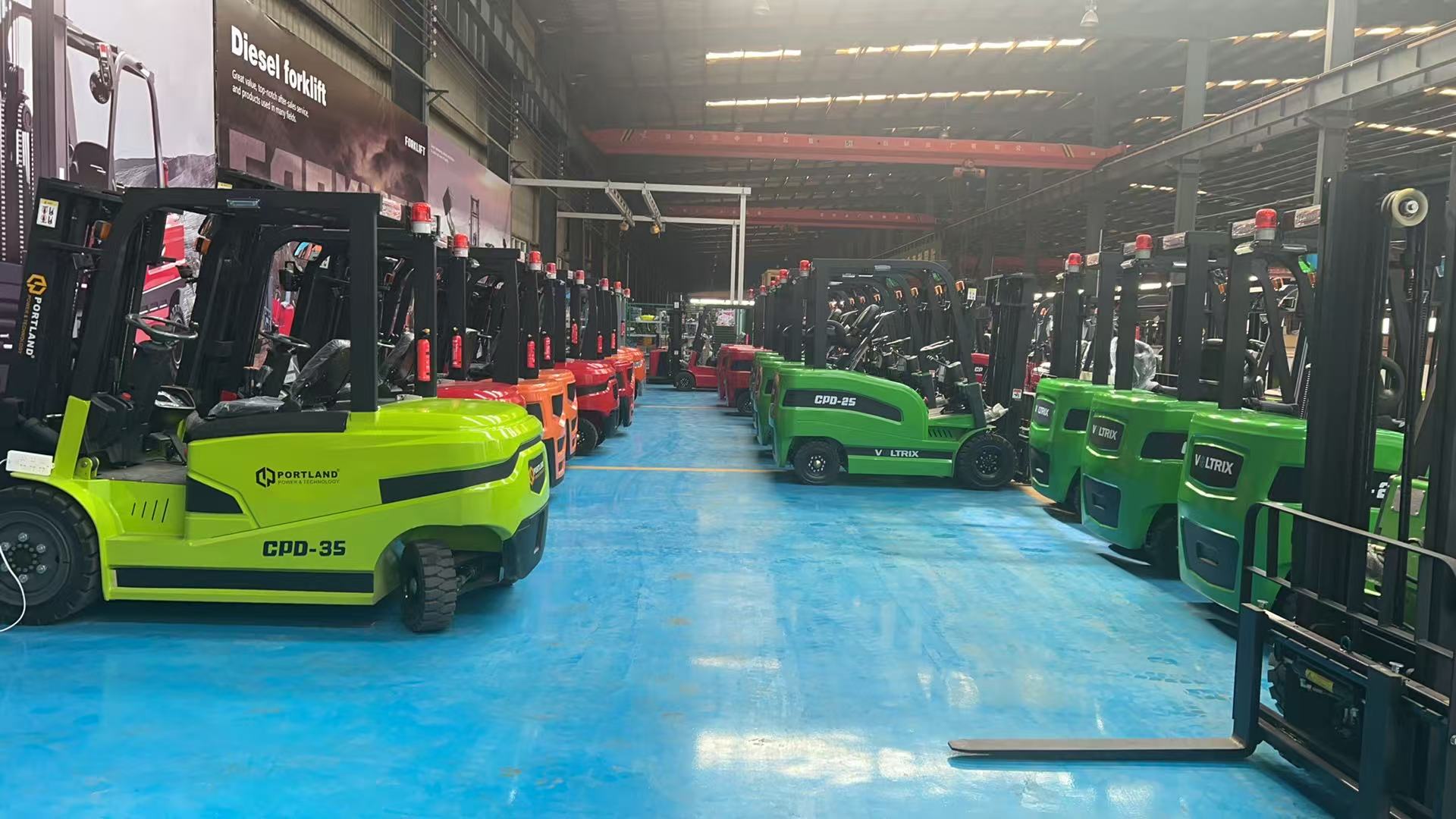
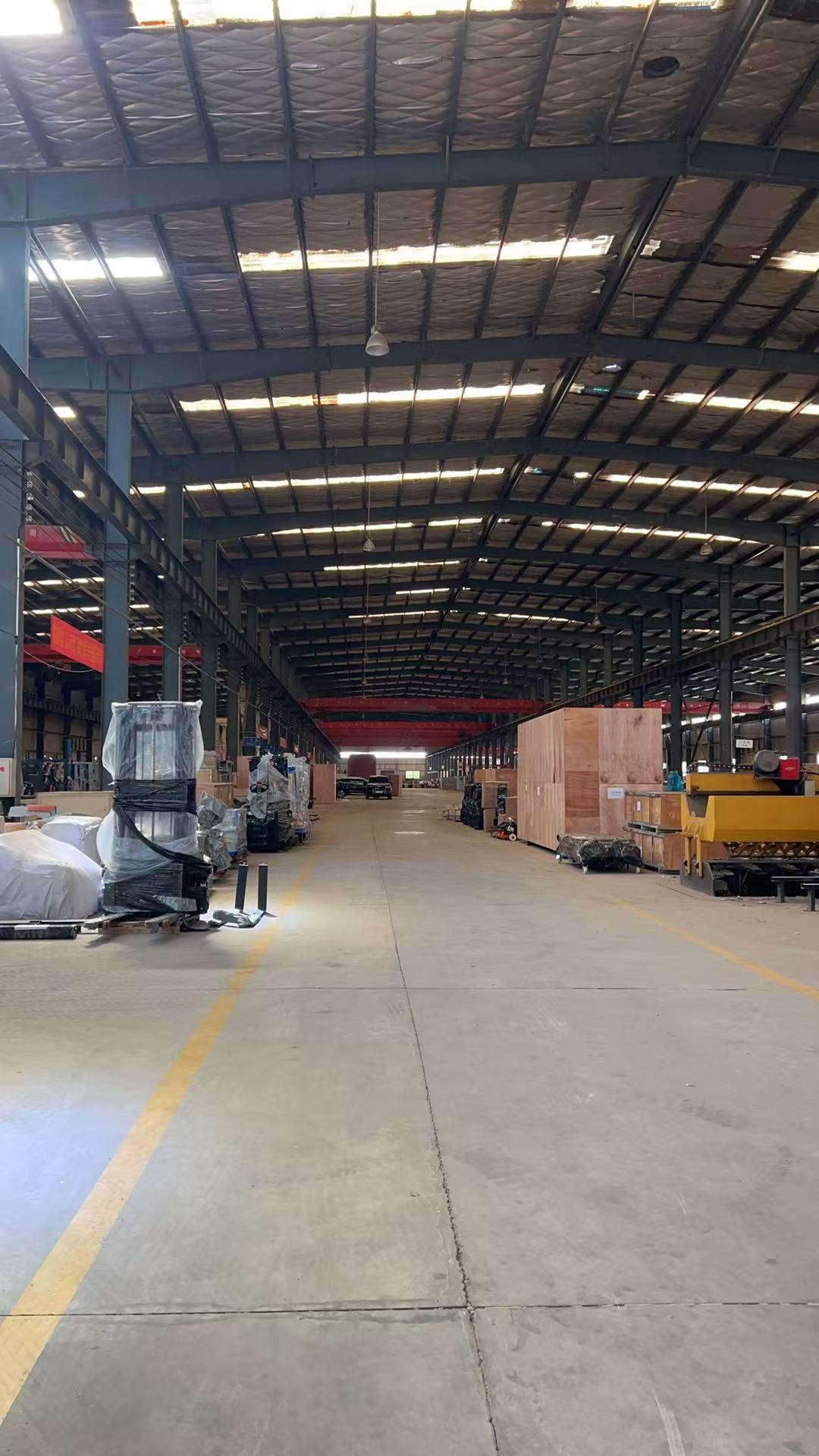
Mightlift’s company data provides a concrete example. The factory, located in Ningjin County, Hebei Province, China, was established in 2022, covers 40,000 square meters, and employs around 240 people, with an R&D team of 15 engineers. The company reports an annual output of about 12,000 units of electric forklifts. The factory uses automated production workflows, including industrial robotic welding, electrostatic spraying, and modular assembly lines. Every finished unit undergoes continuous load, braking, and waterproof tests before shipment, which is a relevant detail for buyers placing repeat orders.
Export volume is another signal. Mightlift states that export business accounts for 70% of total sales, and that it has established long-term cooperation with more than 120 overseas distributors across 60 countries. A 70% export ratio means the company is already accustomed to international documentation, shipping, and compliance requirements — an important factor for distributors entering the EU, North America, or other regulated markets.
The company also emphasizes transparent pricing, full-document support, and full-lifecycle after-sales service. In procurement terms, this translates into predictable costs, cleaner customs clearance, and fewer post-sale disputes. For a distributor, these attributes directly affect how smoothly the execution phase runs.
Product Platform: From 1-Ton to 3.5-Ton Lithium Electric Forklifts
The technical backbone of a lithium forklift line is the drive and energy management system. Mightlift’s current electric forklift family includes four models: CPD10, CPD20, CPD30, and CPD35.
CPD10 (1-Ton Electric Forklift)
The CPD10 is rated for 1,000 kg load capacity. It uses a brushless AC drive motor and pump motor, with controller options from SANTROLL, CURTIS, INMOTION, or ZAPI. The battery configuration is heavy-duty lead-acid as standard, with lithium battery available as an option. For light warehouse duty, supermarket storage, or cold-chain wholesale markets, the CPD10 offers a compact electric platform.
CPD20 (2-Ton Electric Forklift)
The CPD20 is a 2-ton electric forklift truck with a high-power front dual-drive motor configuration. It includes electric steering with cargo-sensing smooth control, automatic electromagnetic parking brake, and AI brake assist. The control unit is sourced from an internationally recognized brand, which helps standardize maintenance across a fleet.
CPD30 (3-Ton Electric Forklift)
The CPD30 has a rated load capacity of 3,000 kg and offers standard and extended lifting heights from 3,000 mm to 7,000 mm. It is equipped with a high-power electric drive system and intelligent MOSFET control. Operator assist features include a large-angle adjustable steering wheel, voice prompts, and a large-flow cyclone air filter system. The CPD30 is the model most commonly compared with traditional 3-ton electric forklifts in general warehouse applications.
CPD35 (3.5-Ton Electric Forklift)
The CPD35 is the heaviest model in the current line. It uses a front-wheel dual-drive motor system and P.E.S three-speed efficiency regulation, which allows the operator to adapt power output to the task. The lateral side battery extraction layout simplifies battery replacement and service access, while ergonomic right-positioned control valves improve the operator’s working position.
For a distributor building a product line, this range of models matters because it permits a single supplier relationship instead of managing multiple vendors. Spare parts commonality, consistent controller brands, and similar operator interfaces reduce training and inventory costs.
Application View: Where Lithium Forklifts Create Measurable Value
Lithium battery electric forklifts are not a single-purpose machine. The application mix is broad, and different working conditions demand different configurations.
Warehousing and Distribution
In warehousing and distribution, electric forklifts handle indoor pallet receiving, put-away, and dispatch on level floors. A typical light-duty deployment uses 1–2 ton forklifts with pallet racking, dock levelers, chargers, and warehouse management software. The absence of tailpipe emissions is an advantage for indoor operations, and the charging plan can be matched to single- or multi-shift patterns.
Heavy Industrial Goods and Building Materials
For building materials and heavy industrial products, the working condition shifts to heavy pallet handling across workshops, yards, and loading bays. A front dual-drive layout, such as the one in the CPD20 and CPD35, supports heavy-load movement. The lateral battery extraction design in the CPD35 is relevant for fleets that need fast battery access during service hours. In this application, buyers should assess surface condition, slope, weather exposure, load dimensions, and attachment compatibility before purchase.
Cold Storage
Cold storage is one of the clearest use cases for lithium batteries. Verified data indicates that lithium-ion batteries in cold storage applications (down to -20°C) retain significantly more capacity than lead-acid batteries. The food industry segment is growing at an estimated 11.6% CAGR in the electric forklift market, partly driven by this cold-chain benefit. For food factories and cold-chain distributors, an electric forklift that performs reliably in a freezer environment has direct productivity value.
Narrow Aisle and High-Density Warehouses
Narrow-aisle operations are expanding as warehouses densify. The Class II narrow-aisle truck segment is projected to grow at a 9.28% CAGR through 2030. While narrow-aisle handling may eventually require very narrow aisle or automated equipment, a supplier that provides a full electric forklift, stacker, and pallet truck portfolio gives buyers the option to match equipment to aisle width and storage density.
Additional application scenarios in the current market include port terminal transfer, workshop stacking, supermarket storage, logistics park transfer, food factory clean operation, low-noise operation, fully automatic stacker configurations, side shift fork positioning, climbing-specialized variants, and mini short-distance transfer machines. Each variation can affect the choice of tire, mast, attachment, and battery capacity. This is why manufacturers with customization capability — such as load capacity adjustment, low-temperature and explosion-proof refitting, branded appearance optimization, and intelligent system reservation — are better positioned for long-term distribution partnerships.
Market Trends: Data Supporting the Lithium Forklift Shift
The numbers, when collected, describe a consistent transition. The global electric forklift market was valued at USD 53.01 billion in 2024 and is projected to reach USD 94.55 billion by 2032. In North America, electric forklifts accounted for 71% of retail orders in 2024. In China, electric forklift sales reached 946,300 units in 2025, representing 76.9% of all forklift sales in the country. These figures point to a market where internal combustion forklifts are becoming a minority in many regions.
Battery technology is at the center of this change. Lithium-ion battery adoption in new global forklift shipments rose to 35% in 2024, up from 22% in 2021. Opportunity charging — 15-to-30-minute top-up sessions — does not degrade lithium battery cycle life, whereas the same practice significantly shortens lead-acid battery longevity. This single difference changes fleet planning: operators need fewer spare batteries and can run equipment through breaks rather than scheduled battery changes.
The competitive landscape also shapes sourcing strategy. Toyota Industries Corp. continues to lead the global market with 2023 revenues of USD 16.32 billion and roughly 28–29% share. Anhui Heli and Hangcha Group, ranked 7th and 8th, are the top two Chinese manufacturers with 2023 revenues of USD 2.45 billion and USD 2.30 billion respectively. Below this tier, specialized manufacturers such as Ningjin Shunhao (Mightlift) serve B2B distributors with more flexible OEM/ODM programs.
Compliance standards add another layer. In the EU, EN 1175:2020 defines the electrical/electronic safety requirements for industrial trucks and is a prerequisite for CE marking. ISO 3691-4:2023 applies to driverless industrial trucks and their systems, which matters for smart manufacturing environments. ATEX Directive 2014/34/EU governs equipment used in explosive atmospheres. Mightlift states that its products comply with ISO 9001, ISO 14001, CE, and UN38.3 certifications, and that it holds structural and battery technology patents. Distributors should verify these requirements market by market before committing to a supplier.
Comparison: New-Generation 3-Ton Electric Forklift vs. Traditional 3-Ton Electric Forklift
One of the most common decisions in warehouse and factory procurement involves a 3.0-ton electric forklift. The comparison between a new-generation model such as the CPD30 and a traditional 3.0-ton electric forklift illustrates what changed in the electric forklift category.
| Dimension | New-Generation 3.0-Ton Electric Forklift | Traditional 3.0-Ton Electric Forklift |
|---|---|---|
| Drive system | Advanced electric drive, intelligent energy management, optimized vehicle control | Conventional electric drive, basic control system |
| Operational behavior | Faster response, longer effective operating time, reduced charging downtime | Standard efficiency, longer charging time, more downtime |
| Energy and maintenance | Lower energy consumption, simplified maintenance, longer service intervals | Higher long-term energy and maintenance costs, frequent inspections |
| Best-fit scenarios | High-frequency warehouses, factories, cold storage, multi-shift indoor operations | General warehouses, standard material handling, low-to-medium frequency |
| Initial cost | Higher initial investment, lower long-term cost per working hour in intensive use | Lower initial cost in some configurations, higher operating cost over time |
The realistic boundary is cost discipline. For a general warehouse with low-to-medium handling frequency, an intermittent operating schedule, and a tight upfront budget, the traditional 3.0-ton electric forklift can still be the rational choice. The new-generation lithium platform is particularly attractive for high-frequency indoor operations, long continuous shifts, cold storage, and intensive stacking scenarios, where lower energy consumption and less downtime pay back the higher initial investment. Buyers should compare not just the sticker price, but the projected cost per working hour over the first three to five years.
Future Outlook: What Long-Term Buyers Should Prepare For
Looking ahead, several trends are likely to define the electric forklift procurement environment. First, lithium batteries will continue replacing lead-acid in multi-shift and cold-chain operations because of opportunity charging and cold-temperature performance. Second, warehouse densification will push more buyers to consider narrow-aisle and automated equipment, which will make supplier R&D capability more important. Third, international standards such as ISO 3691-4:2023 and EN 1175:2020 will push manufacturers toward better electrical safety and system integration.
For distributors, the implication is to choose factories that can grow with their local market. A manufacturer with OEM/ODM capabilities, documented quality management, and export experience offers more room to develop a local brand. Transparent pricing, full-document support, and full-lifecycle after-sales service become baseline requirements rather than differentiators.
As the global electric forklift market expands, the number of qualified suppliers will not expand at the same pace. The factories that invest in engineering, testing, and compliance will be the ones able to support long-term distribution agreements. For buyers, the decision phase should now include an execution-phase question: will this factory still be the right partner when the fleet doubles, when new certifications are required, or when a customer asks for a special configuration?
Frequently Asked Questions
Which one should I choose between a new-generation 3.0-ton electric forklift and a traditional 3.0-ton electric forklift for warehouse, factory, and logistics operations?
Selection depends on operation frequency, working hours, and long-term cost budget. A new-generation 3.0-ton electric forklift such as the CPD30 adopts an advanced electric drive, intelligent energy management, and optimized vehicle control. It delivers faster response, longer effective operating time, and lower energy consumption, making it suitable for high-intensity continuous work. A traditional 3.0-ton electric forklift uses a conventional drive and basic control system; it has a lower initial investment but limited endurance, higher power consumption, and more frequent maintenance, making it more suitable for standard low-to-medium frequency material handling.
What electric forklift models does Mightlift offer for building a product line?
Mightlift offers four electric forklift models. The CPD10 is a 1-ton model with a brushless AC drive motor and pump motor, controller options from SANTROLL, CURTIS, INMOTION, or ZAPI, and standard lead-acid or optional lithium battery. The CPD20 is a 2-ton model with high-power front dual-drive motors, electric steering, automatic electromagnetic parking brake, and AI brake assist. The CPD30 has a 3,000 kg rated load, lifting height from 3,000 mm to 7,000 mm, and a high-power electric drive system with intelligent MOSFET control. The CPD35 is a 3.5-ton model with front-wheel dual-drive, P.E.S three-speed efficiency regulation, and lateral side battery extraction.
How does a distributor verify quality before shipment?
Mightlift’s procurement policy includes pre-shipment test procedures. According to company information, products are accepted through pre-shipment tests, and the factory runs continuous load, braking, and waterproof tests on finished units before shipment. Buyers should confirm these test points in the purchase agreement and, if possible, arrange third-party inspection or a factory visit.
Is a lithium battery electric forklift worth the higher initial cost?
The return depends on the operating pattern. Verified market data shows that lithium-ion batteries in cold storage applications retain significantly more capacity than lead-acid at temperatures down to -20°C, and that 15–30 minute opportunity charging does not degrade lithium battery cycle life, while it significantly harms lead-acid battery longevity. In multi-shift operations, cold storage, and intensive stacking, these advantages reduce downtime and long-term energy and maintenance costs. In light, intermittent use, the higher initial cost may be harder to justify.
What should a distributor look for in a long-term electric forklift supplier?
The key criteria are production scale, R&D capability, export experience, compliance, documentation support, and after-sales service. Ningjin Shunhao (Mightlift), for example, has a 40,000㎡ factory, approximately 240 employees, 15 R&D engineers, and annual output of about 12,000 units. Export business contributes 70% of its sales, and the company reports cooperation with over 120 overseas distributors across 60 countries. It also provides transparent pricing, full-document support, and full-lifecycle after-sales service.