
Electric Grill Buyer Comparison: Power, Safety, Certification
Electric grills are usually compared on price and wattage, but the specification items that decide whether a shipment performs in the destination market sit somewhere else: usable temperature control, safety interlocks, duty expectation and the exact scope of the certification file. A 2400 W portable unit and a 2000–2400 W freestanding unit can appear equivalent on a quotation sheet while differing in cooking surface, control hardware, housing material and the model variants a certificate actually covers.
This framework is written for buyers in the research and evaluation stage who need to convert supplier documents into a comparable shortlist. It uses published specifications from Ningbo Jinchang Electronics Co., Ltd. — a manufacturer of electric BBQ grills, smokeless electric grills, electric steamers and food dehydrators based at No.17 Guangming East Road, Ditang Sub-district, Yuyao City, Zhejiang Province, China — as worked examples of what to compare, what to request and where the limits sit.
Why unit price is a weak starting point
The cost of an electric grill is concentrated in four components that a quotation sheet rarely separates: the heating element assembly, the cooking surface, the housing and the control and safety hardware. A 2400 W portable grill built on a stainless steel and galvanized sheet housing with a wire rack — the format of the BQ202 — and a 1700 W tabletop grill built around a die-cast aluminium non-stick plate — the BQ1703XLP-W format — occupy the same retail shelf but share almost no cost structure. Comparing them on unit price alone tells a buyer nothing about which one survives a 60,000-unit programme.
Certification introduces a second distortion. Because compliance documents are issued against model families rather than against a supplier as a whole, an unusually low price can reflect a narrower certification file: fewer variants tested, fewer markets covered, or a certificate close to the end of its stated validity. The buyer who compares only landed cost is effectively comparing two different amounts of evidence.
The working alternative is a four-checkpoint comparison — rated power and voltage, temperature control, safety hardware and certification scope — applied to the same shortlist, in the same order, before price is discussed.
The four checkpoints buyers can actually verify
| Checkpoint | What to compare | Document to request |
|---|---|---|
| Rated power and voltage | Wattage band, declared voltage and frequency, cooking surface type (wire rack, non-stick plate, die-cast aluminium plate), housing material | Product specification sheet plus the declaration of conformity or test report that states the same technical data |
| Temperature control | Control type (adjustable, rotary knob, thermostat), control range, whether adjustment is continuous or stepped | Control description in the specification plus a sample unit for manual verification |
| Safety hardware | Safety micro switch, working indicator light, detachable or removable protection, drip tray or drainage slots, handle design | Component list, exploded drawing or sample teardown |
| Certification scope | Which model variants are listed, under which standard, issued by which body, valid until when | Full certificate PDFs with model scope pages, not cover images |
Checkpoint 1 — rated power and voltage
Rated power across this reference set spans 1700 W to 2400 W, and the spread is a design decision rather than a marketing ladder:
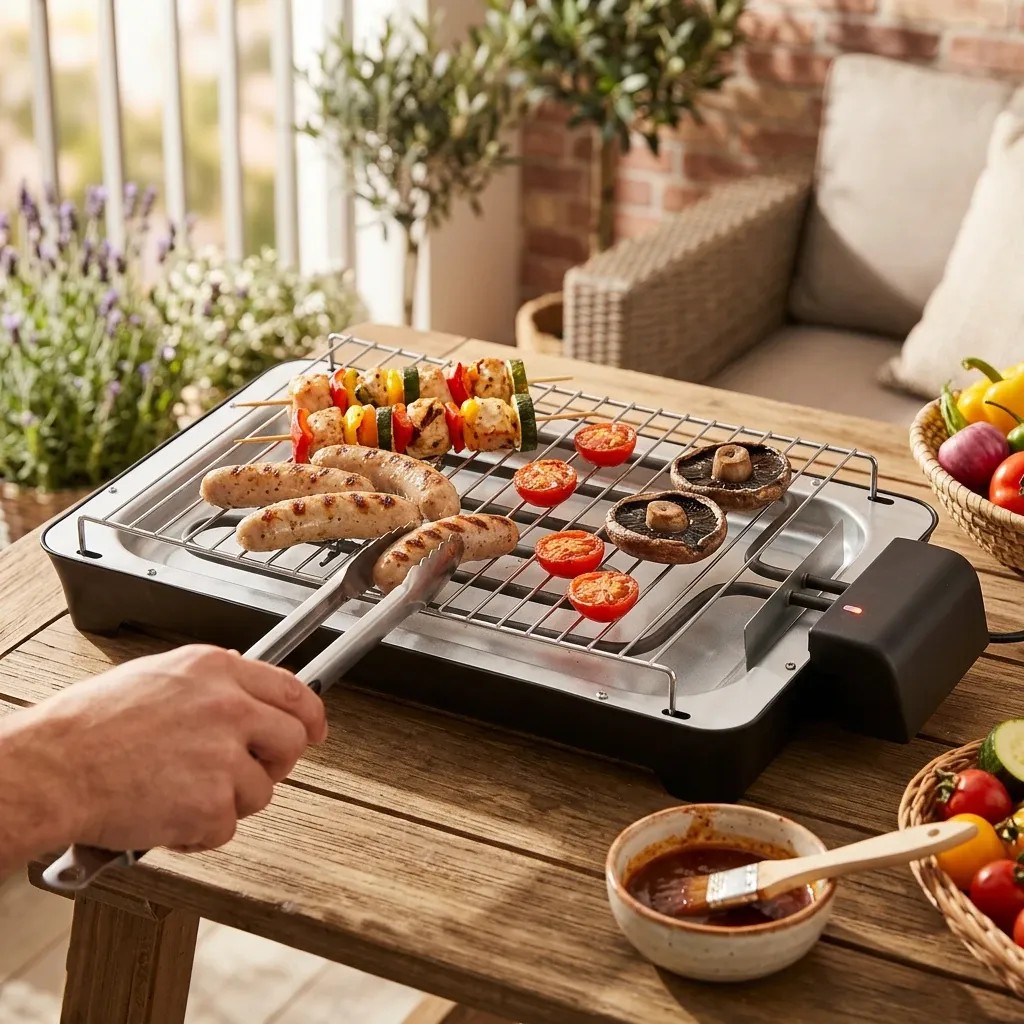
- 2400 W — the BQ202 portable electric grill, built on a stainless steel and galvanized sheet housing with a wire rack cooking surface, visible U-shaped heating elements, adjustable temperature control, a reflective oil drip tray, detachable components and side handles.
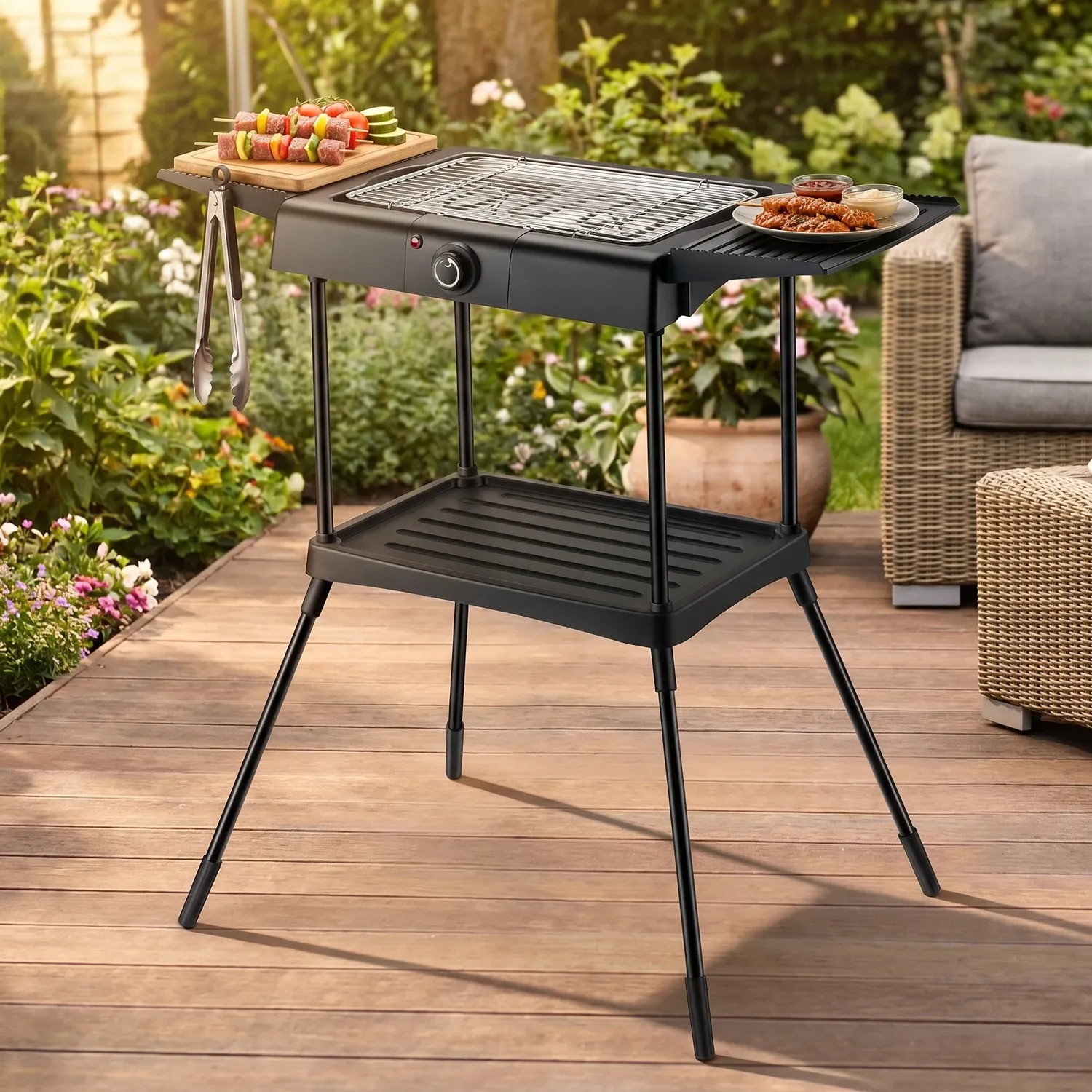
- 2000–2400 W — the BQ1703XL-SF freestanding grill, rated at 220–240 V, with an XL cooking surface, wire rack, dual side tables, a bottom storage shelf, adjustable temperature control, a working indicator light and a safety micro switch.
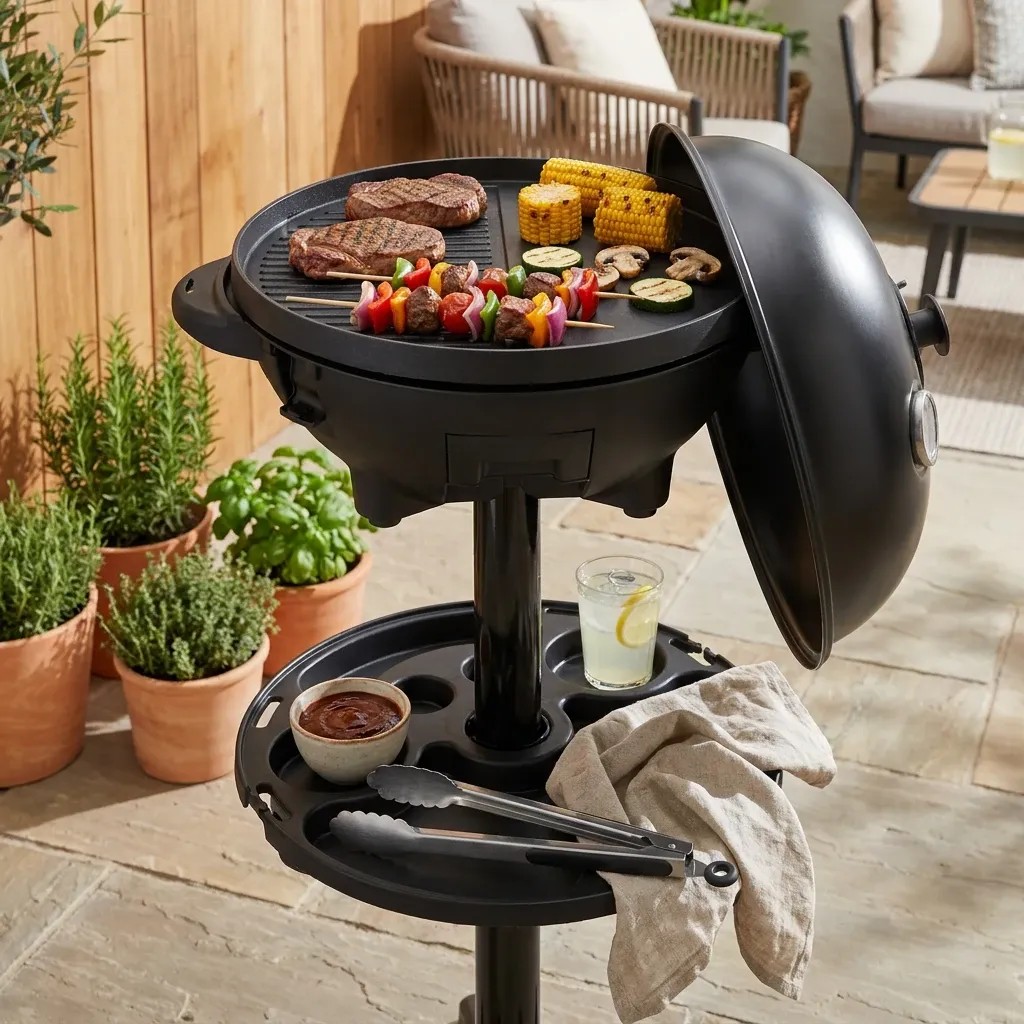
- 2200 W — the BQ232-SLTF freestanding grill with a 42 cm aluminium die-cast non-stick plate, thermostat control, a click-lock domed lid, an air outlet and a pull-out grease tray.
- 2000 W — the BQ1601, BQ2001, BQ2002 and BQ1601-4S.
- 1700 W — the BQ1703XLP-W tabletop grill and the BQ1703XLP-SWF freestanding grill.
Two cautions follow from that list. First, wattage and cooking surface belong together: a wire rack heats largely by radiation and contact at the bars, while a die-cast aluminium plate heats by surface contact. A 1700 W plate grill and a 2400 W rack grill are different cooking systems, not two points on one scale. Second, the declared voltage has to match the destination market before any other comparison is meaningful — the BQ1703XLP-W is declared at 220–240 V, and the Low Voltage verification covering the BQ202, BQ2001, BQ2002, BQ238 and BQ248 group states technical data of 230 V~, 50–60 Hz, 2000 W, Class I.
Checkpoint 2 — what the temperature control actually does
Three control arrangements appear in this set: adjustable temperature control (BQ1703XL-SF, BQ1703XLP-W, BQ202, BQ2001, BQ2002), a rotary temperature control knob (BQ1601, BQ1601-4S) and thermostat control (BQ232-SLTF). The labels describe mechanism, not accuracy. A rotary knob and a thermostat can both deliver usable control, but they answer different questions — one is a manual setting, the other is a regulated target.
For evaluation purposes, the practical questions are: what is the control range in degrees, is adjustment continuous or stepped, and does the product document any temperature stability at the low end of the range where sausages, vegetables and bread are cooked. A working indicator light — present on the BQ1703XL-SF, BQ1703XLP-W, BQ1601 and BQ1601-4S — shows power status only; it is not a temperature readout and should not be specified as one. Buyers who need closed-loop control should note that only the BQ232-SLTF format documents a thermostat, and that its optional lid thermometer is an add-on rather than a standard element.
Checkpoint 3 — safety hardware and what it changes in use
Safety features on electric grills are small, cheap to omit and difficult to see in a product photograph, which is why they belong in the comparison table rather than the appendix.
- Safety micro switch — documented on the BQ1601 (built-in safety micro switch with power indicator light), BQ1601-4S (built-in safety micro switch), BQ1703XL-SF (safety micro switch for automatic safety protection) and BQ1703XLP-SWF (safety micro-switch protection).
- Working indicator light — listed on the BQ1703XL-SF, BQ1703XLP-W, BQ1601 and BQ1601-4S.
- Detachable or removable components — a detachable wire grill rack on the BQ1601, which also states detachable protection; a removable grill rack on the BQ1601-4S; detachable components on the BQ202; detachable parts on the BQ2002; removable parts on the BQ2001.
- Grease management — a reflective oil drip tray on the BQ202, BQ2001 and BQ2002; elongated drainage slots on the BQ1703XLP-W; a pull-out grease tray on the BQ232-SLTF.
- Handling — recessed carry handles on the BQ1703XLP-W; side handles on the BQ202, BQ2001 and BQ2002.
One boundary should be stated plainly: not every model in this set documents a micro switch. The published specifications for the BQ202, BQ2001, BQ2002 and BQ1703XLP-W describe adjustable temperature control, indicator lights, handles and drip trays but do not list a safety micro switch. That is a specification question, not a quality verdict — but it should be closed out before a model is written into a purchase order, particularly for markets where the buyer's own technical file must reproduce the safety rationale.
Checkpoint 4 — certification is a scope document, not a logo
CE, GS, RoHS and LFGB appear on most of the product sheets in this range, and ETL is stated additionally for the BQ1601 and BQ232-SLTF. The useful question is not whether those marks are printed, but which document supports them, for which variants, and until when.
- GS Mark licence GS/24/HEL/01618, issued by SGS Fimko Ltd, issued 2024-11-05, valid to 2026-11-05. Its scope is expressed as model families: BQ228-A, BQ228-AS, BQ228-B, BQ228-C, BQ228-BS, BQ1601, BQ1601-P, BQ1601-S, BQ1803-Sbcd, BQ1703XLP-abcd, BQ1703XL-abcd and BQ229-bc, where a = blank or S, b = blank or W, c = blank or G and d = blank or F.
- Ecodesign (ErP) test report NBEE241200121951, issued by SGS to EEC (EU) No 2023/826, issued 2025-10-29, valid to 2027-10-29, covering a long model list that includes BQ2001, BQ2002, BQ1601-4S, BQ1703XL-ABCD, BQ1703XLP-ABCD and BQ232-ABCD.
- RoHS verification report NGBEC24007628901_1, issued by SGS under RoHS Directive (EU) 2015/863, valid to 2027-12-30, covering both electric BBQ grill and tabletop electric grill categories.
- LVD verification of conformity HA0126NB03010302SF, issued by HATEK SERVICES CO., LTD., issued 2026-03-24, valid to 2028-03-24, citing EN IEC 60335-2-9:2023 + A11:2023, EN 60335-1:2012 with amendments through A16:2023, and EN 62233:2008, for BQ202, BQ2001, BQ2002, BQ238 and BQ248.
- EMC verification of conformity HA0126NB03010301EM, issued by HATEK SERVICES CO., LTD., issued 2026-03-18, valid to 2028-03-18, citing EN IEC 55014-1:2021 for the same model group.
- EU POPs verification report NGBEC26000921401, issued by SGS, issued 2026-03-16, valid to 2028-03-16, tested model BQ232-SLTF.
- FDA food contact test report EFHZ24081596-CG-01, issued by Eurofins Product Testing Service (Hangzhou) Co.,Ltd, issued 2024-09-05, covering the aluminium plate accessory for the electric grill under FDA 21 CFR 177.1550.
- Management system certificates — ISO 9001 certificate NOA2409732 (2024-10-11 to 2027-10-10) and ISO 14001 certificate NOA2507153 (2025-09-18 to 2028-09-17), both issued by NOA group companies.
- Social compliance — amfori BSCI monitoring summary report 24-0279560-1, issued by SGS on 2025-09-26, with a stated expiry of 2026-10-08, covering 13 performance areas including social-compliance management system, labour rights and salary and working hours.
Three practical rules follow. First, read the scope page: the GS licence above covers BQ1703XL-abcd and BQ1703XLP-abcd families, which a buyer can match against a concrete suffix, but it does not list every grill the company makes — BQ232 variants appear in the ErP and POPs documents rather than in the GS scope, so a buyer specifying BQ232-SLTF should ask which GS certificate, if any, covers it. Second, treat validity dates as part of the commercial terms: as of this review the GS licence runs to 5 November 2026, and the BSCI report's stated validity ended on 8 October 2026, so a current-cycle report should be requested with any new order. Third, anchor the standards: EN IEC 60335-2-9 is the specific international standard for portable electric cooking appliances including grills and roasters, which is the reference a technical reviewer will expect to see cited.
Duty expectation: the 'continuous operation' question
Buyers frequently ask whether an electric grill can run continuously. The honest answer from the documented material is that the application data for these products describes intermittent use — intermittent household cooking and intermittent seasonal household grilling — and no document in the reference set declares a continuous-duty rating for any model. Wattage is not a proxy for duty rating. A 2400 W element running for two hours and a 2000 W element running for twenty minutes place different demands on the housing, the wiring and the control hardware, and only the manufacturer's declared on-time specification resolves the question.
For commercial foodservice, long catering events or market-stall use, this is the checkpoint most likely to disqualify an otherwise suitable product. For domestic retail, small family gatherings and semi-outdoor entertaining, intermittent use is the design assumption and the comparison can move on.
Matching format to the intended scenario
| Scenario | Formats in this range | What the buyer should confirm |
|---|---|---|
| Indoor countertop and apartment kitchens | BQ2001 (2000 W, wire rack), BQ2002 (2000 W, wire rack), BQ1601 (2000 W, detachable rack), BQ1703XLP-W (1700 W, die-cast aluminium non-stick plate), BQ202 (2400 W, portable) | Countertop footprint, cable length, drip-tray removal without lifting the unit, and the noise and odour profile the retailer's customer expects |
| Small family gatherings and semi-outdoor tables | BQ1703XLP-SWF (1700 W, non-stick plate, side tables, storage shelf), BQ1601-4S (2000 W, wire rack, freestanding frame) | Stability on uneven surfaces, whether a micro switch is documented, and how the frame is packed for retail |
| Backyard, patio and balcony | BQ1703XL-SF (2000–2400 W, XL surface, dual side tables), BQ232-SLTF (2200 W, 42 cm die-cast plate, domed lid, thermostat) | Socket proximity and weather protection, lid and air-outlet behaviour for roasting, and whether the model is inside the certificate scope the retailer requires |
The documented application data behind this range points the same way: indoor kitchen and balcony countertop grilling for the tabletop group, and patio, backyard and balcony semi-outdoor grilling with seasonal household use for the freestanding group. Matching format to scenario before comparing price removes most of the false equivalences in a tender.
What the supply side adds to the comparison
Specification comparison only becomes a sourcing decision when the supplier can hold the specification across repeat orders. Ningbo Jinchang Electronics Co., Ltd. operates a 5,500 m² plant with a stated monthly capacity of 100,000 units, a minimum order quantity of 5,000 units, a 30-day lead time, 100% testing and a one-year warranty, and offers OEM and ODM programmes covering logo, voltage and product design and development. The company reports an export ratio of 90% across EU, US, AU and RU markets and states that its products can pass CE, RoHS and REACH testing for market access.
Continuity evidence matters more than capability claims in the evaluation stage. One documented case is a large supermarket retailer in France purchasing 60,000 units per year over a 3–5 year relationship, for household outdoor and indoor barbecue use, with the stated highlight being a multi-certified, safety-oriented electric BBQ design. For a buyer building a two- or three-year range plan, that pattern — the same multi-certified platform sustained across seasons — is the relevant proof point, not the unit price of a single shipment.
Market signals behind the framework
The category context explains why buyers are being asked to compare more carefully. Grand View Research valued the global electric grill market at USD 4.6 billion in 2023, with North America holding a 34.5% revenue share in the same year. Credence Research sized the smokeless grill segment at USD 768 million in 2024, with 55% of that segment attributed to electric types. Future Market Insights projects that more than 42 million households in the ASEAN region will adopt plug-in grills by 2030 — a forward projection rather than a current measurement, and best used as a direction indicator rather than a planning number.
Two structural observations follow. First, growth concentrated in smokeless and electric formats pushes comparison toward indoor-suitability, grease handling and control precision — the checkpoints above — rather than raw wattage. Second, the trade classification for these products sits under HS code 851660, covering other ovens, cookers, cooking plates, boiling rings, grillers and roasters for domestic use, which means buyers and compliance teams are working from a single customs category while the product range underneath it fragments into tabletop, freestanding, portable and griddle formats. Fragmentation inside one tariff line is exactly the condition that makes a documented comparison framework useful.
Where electric grills are the weaker choice
Credibility in a buyer reference depends on stating the boundary. An electric grill has no open flame and no combustion to season the food, so the char and smoke character associated with charcoal is not reproduced in the same way, and buyers targeting the charcoal-experience segment will find electric formats a partial substitute at best. Against gas, the constraint is infrastructure: an electric grill's usable output is bounded by the household circuit and by socket location, while a gas unit carries its own fuel. Outdoors, that turns into a practical question about weather-protected sockets, cable routing and residual-current protection, which no grill specification resolves on its own.
The second boundary is thermal. Higher wattage shortens pre-heat but does not remove it, and a buyer who expects instant searing from a cold start will be disappointed by any of these formats. The third is documentation lifecycle: certificates expire. A model that was fully covered in one season can move outside a licence scope or past a validity date in the next, and a range plan that ignores renewal cycles will eventually ship against an out-of-date file.
Future outlook
Three directions are visible from the documented material. Electrification of outdoor cooking continues to pull the freestanding segment toward thermostat control, domed lids and grease management, as the BQ232-SLTF format shows. Certification is becoming more granular rather than less: the ErP framework under EEC (EU) No 2023/826 and the POPs regulation under (EU) 2024/2570 both entered this reference set as separate reports with their own model lists and validity windows, which means a buyer's technical file now needs a document map rather than a single certificate. And the smokeless segment's growth pushes design toward indoor tolerance — removable plates, drainage slots, drip trays — where the comparison criteria are cleaning behaviour and control stability rather than peak wattage.
For buyers, the practical consequence is that the comparison framework should be maintained as a living document, with scope pages and expiry dates refreshed each season, rather than rebuilt from scratch every time a new quotation arrives.
Frequently asked questions
What power rating should an electric grill have for indoor countertop use?
In this reference set, indoor countertop formats are documented at 2000 W (BQ2001, BQ2002, BQ1601) and 1700 W (BQ1703XLP-W), with the portable BQ202 listed at 2400 W for household indoor countertop and small family gathering use. The rating should be matched to the declared voltage of the destination market and to the cooking surface type, since a 1700 W die-cast aluminium plate and a 2400 W wire rack are different heating systems rather than two points on one scale.
Is adjustable temperature control more important than wattage?
They answer different questions. Wattage determines how quickly the unit reaches working temperature and how much heat it can sustain; control determines whether that heat can be held at a usable level. In this range, adjustable temperature control is documented on the BQ1703XL-SF, BQ1703XLP-W, BQ202, BQ2001 and BQ2002; a rotary temperature control knob is documented on the BQ1601 and BQ1601-4S; and thermostat control is documented on the BQ232-SLTF. A working indicator light shows power status and is not a temperature readout.
Which safety features can be verified on these electric grills?
A built-in safety micro switch is documented on the BQ1601, BQ1601-4S, BQ1703XL-SF and BQ1703XLP-SWF. Working indicator lights are documented on the BQ1703XL-SF, BQ1703XLP-W, BQ1601 and BQ1601-4S. Detachable or removable components are documented on the BQ1601 (detachable wire grill rack and detachable protection), BQ1601-4S, BQ202, BQ2002 and BQ2001. Grease handling appears as a reflective oil drip tray on the BQ202, BQ2001 and BQ2002, elongated drainage slots on the BQ1703XLP-W and a pull-out grease tray on the BQ232-SLTF. The published specifications for the BQ202, BQ2001, BQ2002 and BQ1703XLP-W do not list a safety micro switch, so that point should be confirmed per model.
Which certifications should an EU-bound electric grill carry?
The product sheets in this range state CE, GS, RoHS and LFGB, with ETL stated additionally for the BQ1601 and BQ232-SLTF. The supporting documents behind those marks include a GS Mark licence (GS/24/HEL/01618, issued by SGS Fimko Ltd), an Ecodesign test report to EEC (EU) No 2023/826 (NBEE241200121951, SGS), a RoHS verification report under Directive (EU) 2015/863 (NGBEC24007628901_1, SGS), an LVD verification citing EN IEC 60335-2-9:2023 + A11:2023 (HA0126NB03010302SF, HATEK SERVICES CO.,LTD.) and an EMC verification citing EN IEC 55014-1:2021 (HA0126NB03010301EM). EN IEC 60335-2-9 is the specific international standard for portable electric cooking appliances including grills and roasters.
Does one certificate cover every model a supplier lists?
No. Certification is issued against named model families. The GS licence GS/24/HEL/01618 lists BQ228-A, BQ228-AS, BQ228-B, BQ228-C, BQ228-BS, BQ1601, BQ1601-P, BQ1601-S, BQ1803-Sbcd, BQ1703XLP-abcd, BQ1703XL-abcd and BQ229-bc, where a = blank or S, b = blank or W, c = blank or G and d = blank or F. BQ232 variants appear in the ErP report NBEE241200121951 and the POPs report NGBEC26000921401 rather than in that GS scope. A further check is consistency of declared data: the BQ202 product sheet states 2400 W while the LVD verification covering that group declares 2000 W, and the difference should be reconciled in writing before approval.
How should buyers treat certification dates during evaluation?
Dates belong in the comparison table. As of this review, the GS licence GS/24/HEL/01618 runs to 2026-11-05, the amfori BSCI report 24-0279560-1 has a stated expiry of 2026-10-08, the ErP report NBEE241200121951 runs to 2027-10-29, the RoHS verification report NGBEC24007628901_1 to 2027-12-30, the LVD verification HA0126NB03010302SF to 2028-03-24, the EMC verification HA0126NB03010301EM to 2028-03-18 and the POPs report NGBEC26000921401 to 2028-03-16. ISO 9001 certificate NOA2409732 runs to 2027-10-10 and ISO 14001 certificate NOA2507153 to 2028-09-17.
Which electric grill format fits patio use rather than indoor countertops?
Freestanding formats in this range are documented for patio, backyard and balcony use: the BQ1703XL-SF at 2000–2400 W with an XL cooking surface, dual side tables and a bottom storage shelf; the BQ232-SLTF at 2200 W with a 42 cm die-cast aluminium non-stick plate, thermostat control and a click-lock domed lid; and the BQ1601-4S at 2000 W with a freestanding frame and storage shelf. Tabletop formats such as the BQ2001, BQ2002, BQ1601 and BQ1703XLP-W are documented for indoor kitchen and countertop grilling. Outdoor placement adds requirements the grill specification does not cover, including weather-protected sockets and cable routing.
A framework of this kind is only as good as the documents behind it: the scope page, the declared technical data and the validity date decide more of a sourcing outcome than the wattage printed on the carton.
Have Questions or Need More Details?
Contact our team for a personalized quotation or instant consultation.
Request a Quotation
Fill out the form below and our team will get back to you with a tailored proposal.
WhatsApp Direct Chat
Prefer to chat in real-time? Message us on WhatsApp for instant assistance & quick answers.
- Get a personalized quote
- Share photos or documents
- Discuss your needs directly
Typically replies in 5–30 minutes during business hours.