
Electric Rescue Tools: Certification and Spec Guide
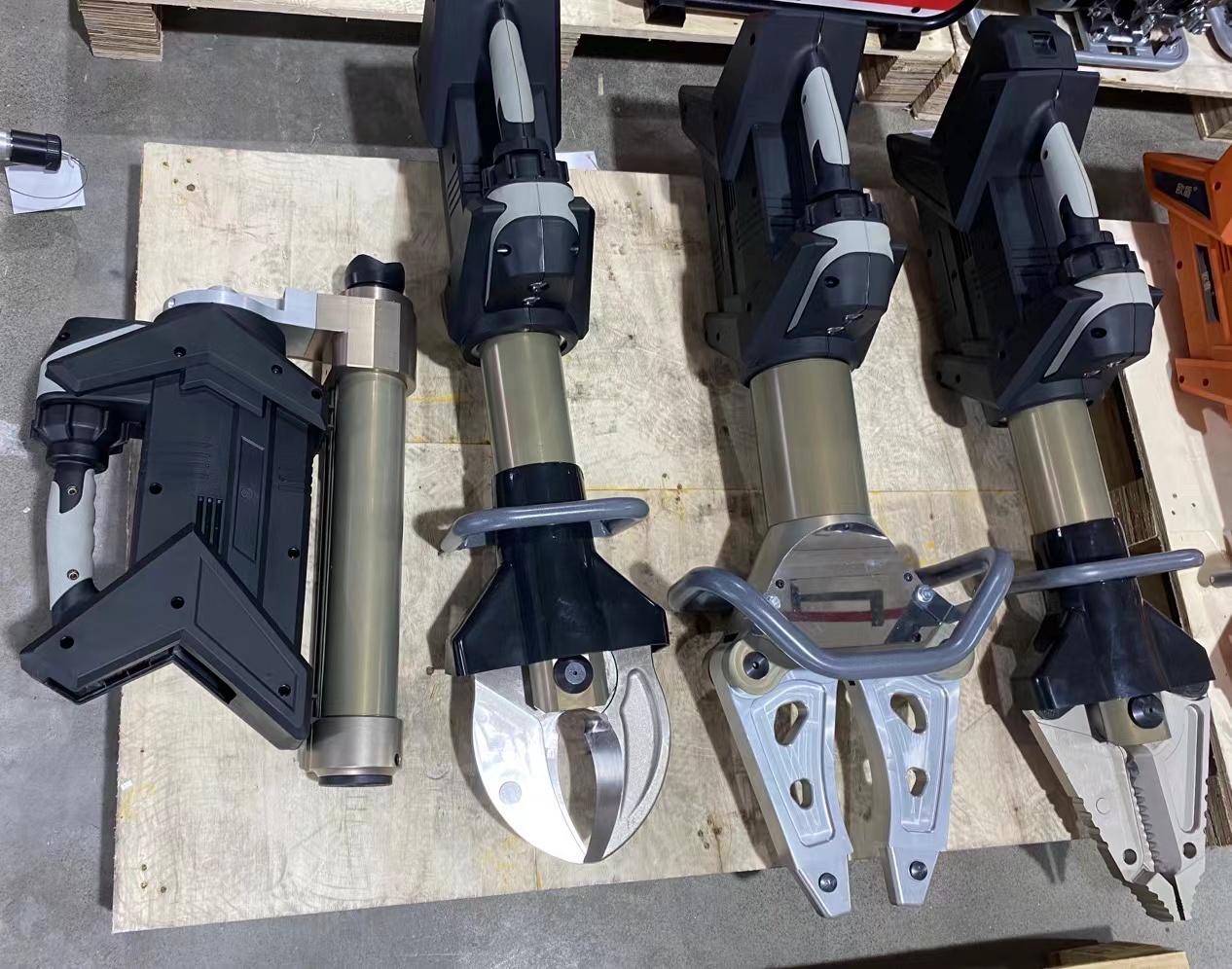
Electric rescue tools have moved from an experimental alternative to a defined procurement category. The deciding factors, however, are rarely peak marketing numbers. They are certification scope, rated pressure, battery platform constraints, and the ability of a supplier to document each of those claims for the exact model being purchased. This guide examines how fire and rescue services, industrial buyers and distributors can structure a specification review around those constraints, using the ODE Hydraulic & Electric Rescue Tools portfolio as a working reference.
Why constraint review, not peak numbers, drives electric rescue tool procurement
When a rescue organisation specifies an electric rescue tool, the first decision is usually framed as a cutting force or spreading distance question. In practice the binding constraints sit elsewhere. A tool that meets a force target but sits outside the applicable standard edition, or whose battery platform is not documented against the required voltage and capacity, cannot be cleared for front-line deployment regardless of its rated performance.
Three constraint layers typically determine whether a battery-powered rescue tool is fit for purchase:
- Standards and certification layer — which directive, standard edition and conformity route the tool claims to comply with, and whether a certificate number can be traced to the specific model.
- Technical parameter layer — rated working pressure, cutting force, spreading force, opening distance, stroke, battery voltage and capacity, and how those parameters are defined.
- Commercial and delivery layer — minimum order quantity, lead time, OEM/ODM terms, after-sales model and spare-part continuity.
Electric hydraulic rescue tools replace the external oil pump and connecting hoses of conventional hydraulic systems with an integrated battery-driven architecture. That integration removes one failure mode (hose routing and pump transport) and introduces others (battery availability, charge status, and the need to verify that a given tool is actually certified as an electric product, not only as a hydraulic one). Buyers who treat the certifications and the battery platform as the primary constraint, and the force values as secondary, tend to make cleaner shortlists.
Certification: what documents should be traceable for each tool
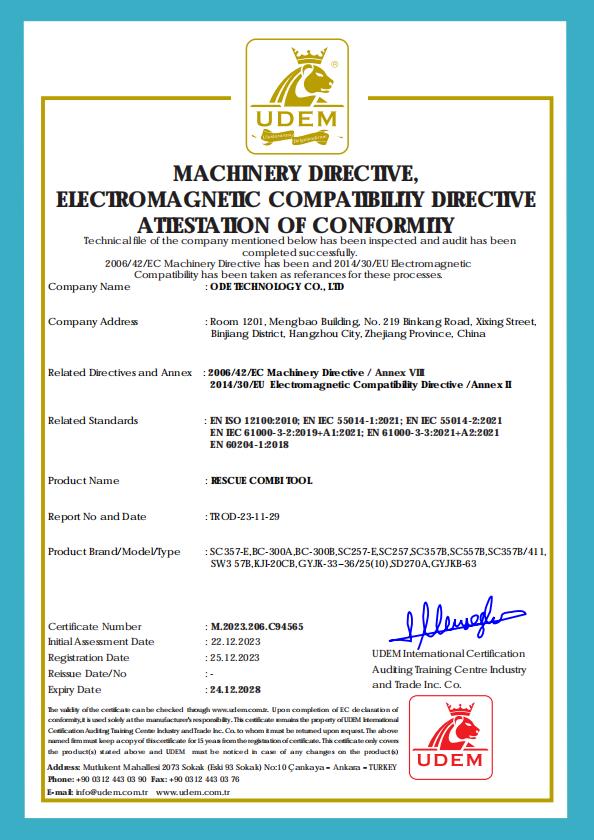
For European market access, two document families matter. The first is the CE attestation of conformity under the Machinery Directive and the Electromagnetic Compatibility Directive. The second is the quality and occupational health and safety management system certification, which evidences process control rather than product performance.
CE attestation of conformity
ODE Technology Co., Ltd holds CE attestations of conformity issued by UDEM International Certification Auditing Training Centre Industry and Trade Inc. Co., covering its rescue combi tools, rescue cutters, rescue spreaders, rescue rams, hydraulic breaching tools and hydraulic pumps. Each attestation references a unique certificate number and a defined scope of product models. Examples include:
| Certificate Number | Product Scope | Validity |
|---|---|---|
| M.2023.206.C94565 | Rescue combi tool (SC357-EC, SC257, SC257-E, SC357B, SC557B, SC357B/411, SW3 57B, KJ20CB, GYJK-33-36/25(10), SD270A, GYJKB-63, among others) | Valid until 24.12.2028 |
| M.2023.206.C94566 | Rescue cutter (S312-E, BC-15A, S211, S251-E, S311B, S511B, S212, S250E, SW305BS, SW311B, among others) | Valid until 24.12.2028 |
| M.2023.206.C94567 | Rescue spreader (SP210, SP310B, SP510B, SP301-E, SP310-E, SP725-B, SP725-E, SP725-L, SP720B, SW310B, HE-500S, HE-720DA) | Valid until 24.12.2028 |
| M.2023.206.C94563 | Rescue ram (R412-E, R422-E, R410, R412B, R422B, R400, R420, R430, R421, R0, RS30-E, HR-100S, HR-110CA, SW-R422B) | Valid until 24.12.2028 |
| M.2023.206.C94572 | Hydraulic pump (PG305GB, P610GSB, MP-63/0.4, MP-63/0.5, MA-MP2-63/0.4, MA-MP2-63/0.66/R, BT4-C63/0.66(HA), BK2-700, P620GB, P400GB, P40DGB, CB-BS, CB-B6, HMP-350A, HMP-380L, CP-700, BS-700, BS-72, BB-750, BB-1500, BR-3000, GYB-63D, ZCB-700D) | Valid until 24.12.2028 |
| M.2023.206.C94573 | Hydraulic breaching tools (EHK-5A, EHK-5B, EHK-5C, EHK-5D, EHK-5S, FDM-4, FDM-5, FDM-6, SL-700D, WAHY-10, PRT-8A, PRT-8, JLH-6000) | Valid until 24.12.2028 |
The applicable harmonised standards listed on the CE attestations include EN ISO 12100:2010, EN IEC 55014-1:2021, EN IEC 55014-2:2021, EN IEC 61000-3-2:2019+A1:2021, EN 61000-3-3:2021+A2:2021 and EN 60204-1:2018. Buyers should treat the certificate number and the listed model scope as a single unit: a certificate only covers the models it enumerates.
EN 13204 and the edition question
EN 13204 is the European standard family for double-acting hydraulic rescue tools used by fire and rescue services, specifying safety and minimum performance requirements together with test methods. The 2016 edition is referenced in many national databases, while DIN lists EN 13204:2025 as the newer edition titled “Powered rescue tools for fire and rescue service use — Safety and performance requirements,” replacing the 2016 edition and earlier related standards. The title change from “double-acting hydraulic” to “powered” reflects the category’s migration toward battery-electric tools.
The practical implication for buyers is that the standard edition cited in a tender or technical file changes what must be demonstrated. Several ODE electric models, including the SC370-E combi tool, SP725-E battery spreader, S251-E battery rescue cutter and R530-E two-stage electric ram, are documented as EN 13204 approved. As with any standard reference, the correct procurement step is to request the applicable edition, the declaration of conformity, and product-specific test documentation for the exact model — not the family-level claim.
ISO 9001 and ISO 45001
ODE Technology Co., Ltd operates under an ISO 9001 quality management system certificate (No. 1952024Q10666R1M, issued by Beijing Kun Biao Certification & Inspection Co., Ltd., valid 2024-11-20 to 2027-11-19) and an ISO 45001 occupational health and safety management system certificate (No. 1952024B029R0M, issued by V.BRZ, valid 2024-07-22 to 2027-07-21). The ISO 45001 scope explicitly covers the production and sales of hydraulic motors, hydraulic pumps, hydraulic components, electro-hydraulic tools and rescue tools. For buyers, these certificates do not replace product-level conformity evidence, but they do indicate that the manufacturing process has been audited against recognised management system requirements.
Core performance parameters that determine tool selection
Once the certification layer is cleared, the specification review moves to the parameters that determine whether the tool can actually perform the intended task. Four parameter groups carry most of the decision weight: working pressure, cutting force with cutting capacity, spreading and pulling performance, and physical weight.
Rated working pressure as a platform anchor
ODE’s rescue tool range is built around a 72 MPa (720 bar) rated working pressure. This figure appears consistently across the electric combi tool SC370-E, battery spreader SP725-E, battery rescue cutter S251-E, hydraulic combi tool SC370-L, hydraulic cutter S251-L, hydraulic spreader SP725-L, hydraulic ram R410 and hydraulic ram R522-L. A shared pressure anchor means that tools from the same range can be combined without additional pressure-tier qualification, and that the power source — whether a manual pump, engine pump or battery-powered pump — is selected on portability and duty-cycle grounds rather than on pressure compatibility.
Cutting force and cutting capacity
Cutting force alone is an incomplete specification. What matters for rescue work is the combination of maximum cutting force and the diameter of material the tool can actually sever. The table below summarises representative ODE models.
| Model | Type | Cutting Force | Cutting Capacity | Weight |
|---|---|---|---|---|
| SC370-E | Battery combi tool | 940 kN | Φ38 mm Q235 round steel; 20 mm Q235 steel plate | 18.5 kg |
| S251-E | Battery rescue cutter | 940 kN | Φ40 mm Q235A round steel; 20 mm Q235A steel plate | 17 kg |
| S312-E | Battery cutter | 800 kN | Φ32 mm Q235A round steel; 16 mm Q235A steel plate | 19.5 kg |
| SC357-E | Battery combi tool | 800 kN | Φ32 mm Q235 round steel; 8 mm Q235 steel plate | 18.5 kg |
| SC370-L | Hydraulic cutter and spreader | 940 kN | Ø38 mm round bar; 12 mm Q235 | 13.5 kg |
| S251-L | Hydraulic cutter | 940 kN | Ø40 mm Q235 round steel | 12.5 kg |
| SC257 | Hydraulic combi tool | 600 kN | Ø30 mm Q235 round steel; 8 mm Q235 steel plate | 15.1 kg |
| S175-L | Hydraulic cutter | ≥604 kN | ≤φ30 mm Q235A round steel | ≤9.5 kg |
Reading the table together with the certification scope is what allows a buyer to shortlist: an electric cutter certified for Φ40 mm round steel is a materially different tool from one certified for Φ32 mm, even where both are described as “electric rescue tools.”
Spreading, pulling and propping
For extrication and collapse response, spreading and pulling performance often determines whether a passage can be opened. Representative ODE values include a 38–65 kN spreading force and 740 mm maximum spreading distance on the SP725-E battery spreader and SP725-L hydraulic spreader, with a 95 kN maximum squeezing force and 640 mm pulling distance on the electric model. The SC370-E combi tool is rated for a 45–145 kN spreading force, 390 mm spreading distance, ≥153 kN squeezing force and 95 kN pulling force over 300 mm.
Propping performance is defined by the ram range. The two-stage R530-E electric ram delivers a 140 kN first-stage force over a 400 mm stroke, then a 70 kN second-stage force over a 345 mm stroke, extending from a retracted length of ≤540 mm to an extended length of ≥1285 mm. The R322-E two-stage electric ram uses the same 140 kN / 70 kN split, extends to 1385 mm, and weighs 21.4 kg. The R522-L two-stage hydraulic ram reaches a 275 kN first-stage lifting force at 935 mm and a 140 kN second-stage force at 1285 mm.
Weight and single-person operation
Weight is a specification constraint, not a comfort detail. It determines whether a tool can be carried and operated by one rescuer in a confined space. Comparing like capabilities across the ODE range shows the pattern buyers should expect from the electric transition.
| Function | Hydraulic Model & Weight | Electric Model & Weight |
|---|---|---|
| Combi tool (940 kN cutting) | SC370-L — 13.5 kg | SC370-E — 18.5 kg |
| Rescue cutter (940 kN cutting) | S251-L — 12.5 kg | S251-E — 17 kg |
| Spreader (38–65 kN spreading) | SP725-L — 16.7 kg | SP725-E — 22.6 kg |
Battery platform and operational constraints
Because an electric rescue tool is only deployable when its battery is charged and functional, the battery platform should be evaluated with the same rigour as the hydraulic pressure rating.
The ODE electric rescue tool range uses a DC 28 V lithium battery platform at 5 Ah / 5.0 Ah capacity. The SC370-E combi tool, S312-E battery cutter and SP725-E battery spreader specify DC 28 V 5.0 Ah batteries; the SC357-E combi tool specifies DC 28 V 5 Ah. The R322-E and R530-E electric rams and the R412-E electric ram use the same DC 28 V 5.0 Ah specification.
Operational features built into that platform include plug-and-play battery installation, seven LED indicators showing seven battery levels, a low-power alarm that activates below 20% remaining capacity, and LED night lighting integrated into the handles for dark or smoke-filled environments. A star-shaped directional valve is used for thumb-operated control, and a built-in bi-directional hydraulic lock with self-locking function holds a tool at any position to prevent unexpected retraction — a safety feature of particular value during propping operations in collapsed structures.
Purchase packages follow a consistent structure: two rechargeable batteries, one charger, one carrying strap and a military-grade rolling engineering case per tool. Buyers should confirm that the number of batteries supplied matches the number of simultaneously operated tools, since a shared battery pool changes the practical duty cycle of a set.
Alternative power sources remain relevant for specific conditions. The P600OGB battery powered pump operates at a rated pressure of 72 MPa with a 28 V, 5.0 Ah battery and a hydraulic oil tank capacity of 1.5 L, at a weight of ≤8.9 kg excluding the battery. The BS-63 manual pump is rated at 72 MPa with a 2.4 L oil volume, a high-pressure flow of 2.57 ml per cycle and a maximum handle force of 264 N, and the ODE P620ASL hand pump offers a comparable 72 MPa rating with a maximum handle force of 265 N. Engine-driven units include the BE-MP-63/0.5 single-output pump at 72 MPa and the MDP220 double-output pump at ≥72 MPa with a 4.5 L hydraulic oil tank.
Application scenarios and configuration logic
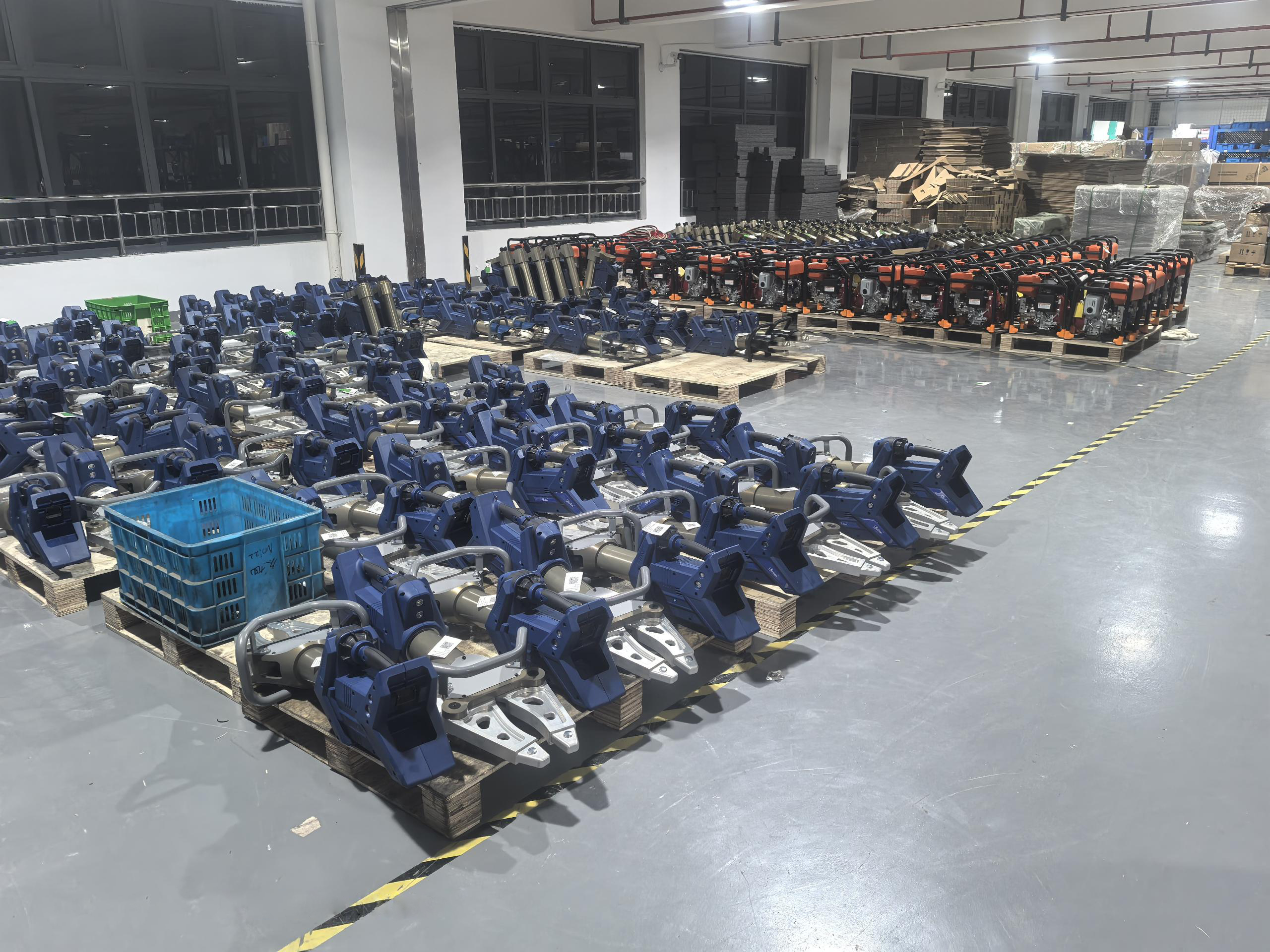
Electric hydraulic rescue equipment is designed for fire fighting, earthquake disaster relief, traffic accident rescue, forest fire rescue and general emergency demolition. ODE’s documented application set spans fire rescue, vehicle accident rescue, building collapse response, and end-of-life vehicle dismantling.
The configuration logic for a rescue team typically follows the incident type rather than a fixed bundle:
- Vehicle extrication — combi tool plus spreader plus ram, with the combi tool providing combined cutting and spreading, the ram stabilising the vehicle body, and the spreader opening door pillars and roof structures.
- Structural collapse and earthquake response — ram-led configuration, using the two-stage electric ram’s 140 kN first-stage force to prop load-bearing components and create escape passages. The amphibious tool set includes a pump rated for an underwater working depth of ≥100 m.
- Confined-space entry — the EHK-5A and EHK-5D Rescue Backpack Door Opener sets package a micro cutter, micro spreader, mini door opener and battery-powered pump into a single-bag configuration, allowing one person to enter and work before larger tools are staged.
- Rebar and structural steel work — cordless rebar cutters such as the RC-16B, RC-20B and RC-25B for rebar diameters from 4 mm to 25 mm, with cutting speeds from 3.5 to 6 seconds per cut.
Documented field use includes deployment by Yunnan Fire and Rescue Service and Aksu Fire and Rescue Service in China, use by Malaysian rescue teams in truck crash emergencies, and use by China Blue Sky Rescue members during the Turkey earthquake response in Malatya Province. These are deployment records, not performance benchmarks; they indicate that the tools have been used in real incident conditions but do not substitute for product-level test documentation.
Manufacturing, lead time and customization constraints
The commercial layer of a procurement decision is often where timelines slip. ODE Technology Co., Ltd was founded in 2010 and is a National High-Tech Enterprise and a National Specialized, Refined, Differential and Innovative “Little Giant” Enterprise, operating a provincial-level research institute and holding close to 200 patents. Its Deqing, Zhejiang facility covers 110,000 m2 with approximately 200 employees.
Published capability terms include a monthly capacity of 5,000 units, a lead time of 45–60 days, and a minimum order quantity of 2 units. Customization covers drawing design services and adjustments to voltage, power, colour, brand and minor function changes, under an OEM/ODM model. After-sales support is provided remotely. Products are exported to the USA, EU, Thailand, Vietnam, Morocco, Serbia, Hungary, Brazil and Argentina.
For buyers, these figures define the boundary conditions of the commercial negotiation: a two-unit MOQ makes pilot configuration testing feasible, but the 45–60 day lead time needs to be planned against installation schedules, and OEM customization should be scoped against the certificate scope for the affected models, since a material change to voltage, power or function can move a product outside its existing conformity evidence.
Comparison with traditional hydraulic rescue systems
Electric rescue tools are not a wholesale replacement for hydraulic systems in every scenario. The comparison that matters at the procurement stage is functional, not ideological.
| Dimension | Hydraulic rescue tools | Electric hydraulic rescue tools |
|---|---|---|
| Power source | External pump (manual, engine or battery-driven) with hoses | Integrated DC 28 V lithium battery, no hoses |
| Setup time | Requires pump positioning and hose connection | Tools deploy directly; single-person operation feasible |
| Weight per tool at comparable capability | Lower — e.g. SC370-L at 13.5 kg, S251-L at 12.5 kg | Higher — e.g. SC370-E at 18.5 kg, S251-E at 17 kg |
| Extended-duty operations | Continuous power while engine or manual pump operates | Bounded by battery charge and the number of batteries carried |
| Worksite constraints | Hose routing limits movement in rubble or confined structures | No hose routing; individual tool mobility is higher |
| Maintenance exposure | Pump, hose couplings and hydraulic fluid management | Battery, charger and electronic control management |
Future outlook
Two developments shape the near-term direction of this category. The first is the standards transition: the shift from the 2016 EN 13204 edition to the 2025 edition — with its broader “powered rescue tools” framing — will gradually change what tender documents require and what conformity evidence suppliers must produce. Buyers should expect to re-verify compliance documents against the applicable edition during the transition period rather than accept a family-level statement.
The second is the continued development of the electric-hydraulic platform itself. ODE’s own product history records the move from a mobile hydraulic rescue tool line into 220 V brushless electric-hydraulic tools and then into the 28 V electric-hydraulic rescue series that forms the current electric range. The direction of travel — integrated battery power, hose-free deployment and intelligent battery management — is now visible across combi tools, cutters, spreaders and rams. As with any transition, the buyer’s protection is the same: specification review against traceable certifications, product-specific parameters, and clearly stated commercial boundaries.
FAQ
What certifications should an electric rescue tool carry for the EU market?
EU market access for hydraulic and electric rescue tools typically relies on a CE attestation of conformity under the Machinery Directive 2006/42/EC and the Electromagnetic Compatibility Directive 2014/30/EU. ODE Technology Co., Ltd holds attestations issued by UDEM International Certification Auditing Training Centre Industry and Trade Inc. Co., covering rescue combi tools (M.2023.206.C94565), rescue cutters (M.2023.206.C94566), rescue spreaders (M.2023.206.C94567), rescue rams (M.2023.206.C94563), hydraulic breaching tools (M.2023.206.C94573) and hydraulic pumps (M.2023.206.C94572), all valid until 24 December 2028. The applicable harmonised standards include EN ISO 12100:2010, EN IEC 55014-1:2021, EN IEC 55014-2:2021, EN 61000-3-3:2021+A2:2021 and EN 60204-1:2018. Buyers should match the certificate number to the specific model being purchased.
What cutting and spreading performance should be expected at the 72 MPa pressure tier?
At a 720 bar (72 MPa) rated working pressure, representative values across the ODE electric rescue tool range include a maximum cutting force of 940 kN on the SC370-E combi tool and the S251-E battery rescue cutter, with cutting capacity of Φ38 mm and Φ40 mm Q235 / Q235A round steel respectively, and 20 mm steel plate. The SC357-E combi tool and S312-E battery cutter are rated at 800 kN, with capacities of Φ32 mm Q235 / Q235A round steel. Spreading force on the SC370-E is 45–145 kN over a 390 mm distance, while the SP725-E battery spreader delivers 38–65 kN over 740 mm.
Can electric rescue tools operate underwater or in confined spaces?
ODE offers an amphibious rescue tool set with male-female snap fastener interfaces, including the P610AES pump, which is rated for an underwater working depth of ≥100 m with a low-pressure output flow rate of ≥1.75 L/min, a rated output flow rate of ≥0.44 L/min and a battery capacity of ≥8.4 Ah. For confined-space work, the EHK-5A and EHK-5D Rescue Backpack Door Opener sets combine a micro cutter, micro spreader, mini door opener and battery-powered pump into a single-bag configuration; the EHK-5D micro cutter is rated at a maximum cutting force of 240 kN with a Φ22 mm round steel cutting capacity.
What battery platform do these electric rescue tools use?
The electric rescue tool range uses a DC 28 V lithium battery platform at 5 Ah or 5.0 Ah capacity. The battery design is plug-and-play, with seven LED indicators showing seven battery levels and a low-power alarm that activates below 20% remaining capacity. Each tool is supplied with two rechargeable batteries, one charger, one carrying strap and a military-grade rolling engineering case. For applications where rechargeable power is impractical, ODE also supplies the BS-63 manual pump (72 MPa, 2.4 L oil volume, maximum handle force 264 N) and the P620ASL hand pump (72 MPa, maximum handle force 265 N).
What are the OEM/ODM terms, minimum order quantity and lead time?
ODE Technology Co., Ltd offers an OEM/ODM production model that includes drawing design services and supports customization of voltage, power, colour, brand and minor function adjustments. The published minimum order quantity is 2 units, the monthly production capacity is 5,000 units, and the lead time is 45–60 days. After-sales support is provided remotely. Buyers planning customized configurations should confirm the impact of any change on the scope of the applicable CE certificate before approving a variant.
How does a two-stage ram differ from a single-stage hydraulic ram in rescue propping?
A two-stage ram extends in two successive strokes at different force levels. The ODE R530-E two-stage electric ram has a first-stage extension stroke of 400 mm at 140 kN, followed by a second-stage stroke of 345 mm at 70 kN, with a retracted length of ≤540 mm and an extended length of ≥1285 mm. The R522-L two-stage hydraulic ram reaches a first-stage lifting force of 275 kN at 935 mm and a second-stage force of 140 kN at 1285 mm. Single-stage rams such as the R410 lift 140 kN across a 400 mm stroke with a 540–940 mm extension range. Two-stage units are selected when the required support length exceeds what a single stroke can provide within the available closing length.
Have Questions or Need More Details?
Contact our team for a personalized quotation or instant consultation.
Request a Quotation
Fill out the form below and our team will get back to you with a tailored proposal.
WhatsApp Direct Chat
Prefer to chat in real-time? Message us on WhatsApp for instant assistance & quick answers.
- Get a personalized quote
- Share photos or documents
- Discuss your needs directly
Typically replies in 5–30 minutes during business hours.