
Electric Two-Wheeler BMS: A Practical Orientation Guide
An electric two-wheeler is only as dependable as the electronics supervising its lithium pack. This industry reference explains what an electric two-wheeler battery management system (BMS) does, which specifications decide whether it fits a given pack, where the genuine limits sit, and how the two- and three-wheeler BMS segment is shifting in India and Southeast Asia.
What an Electric Two-Wheeler BMS Actually Does
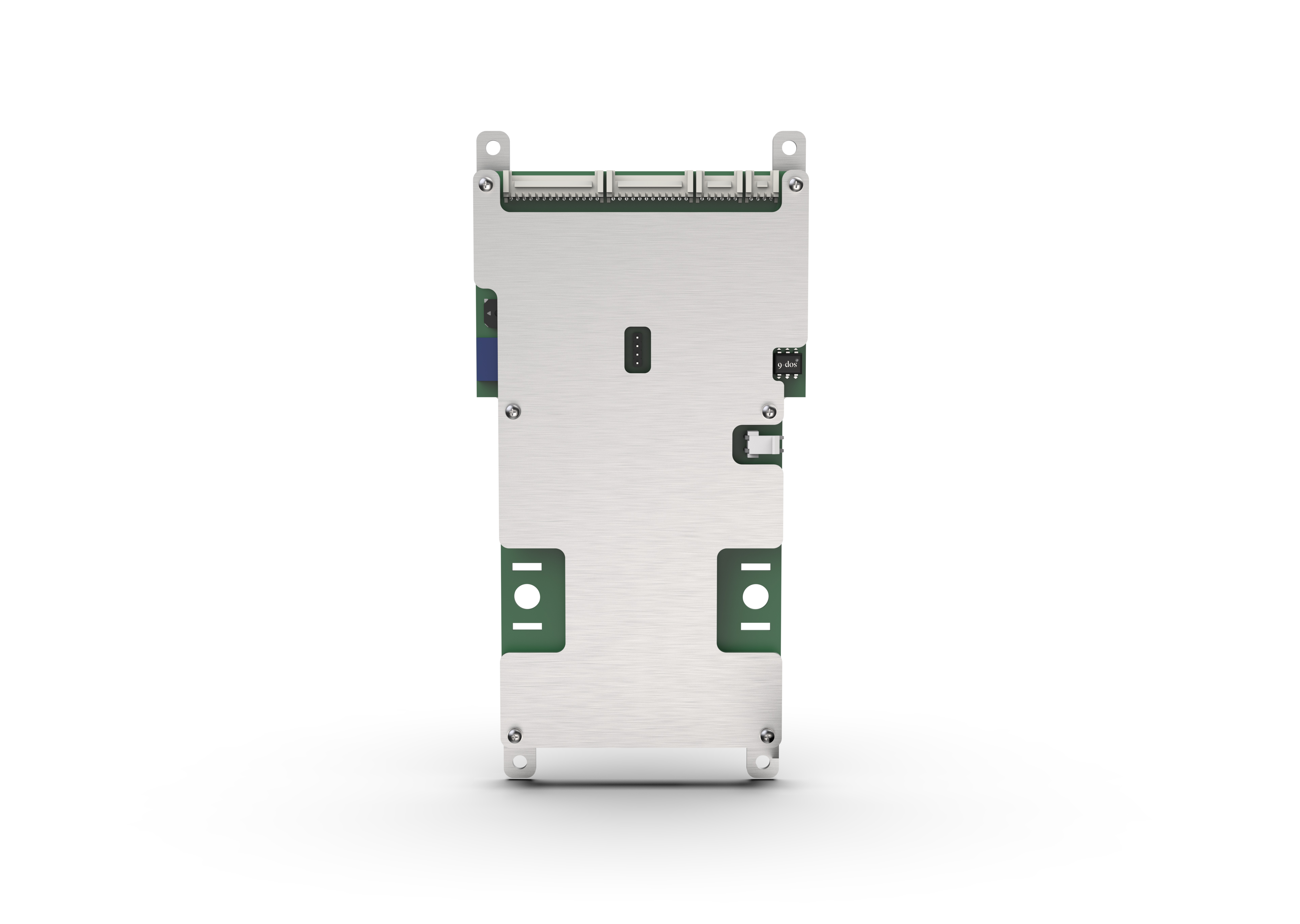
A battery management system (BMS) is the electronic controller inside a lithium battery pack that monitors cell voltage, current and temperature. That functional description is consistent across published industry explanations. Corporate technical literature also describes the BMS as an electronic system that manages a rechargeable battery by protecting it from over-voltage, under-voltage and over-current. In larger battery energy storage systems, the U.S. Department of Energy describes the BMS as both a hardware and software component that connects to the energy management system (EMS) and the power conversion system (PCS) to manage the system charge.
The two-wheeler version performs the same supervisory role inside a far tighter envelope. A traction pack on a two-wheeler is packaged under a rider, exposed to daily charge and discharge cycles, and increasingly shared across fleet, delivery and battery-swap operating models. The board must therefore deliver monitoring, protection, balancing and communication within limited installation space, and at a component cost the vehicle can absorb.
That is why the electrical envelope of light electric vehicles varies so widely. Two-wheeler-oriented BMS models published by Pengpai Energy, for example, span 15–90V, 20–95V, 30–60V and 0–48–60V voltage platforms across configurations from 7S to 24S. A specification sheet, not a category label, is what determines whether a unit will work in a specific pack.
Why the BMS, Not the Cell Alone, Defines Pack Reliability
Lithium cells degrade and, in fault conditions, become hazardous when cell-level conditions are not continuously supervised. Over-charge, over-discharge, over-current, over-temperature and short-circuit events are the standard fault categories a traction BMS is expected to intercept. Without continuous supervision at cell level, a pack has no mechanism to isolate a fault before it propagates.
Regulation has moved the question from preference to requirement in some markets. In India, AIS-156 establishes mandatory safety requirements for lithium-ion battery packs and battery management systems used in L-category vehicles — two- and three-wheelers — with effect from 1 April 2023. For an OEM or fleet operator in that market, the BMS is a compliance component, not an accessory.
The commercial opportunity is measurable. IMARC Group valued the India battery management system market at USD 327.9 million in 2025 and projects it to reach USD 1,347.6 million by 2034. Growth of that shape attracts suppliers of very different maturity levels, which is precisely why buyers need a repeatable way to read a BMS specification rather than a supplier's summary of it.
Pengpai Energy: A BMS Manufacturer Focused on Light-Power Applications
Hefei Pengpai Energy Technology Co., Ltd (Pengpai Energy) is a China-based national high-tech enterprise established in 2017 that specialises in the research, development, manufacturing, sales and service of new energy battery management systems and intelligent energy management platforms. Its main products are BMS for electric two-wheelers, three-wheelers, low-speed four-wheelers and other light-power applications, and its products are also used in two-, three- and four-wheeled vehicles, commercial vehicles, intelligent robots and drones.
The company operates a 2,500 m² manufacturing facility with approximately 100 employees, of whom more than 60% are R&D engineers. Annual production capacity reaches 800,000 units. Export business accounts for 60% of total sales, and the company has established marketing branches in Southeast Asia, India, North America and Europe. It holds ISO9001 quality management system certification, states that its BMS products comply with CE and FCC standards, and owns a set of independent intellectual property rights covering battery state estimation, safety protection algorithms and intelligent energy scheduling.
Reading an Electric Two-Wheeler BMS Specification
Six parameter groups decide whether a BMS will fit a given two-wheeler pack. Each is a constraint, not a feature.
1. Voltage platform and series count
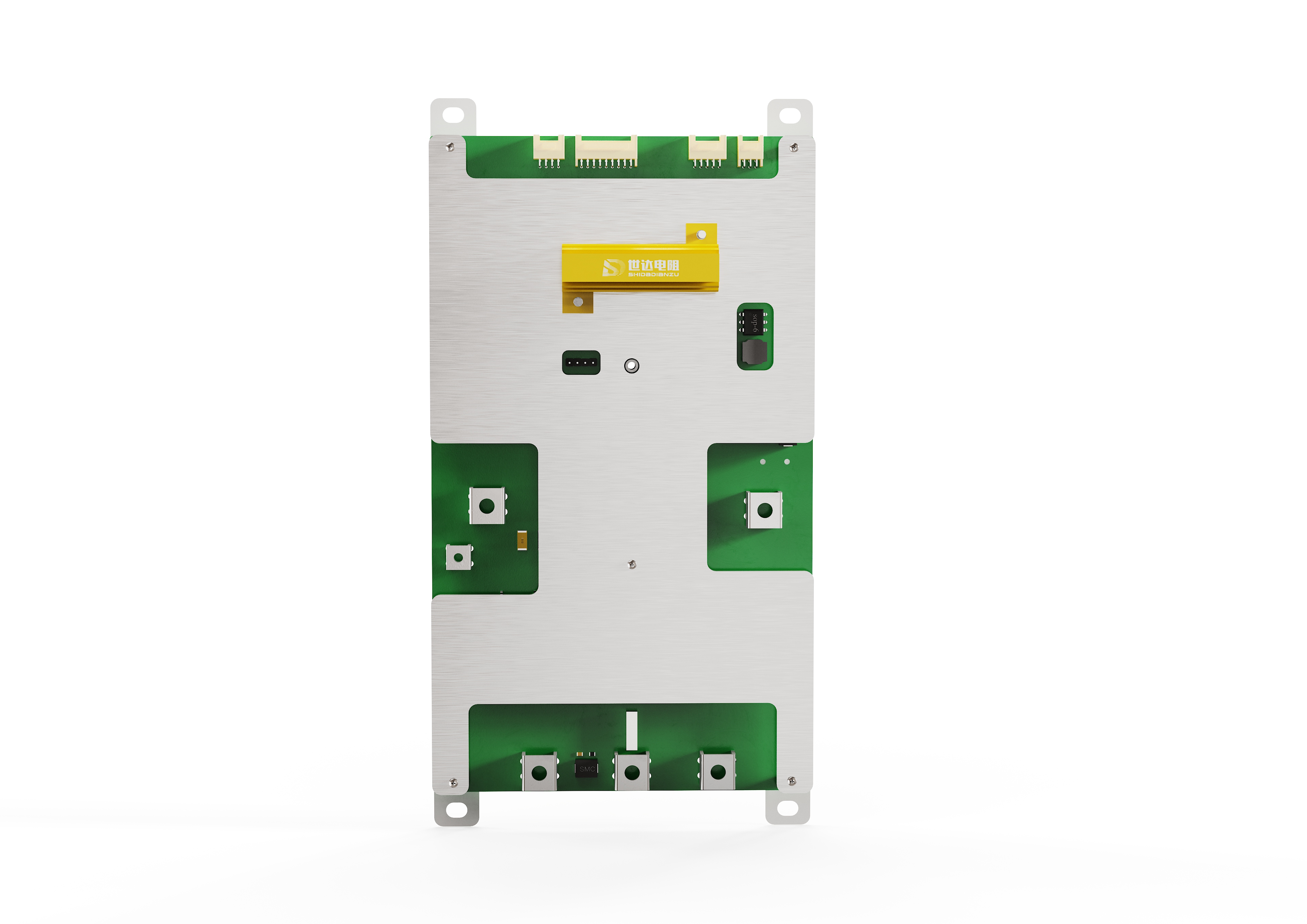
The voltage platform defines the pack's nominal operating window, and the series count defines how many cells the board must monitor individually. Pengpai Energy's two-wheeler-oriented models cover 30–60V with 16S (DTH2421), 15–90V with 7S–24S (DTH2505), 20–95V with 10S–24S (PNRG-MA24S60), and 0–48–60V with 8S–16S (B2107). A mismatch here cannot be corrected by configuration software.
2. Continuous and peak current, with the time window
Continuous current determines normal operation; peak current determines what the pack can deliver briefly during acceleration or hill starts. The time window matters as much as the number. DTH2421 is rated for 40A continuous charge and 100A continuous discharge with a 210A peak for 1 second; DTH2505 offers selectable grades from 50A to 200A continuous with peak current from 100A to 400A for 30 seconds; PNRG-MA24S60 provides 60A continuous (40A optional) with a 120A peak for 30 seconds, or 80A for 30 seconds on the 40A version.
3. State estimation: SOC, SOH and SOP
A BMS with SOC estimation converts raw voltage and current readings into a usable fuel gauge, a health indicator and a power-availability limit. Accuracy claims should always be read with their stated condition. Across the published Pengpai Energy family, SOC error figures range from ≤5% to ≤8%, and those figures are specified at 25 °C. SOC, SOH and SOP accuracy varies with temperature, load profile and cell ageing, so the stated value is a reference point at a defined condition rather than a guarantee across every operating environment.
4. Communication interface and wake-up method
The interface determines what the BMS can talk to. DTH2421 uses isolated CAN ×2. DTH2505 uses Bluetooth as standard with CAN or RS485 optional. PNRG-MA24S60 uses Bluetooth as standard with TTL, one-wire or 4G-GPS available as options. B2107 provides CAN ×1 and RS485 ×1. Wake-up behaviour matters in practice for parasitic drain and for how the vehicle behaves after long idle periods: published wake-up methods across the family include charge and discharge DET wake-up, ACC wake-up, charger wake-up, communication wake-up, short-circuit wake-up and AFE interrupt wake-up, depending on model.
5. Protection set and balancing current
Protection coverage should be checked function by function. DTH2421 and DTH2505 cover short-circuit, over-charge, over-discharge, over-current, over-temperature, over-voltage and under-voltage protection, and both support a pre-charge function. Passive balancing current differs by model — ≥50mA at 25 °C on DTH2421, ≥50mA at 3.3V on PNRG-MA24S60, and ≥150mA on DTH2505 — and higher balancing current shortens the time needed to bring a drifted pack back into alignment.
6. Thermal sensing and environmental envelope
Temperature sensing channel count and operating range define where the board can be used. DTH2421 provides 4 external plus 3 built-in NTC channels, DTH2505 provides 2 built-in plus 4 external NTC channels with an operating range of −40 °C to 120 °C, PNRG-MA24S60 provides 2 built-in plus 2 external NTC channels across −30 °C to 85 °C, and B2107 provides 6 external plus 1 MOS channel across −40 °C to 85 °C.
Where Two-Wheeler BMS Products Are Deployed
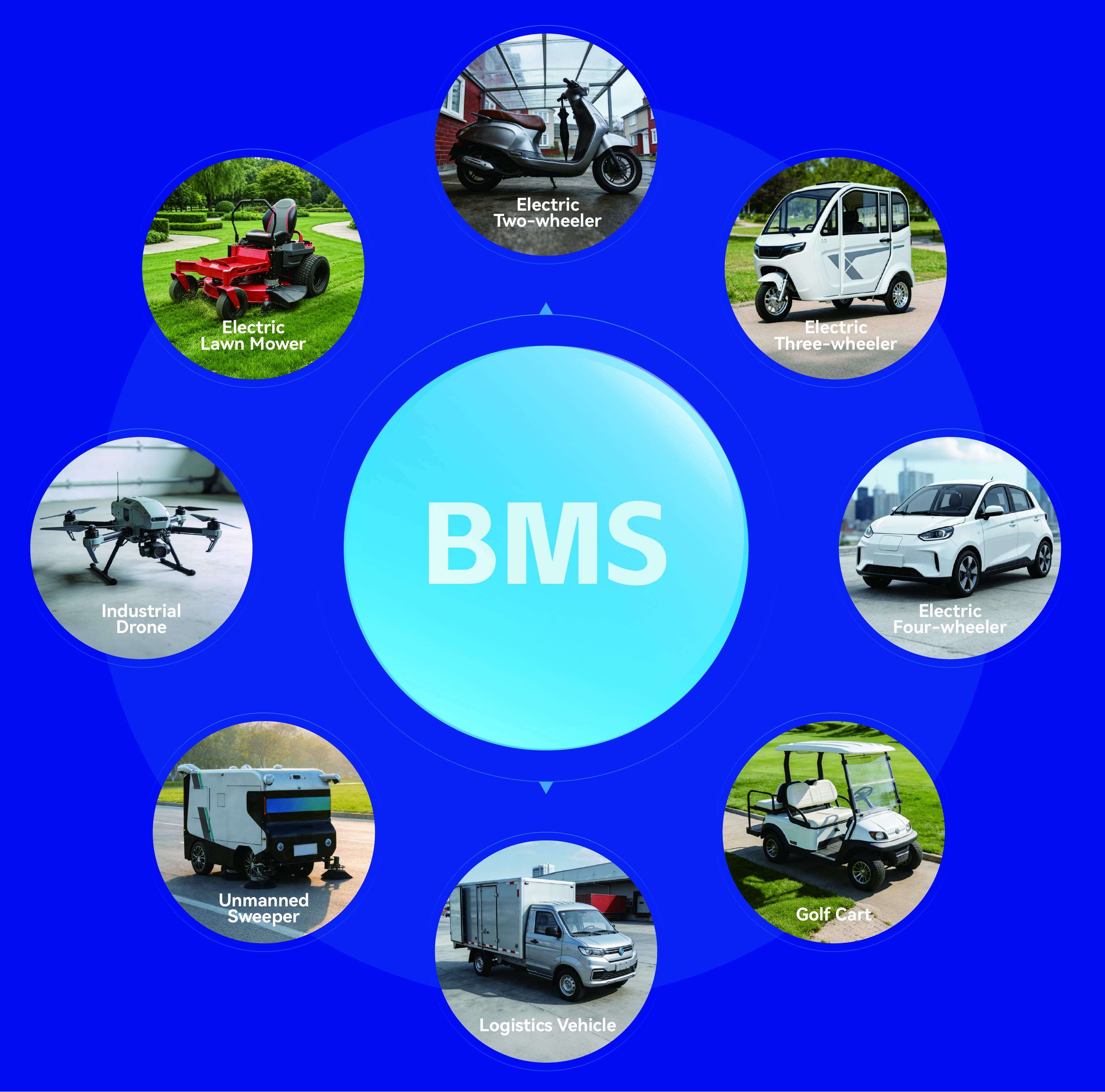
Installation follows a consistent pattern across the segment. The BMS sits inside the vehicle or equipment battery pack and communicates with vehicle controllers, chargers, displays or software platforms through CAN, RS485, Bluetooth, TTL or single-wire interfaces. Its function is to monitor and manage battery voltage, temperature, current and operating status, with protection, balancing, pre-charge and communication behaviour depending on configuration.
For two-wheelers specifically, the published industry coverage extends well beyond private commuting. Documented application industries for two-wheeler and light-duty BMS models include food delivery, express and logistics, shared mobility, municipal sanitation, property management, urban management and patrol, factory logistics, battery swap station operation, instant retail and campus commuting. Project types supported include OEM vehicle integration, battery-pack projects, customised BMS development, and volume manufacturing and export programmes.
The geographic spread of these projects is concentrated in markets where light electric mobility carries the most traffic: India, China, Indonesia and Vietnam are identified operating markets for two- and three-wheeler and low-speed vehicle applications. That concentration has consequences for specification, because the environmental and duty-cycle conditions of a delivery fleet in a monsoon market differ from those of a leased commuter scooter.
Market Signals Shaping the Two-Wheeler BMS Segment
Three signals are currently reshaping how two- and three-wheeler BMS are sourced.
Regulation is becoming the entry ticket. AIS-156 made safety requirements for lithium packs and BMS mandatory in India's L-category vehicles from 1 April 2023. Standards of this type compress the supplier field, because a BMS that cannot be qualified against a market's safety framework is not sellable in that market, regardless of its electrical specification.
Localisation is moving from intent to structure. In September 2026, The Economic Times reported that LeSol Group had partnered with Hefei Pengpai Energy Technology Co. Ltd to develop battery management system solutions for electric vehicles in India, initially focusing on two- and three-wheelers. The same report states that LeSol Group is targeting a 10% share of India's organised BMS market within three years, an estimate the company puts at more than one million units annually. That figure is a company target rather than a verified outcome, but the structural point stands: suppliers are forming local partnerships to shorten supply lines and align with domestic compliance expectations.
Market sizing is directionally clear but numerically contested. India-specific BMS market values from commercial research are reasonably well bounded, whereas publicly circulating global BMS market figures diverge substantially between research publishers and are based on undisclosed methodologies and differing forecast horizons. Those conflicting global numbers should not be used to justify capacity or entry decisions. Segment-level data — split by two-wheeler, three-wheeler, four-wheeler and e-rickshaw — remains largely absent from public sources, which means buyers are still assessing this segment supplier by supplier rather than through aggregate statistics.
Integrated Two-Wheeler BMS vs. Other Architectures
Two-wheeler packs generally use an integrated single-board BMS because installation space and bill-of-materials cost are tight. The trade-off becomes visible when compared with modular architectures. Industry literature notes that modular BMS designs improve scalability and reliability and are therefore suitable for large systems such as electric vehicles, where the pack is large enough to justify distributed measurement and a master-slave structure.
For a two-wheeler, that additional architecture usually adds cost, wiring and packaging volume that the vehicle cannot recover. The practical consequence is that a two-wheeler BMS must achieve its accuracy and protection coverage with fewer sensing channels and a tighter thermal design than a four-wheeler or stationary storage system.
Where a pack was historically managed by a simple protection-only board that interrupts current on fault, an integrated communicating BMS adds continuous state estimation, coordinated cell balancing and a data link to the controller, charger or display. The difference is not a matter of marketing language: it is the difference between a pack that reports its condition and one that simply stops when a threshold is crossed.
Limits buyers should plan around
- A BMS cannot compensate for weak cells. It balances and protects a pack; it does not restore capacity lost to cell quality or ageing. Selecting a capable BMS on top of an inconsistent cell supply is not a safety strategy.
- Accuracy figures are condition-specific. SOC and SOH values such as ≤5% or ≤8% are specified at 25 °C. In cold, hot or high-load duty cycles, expect deviation, and design the vehicle's range display and protections accordingly.
- Environmental conditions must be confirmed per project. Documented operating conditions for light-power vehicle applications note that exact temperature, vibration, ingress-protection and load conditions require confirmation for the specific installation. A general product classification is not an environmental qualification.
- Compliance frameworks do not transfer automatically. CE and FCC compliance of BMS products addresses different regulatory frameworks than India's AIS-156 requirements for L-category lithium packs. Market-specific conformity should be confirmed separately for each destination market.
What to Expect Next
Three trajectories appear most likely to shape the two-wheeler BMS segment over the next development cycle.
First, communication depth will keep increasing. Models already support connection to APP, PC, IoT platforms and displays for vehicle monitoring and software expansion, and options such as 4G-GPS are appearing alongside Bluetooth as standard. As fleets and swap operators need pack-level visibility, the BMS becomes a data source rather than a passive controller.
Second, customisation will move earlier in the process. BMS suppliers now publish that customised PCBA and integrated hardware-software development can be confirmed against cell chemistry, series count, current, protocol and operating conditions. That shifts the buyer conversation from catalogue selection toward joint specification — which favours buyers who arrive with a defined electrical envelope rather than a general request.
Third, the algorithmic layer will differentiate products with similar hardware ratings. Published development priorities across the BMS field include battery state estimation, safety protection algorithms and intelligent energy scheduling. Because protection thresholds and balancing currents are increasingly comparable between competent suppliers, estimation quality and fault-handling logic become the more durable differentiators.
For buyers, the practical implication is unchanged: define the pack envelope first, then qualify suppliers against it. For two-wheeler and three-wheeler programmes in India and Southeast Asia, that envelope now includes a compliance pathway as well as an electrical one.
FAQ
What does a battery management system do in an electric two-wheeler?
It is the electronic controller inside the lithium battery pack. It monitors cell voltage, current and temperature, and protects the pack from over-voltage, under-voltage and over-current. Depending on configuration, a two-wheeler BMS also performs cell balancing, pre-charge control, state estimation for SOC, SOH and SOP, and communication with the vehicle controller, charger or display.
How does an electric two-wheeler BMS differ from a three-wheeler or low-speed four-wheeler BMS?
The supervisory function is the same; the electrical envelope and housing differ. Some published models are classified across several segments at once — for example, the DTH2505 is listed for two-wheelers, three-wheelers, low-speed four-wheelers, electric motorcycles and shared mobility battery packs. Selection still depends on the actual cell chemistry, series count, voltage platform, continuous and peak current, communication protocol and installation space of the specific pack.
Which specifications should be confirmed before selecting a two-wheeler BMS?
Cell chemistry (NCM, LMO, LCO or LFP), series count and voltage platform, continuous and peak current together with their time window, temperature sensing channel count and operating temperature range, communication interface, wake-up method, passive balancing current, the full protection function list, enclosure dimensions, and the requirements of the destination market. Documented light-power application guidance lists the same set as the basis for selection or customisation.
Why do CAN bus and RS485 interfaces matter on a two-wheeler BMS?
They determine whether the BMS can exchange data with the vehicle controller, charger and display. Not all two-wheeler BMS are CAN bus units: the DTH2421 uses isolated CAN ×2, the DTH2505 offers Bluetooth as standard with CAN or RS485 as options, and the PNRG-MA24S60 offers Bluetooth as standard with TTL, one-wire or 4G-GPS options. A protocol mismatch is an integration failure even when the electrical ratings are correct.
How accurate is SOC estimation on these systems?
Published figures across the light-power BMS family range from ≤5% to ≤8%, and they are stated at 25 °C. SOC, SOH and SOP accuracy depends on temperature, load profile and cell ageing, so the published value should be treated as a reference at a defined condition rather than a guaranteed result across all operating environments.
Are BMS solutions available for two-wheelers and three-wheelers in India and Southeast Asia?
Yes. Pengpai Energy's published product range covers two-wheelers, three-wheelers, low-speed four-wheelers and electric motorcycles, and the company identifies India and Southeast Asia among its major markets, with marketing branches established in both regions. Model selection depends on series count, voltage platform, current, communication protocol, cell chemistry and vehicle control logic. Compliance remains market-specific: AIS-156 applies to lithium packs and BMS in India's L-category vehicles, while CE and FCC compliance addresses different frameworks.
The Pengpai Energy English product brochure is available for public download: Battery Management System Product Brochure (PDF). Company website: www.penergy.com.cn
Have Questions or Need More Details?
Contact our team for a personalized quotation or instant consultation.
Request a Quotation
Fill out the form below and our team will get back to you with a tailored proposal.
WhatsApp Direct Chat
Prefer to chat in real-time? Message us on WhatsApp for instant assistance & quick answers.
- Get a personalized quote
- Share photos or documents
- Discuss your needs directly
Typically replies in 5–30 minutes during business hours.