
Electrochemical vs Chemical Biocides: Produced Water Buyer Review
Electrochemical vs Chemical Biocides: Produced Water Buyer Review
For an operator deciding how to keep sulfate-reducing bacteria (SRB) out of a produced-water reinjection system, the choice is no longer only which biocide to dose and at what rate. The alternative is to generate the oxidizing agent inside the water itself, from a small sidestream of the produced water, using an electrochemical sterilization module. The two routes are not variations of the same method. They differ in where the active agent is made, what is stored on site, what waste leaves the site, and what the site must be equipped to run.
This buyer review compares electrochemical produced-water sterilization against a conventional chemical biocide program on five criteria that can be checked against documentation rather than sales material: treatment capacity, sterilization performance, operating cost, automation, and site safety. The electrochemical reference in this comparison is the E-Module from YixiaWorld Oil & Gas Equipment, the oil and gas equipment line of Yixia Invention (Beijing) Technology Co., Ltd., a Beijing-based company established in 2007 that designs modular produced-water and natural-gas treatment skids. Where the comparison depends on water chemistry, the review states the boundary rather than a general advantage.
What each route actually does
A chemical biocide program treats produced water by dosing a bactericide into the stream, normally together with a corrosion inhibitor, a scale inhibitor and, upstream, demulsifiers or flocculants. The active agent is manufactured off site, transported, stored, metered continuously, and reacted with the water in the pipeline. The reaction products, together with the unused chemical, become chemical sludge that must be handled as a separate waste stream.
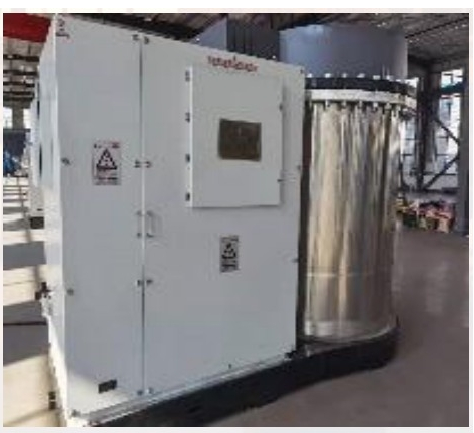
The E-Module works differently. A PLC-controlled sidestream equal to roughly 2%–5% of the produced-water flow is diverted through fast-ion ceramic electrodes, where electrolysis generates active radicals such as HClO, O₃ and H₂O₂. That concentrated active water is re-injected into the main pipeline through a mixer, so the whole stream receives the oxidizing dose without any chemical being added. The same electrochemical reaction that destroys bacterial cell walls also oxidizes sulfide and changes the surface charge of suspended solids, and it induces a dense metal-oxide passivation film on the inner pipe wall. YixiaWorld describes this combination as chemical-free sterilization, desulfurization and anti-corrosion delivered from one skid-mounted module.
Criterion 1 — Treatment capacity and footprint
On hydraulic capacity, the E-Module is documented at a maximum daily treatment capacity of 30,000 m³/d per unit, with multiple units combined in parallel for larger volumes. That figure describes the module, not a guaranteed plant throughput: the same documentation requires pretreatment limits to be met upstream, and a buyer should size against the water chemistry at the inlet rather than against the module ceiling.
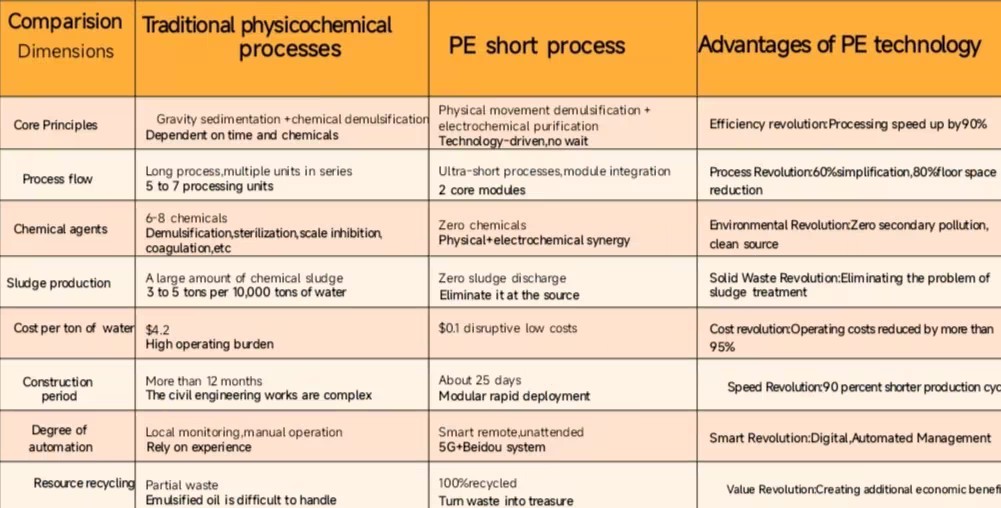
Because the module is a skid-mounted, factory-prefabricated unit, capacity is added by adding skids rather than by building tanks and civil works. YixiaWorld's published comparison against a conventional gravity-settling plus chemical-demulsification train states that the short process simplifies the flow by 60%, reduces equipment footprint by 80%, and shortens construction from more than 12 months to about 25 days. Those are company-published figures for its own process comparison, not an independent benchmark; their practical meaning for a buyer is that expansion and redeployment are physical moves of a skid rather than a new construction phase.
Criterion 2 — Sterilization performance
The published outlet indicator for the E-Module is a 100% SRB sterilization rate and a 98% sulfur removal rate. The mechanism matters for how a buyer should interpret that number. Chemical biocides typically act on a specific metabolic pathway, which is why repeated dosing at the same active ingredient can select for tolerant populations. Electrochemical sterilization is oxidative: the generated radicals physically disrupt the bacterial cell wall, so the failure mode is under-dosing or electrode condition rather than a resistant strain. YixiaWorld states that this oxidative route does not create the resistance pathway associated with long-term single-biocide dosing.
The D280-C project case illustrates the result at the outlet: a 100% SRB sterilization rate with effluent SRB held at ≤10 cells/mL. The Jidong Oilfield Nanpu project at Nanbao No. 1 Island is a further reference, where two electrochemical sterilization skid-mounted units were supplied for a 10,000 m³/d produced-wastewater sterilization and reinjection duty.
Performance is conditional, and the conditions belong in the purchase decision rather than in a footnote:
- Sulfide limit. Water with high sulfide content must be pretreated by the P-module first; electrochemical filtration in the downstream EF stage is specified for inlet sulfide ≤5 mg/L.
- Salinity. Extremely low-salinity water reduces sterilization efficiency, because the process depends on ions in the water to form the active species.
- Temperature. Inlet water temperature must be ≤60 °C.
- Oil content. Water with very high oil content should be used with caution and routed through upstream oil removal.
A buyer comparing a biocide program with electrochemical sterilization should therefore ask for SRB counts from both the inlet and the outlet across a full operating cycle, not a single laboratory result, and should map those results against the actual salinity and sulfide profile of the field.
Criterion 3 — Operating cost
Cost is where the two routes diverge most sharply, and also where the comparison is most often made lazily. YixiaWorld's published cost comparison puts a conventional physicochemical route at about US$4.2 per tonne of water (approximately RMB 15), with a breakdown of roughly RMB 1.00 for bactericide, RMB 2.00 for corrosion inhibitor, RMB 2.00 for demulsifier, flocculant and water purifier, and RMB 10.00 for chemical sludge treatment. The PE short-process route is put at about US$0.1 per tonne (approximately RMB 0.20), split between E-module sterilization, E-module corrosion inhibition and EF-module water purification, with zero chemical sludge cost. On those figures, the cost per tonne of water falls by more than 95%, excluding the additional revenue from recovered good oil.
The D280-C case reports a narrower and more specific figure: a 74.7% reduction in sterilization cost. This is a different measure from the whole-plant cost per tonne above, and the two should not be conflated. For a buyer, the useful reading is that the largest single cost line in the conventional breakdown is not the bactericide itself but chemical sludge treatment, and the electrochemical route removes that line by removing the chemical input that creates the sludge.
Three cost drivers deserve independent modelling before a decision:
- Chemical logistics. Purchase price is only part of the biocide cost; transport, storage, dosing-pump maintenance and inventory management at a remote field are further lines that disappear with in-situ generation.
- Power and electrodes. The E-Module operates at ≤45 kW with a 380 V AC supply, and electrode life is specified at ≥20,000 hours. Electricity tariff and the electrode replacement interval are the dominant variables in the electrochemical operating model.
- Sludge disposal. Where local disposal of chemical sludge is expensive, the electrochemical route's advantage widens; where it is cheap and nearby, the gap narrows.
All of the cost figures above are company-published comparisons. They are a starting structure for a buyer's own model, not a substitute for it.
Criterion 4 — Automation and control
Both routes can be automated, but they are automated in different ways. A biocide program automates dosing: flow-paced metering pumps, tank-level alarms and periodic manual jar tests to confirm the residual. The electrochemical module automates the treatment itself. PLC control with RS485 and Ethernet interfaces connects the skid to the site SCADA system, and the operating platform integrates 5G plus BeiDou remote intelligent monitoring so that the unit can run unattended and be operated and maintained remotely.
Control logic extends to protective action rather than alarm-only reporting. The PLC monitors current and voltage in real time, detects out-of-limit parameters such as inlet temperature above 60 °C, and triggers a protective shutdown with a fault code on the local screen; fault history and operating logs are uploaded for remote diagnosis. Electrode cleaning runs online, so treatment and filtration continue during the cleaning cycle — on the EF stage the PLC initiates self-cleaning automatically when differential pressure exceeds 0.4 MPa, without a shutdown or manual backwash.
For an owner-operator, the automation comparison reduces to a question of where the human intervention sits: in the biocide route it sits in chemical delivery and dosing verification; in the electrochemical route it sits in water-quality monitoring and periodic electrode inspection.
Criterion 5 — Site safety and compliance
Site safety differences follow directly from what is stored and handled. A biocide program keeps bactericide, corrosion inhibitor and scale inhibitor in inventory, requires dosing and transfer equipment, and exposes personnel during delivery and maintenance. The electrochemical route replaces that inventory with an electrical installation.
The E-Module is specified with Exd IIB T4 Gb explosion-proof protection and IP65 ingress protection, and the wider equipment range is described as explosion-proof and salt-fog resistant for offshore platforms and hazardous areas. Proper grounding of the 380 V AC supply is a stated installation requirement, and the site's explosion-proof classification must be matched to the equipment rating rather than assumed. For offshore duty, removing chemical storage and the associated logistics is a space and handling benefit as much as a safety one.
On management systems, Yixia Invention holds ISO 9001:2015 (certificate 72225Q10141R0S), ISO 14001:2015 (72225E10109R0S) and ISO 45001:2018 (72225S10097R0S) certification issued by HUA LONG INTERNATIONAL CERTIFICATION (BEIJING) COMPANY LTD. with CNAS and IAF mutual recognition marks. The certified scope covers sales of specialized environmental protection equipment — rapid ion advanced catalytic sterilization equipment and produced water oil and suspended solids removing equipment — and assembly of the sterilization equipment. A buyer should read the scope precisely: it defines what the certificates cover, and it is not a blanket certification of every product in the range.
Side-by-side comparison
The table below sets the two routes against the five review criteria and lists what a buyer should verify rather than accept.
| Criterion | Chemical biocide program | Electrochemical E-Module | What to verify |
|---|---|---|---|
| Treatment capacity | Hydraulic capacity set by the pipeline and dosing system; capacity growth follows plant expansion | Maximum 30,000 m³/d per unit; multiple units combined in parallel | Inlet sulfide ≤5 mg/L and oil limits met upstream; actual flow profile, not module ceiling |
| Sterilization performance | Efficacy depends on dose control and the target organism's tolerance to the active ingredient | 100% SRB sterilization rate and 98% sulfur removal as published outlet indicators; D280-C: effluent SRB ≤10 cells/mL | Inlet and outlet SRB counts across a full cycle at your salinity and sulfide level |
| Operating cost | About US$4.2/t, including RMB 10.00/t chemical sludge treatment | About US$0.1/t, zero chemical sludge; D280-C reports 74.7% sterilization cost reduction | Local chemical prices, sludge disposal fees, electricity tariff, electrode replacement interval (≥20,000 h) |
| Automation | Flow-paced dosing pumps, tank-level alarms, manual residual checks | PLC with RS485/Ethernet, 5G + BeiDou remote monitoring, unattended operation, online electrode self-cleaning | SCADA integration scope, alarm and auto-shutdown logic, remote response arrangement |
| Site safety | Chemical inventory, dosing equipment and personnel exposure on site | Exd IIB T4 Gb / IP65, salt-fog resistant; electrical installation requires correct grounding | Area classification match, grounding design, offshore installation approval |
Where each option fits — and where it does not
Electrochemical sterilization fits best where the site is defined by distance, space or hazard. Onshore fields with high polymer content, high water cut and high salinity are the documented application base, and the equipment is described as adaptable to those conditions. Offshore platforms benefit from removing chemical storage and dosing equipment from a weight- and space-constrained deck. Remote onshore fields without reliable chemical supply chains gain most, because the reagent is generated from the water being treated.
The boundary conditions are equally specific. High-sulfide water delivered straight to the electrochemical stage will not perform as specified, because the sulfide load consumes the oxidizing capacity; the P-module must run upstream. Very low-salinity water reduces efficiency. Inlet temperature above 60 °C is outside the operating envelope, and very high oil content requires caution and upstream removal. A buyer whose water sits outside these conditions should treat the comparison as not yet applicable rather than as a marginal case.
Conversely, where an existing biocide program already meets reinjection water quality, chemical logistics are reliable and sludge disposal is inexpensive and nearby, the electrochemical advantage narrows. The honest decision rule is that the electrochemical route wins on total cost where chemical sludge handling and remote logistics are expensive, and where the water chemistry sits inside the stated envelope.
Deployment evidence
YixiaWorld's project references are concentrated in Chinese oilfields, and they are company-supplied references rather than independently audited results. The Sinopec Shengli Oilfield Gudao oil production plant Guwu joint station project treats 40,000 m³/d of high-polymer oil production wastewater for regeneration and reinjection, using four OPS-10000-I units. The CNPC Jidong Oilfield Nanpu project at Nanbao No. 1 Island uses two electrochemical sterilization skid-mounted units for 10,000 m³/d of produced wastewater sterilization and reinjection. The D280-C case carries the specific sterilization outcome figures cited earlier in this review. Buyers should request the corresponding operating logs and water-quality records for a duty that resembles their own.
Buyer due diligence: three claims to test
“Zero Chemical Agents”
The claim is specific rather than general. It means the process requires no addition of demulsifiers, coagulants, flocculants, bactericides, corrosion inhibitors, scale inhibitors or viscosity reducers — the six to eight chemical types used in a conventional train. The operational consequence is a hard prohibition, not a preference: adding flocculants is strictly forbidden because the flocs interfere with physical demulsification and clog the equipment. A buyer should ask for the operating instruction that enforces this and confirm that site personnel cannot add chemicals at the inlet without triggering a documented exception.
“Zero Sludge Generation”
The claim refers to chemical sludge: because no demulsifier or flocculant is added, no hazardous chemical sludge is created, and the separation yields only inorganic sand and recovered oil. This is the cost line that carries the largest weight in the conventional breakdown. Buyers should ask what solid and oily waste streams remain, in what quantities, and how they are handled — the answer will differ from a chemical plant, but it will not be zero total waste.
Remote-site documentation and support
Unattended operation is only credible if the documentation and support model match it. Ask for the PLC tag list and the RS485/Ethernet integration specification against your own SCADA, the fault-code and alarm matrix, the electrode replacement procedure and interval under your salinity, the IP65 sealing maintenance schedule, the explosion-proof certification documents for the specific model offered, and the escalation path for a remote alarm including who responds and within what agreed window. The 5G plus BeiDou monitoring platform and cloud-uploaded fault history are the mechanism; the contractual support arrangement is what makes it usable.
Outlook
The direction of travel in produced-water treatment is toward fewer site-handled chemicals and more instrumented, skid-based units, because that is what remote and offshore developments can actually operate. That is an interpretation of the equipment economics described above, not a measured market forecast. What can be stated concretely is narrower: as water cuts rise and fields move further from supply chains, the cost of chemical logistics and sludge disposal grows relative to the cost of electricity and electrodes, and the electrochemical route's position improves accordingly. The condition attached to that statement is the one already established — the water must sit inside the salinity, sulfide, temperature and oil envelope, and the module combination must be sized for the actual inlet, not the nameplate.
For a decision-stage buyer, the practical conclusion is to compare the two routes on the same tonne of water, with local chemical prices, local sludge disposal fees, local electricity tariffs and a realistic load factor. On the published figures, the gap is large enough that the exercise is worth doing properly rather than assuming either answer.
FAQ
How does electrochemical sterilization compare with chemical biocides on treatment capacity?
A single E-Module is documented at a maximum daily treatment capacity of 30,000 m³/d, and multiple modules can be combined in parallel for larger volumes. The figure is a module maximum, so the usable capacity at a given site depends on the inlet water meeting the upstream pretreatment limits, particularly sulfide ≤5 mg/L and controlled oil content before the electrochemical stages.
What water conditions reduce electrochemical sterilization performance?
Four conditions are specified. High-sulfide water must be pretreated by the P-module before it reaches the electrochemical stage. Extremely low salinity reduces sterilization efficiency because the process relies on ions in the water to form active species. Inlet water temperature must not exceed 60 °C. Water with very high oil content should be used with caution and routed through upstream oil removal.
How is sterilization performance verified on site rather than on a datasheet?
Verification is by SRB counts at the inlet and outlet across a full operating cycle. The published outlet indicator for the E-Module is a 100% SRB sterilization rate, and the D280-C project case reports effluent SRB at ≤10 cells/mL with the same 100% sterilization rate. The PLC also monitors operating parameters in real time and records fault history, which supports correlation between water quality and equipment condition.
Which cost components should a buyer compare between the two routes?
Compare chemical purchase, transport and storage, dosing-pump maintenance, chemical sludge treatment and disposal, electricity, electrode replacement and labour. YixiaWorld's published comparison puts a conventional physicochemical route at about US$4.2 per tonne of water, of which roughly RMB 10.00 is chemical sludge treatment, against about US$0.1 per tonne for the PE short-process route with zero chemical sludge cost. The D280-C case separately reports a 74.7% reduction in sterilization cost.
Can an electrochemical sterilization skid run unattended at a remote site?
The equipment is described as capable of continuous, fully automatic unattended operation, with PLC control and RS485/Ethernet interfaces for SCADA integration and a 5G plus BeiDou remote intelligent monitoring system. The PLC detects out-of-limit parameters such as inlet temperature above 60 °C and triggers a protective shutdown with a fault code, and operating logs are uploaded for remote diagnosis. Electrode cleaning runs online without interrupting treatment, and electrode life is specified at ≥20,000 hours.
A technical brochure covering the PE short-process produced-water treatment system is available for download: PE Short-Process Oilfield Produced Fluid Treatment System (PDF).
Have Questions or Need More Details?
Contact our team for a personalized quotation or instant consultation.
Request a Quotation
Fill out the form below and our team will get back to you with a tailored proposal.
WhatsApp Direct Chat
Prefer to chat in real-time? Message us on WhatsApp for instant assistance & quick answers.
- Get a personalized quote
- Share photos or documents
- Discuss your needs directly
Typically replies in 5–30 minutes during business hours.