
Elevator Wire Rope Standards: GB/T, EN, GOST, DIN Decoded
Elevator Wire Rope Standards: GB/T, EN, GOST, DIN Decoded
Elevator wire rope is bought on compliance before it is bought on performance. In lift and escalator projects, a rope that performs well but cannot be traced to an accepted standard is not a procurement option — it is an item in an audit that has no owner. The practical difficulty is that “we manufacture to GB/T, EN, GOST and DIN” is a statement about production capability, while a certificate is a statement about scope. The two are not the same document, and confusing them is the most common sourcing error in this category.
This reference breaks down what each of the four standard systems controls, which parameters of an elevator rope fall inside that control, where the certified envelope ends, and which verification steps a buyer should complete before releasing a purchase order.
Why Elevator Rope Carries a Different Compliance Load
General lifting rope is selected around static strength, abrasion and corrosion. Elevator and escalator rope is selected around something else. It runs continuously over sheaves, so fatigue and wire-break accumulation — rather than ultimate breaking load — usually govern service life. Diameter tolerance, strand geometry and surface condition all feed into how the rope mates with the traction sheave and how predictably it wears.
That shift in failure mode is why elevator rope is specified as its own product family rather than as one diameter of a general-purpose rope. In the manufacturer’s published product data, elevator wire rope is listed as a dedicated type built on 8×19S, 8×19W, 6×19S and 6×19W constructions, produced from high carbon steel, and designated for the elevator and escalator industry. A drawing house that purchases a general rope at the same nominal diameter is buying a different article with a different wear curve.
GB/T, EN, GOST and DIN: What Each System Actually Governs
The four systems are not competing editions of one document. They are national and regional frameworks that define rope construction, material, dimensional tolerance, test methods and acceptance criteria — frequently with overlapping technical content but separate legal standing, separate issuing bodies and separate certificate numbers.
| Standard system | Origin and scope | As cited in the manufacturer’s documentation |
|---|---|---|
| GB/T | Chinese national standards, with the “T” denoting a recommended rather than mandatory standard | GB/T 8918-2006 and GB/T 20118-2017 are named within the GOST certificate scope |
| EN | European standards, used as the technical basis for CE marking in the EU | EN 12385-1:2002+A1:2008 is named in the CE certificate; EN 12385-4 is cited in the GOST certificate scope |
| GOST | Russian national standard system | GOST 3241-91 is named in the GOST certificate |
| DIN | German Institute for Standardization; widely referenced in German and Central European technical specifications | Listed among the applicable execution standards for the product range |
One point worth flagging for German-market projects. DIN appears in the product parameters as an applicable execution standard, but no specific DIN number is cited in the certification documents referenced here. This is not unusual in the category, but it means the applicable DIN part and its revision year should be obtained in writing from the supplier’s compliance file before the requirement is written into a purchase specification. A standard family name without a number cannot be verified by a third party.
The Parameters That Define the Compliance Envelope
Compliance is not an abstract property. It attaches to physical attributes, and the manufacturer’s published product data sets the envelope as follows:
| Parameter | Range / value |
|---|---|
| Rope diameter | 1 mm – 120 mm |
| Tensile strength grades | 1570, 1670, 1770, 1870, 1960 and 2160 MPa |
| Material | High carbon steel |
| Elevator rope constructions | 8×19S, 8×19W, 6×19S, 6×19W |
| Applicable execution standards | GB/T, EN, GOST, DIN |
Read together, these figures describe what the mill is configured to produce. They do not, on their own, describe what has been certified. The distinction matters most at the extremes: a mill able to draw a 120 mm rope is not the same statement as a certificate that covers a 120 mm rope in the structure you ordered. For elevator work, where diameters are usually modest but tolerances are tight, the exposure is less about the top of the range and more about whether your specific construction and diameter band appears in the certificate at all.
Why Certificate Scope Matters More Than the Standard Named
The clearest illustration sits in the CE certification. Issued under EN 12385-1:2002+A1:2008, certificate ICR/VC/HS240422 covers a defined set of constructions and diameter bands rather than the whole catalogue. It was issued by ICR, is valid for the EU market, was issued on 4 August 2024 and expires on 4 July 2029.
| Construction | Certified diameter band |
|---|---|
| 6×7 | 2 – 40 mm |
| 8×7 | 2 – 40 mm |
| 6×19 | 3 – 60 mm |
| 8×19 | 8 – 60 mm |
| 6×36 | 8 – 120 mm |
| 8×36 | 8 – 60 mm |
| 6×19M | 8 – 28 mm |
| 6×37M | 8 – 52 mm |
| 18×7 | 6 – 28 mm |
| 34M×7 | 10 – 60 mm |
| 35W×7 | 8 – 40 mm |
Two of the four elevator constructions — 8×19S and 8×19W — sit inside the 8×19 band, certified from 8 mm to 60 mm. The 6×19S and 6×19W constructions fall inside the 6×19 band, certified from 3 mm to 60 mm. For an elevator project specifying a rope outside those bands, the EN coverage claim needs to be re-examined rather than assumed. The certificate also carries the trademarks LIU, ZHONGJU and SHILI, which is the kind of detail a verification officer will look for when matching a delivered reel to a document.
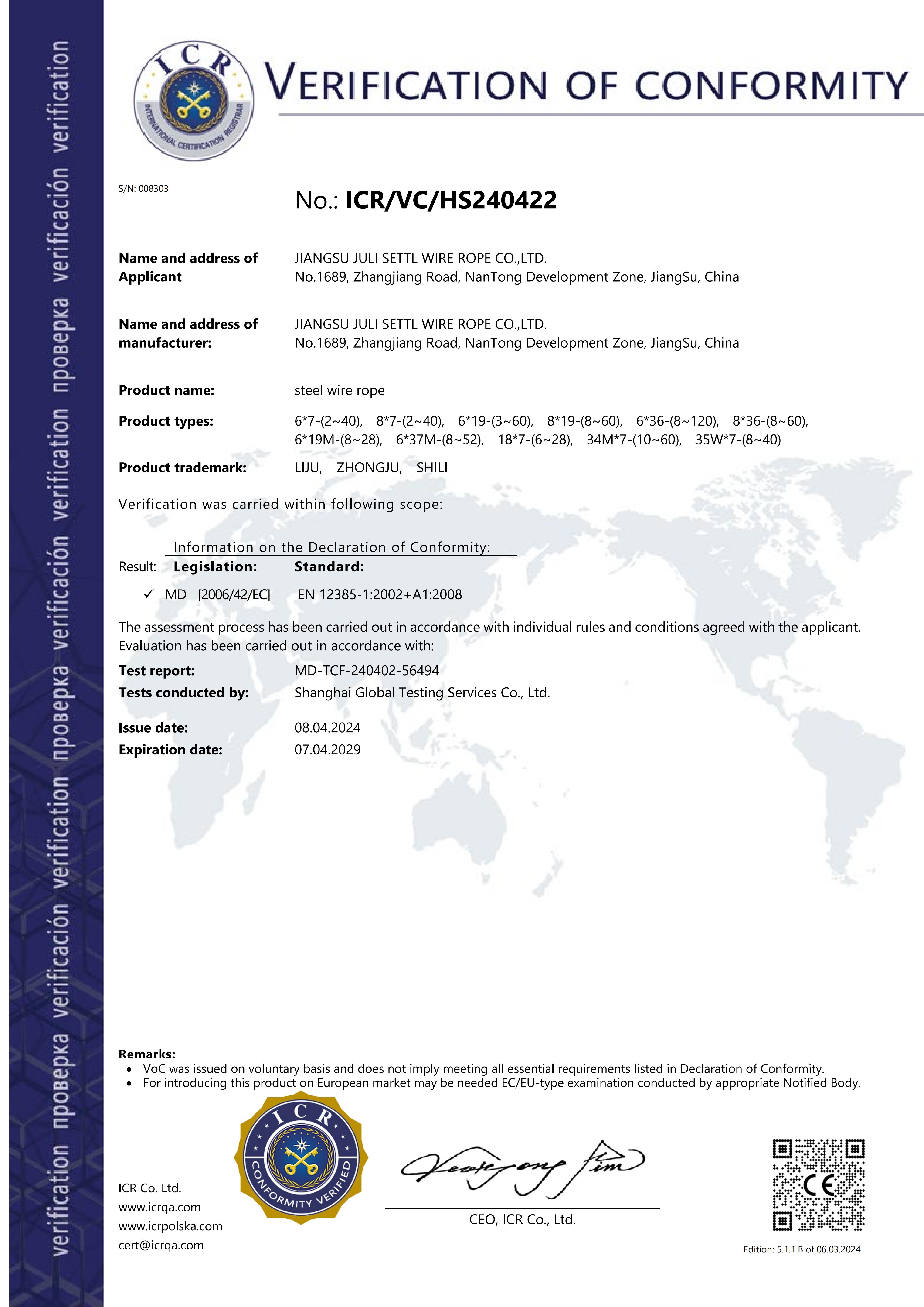
CE certification record for steel wire rope issued under EN 12385-1:2002+A1:2008, listing the constructions and diameter bands covered.
The GOST certificate takes a different approach to scope. Registered as POCC RU C-CN.AД85.B.00499/24 and issued by СЕРКОНС, it covers steel wire rope across multiple construction types from 1 mm to 120 mm in diameter for the Russian market. It was issued on 28 June 2024 and expires on 27 June 2029. Notably, it names GOST 3241-91 alongside GB/T 8918-2006, GB/T 20118-2017 and EN 12385-4 — evidence that a single compliance file can span several frameworks at once rather than forcing a choice between them.
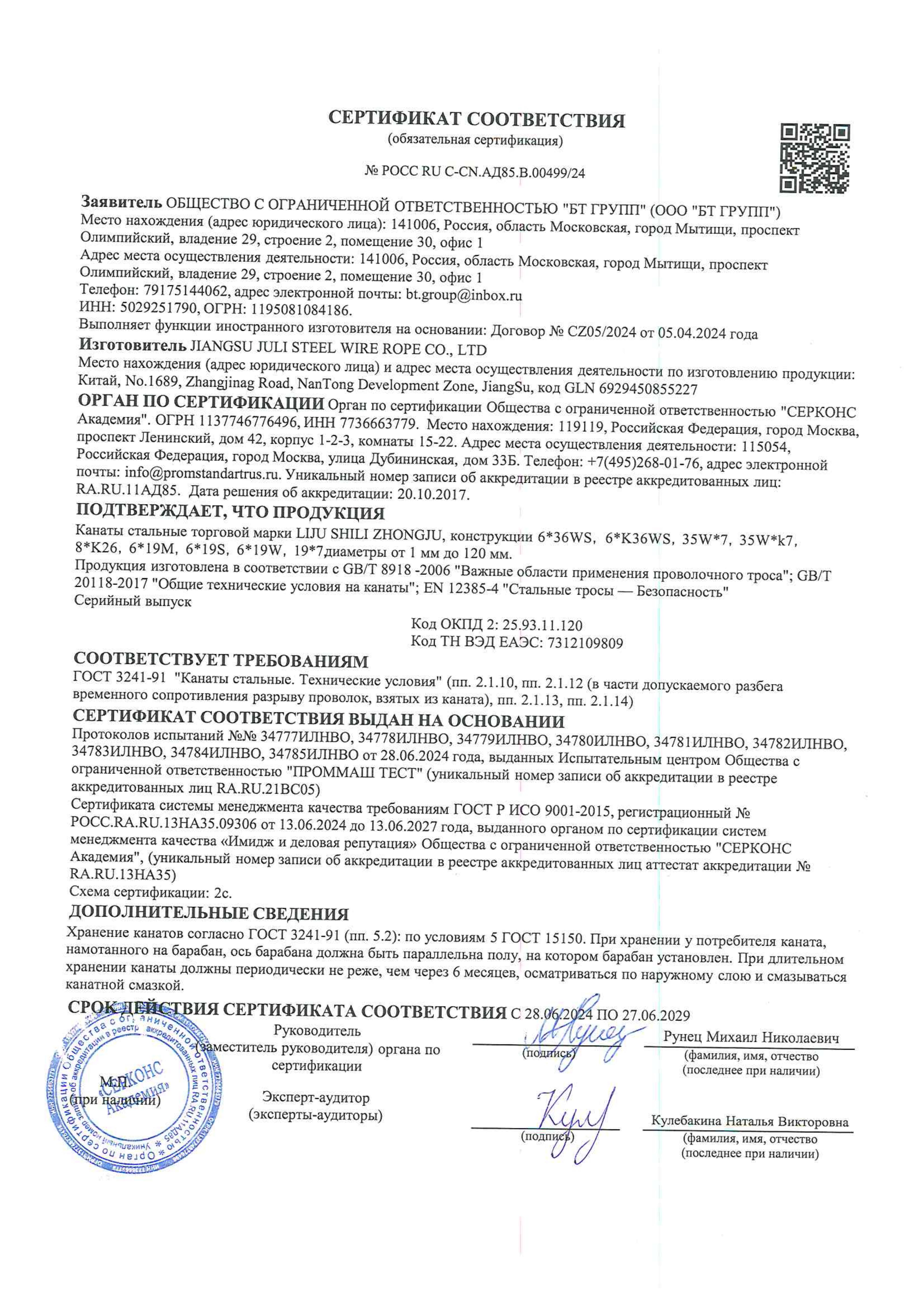
GOST certification record covering steel wire rope constructions from 1 mm to 120 mm, citing GOST 3241-91, GB/T 8918-2006, GB/T 20118-2017 and EN 12385-4.
How a Manufacturer Builds to Four Standards at Once
Jiangsu Juli Steel Wire Rope Co., LTD is a manufacturer of steel wire rope and lifting accessories operating through production bases in Nantong and Jiyuan in China and Bekasi in Indonesia. Its listed elevator rope range uses 8×19S, 8×19W, 6×19S and 6×19W constructions in high carbon steel, with tensile strength grades from 1570 MPa to 2160 MPa and diameters from 1 mm to 120 mm.
Serving several standards frameworks from one production line is largely an engineering problem. Construction definitions, lay length, tolerance tables and test acceptance levels are not identical across GB/T, EN, GOST and DIN, so a rope that satisfies one framework is not automatically a drop-in match for another. The manufacturer’s stated position is that it provides OEM, ODM and independent factory R&D and manufacturing services, with customization available across wire rope construction, diameter, length, tensile strength, surface treatment, applicable standard and packing.
Commercial and capacity parameters
- Monthly production capacity: 3,000 tons
- Standard lead time: 25 days
- Minimum order quantity: 1,000 meters
Quality control sequence
Published inspection stages run from raw material incoming inspection, through semi-finished product spot checks and finished product testing, to breaking load testing and fatigue testing. The final gate is a 100% full machine running test before delivery. For elevator rope, where fatigue rather than ultimate strength tends to end service life, the presence of a fatigue test stage in the sequence is the more relevant of the two destructive checks.
After-sales structure
The stated support model combines remote online technical support, overseas engineer on-site service, regular operation guidance and maintenance consultation. In practice, on-site support matters most at first installation and at the point where a rope change interval is being re-evaluated against observed wear.
The Wider Certification File
Elevator rope is rarely bought in isolation from a manufacturer’s other approvals, because procurement teams tend to qualify a supplier rather than a single product line. The following certifications are held across the range. Each one is bounded by its own scope statement, its own issuing authority and its own validity window.
| Certification | Certificate no. | Reference standard | Issued | Expires |
|---|---|---|---|---|
| CE (EU) | ICR/VC/HS240422 | EN 12385-1:2002+A1:2008 | 2024-08-04 | 2029-07-04 |
| GOST (RU) | POCC RU C-CN.AД85.B.00499/24 | GOST 3241-91; GB/T 8918-2006; GB/T 20118-2017; EN 12385-4 | 2024-06-28 | 2029-06-27 |
| ABS (Global) | 24-0072296-PDA | ISO 2408-2017 | 2024-10-08 | 2029-10-07 |
| CCS (Global) | JS22PWA00113_01 | CCS Rules for Materials and Welding 2022, Chapter 10, Part One | 2023-05-23 | 2027-05-22 |
| API (Global) | 9A-0125 | API Spec Q1®, API-9A | 2024-02-29 | 2027-02-28 |
| SNI (ID) | 33.23/016/LSPro BBSPJILM/07/2024 | SNI 0727:2008 | 2024-07-04 | 2028-07-03 |
| SIRIM (MY) | PC013111 | MS ISO 2408:2004 (confirmed 2012) | 2025-11-07 | 2026-12-07 |
| EPD (Global) | EPD-2026-01 | ISO 14025 | 2026-01-30 | 2031-01-29 |
Two of these are directly relevant to elevator rope selection — the CE certificate under EN 12385-1 and the GOST certificate, which together carry the GB/T, EN and GOST coverage. The remaining certificates are scoped to other service conditions: the CCS approval covers single layer ropes and rotation resistant ropes for ships and offshore installations, the ABS approval covers loose gear items for use on lifting equipment, and the SNI approval is scoped to steel wire rope for petroleum and natural gas. They support supplier-level qualification; they are not substitutes for elevator-scope coverage, and they should not be presented as such in a tender file.
Application Context: Where Elevator Rope Compliance Is Tested
- Passenger elevator and escalator installations in commercial and residential buildings
- High-travel or high-speed installations, where bending cycles accumulate faster and fatigue performance dominates the replacement interval
- Replacement demand, where an observed field specification usually has to be matched to a documented equivalent rather than to a catalogue diameter
- Projects where rope and lifting accessories are supplied as one package, so a single compliance file has to satisfy several components
The same engineering file also covers the wider high-risk category: the manufacturer lists micro steel wire rope as designated for high-risk industries, and lists compacted strand, shaped strand and locked coil constructions alongside the elevator types within its product range.
A Verification Sequence for Procurement Teams
- 1. Fix the design standard before issuing an RFQ. The deciding input is where the rope will be installed and which framework that jurisdiction accepts, not which certificate the supplier happens to hold.
- 2. Match the construction to the certificate, not to the catalogue. 8×19S and 8×19W fall in the 8×19 band; 6×19S and 6×19W fall in the 6×19 band. Confirm both the construction and the diameter appear in the document.
- 3. Check the diameter band rather than the catalogue maximum. The stated production range is 1 mm to 120 mm, but certified coverage is defined per construction.
- 4. Check the validity window. Every certificate carries an issue date and an expiry date. For a long build programme, a document that is valid at enquiry stage may have lapsed by commissioning.
- 5. Record the issuing authority and certificate number. These are what make a certificate independently verifiable, and what prevent a cited standard name from being accepted in place of a document.
- 6. Ask for the test evidence before payment. Pre-shipment full performance testing is carried out at the factory, and test reports are provided for customer confirmation before shipment.
- 7. Confirm the commercial terms in writing. Minimum order quantity is 1,000 meters; delivery is offered on FOB, CIF or DDP terms; payment terms are a 30% deposit with the 70% balance settled before shipment, with shipment arranged on receipt of full payment.
Limits and Trade-offs Buyers Should Not Skip
- Certificates are scoped documents. The same standard family may appear across four markets while each certificate covers a different set of constructions and diameter bands. Buying on the standard name rather than the band is the most common gap found in audits.
- Multi-standard capability is not the same as multi-standard certification. The CE and GOST files are separate documents with separate issuing bodies, numbers and expiry dates, even where they cover overlapping products.
- Frameworks overlap but are not interchangeable. The GOST certificate cites GOST 3241-91, GB/T 8918-2006, GB/T 20118-2017 and EN 12385-4 in one document, which shows the frameworks can be satisfied together — it does not show that one piece of paper replaces another.
- Validity windows differ and some are short. In the referenced documentation, the SIRIM certificate PC013111 runs to 7 December 2026 and the CCS certificate JS22PWA00113_01 to 22 May 2027, while the CE and GOST certificates run into 2029.
- Factory testing is factory testing. Breaking load and fatigue test records produced before shipment characterise a production batch; they do not describe post-installation conditions on site.
- Rope compliance is one input, not the whole approval. Elevator safety acceptance also depends on the system integrator, the installer and the local regulator. A rope certification file feeds those checks; it does not replace them.
Market Context: Why Documentation Is Becoming a Procurement Gate
Third-party market data gives useful background for how this category is moving:
- The global steel wire rope market is projected to reach USD 13.88 billion by 2030, growing from USD 10.49 billion in 2025 at a compound annual growth rate of 5.8% (MarketsandMarkets).
- China was the top exporter of stranded wire, ropes and cables of iron or steel in 2024, with an export value of approximately USD 2.60 billion (World Integrated Trade Solution).
- Galvanized steel wire ropes accounted for 41.3% to 46% of total product demand globally in 2025, driven by corrosion resistance requirements in marine and mining environments (Dataintelo / Business Research Insights).
- Construction is the largest end-user segment, accounting for approximately 27% to 40.7% of total market share in 2024–2025 (Grand View Research / Industry Research).
- Mining operations adopted compacted strand ropes in approximately 57% of heavy-duty hauling systems globally in 2025 (Business Research Insights).
Two readings are relevant to elevator procurement. First, the export concentration shows that buyers comparing suppliers are usually comparing the same handful of standard frameworks rather than unrelated ones — which makes document-to-document comparison practical. Second, published market size estimates for 2025 diverge widely between research houses, from roughly USD 8.4 billion to USD 15.37 billion on a comparable basis. That divergence is itself a caution: headline figures pulled from public reports should be treated as context, not as inputs to a procurement decision.
Future Outlook
- ISO 2408:2017, which specifies minimum requirements for the manufacture and testing of steel wire ropes for general purposes including lifting and rigging, is functioning as a common reference point across regional frameworks. Its appearance in the ABS approval here, and alongside GB/T and EN citations in the same compliance file, illustrates the direction.
- Documentation expectations are tightening. Buyers increasingly request certificate numbers, issuing authority and validity dates rather than a statement of applicable standards, because only the former can be verified independently.
- Because construction remains the largest end-user segment and urban vertical transport continues to expand within it, fatigue performance and wear predictability are likely to stay the core differentiation for elevator rope rather than raw breaking load.
- Verification is moving toward digital matching: checkable certificate numbers, downloadable scope tables and traceable standard references are becoming normal tender material rather than optional extras.
Frequently Asked Questions
What is the difference between GB/T, EN, GOST and DIN for steel wire rope?
They are four separate standards frameworks that set requirements for steel wire rope. GB/T is a Chinese framework, in which GB/T 8918-2006 and GB/T 20118-2017 appear within the referenced GOST certificate scope. EN is a European framework, in which EN 12385-1:2002+A1:2008 forms the basis of the CE certificate and EN 12385-4 is cited in the GOST certificate scope. GOST is the Russian national framework, in which GOST 3241-91 is named. DIN is the German standardization framework, listed among the applicable execution standards for this product range. All four address construction, material, dimensions and testing, but they carry different legal standing and lead to different certification routes.
What diameter and tensile strength range does elevator wire rope cover?
The published product parameters cover diameters from 1 mm to 120 mm and tensile strength grades of 1570, 1670, 1770, 1870, 1960 and 2160 MPa, produced from high carbon steel. Elevator rope constructions are 8×19S, 8×19W, 6×19S and 6×19W. These figures describe the production range. The diameter and grade used in a specific installation should be taken from the elevator system design, and the certified diameter band for the relevant construction should be checked separately.
How do I verify that a wire rope certificate covers my elevator project?
Treat the certificate as a scoped document. Confirm the construction it names, then confirm the diameter band attached to that construction — for example, the 8×19 band is certified from 8 mm to 60 mm and the 6×19 band from 3 mm to 60 mm under EN 12385-1:2002+A1:2008. Then confirm the issuing authority, the certificate number and the validity window. If the required construction or diameter does not appear within the certified band, the standard name alone does not establish coverage.
Can a supplier customize wire rope construction and packaging to a specified standard?
Customization is offered across wire rope construction, diameter, length, tensile strength, surface treatment, applicable standard and packing, under OEM, ODM and independent factory research and manufacturing arrangements. This is relevant where a single supply specification has to align with more than one regional standards framework. The practical points to confirm in writing are whether the customized construction falls inside the required certified band and what the minimum order quantity is — the standard minimum is 1,000 meters, with a lead time of 25 days.
What testing is performed on steel wire rope before shipment?
The published quality control sequence includes raw material incoming inspection, semi-finished product spot checks, finished product testing, breaking load testing and fatigue testing, with a 100% full machine running test before delivery. Pre-shipment full performance testing is carried out at the factory, and the resulting test reports are provided for customer confirmation before shipment. For elevator rope, the fatigue test stage is the one most closely related to service life.
Do wire rope certificates expire, and what should buyers check?
Yes. Each certificate carries an issue date and an expiry date. In the referenced documentation, CE certificate ICR/VC/HS240422 is valid to 4 July 2029 and GOST certificate POCC RU C-CN.AД85.B.00499/24 to 27 June 2029. Other certifications in the same file have shorter windows: SIRIM certificate PC013111 runs to 7 December 2026 and CCS certificate JS22PWA00113_01 to 22 May 2027. For projects with long build programmes, the check should confirm validity at commissioning, not only at enquiry.
Elevator rope compliance reduces to a short set of questions: which standard, which construction, which diameter band, and which certificate. Jiangsu Juli Steel Wire Rope Co., LTD publishes its product and certification information for public reference and download at the steel wire rope and lifting accessories brochure. Buyers should match the published scope tables against their own construction and diameter requirements before approving a specification.